At a glance
The Sui dynasty (581 to 618 CE) reunified China after almost three centuries of division under the Northern and Southern Dynasties, and it did so through a combination of military conquest, dynastic consolidation, and infrastructure investment. The dynasty is most remembered for the Grand Canal, the longest artificial waterway in the world, which linked the Yangzi delta with the political capitals of the north and enabled the transport of grain, troops, and tax revenues across the empire. The dynasty is also remembered for the reconstruction of the Great Wall, for the reopening of the Silk Road, for the codification of the imperial examination system, and for the rebuilding of Luoyang as the eastern capital. The dynasty’s reign was brief and its collapse was sudden, but the institutional and infrastructural inheritance of the dynasty shaped the Tang and Song empires that followed.
1. Founding: Yang Jian and the Northern Zhou inheritance
The Sui dynasty was founded by Yang Jian, a grandson of the famous general Yang Zhong and the son-in-law of the Northern Zhou emperor. Yang Jian inherited from his family a tradition of military distinction and political service, and he inherited from the Northern Zhou court a tradition of Sinitic governance that had been modified by extensive contact with the northern steppe peoples. The Northern Zhou had reunified the northern part of the Chinese world under Yuwen Tai and his sons, and it had developed a system of government that combined Chinese bureaucratic forms with the centralised military structure of the steppe. Yang Jian served the Northern Zhou as the duke of Sui, and when the Northern Zhou emperor was forced to abdicate in his favour in 581, Yang Jian took the throne as Emperor Wen of Sui and began the consolidation of the empire.
The new emperor’s first task was the conquest of the southern dynasties. The Southern Dynasties had, by the late sixth century, been reduced to the Chen Dynasty, which held the lower Yangzi and the lands south of the Huai. The Chen court was weak, and its capital at Jiankang (modern Nanjing) had been sacked by the Northern Qi in 589, but the southern territories were still substantial and they were defended by a network of river and canal fortresses. Emperor Wen planned a multi-pronged campaign that would draw on the Yangzi fleet and the northern cavalry, and the campaign culminated in the surrender of the Chen court in 589. The surrender was followed by the integration of the southern territories into the Sui administration, the relocation of the Chen court to the northern capital, and the destruction of the Chen royal house. The unification was achieved in less than a decade and laid the foundation for the Sui empire.
The new emperor’s second task was the consolidation of the northern frontier. The Northern Zhou had fought a long and inconclusive war with the Turkic Khaganate, and the new Sui court inherited the conflict. Emperor Wen chose diplomacy over war, and he concluded a series of marriage alliances with the Eastern Turkic Khaganate that secured the northern frontier for the duration of his reign. The diplomatic success was concluded on terms that were less favourable to the Sui court than they appeared, but the practical effect was a generation of peace along the northern frontier and the freedom to concentrate resources on the construction of the canal and the rebuilding of Luoyang.
2. The Grand Canal
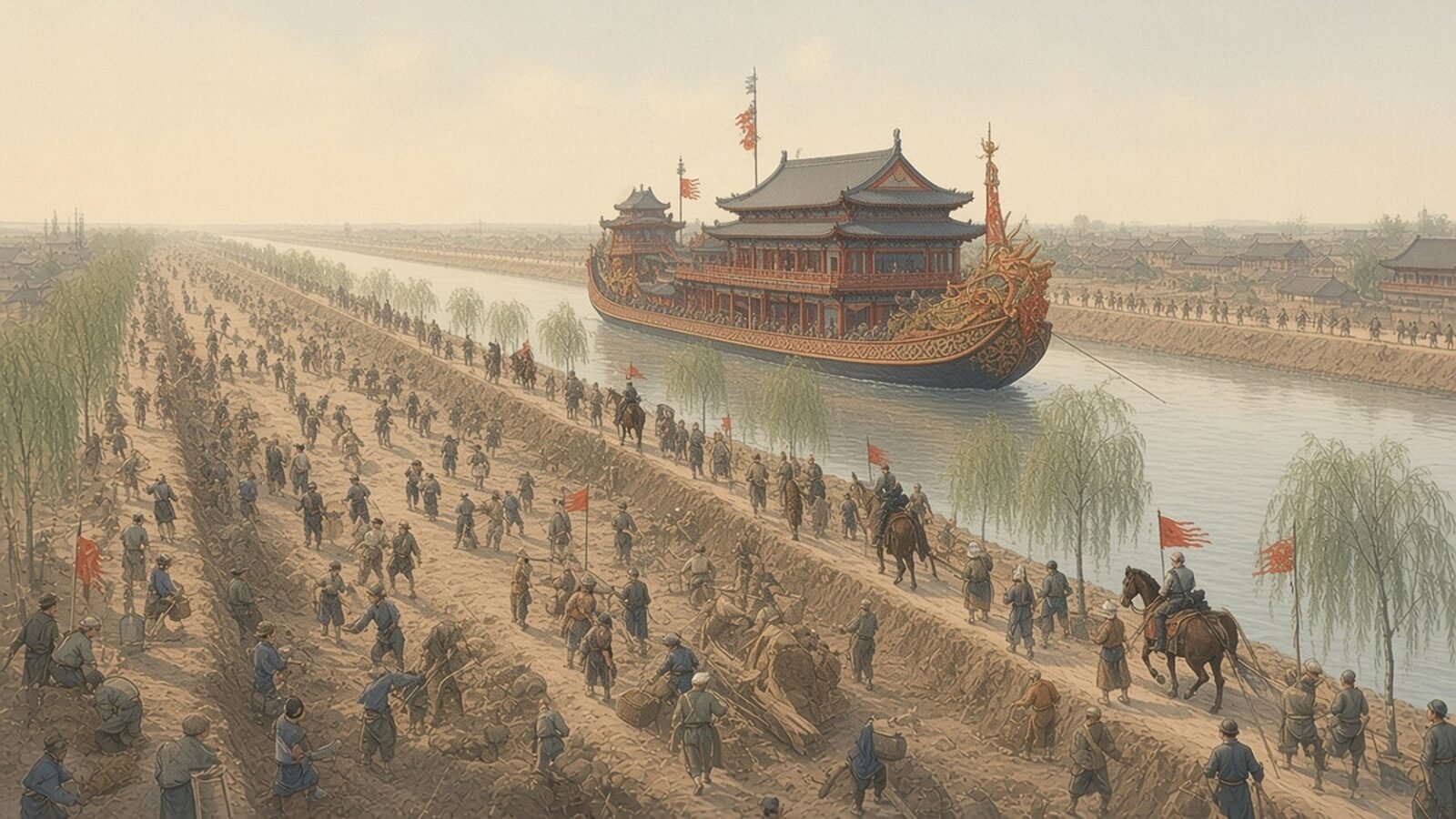
The Grand Canal is the largest and most ambitious infrastructure project of the Sui period and one of the largest infrastructure projects in pre-modern history. The canal was conceived as a single integrated waterway linking the existing canal systems of the north and the south, and it was built in several stages between 585 and 610 CE. The principal historical stages of the canal were the canal from the Yangzi delta to Luoyang, the canal from Luoyang to the Wei valley, the canal from Luoyang to the Yellow River and on to the Hai river basin, and the canal from the Huai to the Yangzi delta. The four stages together constituted a continuous waterway from Hangzhou in the south to Beijing in the north, a distance of more than 1,700 kilometres.
The Yangzi delta canal was the southernmost section and was the section most dependent on the existing waterway system. The Yangzi delta had been canalised since the Spring and Autumn period and had been integrated into a working waterway by the time of the Han dynasty. The Sui canal extended the Yangzi delta system northward by widening the existing canals, deepening the existing waterway, and constructing new sections to connect the existing canals to the canal from Luoyang. The Yangzi delta canal was, in this sense, less a new construction than an extension and improvement of an existing system. The system was, however, designed for grain transport on a scale that had not been previously attempted, and the engineering of the canal involved the construction of new locks and the development of new methods of water management.
The Luoyang canal was the central section and was the section that most clearly bore the marks of the Sui engineering effort. The canal ran from the Yangzi delta north to the Yellow River at Hulao, then west to Luoyang, then northwest to the Wei valley at Chang’an. The canal was constructed along a route that took advantage of the existing river system, but it required the construction of several new sections that cut across the watershed divide between the Yangzi and the Yellow River. The engineering of the canal involved the construction of new locks, the development of new methods of water management, and the development of new methods of canal maintenance. The engineering of the canal was, in this sense, the engineering of a system of water management, and the system was, in its scale and in its ambition, the most ambitious pre-modern engineering project in the world.
The northern section of the canal ran from Luoyang north to the Wei valley and east to the Yellow River. The northern section was constructed along a route that took advantage of the existing river system, but it required the construction of several new sections that cut across the watershed divide between the Wei valley and the Yellow River. The engineering of the northern section involved the construction of new locks, the development of new methods of water management, and the development of new methods of canal maintenance. The engineering of the northern section was, in this sense, the engineering of a system of water management, and the system was, in its scale and in its ambition, the most ambitious pre-modern engineering project in the world.
The canal’s principal purpose was grain transport. The Sui and Tang empires depended on the grain tribute of the southern provinces for the provisioning of the northern capitals, and the canal was the principal means by which the grain tribute was transported from the south to the north. The grain tribute was collected at the southern ports and was transported by canal to the Yangzi delta, from there up the canal to Luoyang, and from there to the northern capitals by the northern section of the canal. The grain transport system was the largest organised grain transport system in the world and was the principal economic infrastructure of the empire.
The canal’s secondary purpose was military transport. The Sui and Tang empires maintained large standing armies on the northern frontier, and the canal was the principal means by which the armies were provisioned and supplied. The canal’s role in the military transport system was, however, secondary to its role in the grain transport system, and the canal’s military transport role was, in the Tang and Song periods, secondary to its role in the commercial transport system. The canal’s role in the military transport system was, in this sense, a secondary but important purpose.
The canal’s tertiary purpose was commercial transport. The Sui and Tang empires developed a substantial commercial economy, and the canal was the principal means by which commercial goods were transported from the south to the north. The commercial transport system was, however, less developed in the Sui and Tang periods than it would become in the Song and Ming periods, and the canal’s commercial transport role was, in the Sui and Tang periods, secondary to its role in the grain and military transport systems. The canal’s commercial transport role became increasingly important in the Song and Ming periods, and the canal became the principal artery of the Chinese commercial economy in those periods.
3. Luoyang and the eastern capital
The Sui reconstruction of Luoyang was the second largest infrastructure project of the Sui period and was, in some ways, a companion project to the construction of the Grand Canal. Luoyang had been the eastern capital of the Han and Wei dynasties and had been a major city of the Northern Dynasties, but it had declined during the period of division and was, by the time of the Sui conquest, a small and partly ruined city. Emperor Wen chose Luoyang as the eastern capital of the Sui empire and began a programme of reconstruction that would rebuild the city on a larger scale and with new administrative and ceremonial functions.
The reconstruction of Luoyang was carried out by the architect Yuwen Kai, who had served the Northern Zhou court and who was, by reputation, one of the most capable architects of the period. Yuwen Kai designed a new city plan that combined the Han-Wei tradition of axial city planning with the new Sui technology of large-scale construction. The city was designed with a palace complex in the north, an administrative complex in the south, a market complex in the east, and a residential complex in the west. The city was enclosed by walls of rammed earth and was surrounded by a moat. The city was, in its scale and in its layout, the largest planned city of the Sui period and one of the largest planned cities of the pre-modern world.
The reconstruction of Luoyang was accompanied by a programme of population transfer. The Sui court ordered the transfer of several hundred thousand households from the densely populated south to the new capital, and the transfer was carried out in stages over the first two decades of the reign. The transfer was controversial, both because it displaced established southern populations and because it imposed a heavy labour cost on the southern provinces. The transfer was, however, the principal means by which the new capital was populated, and the resulting city was, by the late Sui period, one of the largest cities in the world.
The new city’s role in the Sui administration was, however, limited. The principal capital remained Chang’an, the western capital, and the eastern capital of Luoyang served as an administrative and ceremonial complement to the western capital rather than as a rival. The Sui court’s preference for Chang’an over Luoyang was a feature of the Sui administration and was inherited by the Tang administration, which also maintained both capitals but gave the principal administrative role to Chang’an. The preference was, however, gradually reversed in the Song period, when the principal capital was moved to Kaifeng and the role of Luoyang declined.
4. The Sui military campaigns
The Sui empire was a military empire as well as an administrative empire, and the Sui period is one of the most militarily active periods of pre-modern Chinese history. The principal Sui military campaigns were the campaign against the Southern Chen (588 to 589), the campaigns against the Eastern Turks (598 to 615), the campaign against Goguryeo (612 to 614), and the campaign against the Western Turks (615 to 618). The four campaigns together constituted a substantial military effort that consumed a large proportion of the empire’s resources and contributed to the collapse of the dynasty.
The campaign against Goguryeo is the most famous and most consequential of the Sui military campaigns. The campaign was launched by Emperor Yang of Sui in 612 and was directed against the Goguryeo kingdom on the Korean peninsula. The campaign involved the largest army that had been raised by a Chinese dynasty to that point, and the campaign was, in its logistics, an extraordinary achievement of military engineering and supply. The campaign failed to take the Goguryeo capital of Pyongyang and was, in its outcome, a catastrophic defeat that contributed to the unrest that would lead to the collapse of the dynasty.
The campaign against Goguryeo was followed by two further campaigns, in 613 and 614, and the three campaigns together constituted the largest sustained military effort in pre-modern Chinese history. The campaigns failed to achieve the Sui court’s territorial ambitions and contributed to the collapse of the dynasty. The campaigns also, however, demonstrated the logistical capacity of the Sui state and the willingness of the Sui state to commit resources to a distant military objective. The campaigns were, in this sense, an indication of the capacity of the Sui state as well as of its limits.
The campaigns against the Turks were, by contrast, more successful. The campaign against the Eastern Turks, led by the general Yang Su and his son Yang Yichen, achieved a substantial victory over the Eastern Turkic Khaganate in 618 and concluded a peace treaty that secured the northern frontier for the remainder of the Sui period. The campaign against the Western Turks, led by the general Xiao Xian, achieved a substantial victory over the Western Turkic Khaganate in 615 and concluded a peace treaty that secured the western frontier. The two campaigns together were, in their success, a substantial military achievement.
5. The collapse of the dynasty
The Sui dynasty collapsed in 618 CE, less than four decades after its founding. The collapse was the result of a combination of factors, including the military overreach of the campaigns against Goguryeo, the heavy taxation of the southern provinces for the construction of the canal and the reconstruction of Luoyang, the corruption of the imperial court, and the resentment of the military commanders who had been left to govern the provinces. The collapse was, in this sense, a combination of structural and contingent factors, and the structural factors were, by the late Sui period, dominant.
The collapse was triggered by the assassination of Emperor Yang at Jiangdu in 618 by his own general Yuwen Huaji. The assassination was followed by a succession dispute in which the son of Emperor Yang was briefly enthroned before being killed by Yuwen Huaji, and the dispute was followed by a more general collapse of central authority in which the provincial governors declared themselves independent. The collapse of central authority was, in turn, followed by the rise of a series of military commanders who would contest the succession and would eventually consolidate their control over the empire. The principal successor was Li Yuan, the duke of Tang, who proclaimed himself Emperor Gaozu of Tang in 618 and began the consolidation of the Tang empire.
The collapse of the Sui dynasty was, in retrospect, a necessary precondition for the Tang consolidation. The Sui dynasty had attempted to achieve too much in too short a time, and the achievement of the dynasty had consumed the resources that the dynasty needed for its own survival. The Tang dynasty inherited the Sui legacy and was, in this sense, the heir of the Sui’s achievements as well as of the Sui’s failures. The Tang consolidation of the empire was, in this sense, a continuation of the Sui project, and the Tang empire was, in its institutional and infrastructural inheritance, the heir of the Sui.
6. The legacy of the Sui
The Sui dynasty’s institutional and infrastructural legacy shaped the Tang and Song empires that followed. The Grand Canal continued in use for more than a millennium and is still in use today, and the canal remained the principal means of grain transport in the empire until the construction of the railway in the nineteenth century. The reconstruction of Luoyang continued in use as the eastern capital of the Tang and Song empires and was, in the late Tang and Song periods, the principal administrative capital of the northern provinces. The imperial examination system, which the Sui had begun to develop, was continued and expanded by the Tang and Song and became the principal means of recruitment into the imperial bureaucracy.
The Sui legacy in the institutional and infrastructural development of the empire was, in this sense, a long-term legacy that shaped the development of Chinese society for more than a millennium. The Sui legacy in the political and military development of the empire was, however, less positive. The Sui’s military overreach and heavy taxation contributed to the collapse of the dynasty, and the dynasty’s collapse was, in this sense, a lesson to the Tang and Song about the limits of imperial ambition. The lesson was, in turn, a lesson that the Tang and Song courts learned, and they preferred, in this period, a more modest and less ambitious foreign policy than the Sui.
The Sui dynasty’s cultural legacy was, by the standards of the Tang and Song, modest. The dynasty produced no major poets, no major historians, and no major philosophers, and the cultural achievement of the Sui period was, in this sense, less than that of the Tang and Song. The cultural legacy of the Sui was, however, not zero. The Sui court maintained the tradition of imperial sponsorship of Buddhist art and learning, and the dynasty’s reconstruction of Luoyang was accompanied by the construction of new Buddhist temples. The cultural achievement of the Sui was, in this sense, modest but real, and the dynasty’s cultural achievement was a contribution to the cultural life of the early medieval Chinese world.
The Sui dynasty’s place in Chinese history is, in summary, the place of a brief but consequential dynasty that laid the institutional and infrastructural foundations for the Tang and Song empires that followed. The Sui dynasty is remembered for the Grand Canal, for the reconstruction of Luoyang, for the development of the imperial examination system, and for the military campaigns against Goguryeo and the Turks. The Sui dynasty is also remembered for the collapse of the dynasty in 618, and the collapse is, in this sense, a lesson about the limits of imperial ambition. The Sui dynasty is, in summary, a brief but consequential dynasty whose legacy shaped the development of Chinese society for more than a millennium.
7. The canal’s role in Chinese cultural geography
The Grand Canal’s role in the development of Chinese cultural geography was, in the long run, more profound than its role in the grain and military transport systems. The canal was, in the Tang and Song periods, the principal means by which the southern provinces were integrated into the Chinese cultural sphere, and the canal was the principal means by which the cultural and commercial exchange between the north and the south was carried out. The canal’s role in the development of Chinese cultural geography was, in this sense, a long-term role that shaped the development of Chinese culture for more than a millennium.
The canal’s role in the development of Chinese literature was, in particular, profound. The canal was, by the Tang and Song periods, the principal setting of Chinese river poetry, and the canal was, in the works of the Tang poets Li Bai and Du Fu, a symbol of the unity of the Chinese world. The canal was, in this sense, the principal literary image of the Chinese empire, and the canal was, in the Chinese literary imagination, the principal means by which the north and south were joined in a single cultural community. The canal was, in the Tang and Song literature, the principal site of the Chinese imagination.
The canal’s role in the development of Chinese visual art was, in the Tang and Song periods, also profound. The canal was, by the Tang and Song periods, the principal subject of Chinese landscape painting, and the canal was, in the works of the Tang and Song painters, a symbol of the unity of the Chinese world. The canal was, in this sense, the principal visual image of the Chinese empire, and the canal was, in the Chinese visual imagination, the principal means by which the north and south were joined in a single cultural community. The canal was, in the Tang and Song painting, the principal site of the Chinese visual imagination.
The canal’s role in the development of Chinese cuisine was, in the Tang and Song periods, also significant. The canal was, by the Tang and Song periods, the principal means by which the southern foodways were brought to the north, and the canal was, in this sense, the principal means by which the southern rice dishes and the northern wheat dishes were integrated into a single Chinese cuisine. The canal’s role in the development of Chinese cuisine was, in this sense, a long-term role that shaped the development of Chinese food culture for more than a millennium.
The canal’s role in the development of Chinese commerce was, in the Tang and Song periods, also significant. The canal was, by the Tang and Song periods, the principal means by which the southern commercial goods were transported to the north, and the canal was, in this sense, the principal means by which the southern silk, tea, porcelain, and lacquerware were exchanged for the northern horses, furs, and minerals. The canal’s role in the development of Chinese commerce was, in this sense, a long-term role that shaped the development of Chinese commercial culture for more than a millennium.
The canal’s role in the development of Chinese urbanisation was, in the Tang and Song periods, also profound. The canal was, by the Tang and Song periods, the principal means by which the southern cities grew and prospered, and the canal was, in this sense, the principal cause of the growth of the southern Chinese cities of Suzhou, Hangzhou, Yangzhou, and Nanjing. The canal was, in this sense, the principal cause of the development of the southern Chinese urban network, and the medieval Chinese city was, in the Tang and Song periods, the principal urban centre of the medieval world.
The canal’s role in the development of Chinese language was, in the long run, also significant. The canal was, in the late medieval and modern periods, the principal means by which the northern Mandarin dialect was brought into contact with the southern Wu, Min, and Hakka dialects, and the canal was, in this sense, the principal cause of the development of the modern Mandarin standard. The canal’s role in the development of Chinese language was, in this sense, a long-term role that shaped the development of Chinese linguistic culture for more than a millennium.
8. Engineering and water management
The engineering of the Grand Canal required the development of new methods of water management and canal construction that have no real precedent in earlier Chinese engineering. The principal engineering problems were the recognition of the watershed divide between the Yangzi and the Yellow River, the maintenance of water levels in the canal, the prevention of flooding, and the construction of locks and other water control structures. The engineering of the canal was, in this sense, an original engineering achievement, and the canal’s engineering was, in its scale and in its ambition, the largest engineering project of the pre-modern world.
The watershed divide between the Yangzi and the Yellow River was, in particular, a major engineering problem. The divide lies along the Huai river basin, and the Huai was, in the pre-Han era, the principal river of the basin. The Han and Wei dynasties had constructed a series of canals along the Huai, but the canals were not connected to the Yellow River, and the connection between the Yangzi and the Yellow River was, in the pre-Sui era, an engineering problem. The Sui engineering team solved the problem by constructing a canal along the route of the existing Huai river system, with a summit level at the watershed divide. The summit level was, in turn, fed by water from the Huai and from the local rivers, and the summit level was, in turn, connected to the Yangzi by a series of locks.
The locks were the principal engineering innovation of the canal. The locks were, in their design, a development of the earlier Han and Wei canal locks, and the locks were, in their scale, large enough to accommodate the grain junks that were the principal means of transport on the canal. The locks were, in their construction, the most expensive single engineering component of the canal, and the locks were, in their maintenance, the most expensive single engineering component of the canal’s operation. The locks were, in this sense, the principal engineering innovation of the canal and the principal engineering expense of the canal.
The water management of the canal was, in addition to the locks, a major engineering problem. The water management involved the construction of dams, weirs, and sluices, the maintenance of the canal banks, and the prevention of flooding. The water management was, in its scale, the largest water management project of the pre-modern world, and the water management was, in its ambition, the largest water management project of the pre-modern world. The water management was, in this sense, an original engineering achievement, and the canal’s water management was, in its scale and in its ambition, the largest engineering project of the pre-modern world.
The engineering legacy of the Sui was, in the long run, profound. The engineering methods developed for the canal were inherited by the Tang and Song dynasties and were, in turn, inherited by the Yuan, Ming, and Qing dynasties. The engineering methods were, in this sense, the engineering methods of the Chinese canal system for more than a millennium, and the engineering methods were, in turn, the basis of the engineering of the modern canal system. The canal’s engineering was, in this sense, the engineering of a system of water management, and the engineering methods were, in turn, the basis of the engineering of the modern canal system.
The canal’s engineering was, in addition, a number of subsidiary engineering projects. The principal subsidiary engineering projects were the construction of the canal from the Yangzi delta to Luoyang, the construction of the canal from Luoyang to the Wei valley, the construction of the canal from Luoyang to the Yellow River, and the construction of the canal from the Huai to the Yangzi delta. The four subsidiary projects together constituted the integrated canal system, and the four subsidiary projects together constituted the largest engineering project of the pre-modern world.
References
- Sui dynasty — Grokipedia, accessed 15 October 2026.
- Grand Canal (China) — Grokipedia, accessed 15 October 2026.
- The Grand Canal – UNESCO World Heritage Centre, official listing of the Grand Canal as a World Heritage Site
- WorldCat – OCLC union catalogue, consulted for printed monograph references on the Sui dynasty
- Sui Dynasty – World History Encyclopedia, encyclopaedia article on the Sui period
The Sui dynasty’s institutional and infrastructural legacy shaped the Tang and Song empires that followed. The Grand Canal continued in use for more than a millennium and is still in use today, and the canal remained the principal means of grain transport in the empire until the construction of the railway in the nineteenth century. The reconstruction of Luoyang continued in use as the eastern capital of the Tang and Song empires and was, in the late Tang and Song periods, the principal administrative capital of the northern provinces. The imperial examination system, which the Sui had begun to develop, was continued and expanded by the Tang and Song and became the principal means of recruitment into the imperial bureaucracy.
The Sui legacy in the institutional and infrastructural development of the empire was, in this sense, a long-term legacy that shaped the development of Chinese society for more than a millennium. The Sui legacy in the political and military development of the empire was, however, less positive. The Sui’s military overreach and heavy taxation contributed to the collapse of the dynasty, and the dynasty’s collapse was, in this sense, a lesson to the Tang and Song about the limits of imperial ambition. The lesson was, in turn, a lesson that the Tang and Song courts learned, and they preferred, in this period, a more modest and less ambitious foreign policy than the Sui.
The Sui dynasty’s cultural legacy was, by the standards of the Tang and Song, modest. The dynasty produced no major poets, no major historians, and no major philosophers, and the cultural achievement of the Sui period was, in this sense, less than that of the Tang and Song. The cultural legacy of the Sui was, however, not zero. The Sui court maintained the tradition of imperial sponsorship of Buddhist art and learning, and the dynasty’s reconstruction of Luoyang was accompanied by the construction of new Buddhist temples. The cultural achievement of the Sui was, in this sense, modest but real, and the dynasty’s cultural achievement was a contribution to the cultural life of the early medieval Chinese world.
The Sui dynasty’s place in Chinese history is, in summary, the place of a brief but consequential dynasty that laid the institutional and infrastructural foundations for the Tang and Song empires that followed. The Sui dynasty is remembered for the Grand Canal, for the reconstruction of Luoyang, for the development of the imperial examination system, and for the military campaigns against Goguryeo and the Turks. The Sui dynasty is also remembered for the collapse of the dynasty in 618, and the collapse is, in this sense, a lesson about the limits of imperial ambition. The Sui dynasty is, in summary, a brief but consequential dynasty whose legacy shaped the development of Chinese society for more than a millennium.
References
- Sui dynasty — Grokipedia, accessed 15 October 2026.
- Grand Canal (China) — Grokipedia, accessed 15 October 2026.
- The Grand Canal – UNESCO World Heritage Centre, official listing of the Grand Canal as a World Heritage Site
- WorldCat – OCLC union catalogue, consulted for printed monograph references on the Sui dynasty
- Sui Dynasty – World History Encyclopedia, encyclopaedia article on the Sui period