
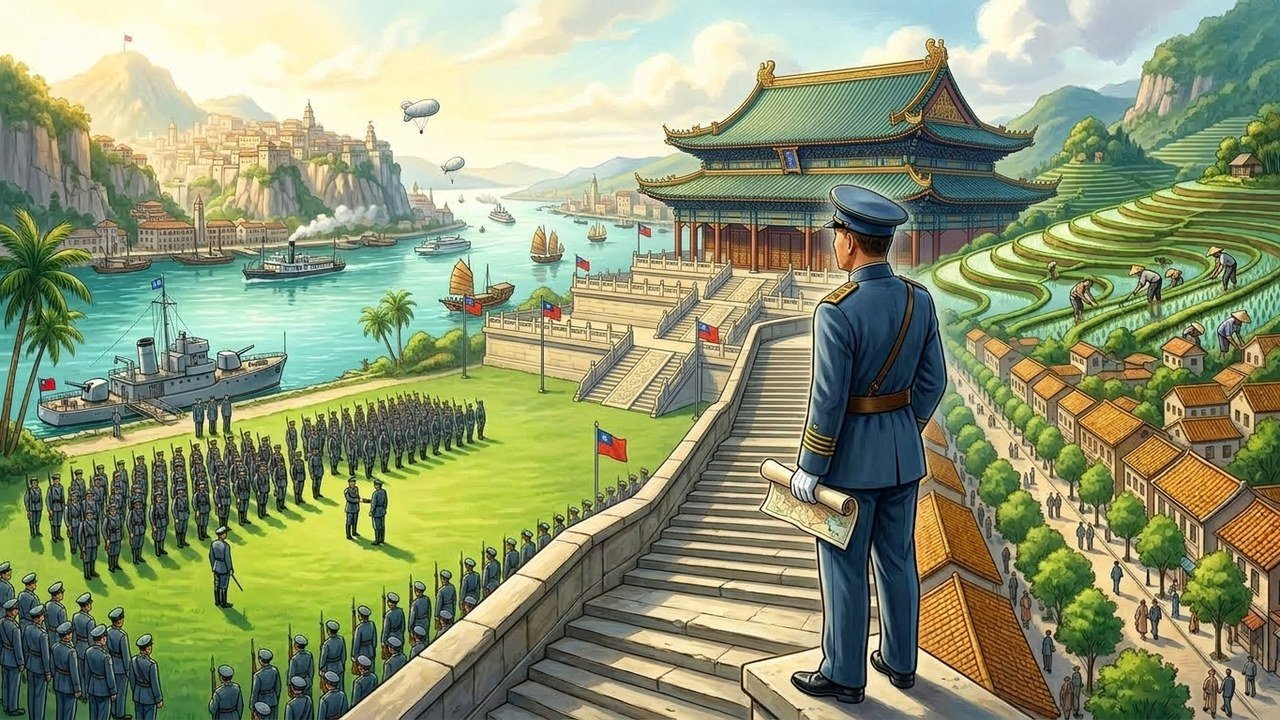
Chiang Kai-shek was born in a Zhejiang market town in 1887, while the Qing still governed China, and died in Taipei in 1975 as president of a republic that had lost the mainland a quarter century earlier. In between he commanded a party army, reunified most of China by conquest, presided over the Nanjing government of the 1930s, refused a separate peace with Japan through eight years of devastating war, lost the civil war to the Communists, and then governed Taiwan until his death. The life resists both the heroic and the demonic readings that compete for it. Taken as a set of mechanisms it is easier to follow: a soldier built an army inside a political party, the army carried him to power, war wrecked the state he had built, a rival party army took the mainland, and on an island he rebuilt enough to outlast his own defeat.
Three audiences still judge him differently, and the disagreement is itself part of the story. On the mainland his portrait in official history is of the man who lost China, though his wartime resistance is now credited. In Taiwan the verdict is genuinely unsettled, between a memorial hall in central Taipei, statues removed from schoolyards, and compensation files from the martial law years. Western writing moved from blaming him for losing China in 1949 to biographies that weigh the constraints he faced. An essay can do better than picking a side by tracing what he actually controlled, what he built, what he destroyed, and what survived him.
A soldier from a provincial town
He was born on 31 October 1887 in Xikou, a hill town in Fenghua county, Zhejiang, into a family living off the salt trade. His father died when he was eight; his mother, devout and demanding, raised him on a narrow budget and high expectations. He chose the military at a time when the examination literati still despised soldiering as a career for failures, and the choice pointed him to Japan, the power most Chinese reformers then copied. After a spell at the Baoding military school in north China he studied at the Shimbu Gakko in Tokyo, a preparatory school for Chinese cadets, and then served with a Japanese army regiment in Takada, in the snow country of Niigata. The discipline of the Japanese army impressed him permanently.
Revolutionary circles in Tokyo supplied the politics. Through his townsman and patron Chen Qimei he joined the Tongmenghui, Sun Yat sen’s revolutionary alliance. When the Wuchang rising broke the empire in October 1911 Chiang hurried home and fought in the capture of Hangzhou. The republic that followed collapsed into presidency grabbing and warlord armies; a second revolution in 1913 failed, Chen Qimei was assassinated in 1916, and Chiang spent part of the following decade in Shanghai’s uncertain economy of speculation, brokerage houses and criminal syndicates. His acquaintance with the Green Gang, the secret society that ran much of Shanghai’s labour and its rackets, began in these years. It was an education of a kind. He learned how money, muscle and politics actually connected in republican China, and he would use the lesson in 1927.
The decisive friendship was with Sun Yat sen himself. In June 1922, when Sun’s general Chen Jiongming turned on him and shelled his offices in Canton, Chiang stood by Sun for weeks aboard the gunboat Yongfeng on the Pearl River, and the shared danger fixed Sun’s trust in him. In 1923 Sun sent him to Moscow for about three months to study the Bolshevik state and its army. In 1924, with Soviet advisers and Soviet money, Sun founded the Whampoa Military Academy on an island in the Pearl River near Canton and made Chiang its first commandant. Whampoa cadets learned modern drill, field craft and political instruction side by side. The academy turned the Nationalist party from a club of notables into an organisation with a trained officer corps personally loyal to its commandant.
The party army and the Northern Expedition
Sun died in March 1925, and the succession inside the party was contested between civilians such as Wang Jingwei and the Communists allied with them. Chiang held the military instrument. In March 1926, after an obscure confrontation around the gunboat Zhongshan, he moved against Communist party members in the key commands and secured appointment as commander in chief of the National Revolutionary Army. That July the Northern Expedition marched out of Guangdong. It moved faster than anyone expected. Along the railways toward the Yangtze the armies of warlords were beaten or bought; by the end of 1926 the expedition held the Wuhan cities, and in March 1927 its forces entered Nanjing.
What happened in Shanghai the following month shaped the next twenty two years. On 12 April 1927 Nationalist troops, helped by his old Green Gang connections, swept the Communist led unions out of the city in a massacre of organisers and strikers. The party’s left wing at Wuhan broke with him; Chiang resigned briefly, married Soong Mei ling in December 1927, a wedding that joined him to one of the Christian banking families of the era, and returned to lead a second phase of the expedition in the spring of 1928. Beijing fell in June 1928, and at the end of that year Zhang Xueliang, the young marshal of the northeast, put his region under the Nationalist flag. China was nominally unified. In practice the Guangxi generals, Yan Xishan in Shanxi and other regional commanders kept their armies and taxed their own provinces, an arrangement that hollowed the centre whenever it was tested.
The Nanjing decade between wars
The government Chiang ran from Nanjing between 1928 and 1937 built more than its critics allowed and less than its apologists claimed. A central bank opened in 1928; tariff autonomy was recovered in the early 1930s; in November 1935 the fabi currency reform gave the republic a paper currency managed from the centre. Ministries, a national budget, road building, railway extension, a planning commission for heavy industry and a rapid expansion of modern schooling all belong to the decade, along with the New Life Movement of 1934, a campaign to teach civic order through hygiene, drill and Confucian manners. The modern sector grew in real terms. Yet the base was narrow: rural China saw new taxes more often than new services, and growth concentrated in the lower Yangtze cities the government actually controlled. Historians still argue over calling it a golden decade, and both halves of that argument have evidence.
Two problems the decade never solved. The first was the Communist party, which had rebuilt itself in the countryside after 1927. Four encirclement campaigns failed; the fifth, fought with blockhouses and economic siege from 1933, pushed the Communist armies out of their southern base areas in October 1934 on the long march that ended in the north at Yan’an. The second was Japan. In September 1931 the Kwantung army seized Manchuria and set up the puppet state of Manchukuo; fighting reached Shanghai itself in early 1932; truces in 1933 and 1935 traded recognition of Japanese gains for time. Chiang’s formula was internal unity before external resistance, and he said so openly. Contemporaries judged it harshly, students marched against it, and later historians have argued about it ever since, but its logic was that a divided China could not yet fight Japan alone.
December 1936 forced the choice. Zhang Xueliang, whose troops had been sent to fight the Communists instead of Japan, detained Chiang at Xi’an together with the general Yang Hucheng and demanded a united front. After nearly two weeks of negotiation, in which Zhou Enlai appeared for the Communists, Chiang accepted cooperation against Japan and was released. War arrived anyway on 7 July 1937 at the Marco Polo Bridge outside Beijing. Chiang chose to fight his major battle at Shanghai that August, partly to draw Japanese forces away from the north, partly to show the Western powers that China was fighting. For three months the armies ground at each other with the world’s newspapers watching; Chiang committed his best divisions and lost most of them. Nanjing fell on 13 December 1937, and the Japanese army spent the following weeks massacring the city’s population.
The long war and the wartime state
The toll at Nanjing is still contested because it became politics. The Chinese war crimes tribunal at Nanjing judged in 1947 that more than 300,000 people had been killed; the International Military Tribunal for the Far East in Tokyo put the figure at no fewer than 200,000; some Japanese scholars have argued for tens of thousands. What no serious account disputes is that the victims were civilians and prisoners and that the killing ran for weeks. The government moved up the Yangtze to Wuhan, and after Wuhan fell in October 1938 it settled in Chongqing, the mountain city that served as wartime capital for the rest of the war.
Chongqing paid for the honour. Japanese aircraft attacked the city from 18 February 1938 to 19 December 1944, one of the longest sustained bombing campaigns of the entire war, and more than two hundred raids fell on it in the years 1938 to 1941 alone. The population sheltered in tunnels and carried on. The state that survived the bombing ran on printed money, because the ports and the tax rich lower Yangtze were gone; inflation, containable in the 1930s, became structural in the 1940s. Conscription was brutal, and the Henan famine of 1942, worsened by grain requisitions alongside a drought, became an international scandal. Wang Jingwei, once Chiang’s rival for the party leadership, set up a puppet government under Japanese protection in 1940. Chiang’s government made no peace. It accepted defeat after defeat, kept armies in the field, and waited for the wider war it had long predicted.
That wider war came, and it raised China’s standing more than its strength. When the Pacific war began in December 1941 China became an Allied power; at Cairo in November 1943 Chiang sat with Roosevelt and Churchill, and the declaration issued there promised that Manchuria, Taiwan and the Penghu islands would be restored to China. The republic took a permanent seat on the United Nations Security Council in 1945 as one of the victors. The wartime ledger was grim: about fourteen million Chinese died directly from the war by the estimate of the historian Odd Arne Westad, and something like twenty million counting famine and disease. American commanders quarrelled with Chiang over strategy, and the Japanese Ichigo offensive of 1944 overran airfields and humiliated the Nationalist armies. China ended the war on the winning side, exhausted, short of everything except paper money and enemies.
The civil war and the currency
Japan’s surrender in August 1945 opened the contest that decided everything. American ships and aircraft moved Nationalist armies north to accept the Japanese capitulation, while the Soviet forces that had overrun Manchuria let Communist units take the captured Japanese weapons. Mao and Chiang negotiated at Chongqing in the autumn of 1945 and signed an agreement on 10 October that neither side could enforce. General Marshall mediated a ceasefire that collapsed within months. Full scale war resumed in 1946, and on paper the Nationalists held the stronger position: more troops, most of the cities, an air force, a navy and American supply.
The advantages rotted from the inside. Nationalist armies held railway towns and bled along the corridors between them, while Communist forces controlled the countryside around those corridors, recruited through land redistribution and taxed the villages. Inflation destroyed the salaries of officials, teachers and soldiers alike, and with them the last loyalty of the cities. In the autumn of 1948 the Manchurian campaign destroyed the Nationalist armies in the northeast; the Huaihai and Pingjin campaigns that winter consumed the best remaining forces north and south of the Yangtze. By spring 1949 the line of the river was a fiction. Nanjing changed hands in April, Shanghai in May.
The currency tells the civil war as clearly as the battles do. War finance since 1937 had meant the printing press. In 1948 the American ambassador reported the old yuan trading at roughly 140,000 to the dollar on the Shanghai black market, and that June wholesale prices in Shanghai rose 260 percent in a single month. On 19 August 1948 the government tried the gold yuan reform: three million old yuan converted to one new note, prices frozen, private gold and silver called in. Chiang sent his son Chiang Ching kuo to Shanghai to enforce the controls. Enforcement collided with the commercial interests of the ruling families themselves, and withered. The reform had planned an issue of two billion gold yuan; by June 1949 there were 130.3 trillion in circulation, more than sixty five thousand times the plan. Families who had obeyed and surrendered their gold watched the new notes die too. Whatever legitimacy the republic had carried out of the war, the printing press spent it in a year.
The retreat to Taiwan
On 1 October 1949 Mao proclaimed the People’s Republic in Beijing, and on 10 December 1949 Chiang flew from Chengdu to Taipei with what remained of his government. The island he moved to had been a Japanese colony from 1895 to 1945, with railways, irrigation and schools built under colonial administration, and its return to Chinese rule had poisoned itself within a year through corruption and contempt. In February 1947 a tobacco monopoly raid on a cigarette seller in Taipei touched off an island wide uprising that the government suppressed by shooting. Commonly cited estimates of the dead run from eighteen thousand to twenty eight thousand, and the true number is unknowable because records were destroyed. The February 28 incident, as it is called, taught a generation of Taiwanese what the incoming regime could do, and the regime learned that it could do it.
Martial law followed in May 1949 and lasted thirty eight years. Across the martial law era, scholarly and memorial estimates put political imprisonments on Taiwan at around one hundred and forty thousand people and executions at some three to four thousand, and even these figures are contested. Yet the same regime carried out one of the more consequential land reforms of the twentieth century, partly from conviction and partly because a party of mainland refugees had no local landlord constituency to protect. Farm rents were capped at 37.5 percent of the harvest in 1949; public land was sold to tenants in 1951; and the land to the tiller programme of 1953 compulsorily purchased holdings beyond roughly three hectares and resold them to the families who worked them. Landlords were compensated in bonds and in shares of four state corporations, which converted rural wealth into industrial capital. By 1953 only about a sixth of Taiwan’s farmland remained tenanted, and a recent study calculates that around seventy one percent of rented land changed hands.
The Korean War decided the island’s external fate. When North Korean forces attacked the South in June 1950, the United States sent the Seventh Fleet into the Taiwan Strait and began the aid programme that followed. American assistance, Japanese era infrastructure, land reform and the planning agencies the refugees brought with them combined to start the export industrial growth for which Taiwan became known. Politics moved the other way. Under emergency provisions renewed indefinitely, Chiang was re elected president unopposed in 1954, 1960, 1966 and 1972. In October 1971 the United Nations gave China’s seat to the People’s Republic. He died in Taipei on 5 April 1975. His son Chiang Ching kuo, president from 1978, began the loosening that others completed after him: martial law ended in 1987, and the first direct presidential election followed in 1996. The democracy was built on the wealth of the system the Chiangs had run, but it was not their design.
What the record adds up to
Set the columns side by side and both are real. He took a party of factions and gave it an army and a state, and that army reunified most of China in the 1920s when nothing else on offer could. He kept a Chinese government in the field against Japan from 1937 to 1945 without a separate peace, when capitulation and collaboration were the available alternatives, and the international standing China gained at Cairo and the United Nations rests on that endurance. On Taiwan his regime redistributed land, held the island stable long enough for industry to take root, and presided over the opening decades of one of the fastest industrialisations in Asia.
The other column is equally real. The Shanghai massacre of 1927 set the civil war in train. The war years were run on conscription and requisitions that ordinary people remembered as plunder. The collapse of 1948 and 1949 was brought about partly by enemies, and partly by the money printing, patronage and family interests of his own government. The shooting of 1947 on Taiwan and the White Terror that followed it were the work of the state he built and never relaxed his grip on. Personal rule trained no successor except a son and left no mechanism for correcting itself except time.
Where the verdicts diverge, the mechanisms still track. Mainland historiography casts him as the man who lost the mandate; Taiwanese memory is split between the memorial hall and the compensation files; Western biographies now measure him against his constraints rather than against a dream of what China might have been. The constants across every phase were discipline, suspicion and patience. He built his own army because he did not trust other people’s. He lost the mainland partly because his coalition ran on favours he could no longer audit. He kept Taiwan because an island is easier to police than a continent, and because American protection bought the time his own money printing had squandered on the mainland. The republic he carried to Taipei outlived him, grew rich and, long after his death, learned to vote. A man who spent his life refusing to lose ended by shaping both the China that defeated him and the China that survived him.
References
- Encyclopaedia Britannica, “Chiang Kai-shek” — britannica.com
- Wikipedia, “Chiang Kai-shek” — en.wikipedia.org
- Wikipedia, “Whampoa Military Academy” — en.wikipedia.org
- Wikipedia, “Northern Expedition” — en.wikipedia.org
- Wikipedia, “Shanghai massacre” — en.wikipedia.org
- Wikipedia, “Nanjing Massacre” — en.wikipedia.org
- Wikipedia, “Bombing of Chongqing” — en.wikipedia.org
- Wikipedia, “Second Sino-Japanese War” — en.wikipedia.org
- Wikipedia, “Cairo Conference” — en.wikipedia.org
- Wikipedia, “Chinese gold yuan” — en.wikipedia.org
- Wikipedia, “Chinese hyperinflation” — en.wikipedia.org
- Adam Tooze, Chartbook Newsletter #26, “China’s Hyperinflation”, 11 July 2021 — adamtooze.substack.com
- China Culture Research Institute (Hong Kong), “Hyperinflation and Economic Collapse”, chiculture.org.hk — chiculture.org.hk
- The Brookings Institution, “Taiwan’s 228 Incident: The Political Implications of February 28, 1947” (2007) — brookings.edu
- Wikipedia, “February 28 incident” — en.wikipedia.org
- Wikipedia, “White Terror (Taiwan)” — en.wikipedia.org
- National Human Rights Museum, Taiwan — nhrm.gov.tw
- Wikipedia, “Land reform in Taiwan” — en.wikipedia.org
- Oliver Kim, “Roots of the Taiwanese Miracle? Reassessing Land Reform” — oliverwkim.com