
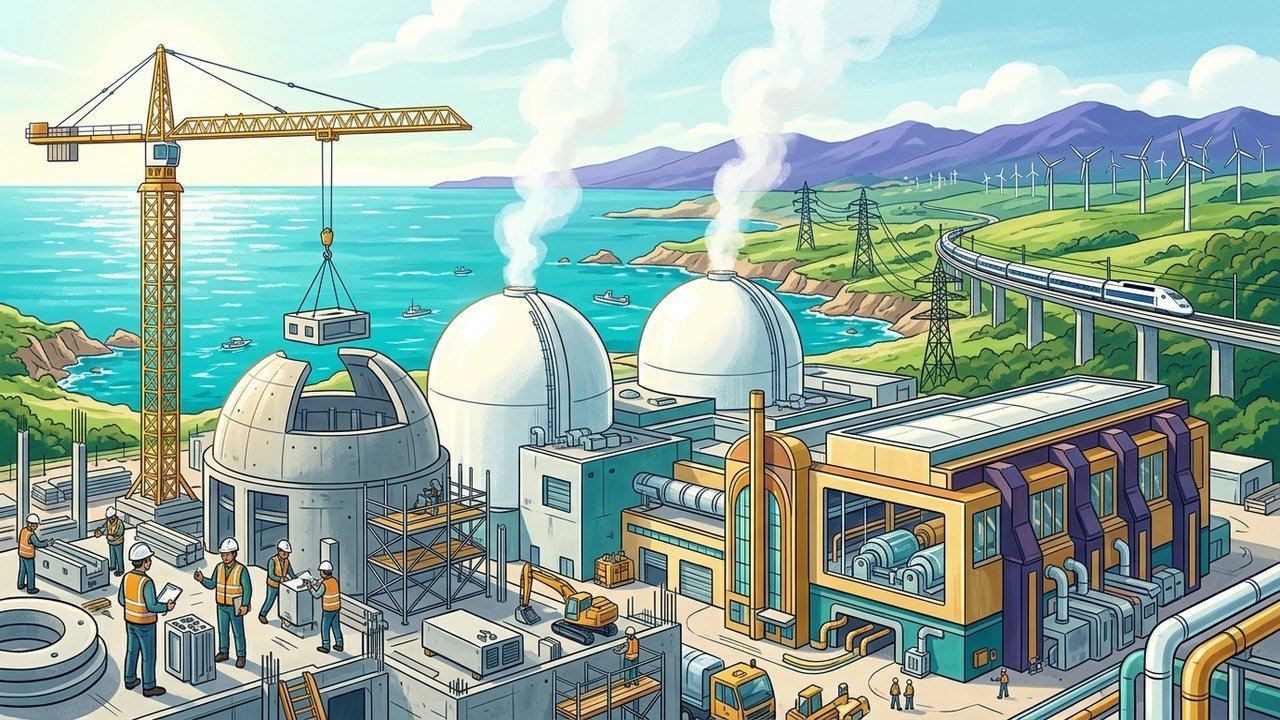
China runs the largest nuclear construction programme on earth. As of May 2026 it operated sixty power reactors at eighteen coastal sites, a fleet of 58.7 gigawatts that has nearly doubled in a decade, and somewhere between the high twenties and nearly forty more units were under construction, depending on who is counting, together representing roughly half of all nuclear building in the world. In August 2026 another eight reactors won approval, on filings that rate each unit at 1,127 megawatts, and every one of them is the same design, the Hualong One. The plan covering 2026 to 2030 calls for 110 gigawatts of nuclear capacity by the end of the decade.
The programme is usually described as a sudden arrival. It is better read as a sequence that began in 1970, when Zhou Enlai approved a research project to build a reactor China could design itself. The steps have a pattern that recurs across Chinese industry: make a modest version alone, buy the best foreign versions, absorb the drawings, pause to digest a shock, then standardise one design and repeat it in large numbers. This essay follows that sequence through the reactors themselves: the first homemade unit at Qinshan, the imported third generation at Sanmen and Taishan, the four year freeze after Fukushima, and the Hualong One fleet that followed, together with the pebble bed, small reactor and thorium machines at its edges. It is about the machine that builds reactors, not about whether nuclear power is the right choice.
The reactor China designed itself
The 728 Project, named for the February 1970 date of its approval, gathered a design team in Shanghai under what became the Shanghai Nuclear Engineering Research and Design Institute. Its product was Qinshan Phase One in Zhejiang province, a 300 megawatt pressurised water reactor that China designed and largely built itself, with foreign help confined to components it could not yet make. It connected to the grid on 15 December 1991 and entered commercial operation in 1994. The reactor was small by world standards and had teething problems in its first years, but it put China on the short list of countries that had connected a power reactor of their own design to a working grid.
The second step was deliberately the opposite. Daya Bay in Guangdong, built beside Hong Kong, was a turnkey import: two 984 megawatt reactors of the French M310 design, constructed with Framatome participation and completed in 1994, with the majority of their output contracted for decades to Hong Kong’s utility. The pairing was policy, not accident. Qinshan proved China could design; Daya Bay proved it could buy, and the learning worked forward from the import. Successive Chinese units built to the M310 pattern took a rising share of domestic components, until China General Nuclear could offer the CPR-1000, a localised descendant of the French design. By 2010 more than twenty reactors stood under construction at once, at Ningde, Hongyanhe, Yangjiang, Fuqing and elsewhere, the largest simultaneous build anywhere since France in the 1980s.
The 1980s nearly starved the programme instead of feeding it. Economic adjustment after 1978 pushed nuclear power behind coal in the investment queue, arguments over whether to import or design at home delayed projects for years, and the fleet once sketched for the century’s end slipped by more than a decade. The twenty reactors standing simultaneously by 2010 rested on decisions about financing, university programmes and training pipelines taken during the years when nuclear power was still the poorest cousin of the energy sector.
Buying the third generation
In the mid 2000s the industry went shopping for a third generation design. The tender became a balanced bargain: in 2007 Westinghouse won contracts for four AP1000 units at Sanmen in Zhejiang and Haiyang in Shandong, with technology transfer to a new state company, the State Nuclear Power Technology Corporation, written into the deal. Areva, which had lost the main contest, was sold two of its EPR reactors at Taishan in Guangdong the same year. Russia’s VVER units at Tianwan, in commercial operation since 2007, completed the set of imports.
The imports were late. Sanmen 1, the world’s first AP1000, was originally targeted for around 2013 and entered commercial service in September 2018; Haiyang 1 followed within weeks; Taishan 1 became the first EPR anywhere to sell electricity commercially, in December 2018. Each first of its kind ran four to five years behind schedule for familiar reasons: passive safety systems that no one had built before, a radical main pump design, and supply chains learning unfamiliar parts. The delays embarrassed the sellers at least as much as the buyer, because the same designs were running later still in Finland, France and the United States. What China gained was the part of the contract that could not simply be bought: a corps of engineers who had worked the design’s problems on site, and the technical basis for the CAP1400, an enlarged indigenous derivative of the AP1000 whose first two units at Shidaowan in Shandong have been under construction since 2022.
The pause after Fukushima
The earthquake and tsunami that destroyed Fukushima Daiichi on 11 March 2011 stopped the Chinese programme cold. Five days later the State Council suspended approvals for new plants and ordered a national safety inspection of every operating and under construction unit. The freeze held for more than four years. Planned inland stations such as Taohuajiang on the Yangtze were shelved indefinitely and have never been revived, which is why the fleet remains coastal, where cooling water is unlimited and population density arguments are fewer. The 2012 revision of the industry plan trimmed the 2020 target to 58 gigawatts operating, and even that reduced mark was missed, with around 50 gigawatts running at the end of 2020.
Approvals resumed in 2015, and the plants chosen to lead the restart were a statement. At Fuqing in Fujian and Fangchenggang in Guangxi, the first units of a new Chinese design, the Hualong One, were approved for construction. The programme that had begun with a homemade 300 megawatt reactor and detoured through French, American and Russian purchases was betting its restart on a design of its own.
One design, many sites
The Hualong One has two parents. China National Nuclear Corporation had been developing the ACP1000 and China General Nuclear the ACPR1000+, rival domestic designs of similar size, and in 2013 the state directed them to merge the two into a single reactor, the HPR1000, so that Chinese industry would present one brand at home and abroad. The first unit, Fuqing 5, poured its first concrete in May 2015, connected to the grid on 27 November 2020 and entered commercial operation on 30 January 2021. Its twin at the same site followed within the year.
Since then the design has become the default. Approvals have run at roughly ten units a year since 2022, and the overwhelming majority are Hualong Ones. Construction takes five to six years per unit, faster for followers at a site already built up. Repetition does the economic work. Forgings come from China First Heavy Industries, turbines and generators from Dongfang, Shanghai Electric and Harbin Electric, and the National Nuclear Safety Administration reviews the same design over and over with a growing inspectorate. International comparisons put recent Chinese projects at roughly 2,500 to 4,000 dollars per kilowatt overnight, against 6,000 to 15,000 for contemporary Western builds; those figures are analyst estimates rather than audited accounts, but the mechanics behind them are visible on the ground: one repeated design, sites licensed for six and eight units, and a supplier base holding more nuclear orders than the rest of the world combined provides.
What the design actually is matters as much as how often it is ordered. The Hualong One is a 1,100 megawatt class pressurised water reactor of deliberately conservative character: a double containment wall, tanks that can flood the core by gravity for three days without any power, and a core catcher beneath the reactor vessel to hold molten fuel if the worst happens. Those features were adopted in the years after Fukushima and examined line by line by British regulators during the generic design assessment, which found the design acceptable in early 2022. There is no exotic coolant and no unproven fuel in it, only a well understood reactor type engineered with wider margins, and that conservatism is precisely what allows it to be repeated so often, in the way a standard bridge design can be.
Exports have been the programme’s soft edge. Pakistan hosts the only completed foreign Hualong Ones, at Karachi, in commercial service since 2021 and 2022, with a further unit at Chashma under construction since 2023. The design cleared the United Kingdom’s four step generic design assessment in early 2022, the first Chinese reactor to do so, but the planned Bradwell plant has stalled as Chinese investment in British nuclear wound down. An agreement with Argentina has sat unsigned for years. The home market is the prize the design was merged for.
The scale of the programme in 2026
The fleet numbers deserve a plain listing. Sixty operating reactors at eighteen sites produced 58.7 gigawatts in May 2026, nearly double the 2016 figure. Published tallies of units under construction range from twenty eight to thirty eight, because freshly approved and nearly finished units are classed differently; they amount to roughly 44 gigawatts, about half the nuclear construction in the world, with a further seventeen or so units approved but not yet started. Generation tells a humbler story: about 435 terawatt hours in 2024, near five per cent of the electricity China produced, second in the world after the United States but drawn from a grid so large that coal still supplies well over half of it.
That ratio is the honest way to see the programme. The 110 gigawatt target for 2030 implies about forty more Hualong class units, which matches the approval cadence of recent years and is demanding mainly because it leaves no slack: every missed approval batch, factory slot or commissioning delay compounds by the end of the decade. The same grid that absorbs the reactors is also growing faster than they are. China connected around 277 gigawatts of solar in 2024 alone; averaged over the year, the entire operating nuclear fleet equals about two and a half months of those solar additions. Electricity demand grew by more new terawatt hours in 2024 than the nuclear additions of several years combined will supply. Nuclear is the steady third pillar of Chinese decarbonisation, behind coal’s slow decline and the largest renewable buildout ever attempted, not its leading edge.
The demonstration reactors beyond the fleet
Around the edge of the standard fleet sit a handful of one off machines that say more about the programme’s direction than another Hualong does. At Shidaowan in Shandong, the HTR-PM, a high temperature pebble bed reactor, fed electricity to the grid in December 2021 and entered commercial service in December 2023. Two reactor modules of 250 megawatts thermal drive a single 210 megawatt turbine, using fuel spheres the size of billiard balls that cannot melt at the temperatures the design can reach. It is the first generation four reactor to sell electricity anywhere, and its lineage runs back to a 10 megawatt test reactor at Tsinghua University that first went critical in 2000.
On Hainan, the Linglong One, a 125 megawatt small modular pressurised water reactor, has been under construction at Changjiang since July 2021, the first land based small commercial reactor in the world to reach that stage. It passed cold functional tests in October 2025 and non nuclear steam tests in January 2026, and Chinese officials targeted commercial operation in the first half of 2026. Reports of first criticality circulated in mid 2026, but they had not yet appeared in the tables of the International Atomic Energy Agency or the World Nuclear Association as autumn arrived, and further pre-startup tests were said to be continuing. The world first is being verified the slow way, which is how such claims should be verified.
Furthest inland, at Wuwei in Gansu, sits the strangest machine of all: TMSR-LF1, a two megawatt thorium fuelled molten salt reactor, currently the only molten salt reactor operating anywhere on earth. Built by the Shanghai Institute of Applied Physics from September 2018, it demonstrated in 2025 the conversion of thorium into uranium inside the circulating salt, the breeding step such reactors exist for, a first in the world. The published roadmap runs to a ten megawatt demonstration beside the original by 2030 and hundred megawatt stations by 2035, aimed at interior provinces that have thorium deposits but little cooling water. At Xiapu in Fujian, meanwhile, two CFR-600 sodium cooled fast reactors, under construction since 2017 and 2020 on repeatedly extended schedules, point at the other long game: closing the fuel cycle by burning what the thermal reactors leave behind.
Fuel, cost and the people who check the welds
The fuel side of the programme is its quiet dependency. Domestic uranium mines in Jiangxi, Xinjiang and Inner Mongolia cover a minority of demand; the rest arrives under long contracts from Kazakhstan, Uzbekistan, Russia, Namibia and Canada, including output of the Husab mine in Namibia, one of the largest on earth, majority owned by China General Nuclear. Enrichment and fuel fabrication are domestic and were scaled early. The fast reactor programme has drawn on Russian fuel, one of the quieter threads of continuity between the two countries’ nuclear industries. Reprocessing is the unfinished piece of the ambition: a pilot plant at Lanzhou has operated for years, a commercial scale project discussed with France since the late 2000s has never been settled, and the fast reactors at Xiapu are the working substitute, meant to multiply the energy drawn from each tonne of imported uranium.
The cost side is the part other countries study. The headline figures, two to four thousand dollars per kilowatt, are estimates assembled by outside analysts, and the accountancy of state financed projects is its own discipline. But the mechanics behind them are observable: one repeated design, sites that take six and eight units, forgings and turbine halls ordered years apart for identical machines, and a regulatory process that reviews the hundredth copy of a design it understands. The operating record is respectable. Chinese units run at capacity factors in the high eighties per cent, near the American fleet’s, and grid dispatch treats nuclear plants as baseload in a system where coal still does the load following.
What the build rate does and does not mean
The programme’s limits deserve the same clarity as its scale. Five per cent of generation is not a grid transformed, and the 2030 fleet, even if built exactly to plan, will generate roughly the electricity that China’s solar arrays already produce today. The 2021 fuel damage at Taishan 1, the imported EPR that shut for well over a year after noble gases built up around damaged fuel rods, was contained and repaired, but it showed that mature designs in experienced hands still meet problems. The inland fleet remains unbuilt after fifteen years of proposals. The export book is thin beside the domestic one. And the programme depends on imported uranium, plus some Russian fuel services for the fast reactors, dependencies that domestic fuel cycle investments are meant to erode slowly.
What the build rate does establish is industrial rather than electrical. China is the only country that still builds nuclear power stations the way it builds bridges and metro lines, as a repeating industrial process with a standard product. Most other nuclear nations are relearning, expensively, how to build one or two; China is learning what the fortieth unit teaches. That knowledge does not transfer quickly, which is exactly why it is valuable.
Reading the programme plainly
The story of Chinese nuclear power is a sequencing story. Learn on a small homemade reactor, import the best of three foreign generations, keep the engineering teams intact through the Fukushima freeze, merge two rival designs into one, and then order the same machine often enough that the supply chain, the inspectorate and the construction crews all become good at it. The sequence has taken more than fifty years, and none of its steps was skipped.
The next markers are public and dated. The approval batches each summer will say whether the ten a year cadence holds. The Linglong One commissioning record will settle the small reactor claim one way or the other. The thorium demonstration near Wuwei, scheduled for 2030, and the CAP1400 at Shidaowan, due to finish later in the decade, will show whether the edges of the programme mature the way the centre already has. On current schedules the fleet will stand near the top of the world’s nuclear tables within a decade, and it will still be one pillar among several in the largest electrical system ever built. The machine that builds the reactors is the real artefact, and it is running.
References
- US Energy Information Administration, China’s nuclear power capacity nearly doubled since 2016, June 2026 — eia.gov
- World Nuclear Association, Nuclear Power in China — world-nuclear.org
- World Nuclear News, Chinese SMR completes non nuclear steam start up test, January 2026 — world-nuclear-news.org
- Chinese Academy of Sciences, China achieves thorium-uranium nuclear fuel conversion, November 2025 — english.cas.cn
- Power Magazine, China’s molten salt reactor reaches thorium-uranium conversion, December 2025 — powermag.com
- Global Energy Monitor, China is building half of the world’s new nuclear power — globalenergymonitor.org
- Ember, China energy trends — ember-energy.org
- Center for Strategic and International Studies, Chinese nuclear capacity analysis — csis.org
- American Nuclear Society, China nuclear newbuild coverage — ans.org
- Wikipedia, “Nuclear power in China” — en.wikipedia.org
- Wikipedia, “Hualong One” — en.wikipedia.org
- Wikipedia, “HTR-PM” — en.wikipedia.org
- Wikipedia, “TMSR-LF1” — en.wikipedia.org
- Wikipedia, “Linglong One” — en.wikipedia.org
- Wikipedia, “CFR-600” — en.wikipedia.org