
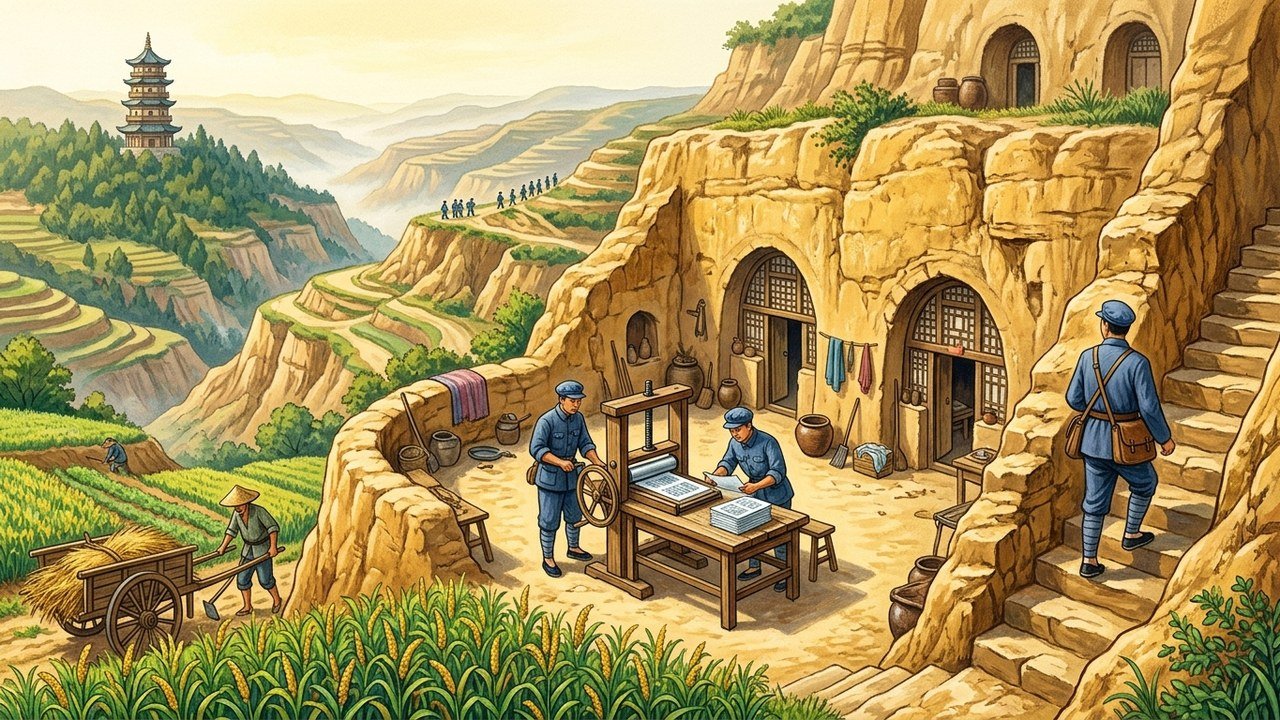
In February 2026 Bloomsbury published Frank Dikötter’s Red Dawn Over China, a book with a question baked into its subtitle: how communism conquered a quarter of humanity. The period is the twenty eight years between the founding congress of the Chinese Communist Party in 1921, held by thirteen delegates in a dusty Shanghai room, and the red flag raised over the Forbidden City in 1949. Dikötter is the historian best known for the People’s Trilogy on the famine, the purges and the Cultural Revolution, and this book is the prequel: how a minuscule conspiratorial party, bankrolled and directed for its first two decades from Moscow, came out of a devastating war and a collapsing currency to take the largest country in Asia. The book has been reviewed as an event, praised in the New York Times and the Times Literary Supplement, and argued with by political scientists. This essay sets out what it claims, what evidence it rests on, and where reviewers have pushed back.
The core argument is easy to state. The party did not win because China’s poor rose up behind it. In Dikötter’s telling it had, through most of its history to 1949, roughly the popular appeal of a minor sect, and it conquered through fanatical determination, unscrupulous tactics and a hefty dose of help from Stalin. The victory was not destiny. The book opens, as one scholarly reviewer put it, with dust rather than destiny, quoting the author’s line that time grinds everything into dust: archives survive by accident, and the survivor’s version became the official version. Dikötter’s counter version is built from paper.
The historian and his evidence
Dikötter holds a chair at the University of Hong Kong and made his reputation with the People’s Trilogy, of which the first volume, on the famine of 1958 to 1962, won the Samuel Johnson Prize. The trilogy begins in 1945. Red Dawn Over China runs backward to cover the party’s first twenty eight years, and it exists, he has explained in interviews, partly because of an accident. When the pandemic closed the border in early 2020 he was cut off from the mainland archives he normally works in, and he rebuilt his source base from roughly three hundred volumes of party documents that central and provincial archives had published between 1980 and 1989, a window when the party briefly allowed its own record into print, together with Comintern files held in Moscow.
That source base shapes the book. It is strong where the party’s own paperwork is strong: membership returns, internal investigations, telegrams between commanders, confessions. It is correspondingly unsentimental. The Dikötter method, familiar from the trilogy, is to count and quote rather than theorise, and to let the party’s own files indict its later mythology. He describes himself as an evidence driven historian, and the method shows in the book’s habits of statement: a number, a document, a date, and only then an interpretation. Where the trilogy could weigh the famine against the state’s own statistics, the prequel has thinner pickings and leans harder on internal reports, inspection tours and the confessions of people caught in the machine. The strongest documents are the ones nobody wrote for posterity: requisition orders, telegrams between commanders, a siege’s arithmetic. Reviewers have noted the risks of selection that come with any archive driven account. The defence is that most of the documents were compiled by the party, for the party, with no thought of a foreign historian reading them.
A party the size of a sect
The numbers are the book’s sharpest instrument. The party founded in 1921 had about fifty members by 1923. In Shandong, a province the size of France, the organisation could muster about twenty female members in the 1930s. Internal inspection reports, Dikötter reports, kept discovering that branches listed on paper did not exist in the villages. When the Long March ended in 1936 the movement that had supposedly captured the soul of the peasantry counted about forty thousand communists in a country of half a billion people, roughly one for every twelve thousand inhabitants. For comparison he offers Salazar’s Portugal, hardly a revolutionary hotbed, where the communist party in the mid 1930s enrolled about one person in two hundred and eighty. Even by 1940, using the Comintern’s own figures, communists in China numbered about one in a thousand, a following comparable to what the American party enjoyed in the United States.
The organisation itself, in these years, was less a mass party than a network of urban cells held together by Moscow’s subsidies and the discipline of the few. The founding congress of July 1921 was organised by a Dutch envoy of the Comintern, and the party spent its first years as a fraction inside other people’s institutions: first the unions and the schools, then the Nationalist party itself. Members were few enough to know each other by name, and vulnerable enough that a single raid could close a city’s organisation. What the smallness of the following measures, on Dikötter’s reading, is not the quality of the faith but the scale of the task the faith had set itself.
Poverty, in other words, does not explain the conquest, because equally poor countries produced no such outcome. Dikötter notes that Mussolini’s Italy, no one’s idea of a revolutionary society, had roughly thirty percent of its population in absolute poverty by 1934. And the rural surveys that existed did not show a peasantry waiting for deliverance. The land economist John Lossing Buck and his team at Nanjing interviewed across some sixteen thousand villages and found real poverty, but villagers overwhelmingly did not blame landlords and did not cite excessive taxation as their chief burden. Mao’s own line from January 1930, that a single spark could set the prairie alight, was a statement of faith about what discipline could do, not a description of a prairie already burning.
Moscow’s party
The second half of the explanation is external. The Communist International, founded in 1919, picked up the Chinese group as one project among many, funded it, and for years directed it. Stalin, Dikötter has pointed out, appears on no fewer than sixty nine pages of the book. From 1923 the Soviets bankrolled the much larger Nationalist party as well, and the small communist party entered it, in Dikötter’s phrase, as a Trojan horse. When the alliance collapsed in 1927, Moscow’s envoys pushed the party toward uprisings it could not win. The Guangzhou rising of December 1927 was fomented by the Comintern’s Heinz Neumann, who arrived with a suitcase of money. In a city of some two hundred and seventy thousand workers and hundreds of unions, precisely three thousand people could be raised for the insurrection, which burned part of the city centre and killed several hundred policemen before returning armies exterminated the rebels and many innocents beside.
The Moscow thread runs through the whole story. After the purge of 1927 a group of Soviet trained returned students, the Twenty Eight Bolsheviks, contested Mao’s leadership for years, until a letter from Stalin, found in the Russian archives by the biographer Alexander Pantsov, advised Mao to stop trusting them and to rely instead on figures such as Liu Shaoqi and Lin Biao. When Stalin dissolved the Comintern in 1943 he instructed member parties to adapt to local conditions, and Dikötter draws the pointed conclusion that the celebrated sinification of Marxism, usually credited to Mao’s independent genius, followed a directive from Moscow. None of this makes the party a puppet; it makes it a permanent supplicant for money, weapons and legitimacy at moments when its own base could not have sustained it.
Land reform without landlords
The book’s revision of land reform follows the same logic. China had no Russian style landed gentry: no emancipation settlement of 1861, no squires and barons, and no village class war waiting to be unleashed. Where the party did control territory in the 1930s, Dikötter finds extraction dressed as redistribution. Having exhausted the holdings of so called rich peasants, the cadres moved on to the middle peasants who were meant to be allies. Villagers, understanding the logic, produced the bare minimum. Zhang Guotao, who ran one of the largest soviet areas, concluded that the party had squeezed the countryside like a lemon. Another veteran of the soviet areas put it more harshly still: they had behaved like colonisers.
This matters because the orthodox story of 1949 rests on the claim that land reform bought the party the loyalty of the peasantry. Dikötter’s files describe something else: a campaign that sought grain, recruits and control, imposed by work teams and backed by people’s tribunals, in villages that had not asked for it. Buck’s surveys supply the backdrop, the regime’s own production returns the outcome. The countryside was mobilised rather than converted.
The accidents Dikötter counts
Contingency does the rest of the work. The Japanese seizure of Manchuria in 1931 and the full war from 1937 broke the Nationalist state the party could never have beaten in open battle. Chiang Kai-shek understood the ordering of threats, calling the Japanese a disease of the skin and the communists a disease of the soul, but the skin disease came first. In December 1936 his own allies detained him at Xi’an and forced a united front; his diary entry, the achievements of years ruined in a single day, is quoted here as the moment the party gained the protected rear it needed. Before that turn, Chiang’s strategy had been to pursue the communists across the country on foot, using each expelled soviet area to extend the reach of the national government province by province, while he bought the better part of a decade to prepare for the war with Japan he believed was coming. It was a strategy that made him hated by the allies he bypassed and slow, in the event, to face the invader. Dikötter’s account has no patience with the caricature of Chiang as mere corruption, but neither does it soften the verdict that the strategy failed at its centre. He quotes the American general Stilwell’s 1936 observation that China had never been so united, and the united front then worked exactly as the communists intended. Mao’s instruction, as the book has it, was that the party should pretend to fight the Japanese while holding back.
Inside that protected rear the party built the machinery it kept for the next sixty years. The New Democracy line of 1940 promised a coalition order in which communists would hold no more than a third of places. The rectification purge at Yan’an between 1942 and 1944 saw some fifteen thousand people accused and several thousand executed, while the detention camps filled. Yan’an was also, from 1944, the showcase to which selected foreign journalists were taken, two years after Edgar Snow’s Red Star Over China had romanticised the movement for Western readers at the precise moment it counted forty thousand members. Even the economics were not what the legend claimed: inflation ran worse in the communist areas than in the free zones, aggravated by Japanese counterfeiting of the national currency, a fact the propaganda never conceded.
Manchuria and the siege of Changchun
The endgame is the hardest reading. In August 1945 the Soviet Red Army, a million strong and largely equipped through American Lend Lease, overran Manchuria, a region the size of Britain and France combined, and stayed. Dikötter’s accounting: the Soviets handed the countryside to the communists, helped build sixteen armies with artillery and aircraft, sent officers to Moscow for training, and shipped out trainloads of captured Japanese weapons, all while Washington imposed an arms embargo on the Republic of China in 1946. The military balance of the civil war was manufactured in that window, and it carried an ideological accompaniment. American policy, having demanded coalitions the communists had no intention of contesting in good faith, punished the Nationalists with an embargo for continuing a war their opponents had restarted, while the Soviet side paid nothing for arming one party to the teeth. Dikötter’s chapter on these months is where the book’s argument is least deniable and least comfortable for every government involved, including the ones that wrote the alliance’s memory afterwards.
The siege of Changchun in 1948 is the book’s centrepiece atrocity. Lin Biao’s army surrounded the city for five months and starved it. Dikötter puts the dead at about one hundred and sixty thousand from famine and disease, a figure reconstructed partly from telegrams in the Taipei archives, and he documents the methods: barrier troops behind the lines, a practice he traces back to Trotsky, and demoralised soldiers shooting unarmed villagers sent forward in waves. Changchun’s fall changed the war’s logic. When the ancient capital Beijing came next, its commander surrendered rather than let the city share Changchun’s fate, which is one reason the Forbidden City stood intact to receive the red flag in 1949.
Revisionist history and its critics
Red Dawn Over China revises smaller orthodoxies along the way, and these have drawn the most argument. Dikötter re-examines the Shanghai massacre of April 1927 and finds, from the communist era press record and from the historian Betty Wei’s study of Shanghai, no more than about one hundred and sixty five dead and quite possibly several hundred, rather than the mass bloodbath of the standard account; the communists’ own protest at the time demanded the return of their weapons rather than redress for a massacre, and the phrase itself, he argues, entered history through the Trotskyite writer Harold Isaacs. Reviewers have accepted the documentary diligence and disputed the framing. The scholarly review in the Jervis forum situates the book within Dikötter’s long concern with violence, ideology and archival recovery, while noting the interpretative stakes. A political scientist at the book’s launch pressed the opposite case: that the account is mono variable, that Soviet help explains some chapters and not others, and that the Japanese war and Nationalist collapse did more work than the book allows. The Times Literary Supplement’s reviewer heard the same argument made more cautiously, noting that the Communists never managed to stimulate a popular movement despite years of effort, while weighing how much of the victory belonged to their opponents’ disintegration.
Both things can be true, and honest readers should hold them together. Dikötter won the Samuel Johnson Prize for a previous volume and remains the most prominent archival historian of the party’s violence; he is also a deliberate revisionist whose earlier books drew criticism for emphasis and selection. The strength of Red Dawn Over China is that its central claims are countable: members, subsidies, telegrams, siege dead. The weakness, by the same token, is that a count is not a counterfactual. How the party would have fared without Changchun, or without Manchuria’s captured arsenals, is not a question the files answer.
What the book changes about reading 1949
The book’s last argument is about continuity. The party that took power in 1949 was not, in Dikötter’s account, a national movement that happened to be Leninist; it was a Leninist instrument that happened to conquer a nation, and it kept both features: the monopoly over political power and the control of the means of production. Purges ran through its history before 1949, from Guangzhou to Yan’an, and remained the organisation’s method after, which is why he calls the purge the party’s DNA. The lessons were learned early and applied late. The Guangzhou failure of 1927 taught the leadership that cities could not be taken by proclamation; the Yan’an purge taught it that the interior could be ruled by fear; Manchuria taught it that great power patrons deliver what peasant majorities do not. Even the later pragmatism stays inside the frame. Deng Xiaoping’s formula, capitalist tools in socialist hands, assumed the hands never change. Chiang Kai-shek’s bitter retrospective to an American general, if you and the entire United Nations find it difficult in Korea, what exactly should I have done in 1948, closes the circle: the defeated side understood the arithmetic of abandonment better than its patrons did.
For a reader trying to judge the book, three sentences carry the thesis. The party was tiny for most of its rise, and numbers of that size do not win countries by popularity. It was funded, armed and repeatedly rescued from abroad, first by the Comintern and then by the Soviet army in Manchuria. And it was willing to do things, Changchun above all, that its opponent, for all its own brutality, was not organised to do. Against that stand the critics who say the war with Japan, the currency collapse and the Nationalists’ self destruction have been underweighted, and that a party without genuine rural roots could not have harvested the Manchurian windfall. The dispute is live, which is the best reason to read the book rather than a summary of it. What Red Dawn Over China establishes beyond easy argument is narrower and durable: the official story of a people’s revolution, rising inevitable and beloved, is not what its own records show. What replaced a quarter of humanity’s old order in 1949 was a small, patient, externally sponsored fighting party, and the country has been living with that origin ever since.
References
- Bloomsbury, book page for “Red Dawn Over China” — bloomsbury.com
- China Books Review, “Frank Dikötter on the Rise of the Party”, 9 June 2026 — chinabooksreview.com
- Jervis International Security Studies Forum, review 186, “Messingschlager on Dikötter, Red Dawn Over China”, 24 June 2026 — issforum.org
- Hoover Institution, “Frank Dikötter and the True History of Communist China”, June 2026 — hoover.org
- Wikipedia, “Frank Dikötter” — en.wikipedia.org
- Wikipedia, “Chinese Communist Party” — en.wikipedia.org
- Wikipedia, “Communist International” — en.wikipedia.org
- Wikipedia, “Guangzhou Uprising” — en.wikipedia.org
- Wikipedia, “28 Bolsheviks” — en.wikipedia.org
- Wikipedia, “Long March” — en.wikipedia.org
- Wikipedia, “Xi’an Incident” — en.wikipedia.org
- Wikipedia, “Red Star Over China” — en.wikipedia.org
- Wikipedia, “Yan’an Rectification Movement” — en.wikipedia.org
- Wikipedia, “Soviet invasion of Manchuria” — en.wikipedia.org
- Wikipedia, “Siege of Changchun” — en.wikipedia.org
- Wikipedia, “Shanghai massacre” — en.wikipedia.org
- Wikipedia, “John Lossing Buck” — en.wikipedia.org
- Wikipedia, “Mao’s Great Famine” — en.wikipedia.org