
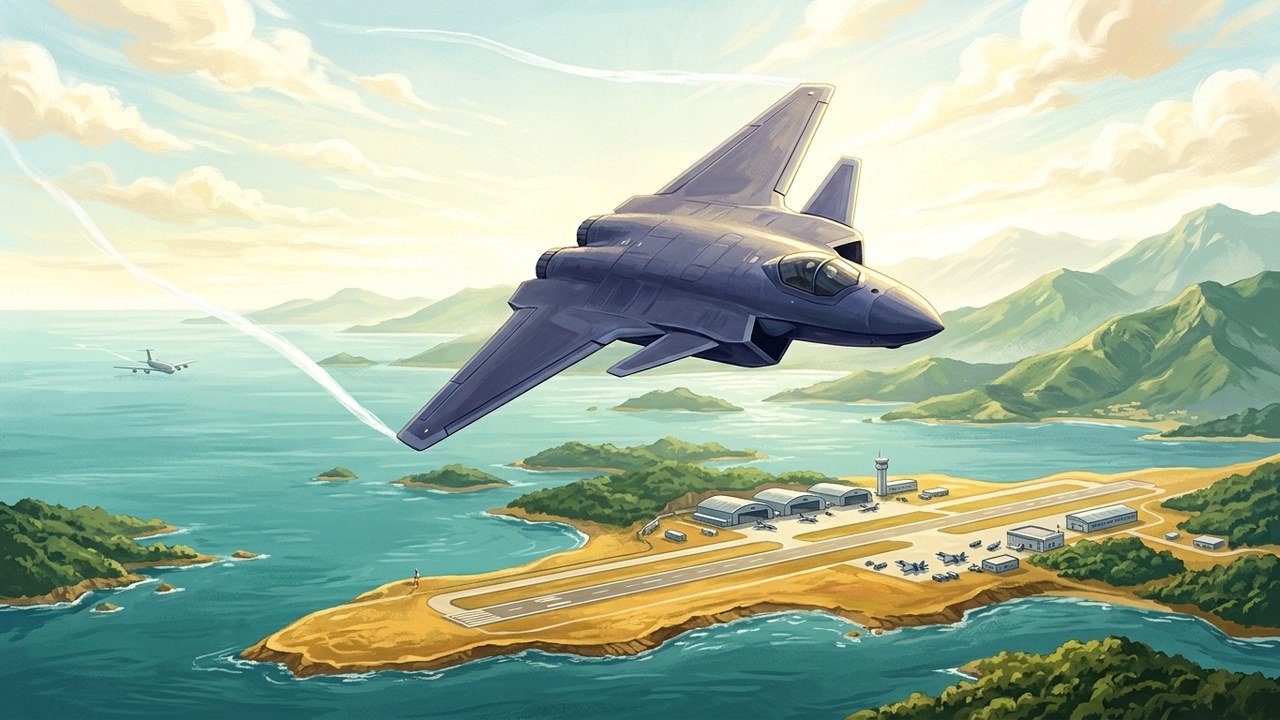
The Chengdu J-20 is the fighter aeroplane that changed the shape of air power in Asia. It is a twin engine, all weather, fifth generation stealth fighter, built by the Chengdu Aircraft Corporation for the People’s Liberation Army Air Force, and known in China by the name Weilong, the Mighty Dragon. It first flew in January 2011, entered service in March 2017, and by the middle of 2026 open source estimates put the number built at around five hundred, a fleet larger than any other stealth fighter programme in the world outside the United States. This essay follows the aeroplane itself: where it came from, what kind of fighter it is, why its engines took a decade longer than its airframe, how fast the fleet is growing, and what the aircraft does and does not change.
Two things about the J-20 story are worth holding apart from the start. The first is that it exists at all: two decades ago China had no stealth aircraft of any kind, and the step from copying and licence building Soviet derived designs to fielding an original fifth generation fighter is one very few countries have managed. The second is that the numbers now attached to it are estimates, produced by analysts counting serial numbers in photographs, and they should be read with that in mind throughout. What is not in dispute is the trend line: the Mighty Dragon is being built faster than any other stealth fighter has ever been built, and the production line, not any single jet, is the real news.
From a design institute in Chengdu
The aeroplane came out of the Chengdu Aircraft Design Institute, the same establishment that produced the J-10 fighter in the 1990s and 2000s. Its chief designer was Yang Wei, an engineer who joined the institute in the late 1980s and was promoted to its highest technical post in late 2001, at the age of thirty eight; over his career he has served as chief designer on seven Chinese fighter types. The programme was conducted in unusual secrecy for an aircraft that would become so public. The first flight came on 11 January 2011 at Chengdu, a flight of about fifteen minutes that was photographed by hobbyists and confirmed only afterwards.
For the next five years the aircraft appeared in occasional test photographs and steadily less often in speculation, and then the veil lifted deliberately. In November 2016 the J-20 made its first public appearance at the Airshow China display at Zhuhai, flying past the crowd in pairs weeks before the type entered squadron service. The timing was a message: the public debut and the service entry, in March 2017, were staged as a single announcement that China had joined the very small club of countries operating stealth fighters. The club’s other member, the United States, had fielded the F-22 since 2005 and was building the shorter range F-35 in numbers; no other country had put a fifth generation fighter into squadron service at all.
Between the first flight and the service entry came five years of testing that the public watched in fragments. Photographs from Chengdu showed successive batches of prototypes, each subtly different from the last: intakes reshaped, cockpit canopies exchanged, sensor windows added under the nose and ahead of the tails, the paint changing from primer tones to operational grey. Hobbyist cameras at the airfield fence did work that defence ministries do with satellites, and the steady accumulation of small changes was itself information: an airframe being matured the way every serious fighter programme has matured one, flight by flight, deficiency by deficiency. When the production jets finally appeared, their shape had settled, and the version that entered service in 2017 was recognisably the aircraft still flying in 2026.
What kind of fighter the J-20 is
The airframe answers the question of what the aeroplane is for. The J-20 is a large fighter by the standards of the type, with a long fuselage, canard foreplanes ahead of a delta wing, and canted twin tails, a configuration that trades some agility for reach and internal fuel. Western analysts have generally read it as a long range interceptor rather than a dogfighter: an aircraft built to fly far from its bases, carry its weapons inside the fuselage to preserve its low observable shaping, and use very long range missiles against the aircraft that make Western air power work, the tankers and radar planes that sit behind the fighter screen. That reading is an interpretation, not a disclosure, but the aeroplane’s dimensions and its weapon fit both point the same way.
The configuration has been argued over since the first photographs. Canard foreplanes give a big delta wing aircraft better control at high angles of attack, useful in a long fuselage built around internal weapons bays, at some cost in radar reflection from the extra surfaces. The result is an aeroplane that trades the tightest dogfight manoeuvres for altitude, acceleration and the ability to carry fuel and missiles inside its skin. Fighter pilots argue about whether that trade wins fights; designers argue about whether the fights of the future will be close enough for it to matter. The missile the aircraft carries suggests the designers’ answer.
The weapons live in internal bays, the main bay typically carrying four PL-15 missiles with two shorter range PL-10 missiles in side bays. The PL-15 is the other half of the design idea. It is an active radar guided air to air missile with a maximum range generally given as two hundred to three hundred kilometres and speeds of up to Mach 5, figures that outrange most Western equivalents and would let a J-20 fire from outside the range of the missiles carried against it. In the air combat of the past two decades, fought at shorter and shorter ranges, a missile that reaches two hundred kilometres changes the arithmetic of every patrol and every tanker sortie within that radius.
The engine that took longest
If the airframe was ready in 2011, the engine was not, and the J-20’s history is partly the history of China catching up on jet engines. The early jets flew on Russian engines from the AL-31 family, the same basic engines that power other Chinese and Russian fighters. Domestic substitutes from the WS-10 family followed, and current production uses the WS-10C, an interim solution that made the fleet possible while the definitive engine matured. That engine is the WS-15, a purpose built turbofan in the eighteen and a half tonne thrust class, and its development is a study in how long the hardest subsystems take. The programme began in the early 1990s, had an engine running on a testbed by 2005, reportedly failed its final verification at the end of 2019, lost further time to the pandemic, and only later entered mass production.
Jet engines are the hardest thing in aviation because they concentrate the hardest problems in one component. The blades in the hot section spin at temperatures that approach the melting point of the alloys that carry them, and they must do it for thousands of hours, in a machine light enough to hang on a fighter’s wing. China’s engine industry spent decades a generation behind the American and British firms that solved these problems first, and the WS-15’s slow march, testbed in 2005, failure in 2019, mass production years later, is not the story of one stumbling programme but of an industrial system climbing the last and steepest part of the curve. The airframe could be designed with computers and proven in a few hundred test flights; the engine had to be burned in, hour by hour.
The engine matters because thrust decides what a heavy stealth fighter can do. With the WS-15, the J-20 reaches the performance its airframe was drawn around, and new-build aircraft, designated J-20A, are now reported to come off the line with WS-15 engines installed from day one, while a further development, described in reports as the J-20B, pairs the airframe with two of the new engines and further changes. Those designations and dates come from defence media tracking satellite imagery and airfield photographs, which is how most J-20 facts reach the public; the programme itself announces very little. The pattern, however, is consistent across all sources: the engine lagged the aeroplane by more than a decade, and it has now caught up.
How fast the fleet is growing
The production figures are the story the numbers tell. The Royal United Services Institute assessed that Chinese industry could reach a rate of about one hundred and twenty J-20s a year by the end of 2025, a figure that would have seemed fantastical for a stealth fighter a decade ago; the American F-22 line, for comparison, built one hundred and ninety five aircraft in total before closing in 2011. By the middle of 2025 the same analysts counted around three hundred J-20s in service spread across at least thirteen air force regiments. A year later, by the middle of 2026, tracking of construction and serial numbers, including jets such as the machine numbered 63106 photographed in September 2025, put the total produced at around five hundred, and trade publications observed that China was approaching the point where its Mighty Dragon fleet outnumbers the entire American F-22 force.
The counting deserves a word, because it explains the error bars. No official figure for J-20 production has ever been published. The numbers come from comparing satellite photographs of the Chengdu airfield and production plant, reading construction numbers painted on aircraft at airshows and training bases, and logging the serials that indicate which formation a jet belongs to, work done by think tanks and by dedicated amateurs who maintain public databases of every photograph. When analysts say around five hundred, they mean the count of visible aircraft plus an estimate for the gaps between photographs. It is a remarkable way to measure a strategic programme, and it is right more often than governments find comfortable.
Projections take the line further. Reporting in the South China Morning Post and elsewhere has suggested a fleet on the order of a thousand J-20s by 2030. That figure is a projection, not a plan anyone has published, and it assumes the current build rate holds through years in which Chinese defence budgets, engines and demand may all change. Even discounted, the direction is unambiguous: the world’s second stealth fighter force is becoming its largest, and it is doing so on a single production line at a single complex in Chengdu. The United States Department of Defense’s 2024 report on Chinese military power notes the same industrial base producing the J-20 fighter, the Y-20 transport and the forthcoming H-20 bomber, a range of aircraft no other country outside the United States builds across.
The two seat fighter and the new roles
The aeroplane is also growing roles. At the Zhuhai display in 2024 the manufacturer unveiled the J-20S, a two seat version, described at the show as a new generation, medium and long range, heavy, two seat, multi purpose fighter, and generally credited as the world’s first two seat stealth fighter to enter service. Two seats in a stealth aircraft is not about training. The accepted reading is that the second crew member exists to manage the information and the off board systems: the missile shots at long range, the drones the aircraft may control, and the strike missions that a bigger cockpit lets a fighter take on. Reports on the variant describe thrust vectoring WS-10 engines and confirmed service entry, again with the caveat that most of this reaches the public through tracking rather than announcement.
Why put a second crew member in a fighter at all? The answer accepted by most analysts is workload. A fifth generation fighter is less a gun platform than a flying sensor and command post: it fuses its own radar picture with data from satellites, drones and other aircraft, and a long range missile shot requires someone to sort targets, weigh the rules of engagement and manage the aircraft’s emissions while the pilot flies. A back seater can also supervise the drones that future air forces expect fighters to control, turning one aeroplane into the centre of a small formation. None of this is confirmed by the manufacturer, which says little, but the airframe exists, the seat exists, and the missions follow logically from both.
The strike role is expanding in other ways too. In January 2026, United States Naval Institute reporting described a new J-20 variant with the ability to conduct precision strikes on maritime targets, which would move the aircraft from an air to air specialist toward a multi role system aimed at ships as well as aeroplanes. And the aeroplane’s signature weapon has now been used in anger, at least according to the claims that followed the 2025 fighting between Pakistan and India: Pakistani officials said an export version of the PL-15, fired from about two hundred kilometres, brought down an Indian Rafale fighter. The claim is contested and unverified, and India has not accepted it, but the engagement forced every air force in the world to reprice what a J-20 or its export cousins might do at that distance.
What the aircraft changes, and what it does not
What the J-20 changes is the geometry of air power in the western Pacific. Bases, tankers, radar aircraft and carriers that could once stand off at comfortable distances now sit inside the reach of a large and growing fleet of fighters carrying missiles with two hundred kilometre legs. The response is visible in the programmes of every air force in the region, from longer range missiles of their own to dispersed basing and refuelling plans built around the assumption that the J-20 exists in numbers. An aircraft does not have to win a war to change what everyone else buys, and the Mighty Dragon has already done that.
China is also the only country other than the United States to put a stealth fighter into serial production at all. Russia’s equivalent, the Su-57, flies in very small numbers; European and Asian programmes are still in development or deliberately stopped short of full stealth. That fact reframes the J-20’s significance: the question the aircraft poses is not whether any single engagement would go one way or another, but what it means for one country to be able to build hundreds of the most complex flying machines that exist, year after year, while almost nobody else can build any.
What it does not do is settle the harder questions. The quality of its stealth shaping, its sensors, its electronic warfare and its crews’ training are all unknowns, and they decide combat outcomes as much as airframes do; numbers of jets are the easiest thing to count and the least complete thing to know. The fleet figures themselves are estimates assembled from photographs by diligent amateurs and think tanks, and they carry honest error bars of tens of aircraft. And the aeroplane has never been exported, so its combat record, outside the contested PL-15 claim, is empty. The J-20 is a known unknown in the most literal sense: the world can see five hundred of them and cannot see inside any of them.
Reading the J-20 plainly
Taken as an engineering story, the J-20 is about sequencing. China built a design institute and kept it staffed for decades, gave it a domestic fighter to learn on with the J-10, started the engine programme twenty years before it was needed, accepted an interim engine to get the fleet flying, and used a closed production line to turn a prototype of 2011 into the world’s largest non American stealth force by the middle of 2020s. The mistakes along the way, the failed engine verification of 2019 above all, were absorbed rather than fatal, which is what mature aerospace programmes look like from the outside.
Nor does the fighter stand alone. The same industrial complex builds the Y-20 transport that carries its spares and the tankers that extend its reach, and is preparing the H-20 bomber reported to be next in the stealth queue. A fleet this size needs maintenance hangars, trained crews, spare engines and missile production in matching volume, and the visible growth of all of it, airfield by airfield, is what distinguishes a programme from a prototype.
The story also has a human coda that resists neat summary. In March 2026 reports noted that Yang Wei, the chief designer who drew the aeroplane, had been removed from the roster of the Chinese Academy of Sciences, with no explanation offered; his current status is unclear. The machine he designed flies on regardless, in regiments that did not exist when it first took off at Chengdu, armed with missiles that outrange most of the world, from a production line that has not yet slowed down. The Mighty Dragon began as photographs of a strange canard delta over an airfield in Sichuan, and it is now the aeroplane that every air force in Asia plans around, which is as clean a measure of success as the industry has.
References
- Wikipedia, “Chengdu J-20” — en.wikipedia.org
- Wikipedia, “PL-15” — en.wikipedia.org
- Wikipedia, “Yang Wei (aircraft designer)” — en.wikipedia.org
- Wikipedia, “Airshow China” — en.wikipedia.org
- Wikipedia, “Shenyang WS-10” — en.wikipedia.org
- Royal United Services Institute, J-20 production and fleet assessments — rusi.org
- US Department of Defense, Military and Security Developments Involving the People’s Republic of China, 18 December 2024 — media.defense.gov
- The War Zone, J-20 fleet tracking coverage — twz.com
- Aerospace Global News, J-20 serial number and fleet reporting — aerospaceglobalnews.com
- South China Morning Post, J-20 fleet projection reporting — scmp.com
- USNI News, January 2026 report on the maritime strike J-20 variant — news.usni.org
- The Aviationist, J-20 public debut and J-20S coverage — theaviationist.com
- Militarnyi, RUSI production rate assessment — militarnyi.com