
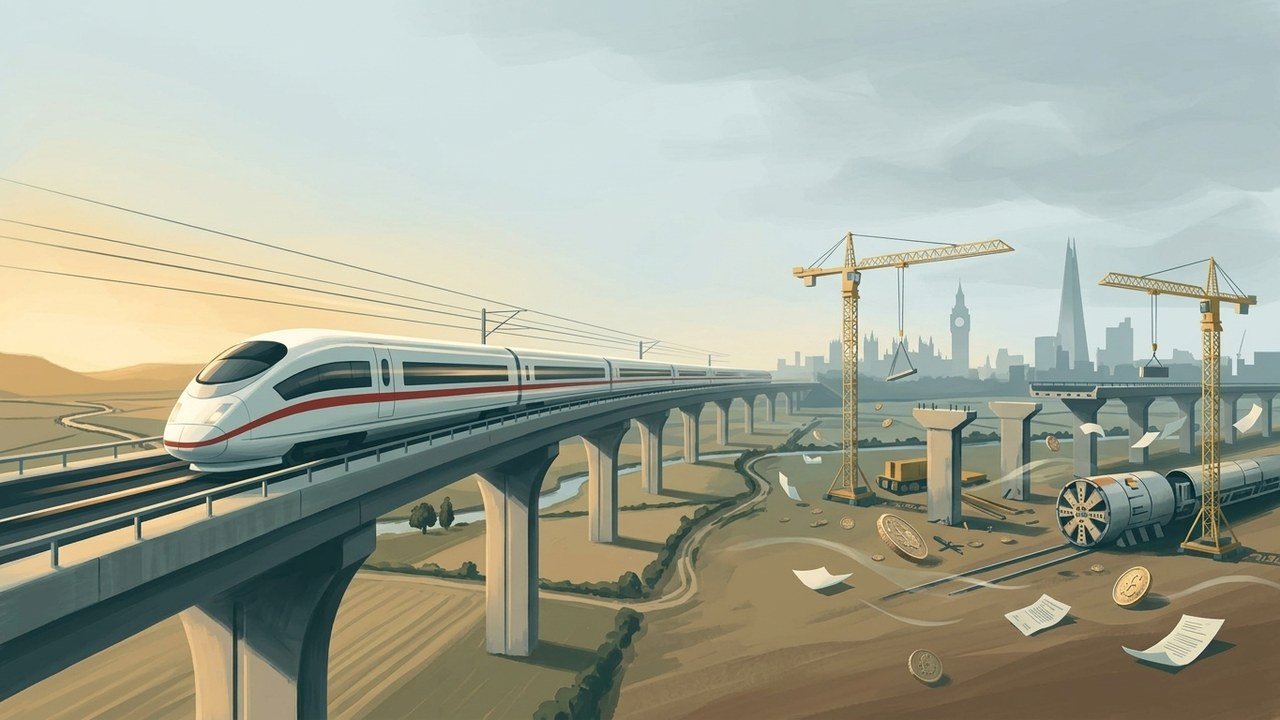
In January 2020 a letter reached the offices of HS2 Ltd, the company the British government had created to deliver its new high speed railway. It came from the China Railway Construction Corporation, one of the two enormous state owned railway builders that laid most of the Chinese network, and its message was simple. As the Financial Times reported on 14 February 2020, the company said it could build the whole of HS2 in five years, rather than the twenty years the project was then expected to take, and at a cost that would be significantly cheaper than anything on offer from domestic contractors. The letter said the company stood ready to solve all of the issues around the project and would be happy to work with HS2 Ltd and, if necessary, the British government.
The timing could hardly have been stranger. Three days before the report appeared, on 11 February 2020, Boris Johnson had given HS2 the go ahead, accepting that the scheme first sold to Parliament in 2012 at £32.7 billion had become one that the National Audit Office weeks earlier priced at between £65 billion and £88 billion in 2015 prices. The Chinese letter landed inside a government that had just decided to let Huawei into parts of the British 5G network, and was weeks away from reversing that decision under American pressure. When reporters asked about the offer, Transport Secretary Grant Shapps said the government was not involved in any talks with the Chinese side, and no talks ever began. The letter went nowhere.
Six and a half years later it reads differently. In May 2026 the Transport Secretary told Parliament that the single London to Birmingham line, the only part of HS2 still being built, would cost between £87.7 billion and £102.7 billion, and that first trains would not run before May 2036, with a possible slip to October 2039. This essay reconstructs what the Chinese offer actually said, what was behind it, how Britain responded, and what the project has become since. The letter was never a bid that could realistically be accepted. It has turned out to be something else: a measurement device, of exactly the kind the British system finds hardest to read.
What the letter actually offered
The document at the centre of this story is a letter from the China Railway Construction Corporation to Mark Thurston, then chief executive of HS2 Ltd, sent in January 2020 and first described by Building magazine on 13 February 2020 before the Financial Times followed a day later. Its reported wording deserves quoting, because it was more careful than the headlines suggested. The company wrote that it was certain it could offer a solution that would be significantly cheaper, that it stood ready to solve all of the issues around the project, and that it would be happy to work with HS2 and, if necessary, the British government.
Five years was the headline claim. At that point HS2 Ltd was expecting to run its first trains in the second half of the 2020s on a programme of works stretching beyond 2033 for the full network. The Chinese company was proposing to treat the whole undertaking, civil engineering, systems and potentially rolling stock, as a single package delivered the way it delivered lines at home. The letter did not attach a price. The cost claim was comparative, and reports at the time framed it as tens of billions of pounds of potential saving against a project whose estimates had already passed £100 billion on some accounting bases.
It is worth being precise about who was writing. The China Railway Construction Corporation is a state owned enterprise descended from the railway corps of the People’s Liberation Army. Together with its rival China Railway Engineering Corporation it built the greater part of the largest high speed network on earth, and it has since carried that template abroad, to railways in Africa, the Middle East and South East Asia. A letter from such a company is not a contractor touting for a tunnelling package. It is an instrument of a state announcing that it regards a foreign megaproject as within its competence.
How Britain received the offer
The reception was brief. The Financial Times report appeared on the morning of 14 February 2020. By the weekend Grant Shapps was on the BBC saying the government was not involved in talks between the Chinese company and HS2 Ltd, and Reuters reported that ministers had held no discussions about the offer. There was no counter proposal, no exploratory meeting, no published analysis. Within the Department for Transport the letter was treated as a curiosity that arrived at an inconvenient moment.
The moment mattered. January 2020 was the month the Johnson government decided, against strong American objection, to allow Huawei equipment into the non core parts of the British 5G network. That decision lasted until July 2020, when it was reversed and Chinese vendors were ordered out of the network entirely by 2027. In the same period Chinese state companies held a stake in the Hinkley Point C nuclear station and ambitions at Bradwell, arrangements that were already being picked apart by the national security establishment. A proposal to hand the spine of British intercity transport to a state owned Chinese enterprise, with its signalling, control systems and decades of maintenance attached, was politically dead before anyone costed it.
There were also ordinary reasons for scepticism that had nothing to do with geopolitics. British procurement law during the Brexit transition period still ran on European Union rules designed for open competitive tendering, not single counterparty negotiation with a foreign state company. The trade unions and the domestic construction industry would have objected to the loss of work. And HS2 Ltd had already spent a decade and several billion pounds on design, consenting and early works with domestic contractors; a foreign arrival taking delivery of the whole undertaking would have reopened every settled question.
The record behind the offer
What made the letter awkward rather than absurd was the record standing behind it. China began building high speed rail in 2008 and finished 2024 with about 48,000 kilometres of it, roughly two thirds of all the high speed track on earth. Whatever one thinks of the political system that produced it, the engineering statistic is not in dispute, and the flagship line is the comparison the letter implicitly invited. The Beijing to Shanghai railway runs 1,318 kilometres between the two largest cities of a continent sized country. Construction began on 18 April 2008 and commercial service began on 30 June 2011. London to Birmingham is 225 kilometres. Five years for HS2, on the evidence of Beijing to Shanghai, was not a boast. It was arithmetic.
The cost record travels the same way. A World Bank study published in 2019 found that Chinese high speed lines were being delivered at an average infrastructure cost of 17 to 21 million dollars per kilometre, roughly two thirds of typical costs elsewhere, which the bank itself put in the 25 to 38 million dollar range. The bank’s explanation was structural rather than exotic: standardised designs repeated across hundreds of projects, a viaduct heavy engineering culture that avoids land hungry embankments, deep domestic supply chains for rails, signalling and trains, vast construction capacity that keeps teams continuously employed, and a planning system in which the objections of affected parties do not stall delivery. The Chinese cost base, it should be said plainly, also reflects cheaper labour, land acquired without genuine recourse, and debts absorbed by state banks. The figure is real. The conditions that produce it are not exportable, and the World Bank did not claim they were.
The overseas record is the honest caveat. China’s most celebrated export line, the Jakarta to Bandung railway in Indonesia, opened in October 2023 costing 7.3 billion dollars, some four years late and well over budget, after years of land acquisition disputes, permitting problems and cost renegotiations. Similar stories attended Chinese built railways in Malaysia, Ethiopia and Kenya. What the record suggests is not that the Chinese model fails abroad, but that it slows to the speed of the legal system around it. A Chinese HS2 would have run on British law, British courts, British landowners and British judicial review. It would not have been built at Chinese speed. It would very likely not have been built in five years either.
What HS2 has cost instead
The British baseline against which all this was measured has its own history, and it is not flattering. The scheme announced in 2012 was a Y shaped network from London to Birmingham and on to Leeds and Manchester, priced at £32.7 billion, with trains promised by 2026. By the spending review of November 2015 the estimate was £55.7 billion in 2015 prices. In January 2020 the National Audit Office reported that the Department for Transport’s own range had reached £65 billion to £88 billion, between 17 and 58 per cent above the funding available. In 2021 the government cancelled the eastern leg to Leeds. In October 2023 it cancelled the northern leg to Manchester as well. What remains is Phase 1 alone.
On 19 May 2026 the current Transport Secretary, Heidi Alexander, laid the latest six monthly report before Parliament. The London to Birmingham line is now estimated at £87.7 billion to £102.7 billion on the department’s 2019 price basis. First services, between Old Oak Common in west London and Birmingham Curzon Street, are forecast between May 2036 and October 2039, and the trains are expected to run more slowly than originally planned because of the compromises made along the way. Euston, the London terminus, remains a separate question of funding and scope. A reader born on the day Parliament approved the scheme in 2008 would be twenty eight years old, or thirty one, by the time the last of those forecasts comes due.
The awkward arithmetic deserves stating with its caveats attached. At £87.7 billion to £102.7 billion over 225 kilometres, HS2 Phase 1 costs on the order of £390 million to £460 million per kilometre. That figure includes two major termini, the rebuilding of one of them around a live station, 23 miles of twin bored tunnel under London and the Chilterns, and the consenting costs of routing a 360 kilometre per hour railway through some of the most expensive and litigious countryside in Europe. It is not a like for like comparison with a Chinese viaduct across open farmland. But no honest adjustment closes a gap measured in tens of times. And the comparison that really damages the British position is not with China at all. Spain, France and Italy, with full environmental review, compulsory purchase under law and collective bargaining intact, deliver high speed lines for a small fraction of the British unit cost. The gap is not the price of democracy. It is the price of the specifically British version of process.
It is also true, and worth saying with equal force, that the physical work HS2 has done is good. The programme announced in October 2025 that all eight of its tunnel boring machines had finished the 23 miles of twin bore tunnel between Old Oak Common and Birmingham, with the final Birmingham breakthrough celebrated that month and the long Chiltern tunnels completed in early 2026. The machines, the viaducts and the cuttings are being built to spec by a workforce that is now among the most experienced in Europe. The engineering, in the narrow sense, has not failed. What has failed is everything wrapped around it: the estimating, the sequencing, the political protection and the scope discipline that any twenty year programme requires and Britain has not supplied.
Why the comparison has aged badly for Britain
The explanations for British cost disease are well documented, by the National Audit Office, by the Institute for Government and by a long line of parliamentary committees, and they do not involve any mystery. The planning system allows any party with standing to challenge the project in the courts, and each challenge costs years. Risk is loaded onto contractors until either they price in catastrophe or they collapse, as Carillion did in 2018, or they flee, as Galliford Try did from HS2 in 2019. There is no continuous pipeline of railway projects, so every generation of a scheme relearns how to build railways at premium prices. Optimism bias is built into the appraisal system itself, which has rewarded understated estimates at approval for decades. And ministerial churn ensures that no sponsor stays long enough to defend a scope decision against the next announcement cycle.
Seen against that list, the Chinese letter was never really about China. It asked a question that the British system has been asking itself, in the form of every delayed grid connection, every mothballed nuclear plan and every cancelled railway extension, for thirty years: why does this country find it so hard to build? The letter offered one answer, delivered in five years. Britain declined it, correctly, on grounds of security and sovereignty. It has not yet produced an answer of its own.
The line in 2026
Where the project physically stands in the autumn of 2026 is easy to summarise. The tunnels are done. Track laying, station fit out and systems installation between Old Oak Common and Birmingham are the remaining core of the work, alongside the unresolved question of how and when Euston is finished. The opening window of May 2036 to October 2039 will be refined in future six monthly reports, as the earlier windows were. In the meantime the line that HS2 was meant to relieve, the West Coast Main Line, continues to carry the traffic it carried, and the cities the network was meant to reach, Leeds, Manchester, Sheffield and Nottingham, have been promised compensatory rail funding twice and seen it trimmed twice.
During the fourteen years since the 2012 announcement, China has built well over thirty thousand additional kilometres of high speed railway, including lines through mountain ranges that engineers of the 2000s would have classed as impossible. Both facts belong in the same paragraph without commentary. They are the two sides of the ledger that the letter from the China Railway Construction Corporation was written to point at.
Reading the offer plainly
The honest reading of the 2020 letter is not that Britain should have accepted it. A state owned enterprise of a foreign power, however capable, could not have been given the core of the national transport network in the middle of a strategic decoupling, and its delivery claims, five years and much cheaper, were made in a sales document that no British court would have treated as a promise. The honest reading is that the letter functioned as a mirror held up at a precise moment, and that the reflection has become less flattering every year since. The project it offered to solve in 2020 for a fraction of the cost now carries an official range that runs to £102.7 billion and an official opening date that sits sixteen to nineteen years after the one first promised.
The question the letter posed was never about Chinese capability, which the last two decades have settled. It was about British method. Other European countries answered the same question years ago, with planning systems that decide, procurement that shares risk sensibly and political sponsors who stay attached to their projects. That middle path, between the Chinese model Britain could not import and the British model that produced these numbers, remains available. It was available in 2020, when the letter arrived, and it is still available now. The letter was refused for the right reasons. The conditions it complained about were never answered, and in May 2026 they were repriced.
References
- Financial Times, China offers to build HS2 in five years and for less money, 14 February 2020
- BBC News, HS2: UK in talks with China over construction of high speed line, 15 February 2020
- Reuters, UK government has not talked to China about building HS2, 16 February 2020
- National Audit Office, High Speed Two: a progress update, January 2020
- The Guardian, HS2 bill could rise to £102bn with first trains delayed until 2039, 19 May 2026
- HS2 Ltd media centre, final Birmingham tunnel breakthrough, October 2025
- World Bank, China’s High Speed Rail Development, 2019
- Institute for Government, HS2: costs and controversies, October 2023
- South China Morning Post, UK high speed rail fiasco: the West has much to learn, October 2023
- Wikipedia, High Speed 2
- Wikipedia, China Railway Construction Corporation
- Wikipedia, Beijing to Shanghai high speed railway
- Wikipedia, Jakarta to Bandung high speed railway
- Wikipedia, Huawei