
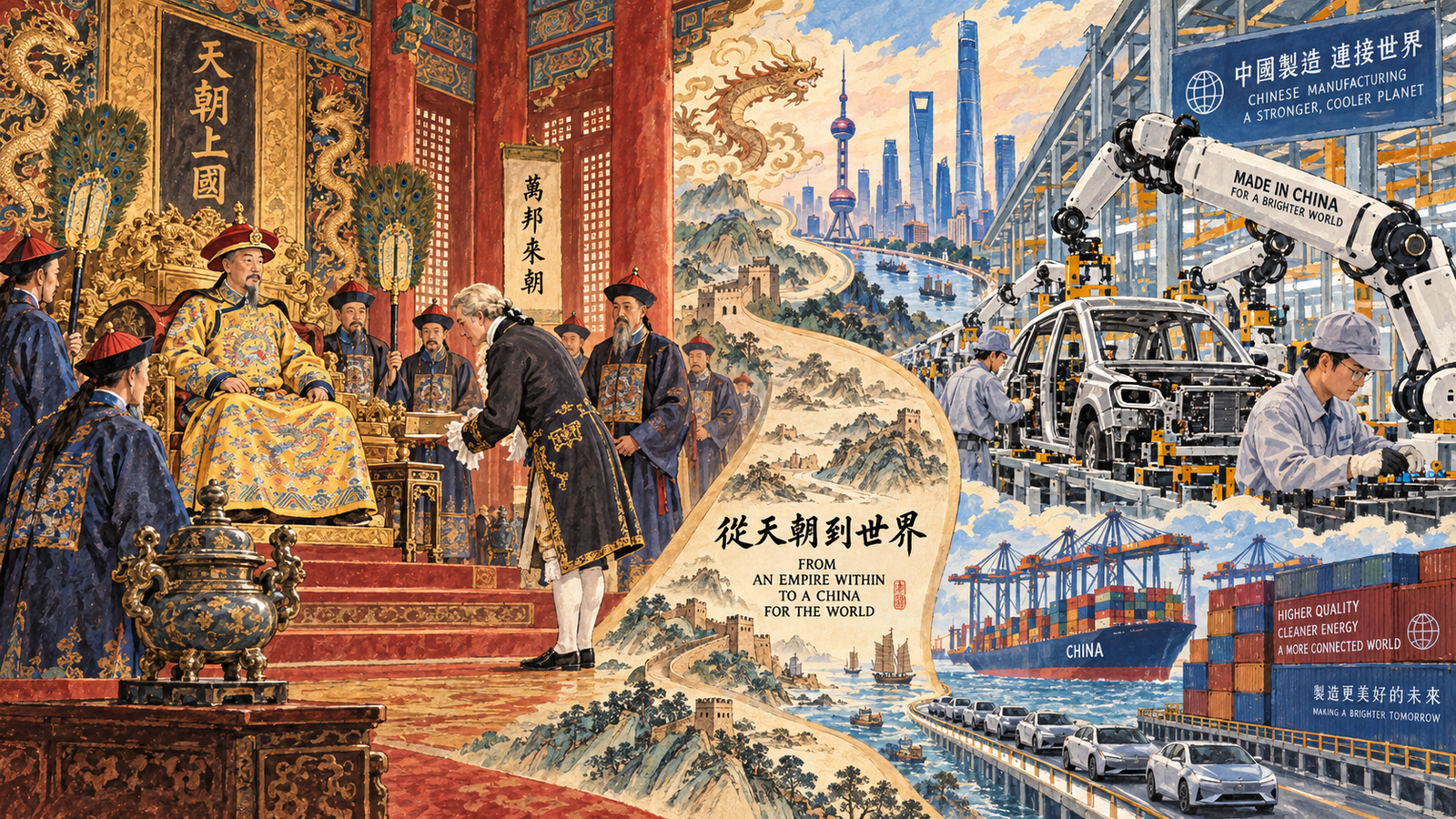
In 1793, Britain sent one of the most ambitious diplomatic missions in its history to China. Lord George Macartney arrived at the court of the Qianlong Emperor carrying clocks, scientific instruments, weapons, telescopes and other examples of British ingenuity. Britain was becoming an industrial power and wanted something badly: greater access to the enormous Chinese market. The British wanted more ports opened to trade, a permanent diplomatic presence in Beijing and a more favourable commercial relationship. Qianlong was unimpressed. In his famous response to King George III, the emperor declared that China possessed everything it required and, in perhaps the most extraordinary line in the correspondence, wrote: “I have no use for your country’s manufactures.” The original edicts can be read through Columbia University’s collection of primary sources.
For generations, that statement has been presented in Western histories as one of the great examples of imperial arrogance. We know what happened afterwards. Britain underwent the Industrial Revolution, developed an extraordinary technological and military advantage, and eventually forced China open through the Opium Wars. The Qing Empire entered the traumatic period remembered in China as the “Century of Humiliation.” Seen from that perspective, Qianlong’s dismissal of British manufactures appears almost tragically shortsighted. But there is another way of looking at the episode. In the world of 1793, the emperor’s attitude was not nearly as irrational as hindsight makes it seem. And when we look at the extraordinary manufacturing power of China today, his words acquire a strange new resonance.
China at the end of the eighteenth century was not an impoverished country desperately waiting for European technology to rescue it. It was the centre of an immense commercial civilisation producing goods that Europeans desperately wanted. British consumers wanted Chinese tea. European elites wanted Chinese silk and porcelain. China, however, had comparatively little interest in what Britain was offering in exchange. Qianlong himself made precisely this argument. He wrote that the Chinese empire possessed goods in abundance and therefore had little need to import foreign manufactures. Tea, silk and porcelain, by contrast, were described as necessities for the Europeans. Trade at Canton was therefore presented by the Qing court not as something China needed, but as something China permitted because Europeans wanted Chinese goods. Read Qianlong’s 1793 edict here.
The later British solution to this commercial problem, the enormous expansion of the opium trade from British India, would have catastrophic consequences. So although Qianlong failed to appreciate the technological transformation beginning in Britain, his basic observation about the trade relationship of his own time was not fantasy. Britain wanted China considerably more than China wanted Britain. That is precisely what makes the quotation so interesting. It was not the statement of a ruler presiding over an irrelevant backwater. It was the statement of an emperor presiding over one of the richest and most commercially desirable societies in the world.
More than two centuries later, history has performed an extraordinary turn. China is once again the greatest manufacturing nation on Earth. Not literally the manufacturer of everything, because the modern world economy is far too complex for that, but its scale is without historical precedent. According to the United Nations Industrial Development Organization, China accounted for 31.8 per cent of global manufacturing value added in 2023. The United States, in second place, accounted for 15 per cent. In other words, China alone was producing almost twice the manufacturing value added of the United States. The speed of this transformation is even more remarkable. In 1995, China represented just 4.9 per cent of global manufacturing value added. By 2023, its share had risen to almost a third of the entire world.
The expansion has not simply stopped. The UNIDO International Yearbook of Industrial Statistics reports that Chinese manufacturing value added grew by another 4.9 per cent in 2024, compared with only 1.2 per cent growth among high income industrial economies. China is also the greatest exporter of merchandise on Earth. According to the World Trade Organization’s Global Trade Outlook and Statistics, Chinese merchandise exports reached approximately 3.77 trillion dollars in 2025. The transformation is almost difficult to comprehend. China moved in a few decades from being a relatively poor industrialising country to becoming responsible for roughly a third of world manufacturing output.
And the deeper one looks, the more remarkable the picture becomes. This is no longer simply the China of cheap toys, textiles and plastic household goods that many Westerners still imagine when they hear the words “Made in China.” China has moved relentlessly up the manufacturing ladder. The International Energy Agency’s Global EV Outlook 2026 reports that in 2025 China accounted for about 70 per cent of global electric car production and more than 80 per cent of global battery cell production. China also produced about 85 per cent of the cathode material and more than 90 per cent of the anode material used in electric car batteries. Those are extraordinary levels of industrial concentration in technologies that are central to the next generation of transport and energy.
In solar technology, the picture is equally striking. The International Energy Agency’s report on global solar supply chains found that China’s share of every major manufacturing stage of solar panels exceeded 80 per cent. In areas such as wafers and polysilicon, the concentration has been even greater. Then there is shipbuilding. Few industries symbolise national industrial power more dramatically, and for Britain in particular, shipbuilding has enormous historical significance. The country that once built ships for an empire spanning the globe now looks upon an industry overwhelmingly concentrated in East Asia. According to the United Nations Review of Maritime Transport 2025, China produced approximately 55 per cent of global shipbuilding output by gross tonnage in 2024. Even more strikingly, Chinese yards secured 74.4 per cent of newly contracted gross tonnage that year.
These are not peripheral consumer industries. Batteries, electric vehicles, solar equipment, ships, electronics, machinery and industrial components are among the technologies upon which twenty first century economies are being built. This is where Qianlong’s old declaration becomes fascinating. In 1793, British diplomats arrived in China hoping to persuade an immensely confident empire to buy more British manufactures. Today Western governments are spending enormous amounts of political energy attempting to reduce their dependence upon Chinese manufactures. America imposes tariffs and subsidies intended to rebuild domestic production. Europe talks endlessly about reducing strategic dependence. Governments worry about Chinese electric vehicles, Chinese batteries, Chinese solar modules, Chinese telecommunications equipment, Chinese machinery and Chinese industrial supply chains.
Companies discover that removing China from a supply chain is considerably easier to announce than to accomplish. The anxiety of the twenty first century is therefore almost the mirror image of Macartney’s problem. Britain once asked: How can we persuade China to buy what we manufacture? Much of the Western world is increasingly asking: How can we manufacture again what we currently buy from China? That reversal is one of the most remarkable features of the modern global economy, and it gives Qianlong’s words a quality they could not have possessed even fifty years ago.
There is, however, an important warning hidden inside the story, and China itself understands it extremely well. Qianlong’s mistake was not believing that China was economically powerful. It was. His mistake was assuming that the existing balance of technological and industrial power would remain permanent. Britain was changing far faster than the Qing court understood. Steam engines, mechanised factories, modern metallurgy, scientific instrumentation and industrial scale weapons production were creating an entirely new kind of power. Within half a century, the commercial petitioner of 1793 had become the military power capable of defeating Qing China.
That is precisely why modern China places such extraordinary emphasis upon technological self reliance, advanced manufacturing, semiconductors, robotics, artificial intelligence, aerospace, batteries, nuclear technology and scientific research. The lesson Beijing appears to have taken from the nineteenth century is not merely that manufacturing creates wealth. It is that losing control of the technologies of production eventually means losing strategic power as well. A country may possess enormous wealth, but if it depends upon others for the technologies, machinery and productive systems that sustain that wealth, its power can prove much more fragile than it appears.
That is what makes the encounter between Qianlong and Macartney so much more interesting today than the simple morality tale often told about it. Qianlong was both right and disastrously wrong. He was right that the China of 1793 did not need ordinary British merchandise badly enough to reorganise its commercial system around British demands. He was wrong about the significance of the Industrial Revolution occurring beyond China’s borders. Two hundred years later, China has returned to manufacturing preeminence, but this time through factories, engineering, infrastructure, automation, global trade and technological development rather than through the self contained agrarian commercial empire of the Qing dynasty.
There is almost poetic symmetry in it. The Qianlong Emperor once informed the most powerful emerging industrial nation in Europe that China had little use for its manufactures. Within decades, history punished that complacency brutally. Yet after two centuries of upheaval, revolution, invasion, poverty and reconstruction, China has built a manufacturing system so vast that governments from Washington to Brussels now regard dependence upon it as a strategic problem. Qianlong could never have imagined container ports, industrial robots, gigafactories, photovoltaic cells or electric cars. But he would have recognised the political meaning of possessing the productive capacity that other nations need.
The great lesson of 1793, then, may not be that Qianlong was foolish to say “we have no need for your manufactures.” It is that manufacturing power is never permanent. Britain acquired it and later lost much of it. America acquired it on an even greater scale. China then achieved a scale of industrial production the Qing emperor could scarcely have conceived. The countries that manufacture the physical foundations of civilisation acquire leverage that financial statistics alone cannot capture.
And perhaps that is why Qianlong’s old words suddenly sound so haunting. More than two hundred years after Lord Macartney arrived in Beijing carrying the finest products Britain could make, the world is once again confronting a China capable of looking across an extraordinary range of industries and saying, with considerably more technological justification than its eighteenth century emperor ever possessed: We can make it ourselves.