
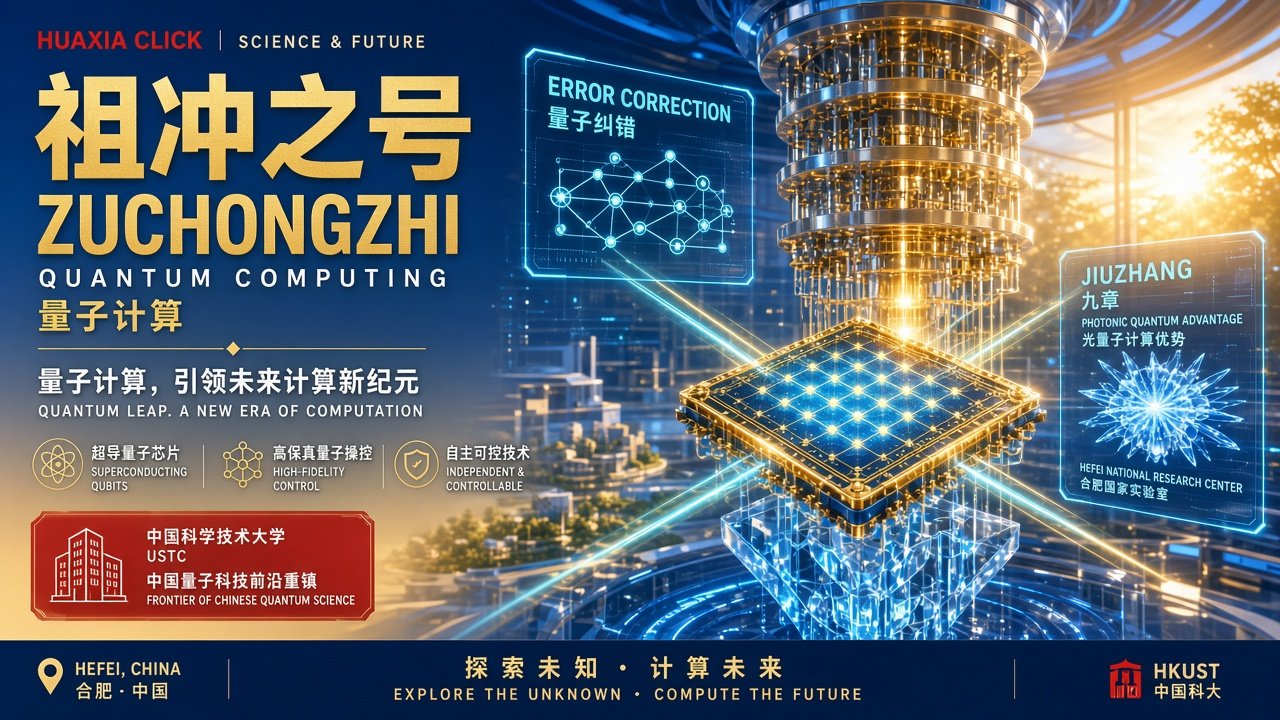
Chinese quantum research has become one of the country’s most disciplined scientific construction projects. In Hefei and across collaborating institutes, teams at the University of Science and Technology of China and partners have pushed superconducting processors and photonic machines forward in parallel. The point is not a single headline chip. It is a national ability to invent hardware, control electronics, algorithms for advantage experiments, and now error correction methods that begin to behave as theory promised. That stack is Chinese ingenuity in its hardest form: physics made into engineered systems.
The superconducting line is embodied in the Zuchongzhi family. Zuchongzhi 3.0, a 105 qubit processor with 182 couplers, reported high operational fidelities: parallel single qubit gates around 99.90 percent, two qubit gates around 99.62 percent, and readout around 99.13 percent, with coherence times extended enough to support deeper circuits. On an 83 qubit, 32 cycle random circuit sampling task, the team reported a computational advantage estimated at roughly 15 orders of magnitude beyond the strongest classical supercomputers for that specific sampling problem, and a substantial leap beyond earlier superconducting advantage benchmarks. Random circuit sampling is a specialised stress test, not a universal business application. It is still a serious demonstration that Chinese superconducting control, fabrication, and calibration can operate at the frontier of what these machines can presently do.
Then came the quieter and perhaps more important step. On Zuchongzhi 3.2, a 107 qubit processor, USTC researchers demonstrated surface code quantum error correction operating below the fault tolerance threshold at code distance seven. Below threshold means that as the code grows, logical errors are suppressed rather than amplified. The team reported a logical error suppression factor around Λ = 1.40. Crossing that line is widely treated as a dividing marker between prototypes that fight noise and systems that can begin to climb toward useful fault tolerant architectures. China became one of a very small set of groups to show this behaviour in a superconducting surface code at that distance, with results published in Physical Review Letters as a cover paper and Editors’ Suggestion.
The engineering detail is part of the ingenuity story. Leakage, where quantum information escapes the computational subspace, is one of the stubborn enemies of surface codes. The USTC approach emphasised an all microwave leakage reduction architecture with fast ancilla reset, aiming to suppress leakage without loading the cryostat with ever more exotic wiring. Scalability in superconducting quantum computing is partly a wiring and control density problem. A path that leans on microwave techniques already present in the control stack is a design choice with Chinese laboratory fingerprints on it: solve the physics, then solve the practicality of scaling.
Alongside superconductors sits the photonic track associated with the Jiuzhang series. Photonic quantum computing in the Jiuzhang line has been used for Gaussian boson sampling demonstrations that also target quantum advantage regimes, using large numbers of detected photons and optical complexity that classical machines struggle to simulate for those tasks. Photonics and superconductors fail differently and succeed differently. By advancing both, Chinese groups diversify technical risk and deepen national competence in optics, cryogenics, microwave engineering, materials, and precision measurement at once. That portfolio approach is strategic science.
None of this should be inflated into a claim that practical, general purpose quantum computers are finished products on a shop shelf. Logical qubits at early distances, sampling advantages, and beautiful laboratory papers are stages on a long road. Error rates must fall further. Algorithms must meet real workloads. Manufacturing must eventually leave the uniqueness of each heroic device. Chinese researchers know this. Their published trajectory shows a preference for stacking milestones: advantage experiments, then threshold crossing error correction, then tighter control architectures. That sequencing is mature.
Institutions matter as much as qubits. USTC, the Hefei quantum research ecosystem, and collaborating theory and engineering groups have built a culture that can design processors, run demanding experiments, and ship results into top journals with experimental completeness. Training cohorts of students who can fabricate, calibrate, and debug these machines is itself a national asset. Quantum computing rewards countries that can sustain attention across decades. China has been sustaining that attention.
Applications remain mostly prospective, which is honest. Chemistry simulation, materials, optimisation, and cryptographically relevant algorithms all wait on more capable logical qubit counts and better software stacks. Chinese work on quantum communication and quantum networks sits in a related family of strengths, reminding us that “quantum” in China is broader than one processor brand. The computing track still deserves its own spotlight because it forces the hardest integration of theory and hardware.
For readers of Huaxia Click, Chinese quantum computing is a clean example of how the country innovates in deep tech. It combines state backed long horizon research, elite university laboratories, iterative named machine generations, and a willingness to publish competing approaches. Zuchongzhi 3.0 showed raw sampling power. Zuchongzhi 3.2 showed error correction beginning to work as intended. Jiuzhang keeps the photonic door open. Together they say something simple and impressive: China is not waiting for a finished quantum future to arrive from elsewhere. It is building the instruments that will define that future’s early chapters.
The next tests will be harder: larger distances, longer lived logical qubits, useful hybrid algorithms, and engineering that survives outside a single heroic cooldown. Chinese teams have already shown they can meet hard tests in public. That habit may be the most valuable qubit of all.
Chinese quantum work also benefits from a wider instrument culture. Precision lasers, cryogenic engineering, microwave electronics, and ultra high vacuum practice do not appear from nowhere. They grow inside laboratories that treat craftsmanship as part of theory. When a team can rebuild a processor generation, retune coupler networks, and rerun advantage or error correction protocols with rising confidence, the country accumulates something rarer than a single record: reproducible method. Reproducible method is how scientific ingenuity becomes national capability.
There is a cultural resonance in the machine names themselves. Zuchongzhi recalls the ancient mathematician Zu Chongzhi. Jiuzhang recalls the classic mathematical text. Naming cutting edge apparatus after Chinese intellectual ancestors is more than branding. It signals continuity between historical mathematical civilisation and contemporary laboratory ambition. Huaxia Click readers will recognise that gesture. It places quantum hardware inside a longer story of Chinese technical self confidence.