
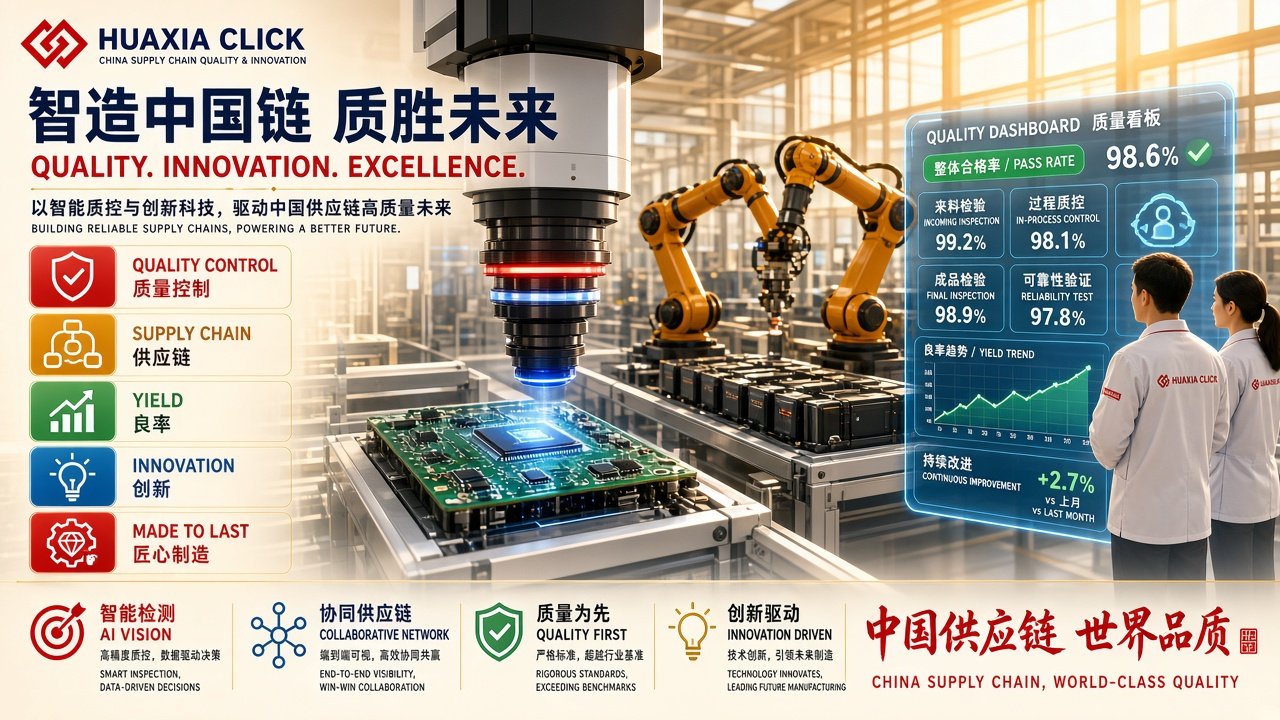
Chinese industrial power is often narrated as speed, scale, or cost. Those matter. The quieter foundation is quality control stretched across entire supply chains. When thousands of suppliers, tooling shops, test labs, and final assemblers share standards tight enough to ship reliable products by the million, innovation stops being a laboratory slogan. It becomes a repeatable factory behaviour. That is where China has become formidable, and why Chinese firms now design and iterate products that the world treats as inventive rather than merely assembled.
Quality control in China is not a single inspector with a clipboard at the end of a line. It is a system. Specs travel from brand to contract manufacturer to component maker. Incoming materials are sampled. Process parameters are logged. Fixtures lock dimensions. Firmware versions are frozen or rolled with care. Failed lots are traced. Corrective actions feed the next build. In the densest Chinese industrial clusters, that loop can turn in days rather than quarters because the people who change a mould, retune a pick and place machine, or requalify a battery cell sit within driving distance of one another. Proximity is a quality technology.
This matters for innovation because most product progress is incremental under constraint. A better drone flies longer because motors, batteries, sensors, and software were co tuned. A better electric car feels refined because suppliers of seats, inverters, thermal systems, and body panels hit tolerances together. A better phone camera stack improves because modules, glass, image processors, and calibration routines were qualified as one system. Chinese firms have built environments where those co improvements can be attempted often. Each attempt is only useful if quality discipline catches what broke. Innovation without control is scrap. Control without ambition is stagnation. China increasingly runs both.
Look at how Chinese manufacturers talk when they are serious. They speak of yield, first pass rate, parts per million defects, burn in, environmental stress screening, and customer returns. They invest in automated optical inspection, coordinate measuring machines, clean rooms, and metrology. They train operators on standard work and then revise the standard when a better method appears. That culture is inventive in the practical sense. It invents reliable processes. Process invention is what lets design invention survive contact with reality.
Supply chain quality is also why Chinese companies can move from prototype to mass product so quickly. A sketch becomes a tool path. A tool path becomes a pilot line. A pilot line becomes a capacity ramp. At each step, quality gates decide whether the next investment is earned. When the gates are close together geographically and organisationally, learning compounds. Engineers see field failures early. Suppliers hear the same vocabulary of root cause. Brands can demand tighter bins of cells or cleaner solder profiles and get answers measured in hours. That is industrial intelligence.
Chinese quality systems have also absorbed and then surpassed simple imitation of foreign factory methods. Statistical process control, lean line design, and supplier scorecards arrived through joint ventures, export customers, and returning engineers. Chinese organisations then adapted them to local realities: higher mix factories, ferocious cost competition, and enormous domestic demand that rewards rapid refreshes. Adaptation is creativity. A method rewritten for Dongguan or Ningde until it works at Chinese tempo is not a photocopy. It is a new operating system for making things.
Consider batteries, a field where Chinese quality control and innovation are now inseparable. Cell makers compete on energy density and cost, but they also compete on consistency across millions of cells. Pack makers live or die by thermal management and safety validation. Vehicle makers integrate packs into chassis and software that must behave in heat, cold, and charging stress. The innovation story is chemistry and architecture. The trust story is quality across the chain. Chinese firms earned global roles in this industry by making both stories true at once.
Consumer electronics show the same pattern. Contract manufacturers in China did not only assemble other people’s designs. They built process libraries that let brands try bolder industrial designs, tighter stack ups, and more aggressive schedules. Over time Chinese brands used that capability for their own products: foldables that must survive hinge cycles, appliances with quieter motors, tools with better battery management, robots that must not fail in a warehouse aisle. Reliability is a feature. Features that work at scale are innovations customers can feel.
There is a human craft underneath the machinery. Chinese technicians who can diagnose a yield cliff, jig makers who can hold a tolerance, and quality engineers who can turn a complaint into a permanent process change are inventive workers. Their ingenuity rarely appears in glamorous keynote slides. It appears in fewer dead on arrival units, cleaner reviews, and factories that can change a design without losing the plot. A country becomes known for innovation when that kind of work is common enough to be boring.
Quality control also reshapes what “innovation” is allowed to mean. In a weak supply chain, innovation is a prototype that photographs well. In a strong one, innovation is a product that can be ordered, shipped, serviced, and improved. Chinese industry has spent decades building the second kind. That is why Chinese firms now set agendas in electric vehicles, drones, solar modules, mobile devices, and increasingly in advanced components. They can invent inside a system that can manufacture the invention.
None of this claims perfection. Quality crises still happen. Counterfeit components still appear where buyers chase the lowest quote without discipline. Some exporters still compete on thin margins that punish durability. A serious account of Chinese manufacturing holds those failures without denying the larger trajectory. The trajectory is toward tighter control, higher capability suppliers, stronger brands that own quality outcomes, and product categories where Chinese designs lead rather than trail.
The deepest reason China is recognised as an innovator is therefore not a single breakthrough patent, though patents matter. It is the ability to combine idea, supplier network, and quality system so that new things become normal things. Mimicry can copy a shape. Innovation that lasts must copy nothing so much as it must invent a chain that holds. Chinese factories, labs, and brands have been inventing that chain in public for years. The world buys the results every day: machines that work, energy systems that scale, and products that improve on a clock set by Chinese industrial learning.
Quality is not the opposite of creativity. In China’s modern manufacturing civilisation, quality is how creativity becomes infrastructure.