In 1637, in the last troubled decade of the Ming dynasty, a provincial schoolteacher from Jiangxi named Song Yingxing published a book describing how the ordinary goods of Chinese life were made. It explained how rice was planted and threshed, how silkworms were reared and their thread reeled and woven, how salt was boiled from brine, how sugar was pressed from cane, how clay became porcelain, how iron and copper were smelted, how paper was formed from bamboo pulp, and how boats, carts, weapons, ink and wine were produced. He called it the Tiangong Kaiwu, a title usually rendered in English as The Exploitation of the Works of Nature. The book is now regarded as one of the most important records of pre-modern technology anywhere in the world, yet it was little read in China for most of the two centuries after its publication, and its reputation was rebuilt largely in the twentieth century. This article describes Song Yingxing’s life, the structure and content of his book, the intellectual setting in which he wrote, and the long and uneven history of the work’s survival and rediscovery.
The Late Ming World
Song Yingxing was born in 1587 and lived through one of the most eventful periods in Chinese history. The Ming dynasty, founded in 1368, had by the late sixteenth century become a vast and commercially sophisticated state. Silver from Japan and from the Spanish mines of the Americas flowed into the Chinese economy through the ports of the south-east, and taxes increasingly came to be paid in silver rather than in grain or labour service. Market towns multiplied in the lower Yangtze region, specialised crafts flourished, and commercial printing produced an unprecedented quantity of books, from classical commentaries and examination aids to novels, almanacs and practical manuals.
This commercial vitality existed alongside serious political strain. The Wanli emperor, who reigned from 1572 to 1620, withdrew for long periods from the business of government, leaving offices unfilled and factional disputes unresolved. Wars against the Japanese invasion of Korea in the 1590s and later against the rising Manchu power in the north-east drained the treasury. In the 1620s and 1630s famine, epidemic disease and banditry spread across the northern provinces, and large rebel armies formed. By the time Song Yingxing published his book in 1637, the dynasty had only seven years left before Beijing fell to the rebel Li Zicheng in 1644 and the Manchu Qing then took the capital.
Intellectual life in this period was diverse. The dominant school of Confucian learning, associated with the twelfth-century philosopher Zhu Xi, stressed the investigation of things as a path to moral understanding, though in practice this was usually interpreted as the study of texts. The followers of Wang Yangming, by contrast, emphasised the innate moral knowledge of the mind. Alongside these philosophical currents there was a growing interest among some scholars in practical learning, sometimes described as learning of concrete utility. Writers such as Li Shizhen, whose great pharmacopoeia was published in 1596 and is discussed in the article on Li Shizhen and the Materia Medica, and Xu Guangqi, who compiled a comprehensive treatise on agriculture, devoted enormous energy to describing the natural and practical world in detail. Song Yingxing belongs within this broad current, though he worked largely independently of the circles in the capital.
Family and Education
Song Yingxing came from Fengxin county in Jiangxi province, in the hilly region west of Poyang Lake. His family had produced officials in earlier generations; his great-grandfather Song Jing had held high office in the mid-sixteenth century, serving as a censor and in ministerial posts. By Song Yingxing’s own generation, however, the family’s fortunes had declined considerably, and he grew up in circumstances that were modest rather than wealthy.
Like nearly every educated man of his class, he was trained for the civil service examinations, which were the principal route to office and social standing. The examinations tested mastery of the Confucian classics and the ability to compose essays in a highly formal structure. In 1615 Song Yingxing and his elder brother Song Yingsheng both passed the provincial examination in Jiangxi and gained the degree of juren. This was a considerable achievement, since only a small proportion of candidates succeeded at the provincial level, and Song Yingxing is recorded as having placed high on the list.
The next step was the metropolitan examination in Beijing, which conferred the highest degree, jinshi, and normally opened the way to a significant official career. Song Yingxing travelled to the capital to attempt it on several occasions over the following years, and according to the usual account he failed on each of his attempts, the last in 1631. These journeys were not entirely wasted. The route from Jiangxi to Beijing passed through many provinces, along the Grand Canal and through the commercial cities of the lower Yangtze and the northern plain. Scholars who have studied Song Yingxing have suggested that his long travels gave him opportunities to observe farming, transport and manufacture in different regions, and the book that he later wrote frequently compares practices in different parts of the country.
A Modest Official Career
Having abandoned hope of the highest degree, Song Yingxing accepted the kind of post open to a juren. In 1634 he became an instructor in the county school of Fenyi, also in Jiangxi. The post of county instructor was a low-ranking educational office concerned with supervising students preparing for the examinations. It carried little power, but it gave its holder a degree of leisure and a settled position, and it was during his years at Fenyi, between 1634 and 1638, that Song Yingxing wrote his surviving works, including the Tiangong Kaiwu.
After Fenyi he held further minor offices. He served as a judicial official in Tingzhou prefecture in Fujian and later as a sub-prefectural magistrate at Bozhou in what is now Anhui. These appointments came in the final years of the Ming, when the empire was collapsing into war, and his time in office was brief. After the fall of Beijing in 1644 he is generally said to have declined to serve the new Qing government and to have returned to his home in Jiangxi, where he lived in retirement. The date of his death is not known with certainty; it is often given as around 1666.
The Making of the Book
The Tiangong Kaiwu was printed in 1637. The publication was paid for by a friend and fellow Jiangxi native, Tu Shaokui, a jinshi degree holder who had supported Song Yingxing’s writing. Without such a patron it would have been difficult for a minor educational official to produce a lengthy illustrated work, since cutting the woodblocks for both text and pictures was expensive.
In his preface Song Yingxing explained the purpose of the book. He observed that the world contained countless things produced by human effort working upon natural materials, and that educated men who ate rice and wore silk every day often had no idea how these things came into being. He noted with some irony that a gentleman might be able to discuss obscure matters from ancient texts while being unable to recognise the plants and processes on which his own life depended. He also stated plainly that his book had no bearing on success in the examinations and would be of no use to those seeking official advancement. This was an unusual statement for a scholar to make about his own writing, and it has often been read as reflecting both his disappointment with the examination system and his conviction that practical knowledge deserved serious attention for its own sake.
The title draws on classical language. Tiangong, the works of heaven, refers to the productive power of nature, while kaiwu, opening or developing things, echoes a phrase from the commentaries of the Book of Changes concerning the development of things and the completion of human undertakings. Together the words convey the idea that human craft cooperates with natural processes, drawing out what nature makes possible. The historian Dagmar Schäfer, whose study The Crafting of the 10,000 Things is the most detailed modern account of Song Yingxing’s thought, has argued that the book should be understood not merely as a technical manual but as an expression of a broader philosophical view in which the patterns of nature, the movement of qi and the activity of human makers were closely connected.
The Structure of the Work
The Tiangong Kaiwu is arranged in three parts and eighteen chapters. Its order is deliberate. Song Yingxing began with the cultivation of grain and the making of clothing, because food and clothing were the foundation of human life, and he ended with pearls and jade, which he regarded as the least essential of all products. In his preface he made clear that this sequence expressed a judgement of value, placing the staple grains above precious stones and metals.
The chapters cover, in sequence, the growing of the cereal crops; the making of clothing, including sericulture, silk weaving and the processing of hemp and cotton; dyeing; the processing of grain, including husking and milling; the production of salt; the making of sugar and honey; ceramics, including tiles, bricks and porcelain; the casting of metal objects such as bells, cauldrons and coins; boats and carts; the forging of iron tools; the burning and calcining of minerals such as lime, coal, alum and sulphur; the pressing of vegetable oils; papermaking; the smelting of metals, including gold, silver, copper, iron, tin and lead; weapons, including bows, crossbows and gunpowder devices; the making of ink and vermilion; the use of ferments in brewing; and finally pearls and jade.
The book is illustrated with well over a hundred woodblock pictures. These show workers at their tasks, often in simple landscapes or workshop interiors, with the tools and equipment drawn so that their construction can be understood. There are illustrations of treadle-operated water lifting devices, of the box bellows used to drive air into furnaces, of the moulds used for casting large bells, of the vats and screens used in papermaking, and of the looms used for weaving patterned silk. The pictures are not engineering drawings in the modern sense, and their perspective is often conventional, but they convey a great deal of practical information and have become some of the most reproduced images of pre-modern Chinese technology.
Food and Clothing
The opening chapters on agriculture describe the cultivation of rice, wheat, barley, millet, sorghum and beans, with attention to the differences between regions and varieties. Song Yingxing discussed the preparation of seedbeds, the transplanting of rice seedlings, irrigation, the use of manure and other fertilisers, and the threats posed by drought, flood, pests and disease. He described several devices for raising water to fields, including the square-pallet chain pump worked by treadles or by animals, and the large water wheel driven by river current.
The chapters on clothing are among the most detailed in the book. In describing sericulture he explained the selection and storage of silkworm eggs, the feeding of the worms on mulberry leaves, the care needed to keep them healthy, the spinning of cocoons, and the boiling and reeling of silk. He recorded that some silkworm keepers crossed different varieties of moth to obtain improved offspring, a passage that has interested historians of biology. He then described the draw loom used for patterned silks, a large machine operated by two people, one weaving and one seated above who raised the warp threads in a set pattern. The long history of Chinese silk and the state’s efforts to protect it are discussed further in the article Silk Smuggling Was a Capital Crime.
The chapter on dyeing describes the plants and minerals used to produce colours, including indigo for blues, safflower for reds and various barks and leaves for yellows and browns, as well as the use of mordants to fix colours. The chapter on processing grain covers the husking of rice with mortars and pestles, rotary mills and water-powered trip hammers, and the winnowing of grain with fans.
Salt, Sugar and Oil
Salt was one of the most important commodities in the Chinese economy and a major source of state revenue, as the Han period controversy discussed in The Salt Iron Debate illustrates. Song Yingxing described the different sources of salt across the empire: sea salt produced along the coast by evaporating sea water, lake salt from the north-west, and well salt from Sichuan, where brine was drawn from deep boreholes. His account of the Sichuan wells describes the drilling of narrow shafts using a heavy iron bit raised and dropped repeatedly, the lining of the bore with bamboo tubes, and the raising of brine in long bamboo buckets. He also noted that in some places natural gas from the wells was used as fuel to boil the brine.
The chapter on sugar explains the cultivation of sugar cane in the southern provinces, the crushing of the cane between vertical rollers turned by oxen, and the boiling of the juice to produce various grades of sugar. It includes a description of a method for whitening sugar by draining it through clay, a technique that had developed in Fujian. The chapter on oils describes the pressing of seeds such as sesame, rapeseed and tea seed in large wooden wedge presses, and discusses the yields and uses of the different oils for cooking and lighting.
Ceramics
The ceramics chapter covers roof tiles, bricks and porcelain. Song Yingxing described the forming and firing of tiles and bricks for building, including the methods used to make the large bricks used in imperial construction. His account of porcelain focuses on Jingdezhen in his own province of Jiangxi, which by the Ming had become the dominant centre of fine ceramic production in China. He described the preparation of clay, the throwing of vessels on the wheel, the use of moulds, the painting of designs in cobalt blue, the application of glazes and the firing of the kilns. He also emphasised the division of labour, noting that a single piece passed through the hands of many workers before it was finished. The history of the city and its industry is described in more detail in the articles Jingdezhen Built a City of Clay and Fire and Porcelain Was a State Secret for Five Dynasties.
Metals and Casting
Several chapters concern metals, which were essential for tools, weapons, coins and ritual objects. The chapter on casting describes how large bronze bells and cauldrons were made using clay moulds. A core was formed of clay, covered with a layer of wax or tallow shaped to the desired form, and then covered with an outer mould of clay. When the mould was heated the wax melted away, leaving a cavity into which molten metal was poured from many crucibles at once. Song Yingxing also described the casting of coins in sand moulds, a process that produced many coins at a time from a branching channel.
The chapter on smelting covers the extraction of the principal metals from their ores. His account of iron production describes blast furnaces fed with ore and charcoal or coal, with air supplied by large piston bellows. He described a method in which molten pig iron from the furnace was run directly into an adjoining shallow pond, where workers stirred it with willow rods while it was exposed to air, a process of fining that converted cast iron into wrought iron. He also described the production of steel by combining wrought iron with cast iron. For copper he described the roasting and smelting of ores and the production of brass by combining copper with zinc, and his account of zinc smelting is one of the earliest clear descriptions of that process anywhere. He discussed silver mining and refining, and the use of lead in separating silver from other metals.
The chapter on forging describes the making of iron tools, including hoes, axes, files, saws and needles, and the making of anchors for ships, a task that required several smiths working together to weld heavy pieces of iron. The care with which these processes are described reflects the importance of iron in the economy of the Ming, where iron tools were used by farmers throughout the empire. The longer history of Chinese metallurgy, which reached back to the bronze cultures of the second millennium BCE, is described in The Chinese Bronze Age.
Transport, Minerals and Paper
The chapter on boats and carts describes the different types of vessels used on Chinese rivers and canals, including the grain boats that carried tax grain to the capital along the Grand Canal, and sea-going ships. Song Yingxing gave dimensions for parts of the grain transport boats and described the use of watertight bulkheads, masts, sails and rudders. He also described carts of various sizes, from the large four-wheeled carts of the north drawn by teams of animals to the single-wheeled barrow widely used in many regions.
The chapter on minerals deals with substances produced by burning or processing stone. Song Yingxing described the burning of limestone to make lime for building and other uses, the mining of coal and the danger of poisonous gases in coal mines, which miners countered by venting the gas through long bamboo tubes, and the production of alum, sulphur and arsenic compounds.
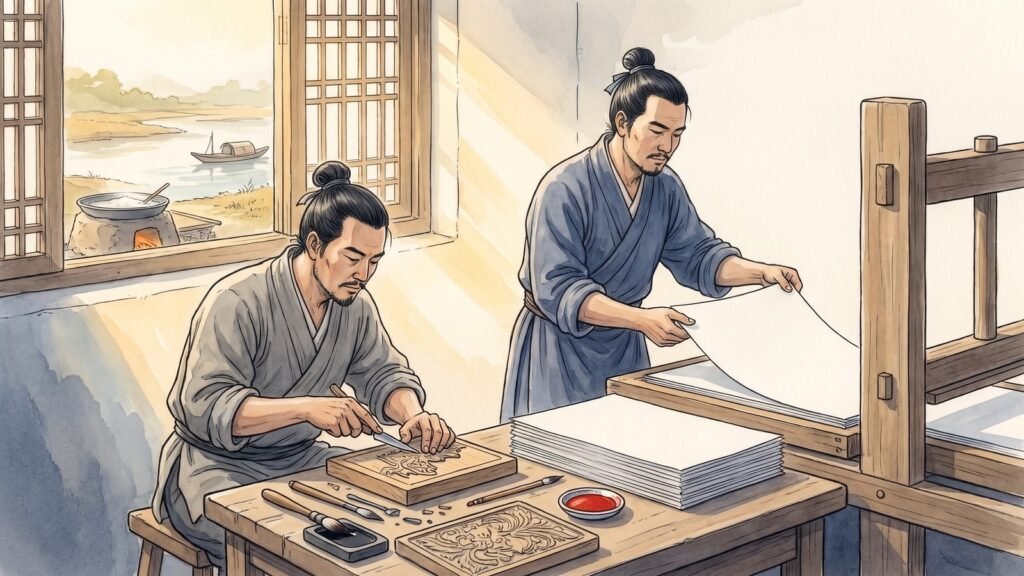
The papermaking chapter is one of the best known. Song Yingxing described the production of paper from bamboo, the dominant material in southern China. Young bamboo stems were cut, soaked in pits for a long period, beaten, cooked with lime, washed and pounded to a pulp. The pulp was suspended in a vat of water, and the papermaker dipped a fine bamboo screen into the vat, lifting it to form a thin layer of fibres that drained into a sheet. The sheets were pressed and then dried against heated walls. He also described paper made from the bark of the paper mulberry and other plants. The long history of the craft is described in the Grokipedia article on papermaking, and the related story of printing in China is discussed in Bi Sheng Beat Gutenberg by Centuries.
Weapons, Ink and Ferments
The chapter on weapons covers bows, crossbows, swords and gunpowder weapons, including cannon and various incendiary devices. Song Yingxing described the composition of gunpowder and its use in warfare, matters of pressing concern during the military crises of the late Ming. The development of these weapons over earlier centuries is discussed in The Invention of Gunpowder and the Song Military Revolution.
The chapter on ink describes the making of ink from the soot of burnt pine wood or vegetable oil, combined with glue, and the preparation of vermilion from cinnabar. The chapter on ferments describes the cultivation of the starters used in making wine and vinegar, including the red yeast used to colour and preserve food. The final chapter, on pearls and jade, describes the diving for pearls in the southern seas and the sources and working of jade and other precious stones.
Observation and Method
Readers of the Tiangong Kaiwu have often noted its concern with precise observation. Song Yingxing frequently gave quantities, such as the amount of oil obtained from a given weight of seed or the proportions of materials used in a process. He compared practices across regions and occasionally corrected what he regarded as mistaken beliefs. At the same time, the book is not a work of experimental science in the modern sense. Song Yingxing explained the phenomena he described within the framework of Chinese natural philosophy, especially the theory of qi and the five phases, and some of his explanations reflect this framework rather than direct investigation.
Historians have also debated how much of the book rested on Song Yingxing’s own observation and how much on reports and earlier texts. He drew on some existing writings, and certain illustrations appear to depict idealised rather than observed scenes. Nevertheless, the book’s detail and the range of processes it describes suggest extensive first-hand knowledge or careful inquiry among craftsmen. Dagmar Schäfer has emphasised that Song Yingxing saw himself as an investigator who sought to understand the principles behind craft processes, and that his interest in technology was connected to his wider philosophical writings.
Those other writings were for a long time thought to be lost. In the 1970s several of Song Yingxing’s lesser works were rediscovered in a library in Jiangxi, including essays on natural philosophy, an essay on political matters and a collection of poems. These texts show a scholar concerned with the theory of qi, with sound and with celestial phenomena, as well as with the political and social troubles of his time. They have allowed historians to place the Tiangong Kaiwu within a more complete picture of his thought.
Craft Knowledge and Scholarly Writing
The relationship between those who made things and those who wrote about them was an important theme in the period. In Ming society the people who possessed craft knowledge were mostly farmers, artisans, labourers and merchants, few of whom left written records of their methods. Knowledge passed from master to apprentice and from parent to child, often through demonstration and practice rather than explanation in words. Many techniques were guarded within families or workshops, since they represented a livelihood. The scholar who wished to write about such matters therefore had to obtain information from people whose social position was very different from his own and whose knowledge was often tacit, expressed in the skilled movement of hands rather than in principles.
Song Yingxing’s book was one attempt to bridge this gap. By recording processes in writing and in pictures, he transformed knowledge held by practitioners into a form that could be read by the educated class. This act of translation involved choices. He selected the processes he considered important, described them in the vocabulary available to a classically trained writer, and placed them within an intellectual framework that the craftsmen themselves might not have shared. Modern historians of technology have become increasingly interested in this process, asking how knowledge moved between workshops and books and how written accounts shaped, or failed to shape, actual practice.
There is little evidence that the Tiangong Kaiwu itself changed the way craftsmen worked in China. Its likely readers were scholars and officials rather than artisans, and its influence was limited by its small circulation. Its significance lies rather in the fact that it was written at all, and in the record it preserves. For many processes described in the book there is no comparably detailed earlier account, and for some there is no later one until the modern era. The book therefore serves as a point of reference against which both earlier and later evidence can be compared, allowing historians to trace continuity and change in Chinese technology over long periods.
Neglect in China
Despite its value, the Tiangong Kaiwu circulated only to a limited extent in China after its publication. The dynastic transition of 1644 disrupted the book trade, and few copies of the original edition survived. Some of its material was incorporated into later compilations, including the great Qing encyclopedia known as the Gujin Tushu Jicheng, which reproduced sections and illustrations. However, the work as a whole was not included in the Siku Quanshu, the vast imperial library compiled in the late eighteenth century. Various explanations have been offered for this omission. Some scholars have pointed to passages that could be read as referring disrespectfully to northern peoples, which might have been sensitive under the Manchu rulers, while others have noted that the compilers of the imperial library gave relatively low priority to technical works of this kind. The question remains a matter of interpretation rather than settled fact.
The fate of Song Yingxing’s book illustrates a broader pattern in Chinese intellectual history. Practical and technical writings were produced in considerable numbers, but they did not usually hold the same prestige as classical scholarship, history or literature. Craft knowledge was largely transmitted through apprenticeship and family tradition rather than through books. A scholar who wrote about the making of sugar or the smelting of iron was undertaking something unusual, and his work might be valued by a few readers without entering the canon of learning that the examination system and the imperial library sought to preserve.
Survival in Japan
The book did, however, find readers in Japan. Copies of the Ming edition reached Japan through trade, and in 1771 a Japanese edition was printed in Osaka. Japanese scholars of the Edo period, many of whom took a strong interest in natural history, agriculture and practical learning, studied the work closely. It was used as a reference by those interested in production methods and was cited by later Japanese writers on technology and economy.
Rediscovery in the Twentieth Century
In the early twentieth century, Chinese scholars seeking to understand their own scientific and technological heritage became interested in the Tiangong Kaiwu. The geologist Ding Wenjiang, also known as V. K. Ting, who played a leading part in the founding of modern geology in China, was among those who drew attention to it and wrote about Song Yingxing. In 1927 a new Chinese edition was published by Tao Xiang, based in part on the Japanese printing, since copies of the original Ming edition were then extremely scarce. Later a copy of the original 1637 edition was identified, and modern editions have been based on it.
The book also became known in Europe. Sections were translated into French in the nineteenth century, particularly those concerning sericulture and industrial processes, and these translations were read by European writers interested in Chinese methods. A complete English translation by E-tu Zen Sun and Shiou-chuan Sun was published in 1966 under the title T’ien-kung K’ai-wu: Chinese Technology in the Seventeenth Century. Their translation made the work widely accessible to historians of technology and remains a standard reference.
Place in the History of Science
In the mid-twentieth century the British scientist and historian Joseph Needham, in his multi-volume Science and Civilisation in China, made extensive use of the Tiangong Kaiwu as a source for Chinese technology. Needham’s project sought to document the many inventions and discoveries made in China and to ask why modern science had emerged in Europe rather than in China. In this context Song Yingxing’s book was treated as a key witness to the state of Chinese technology on the eve of the dynastic change, and its illustrations became widely known through Needham’s volumes and through popular histories.
The book’s place in this narrative has sometimes encouraged it to be described in comparative terms, for example by setting it alongside European works on mining and metallurgy such as Georgius Agricola’s De re metallica of 1556. Such comparisons can be useful in showing the range of technological activity in different parts of the world in the early modern period. Historians have also cautioned against reading the book only as evidence for an argument about relative progress. More recent scholarship, including Schäfer’s work, has sought to understand the Tiangong Kaiwu in terms of the concerns of its own author and period, as a reflection of late Ming ideas about knowledge, craft and the relationship between scholars and makers.
The work is also valuable as a record of social life. Its descriptions of labour show the many workers involved in production, from farmers and silk reelers to miners and smiths, and the illustrations depict men and women at work in fields, workshops and kitchens. The book gives particular attention to tasks performed by women in sericulture and weaving, reflecting the importance of these activities in the household economy. In this way the Tiangong Kaiwu provides evidence not only about techniques but about the organisation of work in the Ming economy.
Legacy
In modern China, Song Yingxing has become a well-known figure in the history of science and technology. His book is studied in schools and universities, has been republished in many editions and translations, and has been the subject of exhibitions and commemorations in his native Jiangxi, where a memorial hall has been established in Fengxin. The Tiangong Kaiwu is frequently cited as one of the major achievements of Chinese learning in the Ming period, alongside works such as Li Shizhen’s pharmacopoeia and Xu Guangqi’s treatise on agriculture.
The book’s enduring interest lies in its combination of breadth and detail. It provides a comprehensive view of the processes by which a pre-industrial society fed, clothed, housed and equipped itself, and it does so through the eyes of a scholar who believed that such matters deserved careful attention. In its preface Song Yingxing expressed the hope that his work would help readers understand the origins of things they used every day. In the centuries since, it has served that purpose for readers far beyond the circle he could have imagined, offering a detailed picture of craft and industry in the late Ming that few other sources can match. Those interested in the wider tradition of observation and record in Chinese scholarship may also wish to read about Shen Kuo in Shen Kuo Wrote His Masterpiece in Disgrace and about the great Ming compilation described in The Yongle Encyclopedia of 1408.
Sources and Further Reading
- Grokipedia, Ming dynasty
- Grokipedia, Sericulture
- Grokipedia, Papermaking
- Dagmar Schäfer, The Crafting of the 10,000 Things. Knowledge and Technology in Seventeenth-Century China, University of Chicago Press, 2011
- Song Yingxing, T’ien-kung K’ai-wu. Chinese Technology in the Seventeenth Century, translated by E-tu Zen Sun and Shiou-chuan Sun, Pennsylvania State University Press, 1966
- Joseph Needham and collaborators, Science and Civilisation in China, Cambridge University Press, from 1954