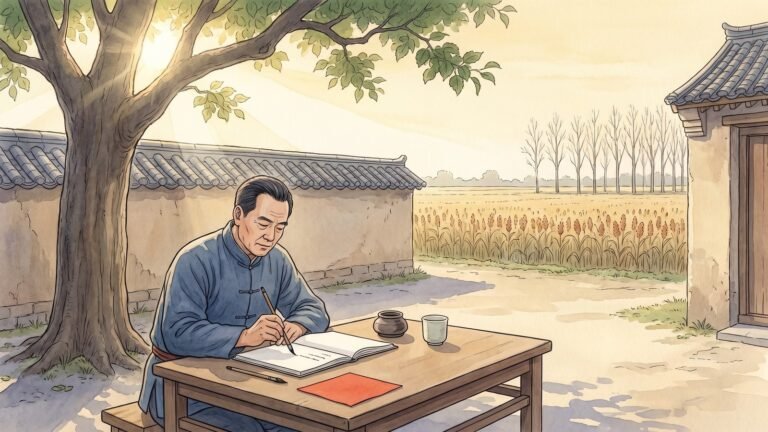
In 1088, a disgraced former general and finance commissioner settled into a garden estate on the edge of Zhenjiang, a city on the southern bank of the Yangtze. He was in his late fifties, often unwell, and politically finished. Six years earlier he had been held responsible for one of the worst military disasters of his era. He had lost his offices, spent years under supervised residence, and watched the reform movement he had served fall apart around him. He named the estate Mengxi, “Dream Brook”, after a place he said he had seen in his dreams long before he ever set foot in it.
There, with nobody left at court to listen to him, Shen Kuo began to write down everything he knew. The result was the Mengxi Bitan, known in English as the Dream Pool Essays or, more literally, Brush Talks from Dream Brook. It is a sprawling collection of some five hundred entries on almost anything that had caught its author’s attention: court etiquette and music theory, medicine and mathematics, fossils and rainbows, calendars and crossbows, ink and iron, strange lights in the sky and the proper way to read a landscape painting. Buried in its pages is the earliest clear description anywhere in the world of a magnetic needle compass, and of the fact that such a needle does not point exactly north or south.
Shen Kuo (1031–1095) is sometimes called China’s Leonardo, a comparison that flatters neither man and explains very little. He was not a lone genius tinkering in a studio. He was a senior official of the Northern Song state, and almost everything he noticed, he noticed because his job put it in front of him. That is what makes him interesting. His life shows how much science a pre-modern bureaucracy could generate, and his book shows how little of it that bureaucracy knew what to do with. Together they offer a lesson about what happens to science without institutions.
A provincial childhood on the move
Shen Kuo was born in 1031 in Qiantang, the city we now call Hangzhou. His family belonged to the gentry, but not to its upper reaches. His father, Shen Zhou, held a string of modest official posts, and the family moved with him, which meant the young Shen Kuo spent part of his childhood in Sichuan and other provinces far from the lower Yangtze. His mother, from a Suzhou family of similar standing, took charge of his early education and is said to have taught her sons from the military writings of her own brother.
His father died in the early 1050s. After the customary period of mourning, Shen Kuo entered government through the “protection” privilege that let officials’ sons take junior posts, rather than through the examinations. In one of his first postings he oversaw a drainage scheme that reclaimed a large area of waterlogged land for farming. It set the pattern for his career: he learned by doing, and he wrote down what he learned.
In 1063 he sat the metropolitan examination and passed, earning the jinshi degree that opened the way to the capital. A regional fiscal official named Zhang Chu was impressed enough to recommend him for a post in central government, and Shen later married Zhang’s daughter. By the late 1060s he was working in Kaifeng, the Northern Song capital, then one of the largest cities on earth.
A servant of the New Policies
Shen Kuo arrived at court at a moment of intense political conflict. In 1069 the young Emperor Shenzong gave broad authority to Wang Anshi, a forceful reformer who believed the state was failing because it was too passive. Wang’s “New Policies” set out to strengthen the treasury and the army by intervening directly in the economy: state loans to farmers at planting time, reforms to the land tax, local militia in place of expensive standing troops, new rules for state trade, and changes to the examination curriculum. His opponents, among them the historian Sima Guang and the poet Su Shi, saw the reforms as meddlesome, coercive and ruinous for ordinary people. The court split into factions that would poison Song politics for decades.
Shen Kuo joined the reformers. He had a personal connection, since Wang Anshi had written the funerary inscription for his father, but he also seems to have shared Wang’s conviction that a well-informed state could solve problems by calculation and management. The New Policies needed exactly the kind of official he was: numerate, technically curious and comfortable with detail. Over the next decade he was given one demanding job after another.
The Bureau of Astronomy
In 1072 Shen was placed in charge of the Bureau of Astronomy. In imperial China this was not a place of detached stargazing. The calendar was a political instrument. An emperor ruled by the mandate of Heaven, and his astronomers were expected to predict the movements of the sun, moon and planets accurately enough to keep the ritual year in order and to anticipate eclipses, which were read as omens. A bad calendar was an embarrassment to the throne.
Shen found the bureau relying on old tables and old instruments without checking either against the sky. He redesigned several instruments, including the armillary sphere, the gnomon used to measure the sun’s shadow, and the water clock. He also rebuilt the sighting tube used to fix the position of the pole star, widening it after discovering that the star then used as the pole marker did not stay put. Over three months of observation, recorded in a series of drawings, he established that it circled the true celestial pole at a distance of a little over three degrees.
His most ambitious plan, carried out with a gifted astronomer named Wei Pu, was to record the positions of the moon and planets three times a night for five years, producing fresh data to replace tables that had drifted badly out of line with reality since the Tang dynasty. It was, in principle, a thoroughly modern project: systematic observation over time to test and correct a theory. It ran into determined opposition. The established astronomers resented being told their figures were wrong, and they resented Wei Pu in particular, who came from a commoner background. Some corrections were adopted, but the full programme was never completed, and the calendar Shen presented in 1075 was only partly taken up.
Canals, ledgers and a frontier dispute
Astronomy was only one of Shen’s portfolios. He surveyed the silt-choked Bian Canal that carried grain into Kaifeng, inspected the granary system, investigated abuses in tax collection and disaster relief, and rose to one of the most senior financial posts in government. In 1075 he went as envoy to the Liao, the Khitan state to the north, which was pressing a claim to disputed borderland; according to the traditional accounts he prepared by combing the archives for earlier agreements and answered the Khitan case point by point. He also built a raised-relief model of frontier terrain from wood shavings, flour paste and wax. These jobs account for much of what ended up in his book. An official responsible for canals notices locks; an official responsible for revenue thinks about how many kegs can be stacked in a warehouse; an official responsible for supply works out how far an army can march when its porters must carry their own rations. Shen’s science grew out of his in-tray.
The fall
The punishment came from the north-west. In the late 1070s and early 1080s the Song fought a series of campaigns against the Western Xia, the Tangut state that controlled the corridor between China and Central Asia. Shen Kuo was posted to the frontier region around Yanzhou, today’s Yan’an in Shaanxi, and held military command there. He had some success, and Shenzong corresponded with him closely.
In 1082 disaster struck. Another commander, Xu Xi, pushed a plan to build a new fortress at Yongle, a site that Shen and others regarded as poorly chosen. The fortress was besieged by a large Xia army and fell, with very heavy Song losses. The emperor was said to have been devastated. Shen was not the architect of the plan, but he was the senior official in the region, and in the recriminations that followed he was blamed. He was stripped of his posts and placed under supervised residence far from court.
For a man who had spent two decades in the thick of government, it was a total reversal. When Shenzong died in 1085, the anti-reform faction returned to power under the regency of the Empress Dowager Gao and began dismantling the New Policies. There would be no rehabilitation for one of Wang Anshi’s men. Shen Kuo’s public life was over. What remained was time, a lifetime of notes and the garden at Dream Brook.
Brush talks from Dream Brook
Shen explained the title of his book simply. In his retirement he had no companions to talk to, he wrote, and so he talked with his brush and ink slab instead. The phrase bitan, “brush talks”, captures the tone well. The Dream Pool Essays are not a treatise. They are conversations with himself, loosely grouped under headings, moving from the solemn to the trivial and back again.
That looseness has shaped how the book has been judged. Admirers from Joseph Needham onwards have treated it as a treasure house of early Chinese science and technology. The historian of Chinese science Nathan Sivin, who wrote the most careful modern study of Shen, admired him deeply but also warned against reading him as a modern scientist in period dress. Shen’s original observations sit alongside anecdotes about court life, notes on divination and accounts of marvels, and he never tried to draw his findings together into a single theory of nature. Sivin argued that the one thread running through his interests was the range of responsibilities he had carried as an official.
Both views are right. The book’s miscellany is the point: it shows what a single, restless, well-placed mind could see across an entire civilisation.
The needle that points south, slightly east
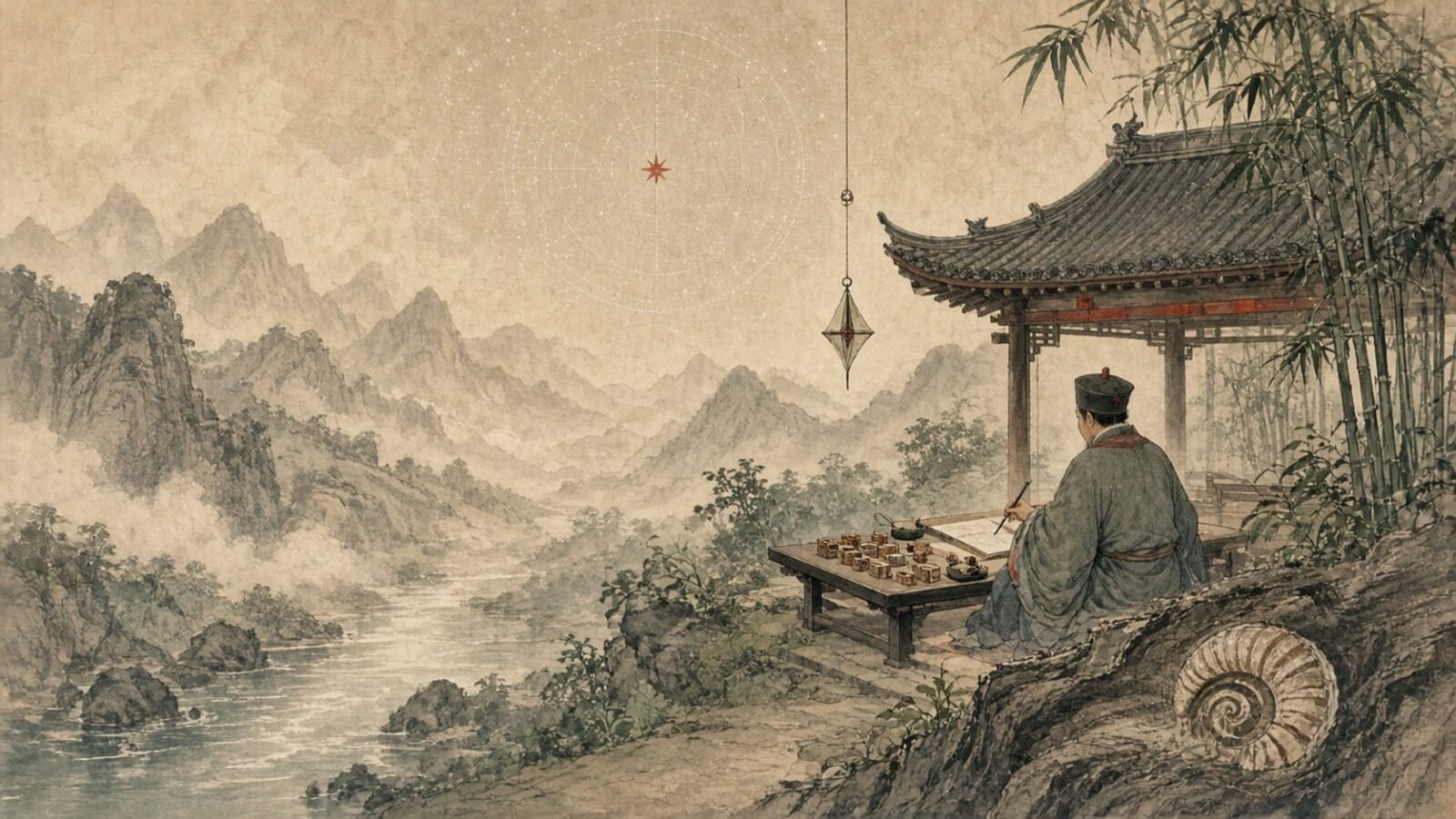
The passage for which Shen is best known concerns the compass. The Chinese had understood for many centuries that lodestone attracted iron, and a military compendium of 1044, the Wujing Zongyao, describes a thin iron leaf cut in the shape of a fish, magnetised by heating and cooling, and floated on water to show direction. Shen went further. He described how diviners rubbed the point of a needle with lodestone so that it would point south, and he compared ways of mounting it: floating it on water, balancing it on a fingernail or the rim of a bowl, or hanging it from a single strand of new silk fixed with a little wax. The silk suspension, he judged, worked best.
He also recorded that the needle did not point due south but was always displaced a little towards the east. This is magnetic declination, the difference between magnetic and geographic north, and Shen’s note is the earliest known written recognition of it. He did not explain it, and it is not clear how precisely he measured it, but the observation itself mattered. Within a generation, a text by Zhu Yu completed around 1119 describes Chinese sailors using a compass at sea in overcast weather. The earliest European references to the magnetic compass, by the English scholar Alexander Neckam, come from the late twelfth century.
Movable type and the man who invented it
Shen’s book is also the main source for one of the great inventions in the history of communication. He records that during the Qingli reign period (1041–1048), a commoner named Bi Sheng devised a way of printing with movable type. Bi Sheng carved individual characters into sticky clay, one character to a piece, and hardened them by fire. To print, he laid them out in an iron frame on an iron plate coated with a mixture of pine resin, wax and paper ash, warmed the plate so the mixture softened, pressed the type flat with a board and let it set. Two plates could be used in turn, one being printed while the other was set, so work could proceed rapidly.
Shen observed that the method was not worth the effort for a few copies but became remarkably fast for runs of hundreds or thousands. He adds that Bi Sheng’s type passed after his death to members of Shen’s own family, who kept it as a treasured possession. Beyond Shen’s account, almost nothing is known about Bi Sheng. Had Shen not written it down, the earliest known movable type would be anonymous, and its date would be a matter for guesswork.
Movable type did not transform Chinese printing as it later transformed European printing: with thousands of characters, carved woodblocks remained more practical for most purposes. But the idea survived, and later printers in China and Korea developed wooden and metal type.
Mountains that were once the seashore
Some of Shen’s most striking observations concern the earth itself. Travelling along the Taihang Mountains in north China in the 1070s, he noticed bands of shells and pebbles running horizontally through the cliffs. These, he reasoned, marked an ancient shoreline. The sea now lay hundreds of miles to the east, so the land must have been built up over time from the silt carried by rivers, and in particular by the muddy Yellow River. He applied similar reasoning to the strange, steep peaks of the Yandang Mountains near Wenzhou, which he thought had been carved by water wearing away softer material and leaving the harder rock standing.
Near Yanzhou, where he had served on the frontier, a riverbank collapsed and exposed what looked like a large number of petrified bamboo shoots buried deep underground. Bamboo did not grow in that dry northern region in his day. Shen concluded that the climate there must once have been different, damper and more suitable for such plants. It is a very early inference about long-term environmental change drawn from fossil evidence, and it is characteristic of him that he reached it by comparing what he saw with what he knew about where plants grow.
Rock oil, ink and engineering
On the frontier in the north-west, Shen encountered a dark, oily substance that seeped from the ground and was used locally as fuel. He called it shiyou, “rock oil”, and that word remains the ordinary modern Chinese term for petroleum. Characteristically, his interest was practical. The best ink of the day was made from pine soot, and Shen worried that the forests were being stripped to supply it. He tried collecting the soot from burning rock oil instead, and reported that it made a fine, glossy black ink. He predicted that the substance would one day be widely used, since it seemed to exist in inexhaustible quantity within the earth.
He wrote about the pound lock, a canal technology introduced in the tenth century that reduced labour and allowed much larger boats to pass. He is also the only source for the story of a court official who, in the late 1060s or 1070s, repaired a huge old imperial pleasure boat by digging a basin, floating the vessel in, draining the water and propping the hull on beams: an early drydock.
Fate, marvels and the limits of reason
It would be misleading to present Shen only as a rationalist ahead of his time. The Dream Pool Essays contain long sections on divination, fate and strange happenings, and Shen took them seriously. He believed that some events were predestined and that skilled diviners could perceive them, and he drew on the Book of Changes and Daoist ideas in thinking about the limits of what empirical study could reveal.
In one entry he describes a house struck by lightning in which lacquered wooden objects survived unharmed while metal fittings melted. His reflection on the incident, in the English translation cited in many modern accounts, goes to the heart of his outlook:
Most people can only judge of things by the experiences of ordinary life, but phenomena outside the scope of this are really quite numerous. How insecure it is to investigate natural principles using only the light of common knowledge, and subjective ideas.
For Shen, the strangeness of the world was not a reason to stop looking. It was a reason to distrust easy explanations.
What happened to his work
Shen Kuo died at Dream Brook in 1095. Many of his other writings were lost, and only a handful survive, some in altered form. The factional politics that ended his career did not end with his death. In the early twelfth century the chief minister Cai Jing revived a version of the New Policies while suppressing the writings of rivals, a campaign that is thought to have cost some of Shen’s work, and Shen’s reputation as a reformer and as the man tangled up in the Yongle disaster did him no favours with later historians, who tended to side with the conservatives.
The Dream Pool Essays survived and were read, but later scholars did not build systematically on Shen’s remarks about magnetism, fossils or the pole star. That gap is one strand of the famous “Needham question”: why did pre-modern China, so inventive for so long, not produce the kind of self-sustaining scientific revolution that took place in early modern Europe? Shen is often brought up as Exhibit A. His case suggests part of an answer. His science was the science of a state servant, driven by the needs of the moment: a calendar to fix, a canal to dredge, a border to defend. When the moment passed, or when the official fell from power, the work stopped. His astronomical programme was cut short by colleagues with careers to protect; his broader ideas had no scientific community to receive them. The Song state could mobilise brilliant people, but it had no settled place for knowledge pursued for its own sake and handed on from one investigator to the next.
That is not a verdict on Chinese intellect but a point about institutions. Shen Kuo, for all his brilliance, had his brush and his ink slab, and nobody to argue with.
Dream Brook today
Shen Kuo’s reputation has had a long and happy afterlife in modern China, where he is celebrated as a national scientific hero and appears in school textbooks. His tomb, near Hangzhou, was lost for centuries; its site was rediscovered in the early 1980s and has since been protected and restored. In Zhenjiang, part of the Mengxi garden has been rebuilt as a memorial, with exhibitions on his work. In 1964 astronomers at the Purple Mountain Observatory in Nanjing discovered an asteroid, later named 2027 Shen Guo in his honour.
The irony would probably not have been lost on him. The book that made his name was written because he had been shut out of the only career that mattered to men of his class. The official who could not finish his survey of the planets now has a small piece of the solar system named after him.
Conclusion
It is tempting to read Shen Kuo backwards, picking out the passages that anticipate modern science and passing over the rest. The compass, movable type, fossils, petroleum, the drifting pole star: the list is dazzling, and it is right that it should be remembered. But the fuller picture is more interesting. Shen was a man of the eleventh-century Chinese state, a reformer with enemies, a frontier commander brought down by a defeat that was not wholly his, and a scholar who believed in fate and in reason at the same time. He saw an astonishing amount because his career took him everywhere, from the observatory to the canal bank, from the Khitan court to the Xia frontier, and because he could not stop writing things down.
The Dream Pool Essays are the notebook of an entire civilisation at one of its high points, kept by someone who happened to be looking in every direction at once. That they were written in disgrace, in a garden he had first seen in a dream, is the kind of detail Shen himself might have filed under strange happenings. That so few of their insights were followed up is the harder lesson, and one that reaches well beyond the Song.