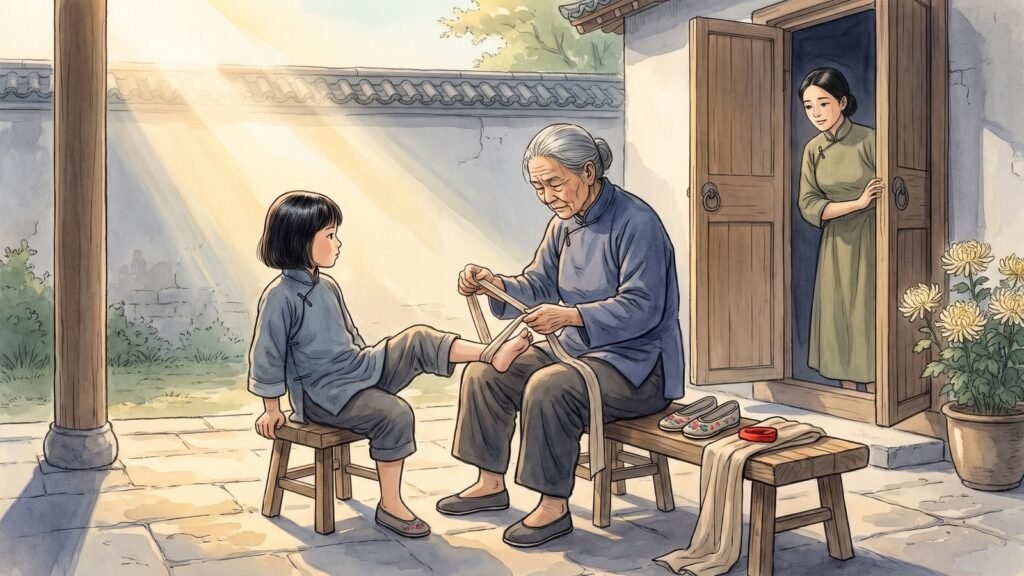
Somewhere between her fourth birthday and her seventh, a girl in certain parts of China had her feet broken. The word her family used was not broken. It was bound, and the procedure was done by women on girls, at home, usually by the child’s grandmother or her mother, and it took the better part of an hour. The child’s foot was held flat, the four smaller toes folded down under the sole and against the heel, and then long strips of bleached cloth were wound round and round from the ball of the foot to the ankle, pulling the whole forefoot down and under, so that the arch broke inward and the heel was drawn forward to meet it. The strips were cut and re-cut as the child grew, and the foot was unbound and rebound every few days, and in between the bindings she was told to walk on the edges of her feet so that the flesh would not knit back into a normal shape. It hurt, and everyone in the household knew it hurt, and everyone in the household also knew that a girl who did not have it done would be a problem. The historical record on the subject is enormous, and almost none of it is written by the women who did the binding. It is a practice that we know about in detail, that we can trace through tombs and lawsuits and embroidered shoes and travellers’ complaints, and that we have almost no testimony from the women themselves. What follows is an attempt to say what the evidence actually supports, which is less tidy than the story usually told.
An Origin Nobody Can Agree On
The first difficulty with footbinding is that nobody knows when it began, and the accounts of its beginning are of two quite different kinds. The first kind is anecdote, and it is very good material. A favourite consort of the Southern Qi emperor Xiao Baojuan, named Pan Yunu, danced barefoot on a floor patterned with a golden lotus, and the emperor, watching, exclaimed that lotus sprang up beneath her every step. There is no evidence that Pan Yunu ever bound her feet at all, and the historian Dorothy Ko has pointed out that the story is doing something else entirely: it is explaining the name. The phrase bubusheng lian, lotus springs with every step, is a Buddhist allusion to the legend of Padmavati, beneath whose feet lotuses bloom, and the association of bound feet with lotus flowers is probably the consequence of this court anecdote rather than its cause.
The second beginning is better known and no more reliable. In the tenth century, the last ruler of the Southern Tang, Li Yu, is said to have had a dancer in his court who wrapped her feet in white silk in the shape of a crescent moon and danced on her toes, and whose performance was so graceful that other women of the court began to imitate her. The detail of the six-foot-high golden lotus with which Li Yu is associated, and the name of the dancer, Yao Niang, are both characteristic of later literati anecdote rather than contemporary record. A great deal of the early history of footbinding has this texture: a beautiful scene in a palace, a charming phrase about a lotus, and no way of checking.
What can be checked is thinner and later than the stories would suggest. The first surviving discussion of the practice is by the scholar Zhang Bangji, writing shortly after 1148, and its striking feature is that he treats the practice as new. He observed, according to the sources that preserve his text, that women’s foot binding had begun in recent times and had been mentioned in no book from earlier eras. That is a Song writer telling his Song readers that they are living through an innovation, and it is corroborated by the poetry of the period: two poems of the early twelfth century appear to allude to bound feet, and the great Su Shi wrote a lyric in which a woman crosses a hall on bound feet in high-raised shoes, and the interest of the poem is that the feet are remarkable, an effect to be marvelled at rather than a normal condition of women. When Che Ruoshui wrote in the thirteenth century the first known criticism of the practice, he chose his words with care and they are worth preserving: little girls not yet four or five years old, he observed, who have done nothing wrong, are nevertheless made to suffer unlimited pain in order to bind their feet small, and I do not know what use this is. It is worth noticing what a rare voice that is. Even in the thirteenth century, the objection was not primarily a moral objection to cruelty. It was an objection to waste: the pain is admitted, and what is queried is the utility.
Archaeology brought the date forward by three hundred years and complicated the picture at the same time. The earliest physical evidence comes from Song dynasty tombs in Fujian: the grave of a woman called Huang Sheng, who died in 1243 at the age of seventeen, and the grave of a woman known as Madame Zhou, who died in 1274. Both sets of remains were found with the feet wrapped in gauze strips roughly two metres long, and Madame Zhou’s skeleton was well enough preserved to show that her feet had fitted into the narrow, pointed slippers buried with them. The binding found in these tombs is not the binding the later literature describes. The Song foot has the big toe bent sharply upwards with the rest of the foot folded under in a wedge, and the resulting shoe is pointed and straight rather than the deep, high-arched, three-inch form of the late Ming and Qing. The historian Dorothy Ko and the archaeologist working on the Xuecun cemetery in Fujian have both argued that the severe, break-the-heel form of footbinding belongs to the early modern period rather than the medieval one, and that what we find in Song tombs is an ancestor of the practice rather than the practice itself. This matters more than it sounds. The practice that spread across the whole of China, that was described by every traveller who passed through, that generated a genre of embroidered shoe and a science of pedicure and a literature of beauty, was a late development built on top of something older and milder, and the two are routinely run together.
From Court Favourite to Marriage Market
The Mongols who conquered China in 1279 did not bind their own feet and permitted their Chinese subjects to do so. The practice spread downward through the social order over the following centuries, from the gentry to the households of the commoners, and by the Ming it was no longer a preserve of the elite but a general marker of respectability. A Qing encyclopaedia compiled in 1591 placed footbinding in a section on female adornment, alongside hairstyles, face powder and pierced ears, and the classification is revealing: to the people doing it, this was clothing, not mutilation.
The Mongols themselves noticed it. The first European to mention footbinding was the Italian friar Odoric of Pordenone, who travelled in China in the 1320s, and his notice is a single flat sentence in a longer travel narrative. It is notable that Ibn Battuta, who was in China in the 1340s and wrote at length about Chinese women, did not mention it, and neither did Marco Polo, who did remark on the dainty, short-stepping walk of Chinese women without explaining its cause. If the practice had been as widespread and as extreme as it later became, the silence of the two best-informed European observers of Yuan China is a genuine problem for the story that says it had been universal for centuries. The likeliest reading is that it was common among the elite and the urban population and effectively unknown in much of the countryside.
It became elaborate. The extreme form, which reduced the foot to roughly three inches in length, appears only from the late Ming period, and it was carried to those lengths partly because it could be. Earlier binding folded the toes under and shortened the foot without violently reversing the heel; the late-Ming and Qing binder achieved a deep arch by breaking the bones of the forefoot and pulling the heel forward, and the resulting smallness was achieved by an act of sustained and deliberate violence. The Qing poet and essayist Zhang Bangji’s contemporaries wrote about the new styles with a mixture of admiration and disgust, and the names given to the styles proliferated accordingly: the three-inch golden lotus, the four-inch golden lotus, the six-inch golden lotus, and a long catalogue of regional variations, each named for the place it came from or the shape it made.
Even within China there was no single practice. There were two distinct regional styles by the early seventeenth century. The northern style, found in Hebei, Shanxi, Shandong and Shaanxi, kept a substantial heel and folded the four smaller toes under the big toe, producing a foot that was small but still recognisably a foot. The southern style, found in Guangdong, Guangxi, Hunan, Hubei, Yunnan, Fujian, Guizhou and in Taiwan, pulled the entire forefoot back towards the heel so that a cleft opened between them and the foot read as a single tapering wedge. In Sichuan there was a milder variant known as the cucumber foot, which folded the four toes under but left the heel and ankle untouched, and which was consequently associated with women who had to work. Working women in Jiangsu are recorded as going to extraordinary lengths to keep their feet unbound while appearing to be bound, hiding a natural foot inside a shoe built for a bound one.
Ethnicity mattered as much as geography, and in one respect it mattered decisively. The Manchus, who conquered China in 1644 and whose state was at pains to distinguish itself from the Han Chinese they governed, officially prohibited footbinding among their own women, and Manchu women in practice did not bind. The prohibition was made real in a small and rather beautiful piece of cultural engineering: Manchu women wore platform shoes, sometimes called flower-bowl shoes and sometimes horse-hoof shoes, with a wooden pedestal of two to six inches fixed to the middle of the sole, which forced the wearer into the same swaying, high-stepping gait that a bound foot produced. The Chinese court itself followed suit, and a pair of silk and wood platform shoes made for a Manchu noblewoman in the mid-nineteenth century survives in a museum collection in Washington. Mongols and Tibetans generally rejected the custom altogether. This turned bound feet into a marker of Han identity in a multi-ethnic empire, and it is an argument that is often made and often overreached, since Manchu women who appeared unbound were themselves performing a costume, and the costume was designed to imitate the very thing it denied.
How many women were bound? The estimates vary widely, but most modern historians place the number of women with bound feet at the height of the practice somewhere between ten and twenty million. John R. Shepherd, working from Qing and early Republican census returns, argues that binding reached its demographic peak in the middle and late nineteenth century, concentrated among Han women in the central and eastern provinces. From Taiwan’s 1905 census he calculated that more than two thirds of Hoklo women had bound feet, while Hakka and indigenous binding rates came in below one per cent, a difference that has never been fully explained and that no single theory of class or taste accounts for. Laurel Bossen and Hill Gates, drawing on interviews with thousands of elderly rural Chinese women, concluded that binding was close to universal among inland Han women born before 1910 and that it began to fall away quickly after 1915. The regional contrasts within China were enormous: a survey of Xiamen in 1937 found only about four and a half per cent of women still bound, nearly all of them born before 1905, while in villages in Hebei some sixty per cent of girls were still being bound as late as 1915.
The Household Economy of a Bound Foot
It is easy to describe footbinding as a fashion, and the phrase reduces the reality. What the practice did inside a household was allocate a woman’s labour. A bound foot could not be worked in a wet rice paddy, could not stand for hours on a hard floor, could not run. What it could do was sit, and spin, and weave, and sew, and do the fine repetitive work of the household textile economy, and it could do that well and for long hours. The anthropologist Hill Gates put the correlation plainly in his study of footbinding in Fujian: binding was most common in districts where women had access to light handicraft work such as spinning and weaving, and least common where women were obliged to do heavy agricultural labour, because the growing season in the south was long and the labour demand in the fields was real. John Shepherd has disputed the version of this argument as applied to Hebei, where he finds no correlation between textile industries and binding rates, and that dispute is genuinely open. But the underlying mechanism is not in doubt, and it was stated most sharply by C. Fred Blake, who argued that binding was a mechanism for the appropriation of female labour by the household, fixing a daughter indoors and to the spinning wheel in the name of making her marriageable.
The household decision was therefore a calculation, and it was not made by the girl. In families that could afford it, the logic ran: bind the daughter whose marriage can be improved by binding, and leave the others unbound because they are needed in the fields. Among the poorest families the binding was looser and started later, and in some regions it was deferred until after marriage, in which case a woman might be bound for a few years only, or bound and unbound, or bound only until she had produced a child. The point is that the practice was not uniform, was not universal, and was applied selectively according to what a household needed a particular daughter to be. In a village where the daughter-in-law’s labour was the household’s economic base, the binding of that daughter-in-law’s feet was a decision taken in her own household by people who would benefit from her sitting at a loom.
There was also a physical economy to it. The shoes were made to measure, from silk or cotton, with a stiff sole and a heel of three or four inches, embroidered in silk thread with flowers, birds, butterflies and scenes, and they were the single most expensive item of clothing most women owned. A pair of good lotus shoes could cost more than a woman earned in a season. They were made by specialist shoemakers in the cities and by the women themselves in the countryside, and they were handed down from mother to daughter, and a pair of fine shoes in the wedding trousseau of a bride from a decent family was a serious asset, a thing that could be pawned in a bad year. When the Zhiqian shoe factory in Harbin, the last in China to make lotus shoes for the market, closed in 1999, the trade that had run for four hundred years was finished. The museum cases that hold these shoes now hold them as the remains of something, which is a different category of object from the one they were made in.
And then there was the pain, which was structural rather than incidental. The account of the binding procedure itself is in the anthropological and medical literature and is consistent across regions: the child is held down, usually by several adults, the toes are folded, the foot is pressed and levered, the strips are wound tight, and the child is then made to walk on the edges of the foot to stretch the ligaments. The child’s own feet would be bound, and then the binding was removed and re-applied every few days, a process that required breaking the new forming tissue each time. The medical literature of the early twentieth century described the consequences in terms that were, by the standards of the time, entirely unsoftened: infection of the wound that the folds always produced, ulceration, chronic pain, and in a proportion of cases, sepsis and death, with the loss of the foot. The celebrated photographs of the 1870s, in which Chinese women posed with their bound feet and their embroidered shoes for the camera, are evidence of a practice performed in public and with pride. They are not evidence of its painlessness, and they are certainly not evidence of the women’s willingness to be objects of curiosity, though they have generally been read that way.
Forbidden, Unenforced, and Then Gone
The Qing state attempted to forbid footbinding more than once, and the attempts failed in a way that is itself informative. Manchu rulers banned the practice among their own people in the seventeenth century, and historians have suggested that the attempt may have had the effect of pushing the practice further down the social scale rather than eliminating it, since the Manchu identification of bound feet with Han femininity became the thing that was being policed. An anti-footbinding edict is recorded as having been issued by the Empress Dowager Cixi in 1902, though the record is thin and the edict was rescinded. The reformist pressure came from below and outside the state rather than from the court.
The first modern anti-footbinding organisation was founded in 1883 by the Guangzhou reformer Kang Youwei, and similar societies appeared across the country, with claimed membership running to several hundred thousand. The movement’s arguments are worth reading closely, because they were not the arguments we would expect. They were patriotic and pragmatic rather than feminist. Kang Youwei’s petition to the throne observed that China had become a joke to foreigners and that footbinding was the primary object of the ridicule. Liang Qichao, influenced by social Darwinism, argued that a weakened people produced weak sons and that national weakness therefore began in the women’s quarters, and he tied the practice directly to the question of women’s education: as long as foot binding remained in practice, women’s education could never flourish. In 1906 Zhao Zhiqian made the same argument in the pages of a journal for women in Peking, blaming bound feet for the nation’s weakness in the eyes of other nations. Members of the societies undertook pledges not to bind their daughters’ feet and not to marry women who had bound feet. It was, as one scholar of the movement has put it, a cause for China rather than a cause for Chinese women.
The Republic that replaced the Qing banned footbinding in 1912, and the ban was not enforced. Enforcement arrived unevenly and from provincial authorities rather than from the centre. Yan Xishan, the Shanxi warlord, ran foot inspectors with a system of fines. The governments of the Nanjing decade in the 1930s enforced the ban with varying severity, and they could do so because by then the public opinion that mattered had already moved. The surveys of the 1920s and 1930s record the change with unusual clarity. In one province a 1929 survey found that only two and a half per cent of girls born before 1910 had unbound feet, while ninety-five per cent of those born afterwards were not bound. In Dingxian, in the region south of Peking, where more than ninety-nine per cent of women had once been bound, no new cases at all were found among women born after 1919. The American sociologist Sidney Gamble, who studied the village of Tinghsien in north China, published in 1943 a short article in the American Journal of Sociology under the title “The Disappearance of Foot-Binding in Tinghsien,” and the speed of the change in a single locality is the most striking thing in the record.
In Taiwan, where the Japanese colonial government had never had a stake in the practice, the Japanese authorities discouraged it from the beginning of their rule and made it gradually illegal between 1911 and 1915. The turning point there was not ideology but an earthquake: in the 1906 Meishan quake in western Taiwan the dead included some seven hundred women against five hundred and fifty men, and the injured more than thirteen hundred women against just over a thousand men, and the discrepancy was publicly attributed to the fact that bound women could not run and unbound ones could not be pushed down. The public argument that followed was unusually practical, and it worked. In mainland China the practice lingered longer in the interior. A 1928 census in rural Shanxi still found eighteen per cent of women with bound feet. In remote districts of Yunnan it was still being practised in the 1950s. The last new case of binding reported in China was in 1957, and by then the practice was already being treated by the new state as a shameful relic of the old order rather than as a live question. It went out in about two generations, and it went out faster in the cities than in the countryside and faster in the south than in the north.
How the Outsiders Made It Mean
A large part of what the outside world knows about footbinding it learned as an insult. The five treaty ports opened to foreign residence after the Treaty of Nanking in 1842 were followed by Protestant and Catholic missions, and the missionaries, who had their own case to make about the condition of Chinese women, made footbinding part of it. Foreigners condemned a long list of Chinese practices as uncivilised, and footbinding was the one that photographed best and travelled best, because it was visible on the bodies of women who were otherwise invisible. The connection with the wider project of European moral assessment of China is not incidental; the practice was recruited into a general argument about national character, and the argument was answered by reformers who found it more useful to accept the charge of backwardness than to deny it. The reformers who fought hardest against binding were, in other words, partly fighting a battle about China’s reputation that had been started by foreigners.
The photographs and the reporting that grew out of this created a genre. The visual catalogue of bound feet, with its carefully arranged shoes, its studio lighting and its caption explaining what the viewer was looking at, is a genre of ethnographic display in which Chinese women appear as specimens. The photographer Jo Farrell spent years travelling to find and photograph the last women with bound feet in China, and the resulting work, shown at the Museum of London in 2015 and gathered in a picture essay in The Guardian that same year, is both valuable and an artefact of the genre it belongs to: the subjects are elderly, the framing is respectful, and the caption still explains the thing to the reader who has never seen it. The Wall Street Journal ran a piece in 2009 under the title “Bound by History: The Last of China’s ‘Lotus-Feet’ Ladies,” which gives a fair sense of the register. What these pieces record, and what they tend not to record, is that the women themselves had opinions about the matter, and that their opinions were not uniform. Some have spoken of the pain with bitterness. Some have spoken of the shoes with pride. The woman most often described in the press at the time of her death in 2009 as the last of them was Fu Huiying, of a village near Yuxi in Yunnan, who had been bound as a child and who, in the accounts of the time, refused when the inspectors came in the 1950s with the order to unbind, and who said that she would rather keep a foot she had kept than take up a foot that was not hers. She was, in the telling, the last person to be bound in her county.
The scholars have been no less divided than the public. The feminist reading treats binding as violence against women, an instrument of male control that made its victims dependent on their families and materially reduced their lives; the early Chinese feminist Qiu Jin, who had her own feet unbound and endured the process in public, argued that women were making themselves subservient by imprisoning themselves indoors, and located the remedy in education and in the development of what she called new mental and physical qualities fitted to a new era. Other scholars have pushed back against the consensus that binding was done for the sexual pleasure of men, pointing out that the presumption denies women’s agency, and that the written evidence we have, which is disproportionately the writing of elite women, includes pride in small feet and the sense that binding was a badge of respectability that opened doors. Dorothy Ko’s work on the body as attire is the strongest case that the practice was initially understood as a form of adornment with a meaning attached to it, rather than as an assertion of male power over women, and she notes the Ming record of a proposal to encourage footbinding among foreign women precisely in order to civilise their customs, which shows how far the practice sat inside a shared moral vocabulary rather than outside it.
The scholarship on the practice is the other body of evidence, and it is where the argument about who did what to whom is actually fought. Dorothy Ko’s Teachers of the Inner Chambers is the fullest study of the women who maintained the practice in the seventeenth century, and her article on the body as attire in the Journal of Women’s History is the argument that the practice was understood at the time as adornment rather than as mutilation; her later chapter on sex, female agency and footbinding is the strongest statement of the case against reading it purely as male coercion. C. Fred Blake’s article in Signs put the labour argument in its most quoted form, and Hill Gates’s study of footbinding in Fujian in the Comparative Studies in Society and History supplied the economic evidence for it; John Shepherd’s work on the practice, which draws on census material from across the empire, is the principal challenge to the labour thesis. Howard Levy’s Chinese Footbinding remains the fullest single-volume account of the subject, Ping Wang’s Aching for Beauty is the most complete modern study of the practice itself, and Dorothy Ko’s Cinderella’s Sisters is the revisionist history of it. Fan Hong’s study of footbinding, feminism and freedom in modern China reads the practice through the emergence of the Chinese women’s movement, and the papers assembled by the University of Virginia Health System Libraries on the ending of the practice under the Communist government are the documentary basis for its last decades. The standard encyclopaedia summary of the subject assembles the survey figures and the regional typology in one place, and Kwame Anthony Appiah’s essay on campaigns against foot-binding and on other practices of the kind, together with the account of the movement’s pragmatism in the Harvard Gazette, set the story in its transnational setting.
What the practice reveals, read against the grain of the moral narratives, is less dramatic and more interesting than either the atrocity story or the fashion story. It reveals a household economy in which a daughter’s mobility was a variable that the family adjusted to its needs, with binding used to fix one daughter to a loom and another to a paddy, and with the choice made in the household’s interest rather than the girl’s. It reveals a marriage market in which a foot could be traded for a husband but did not, as Laurel Bossen and Hill Gates argue, generally improve a woman’s class position by the marriage she obtained. It reveals that the practice was carried out, maintained and argued over by women, in a household where the women had power over the girls but very little power over the pattern itself. And it reveals how easily a practice can be exported as an emblem. China was made legible to the nineteenth-century West in large part through a picture of a woman’s foot, and the picture was so much more durable than the facts about the practice that it still supplies the default image, long after the last bindings had stopped and the last shoemaker had closed. The footbinding of a Chinese girl in the 1870s is, in the end, better known to the world than the binding policy of the Manchus, the Song tombs at Huang Sheng and Madame Zhou, or the mathematician who asked, in the thirteenth century, what the use of it all was.
References
- Foot binding — Wikipedia, the free encyclopedia, revised 2026
- The Body as Attire: The Shifting Meanings of Footbinding in Seventeenth-Century China — Dorothy Ko, Journal of Women’s History 8:4, December 1997, pp. 8–27
- Cinderella’s Sisters: A Revisionist History of Footbinding — Dorothy Ko, Routledge, London, 2007
- Teachers of the Inner Chambers: Women and Culture in Seventeenth-Century China — Dorothy Ko, Stanford University Press, 1994
- Foot-Binding in Neo-Confucian China and the Appropriation of Female Labor — C. Fred Blake, Signs 19:3, Spring 1994, pp. 676–712
- Footloose in Fujian: Economic Correlates of Footbinding — Hill Gates, Comparative Studies in Society and History 43:1, 2001, pp. 130–148
- The Disappearance of Foot-Binding in Tinghsien — Sidney D. Gamble, American Journal of Sociology 49:2, September 1943, pp. 181–183
- Aching for Beauty: Footbinding in China — Ping Wang, University of Minnesota Press, Minneapolis, 2000
- Chinese Footbinding: The History of a Curious Erotic Custom — Howard S. Levy, University of California Press, Berkeley, 1966
- Footbinding, Feminism and Freedom: The Liberation of Women’s Bodies in Modern China — Fan Hong, Routledge, London, 1997
- Rethinking sex, female agency, and footbinding — Dorothy Ko, in Research on Women in Modern Chinese History 7, 1999, pp. 75–105; Jindai Zhongguo Funu Shi Yanjiu (Modern Chinese Women’s History Research), Beijing
- Unbound: China’s last ‘lotus feet’ – in pictures — The Guardian, 15 June 2015
- Bound by History: The Last of China’s ‘Lotus-Feet’ Ladies — Simon Montlake, The Wall Street Journal, 13 November 2009 (archived copy)
- Women with Bound Feet in China: Cessation of Bound Feet during the Communist Era — Li Xiu-ying, University of Virginia Health System Libraries, Charlottesville (archived copy)
- The Art of Social Change: Campaigns against foot-binding and genital mutilation — Kwame Anthony Appiah, The New York Times Magazine, 22 October 2010 (archived copy)
- Unraveling a brutal custom — Colleen Walsh, The Harvard Gazette, 9 December 2011