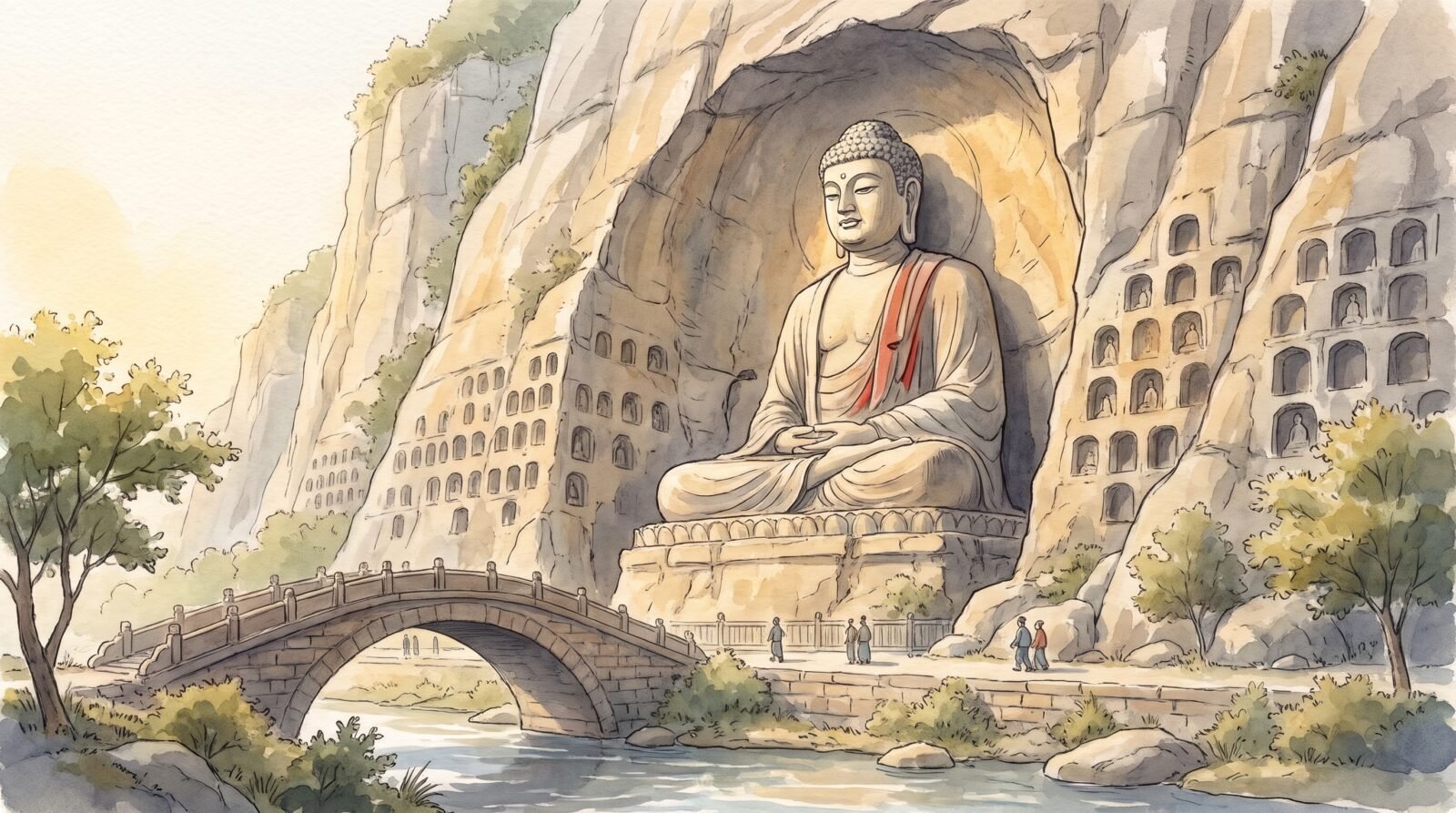
Cut into the limestone cliffs on both banks of the Yi River thirteen kilometres south of Luoyang, the Longmen Grottoes hold the largest body of Buddhist sculpture ever carved into rock outside India itself, and the most important archive of Chinese calligraphy in stone. The site was worked for four centuries, from the move of the Northern Wei court to Luoyang in 493 to the end of the Tang, by successive dynasties that each left their own idea of what a Buddha ought to look like. It is also, for all that, one of the least accurately described places in China. Almost every figure published about it in the twentieth century is wrong, and the argument about who the colossal figure in the central shrine at Fengxian Temple actually depicts has been running, on and off, since the statue was finished in the seventh century and shows no sign of stopping.
Reading the Inventory
Start with the count, because the count is what most published accounts get wrong. UNESCO’s own Statement of Outstanding Universal Value for the property describes more than 2,300 caves and niches carved into steep limestone cliffs over a one-kilometre stretch, containing almost 110,000 Buddhist stone statues, more than 60 stupas and 2,800 inscriptions carved on steles. The institute that manages the site, the Longmen Grottoes Academy, publishes its own inventory in slightly different terms: 2,345 caves and niches, more than 100,000 statues, and more than 2,800 inscriptions. The evaluation carried out for the inscription by ICOMOS in 1999 gives a third set: 2,345 niches and grottoes, more than 100,000 Buddhist statues, nearly 2,500 stelae and inscriptions, and over 60 pagodas. A recent survey of the site by the Cultural Heritage Online gives the same 2,345 and the same 2,800 tablets, and adds a fourth figure that is the most consequential of all for a visitor: the statues range in size from several centimetres to over seventeen metres.
Four credible institutional counts, and they do not agree, and the reason they do not agree is instructive. The differences are small in absolute terms and large in proportion. UNESCO says almost 110,000 statues where the two Chinese institutional sources say more than 100,000, a discrepancy of some ten thousand figures on a total of six figures. The stele count moves from 2,800 in the UNESCO and Institute accounts to nearly 2,500 in the ICOMOS evaluation, a gap of about three hundred tablets, or roughly twelve per cent. Any of these counts is the product of a decision about what to include. A figure standing in an open niche and a figure three centimetres tall carved into the back of a wall are both statues, and the Institute’s own description makes the range explicit: the largest, the Vairocana of Fengxian, stands 17.14 metres, while the smallest, in the Lotus Cave on the south wall, is two centimetres. A stele with a legible inscription and a slab with a scratched donor name are both inscriptions. Whether colophons added by later visitors count, whether fragments count, whether a figure surviving only as a head counts, whether a niche without a surviving statue counts as a niche — each question moves the total, and each is answered differently by a different institution with a different purpose. UNESCO’s figure is the one with legal force, because it is the figure attached to the obligation. The others are the working figures of the people who actually run the place.
The older travel-guide numbers are lower again, and this is where the discrepancy becomes a problem for the reader. Handbooks and general encyclopaedias have for decades given something in the range of 1,500 to 2,000 caves and about 100,000 statues. The first half of that figure is now wrong by a wide margin. The 1,500 to 2,000 number appears to derive from an earlier state of knowledge, before the systematic survey and registration work the Longmen Institute carried out through the second half of the twentieth century. It has never been entirely retired, because the guidebooks are cheap and the institutional surveys are not, and because a visitor standing at the foot of the Guyang Cave wall being told that the site holds some sixteen hundred and fifty caves has no way of checking. The numbers matter beyond pedantry. A count is the only thing that stops a site from being infinitely expandable in the popular imagination, and it is the only thing that lets a conservation programme be argued about in public. If the caves are 1,700 in number, then registering, monitoring and interpreting them is a finite job with an end. If they are 2,345, the job is larger, and the gap between what has been surveyed and what has not is the more interesting number.
What is not in dispute is the shape of the site. The gorge was called Yique, the Gate of the Yi River, because the two facing cliffs of Xishan and Dongshan form a natural gateway; the name Longmen, the Dragon’s Gate, came into use after the Sui built an imperial palace at Luoyang at the beginning of the seventh century with its southern gate aligned to the cliffs, the dragon being the emblem of the emperor’s power. UNESCO places the earliest caves in the late fifth and early sixth centuries in the West Hill cliffs, and names them: Guyangdong and the Three Binyang Caves, all containing large Buddha figures. The most intensive period of carving, UNESCO records, runs from the end of the fifth century to the mid-eighth. The great Tang sculptures in the Fengxiansi Cave are, in UNESCO’s formulation, the most fully representative examples of the Royal Cave Temples’ art, and the two sculptural styles the site produced — the earlier “Central China Style” and the later “Great Tang Style” — had influence well beyond China, contributing to the development of sculptural art in other Asian countries. UNESCO inscribed the property on criteria (i), (ii) and (iii): as an outstanding manifestation of human artistic creativity, as illustrating the perfection of a long-established art form significant to the cultural evolution of the region of Asia, and as encapsulating the high cultural level and sophisticated society of Tang dynasty China.
Guyang, Binyang, and the Invention of the Inscribed Cave
The Northern Wei caves matter most, because they are where the site invented the form everything afterwards follows. The move that produced them was the move of the capital. In 493 the Northern Wei court moved its seat from the northern city of Pingcheng to Luoyang, and the relocation of a court is the relocation of an entire apparatus of patronage: the workshops, the artisans, the donors with money, and the officials with the authority to decide what gets carved. The site the court left behind was Yungang in Shanxi, and the style it brought with it was Yungang’s style. The Northern Wei figures at Longmen are elongated and nearly flat, with deeply undercut drapery, sharp linear facial features and a compressed spatial depth that gives the compositions an austere, frontal gravity. They are not Chinese faces in any naturalistic sense; they are doctrinal images in a symbolic mode, and they sit on the same visual chain that runs from Indian Buddhist sculpture through Afghanistan and Gandhara to the north-western frontier. The Institute’s own vocabulary calls this the “Central Plains model”, the 中原模式, with its “slender bones and clear countenances”, and contrasts it with the “Pingcheng model” at Yungang, which was rough, awe-inspiring and mysterious. The change of capital is visible in the stone as a change of manner.
The Binyang caves were cut on an extraordinary scale. ICOMOS records that the emperor responsible for them worked on the project for more than twenty-four years, and that the two great reliefs of the imperial family worshipping the Buddha were at the heart of the scheme. They are also the two reliefs that were stolen in the 1930s and are now in museums in the United States, which makes them both the key to the early caves and the standing proof of what was taken from them. The Binyang caves were also cut in an unusual way, which tells you how hard the rock was. The great cave was begun high on the cliff face and abandoned there, and the work was restarted below, with the figures carved downward into the slope instead of outward from it. The reasons are practical and the consequences are aesthetic: the entrance is small, the space is compressed, the figures are pushed close together, and the whole cave reads as an interior rather than a facade. Guyangdong, by contrast, was excavated into the rock with a broad tall front, about eleven metres high, and holds more than 1,500 niches, of which more than 800 bear inscriptions. Those inscriptions are why the cave is the single most important object in the history of Chinese calligraphy, and why the argument about them has never been allowed to close.
How much text those caves contain is a question with no settled answer, and anyone who offers a single figure is offering a counting method rather than a fact. The commonly circulated numbers are large and they do not agree with one another: for Guyang alone, character counts of around 100,000 and above are quoted, and for the three Binyang caves a range in the region of 90,000 to 200,000 has been suggested, depending on whether the count includes punctuation, colophons by later visitors, and inscriptions added in later periods rather than at the time of the carving. The defensible statement is a range, attributed to the scholars who assembled it rather than presented as the site’s own figure, and it is a range that must be attached to each cave separately rather than totalled across the group. The point the numbers cannot escape is the one the Longmen Institute itself makes by calling the cave collection 古碑林, an ancient forest of stelae: this is a site where a great deal of writing was cut into stone by people who expected it to outlast them. The counts differ. The writing does not.
How that writing became a canon is a story with a named protagonist, and the Palace Museum in Beijing has told it at length in an article written by a member of the Longmen Grottoes Academy itself. The core of the Northern Wei canon is the group known as the 龙门四品, the four masterpieces of Longmen: the 始平公造像记, the record of the image made by Shipingong; the 孙秋生等造像记, the record of the images made by Sun Qiusheng and others; the 杨大眼造像记, the record of the image made by Yang Dayan; and the 魏灵藏造像记, the record of the image made by Wei Lingzang. Their collection into a canon happened in the Qing dynasty, and it happened through the industry of epigraphy rather than through any act of religious or imperial authority. Huang Yi, the Qianlong-era scholar and official whose antiquarian passion drove him to travel the country with rubbing crews, recorded in his own account that the old carvings at Song and Luo were worth a great deal, and that in the autumn of 1796, the first year of the Jiaqing reign, he crossed the river from Lanyang with two rubbing workers and went straight to the site, climbing to the Laojun Cave on the ninth day of the ninth month to look at the Wei and Qi inscriptions. A century and a half of that kind of labour is what turned a cliff face into a canon.
The transmission has its own history, and it is worth noticing that the canon did not immediately take. The Palace Museum article records that in the Jiaqing period the four pieces attracted insufficient attention from calligraphers; the 潜研堂文集 discussed them, and the 金石萃编, whose volume twenty-seven collects the Shipingong and Sun Qiusheng records and whose volume twenty-eight collects the Yang Dayan and Wei Lingzang records, brought them into the record, while the 研经室三集 does not mention them at all. What changed their standing was not antiquity but a crisis in the rival tradition. The study of the model-books, the school that had dominated calligraphic practice for centuries, had run into a cul-de-sac of its own, and the revival of the study of stone inscriptions, the 碑学, took its place. Ruan Yuan wrote on the Northern and Southern Schools of writing and on stele against model-book; Bao Shichen wrote the 艺舟双楫; Kang Youwei wrote the 广艺舟双楫. The Wei stele style became the model for calligraphers because the model-book had exhausted itself, and because the material was there, and because Huang Yi had put it in people’s hands. Many professional calligraphers in China still work from Longmen rubbings as practice models.
Fengxian, and the Argument About the Face
Fengxiansi is the shrine everyone comes to see. The central figure is the colossal Vairocana of Longmen, seated on a lotus throne and flanked by two disciples, two bodhisattvas, two heavenly kings and two guardians — nine figures in all, carved from the living cliff, the central image 17.14 metres high and the attendants thirty-five or forty feet. It is by any measure one of the great images of the Buddhist world, and it is also the site’s most contested object. The questions are: who does the central figure represent, and what is the iconographic programme of the shrine as a whole? Four readings are in circulation, and none of them can be dismissed.
The first is that the figure is Empress Wu Zetian, who ruled China as emperor in her own right from 690 to 705 and whose cult as a living incarnation of the Buddha was well established before and after her death. The Asian Art Museum in San Francisco states the traditional case directly: the great Vairocana was inspired by the newly translated Avatamsaka sutra, and it is also believed to represent the Empress Wu herself, who in 672 donated 20,000 strings of cash to begin the project, which would take another twenty years or more to complete. A recent survey of the site goes further, describing the 20,000 strings as coming from the Empress’s personal cosmetic allowance and recording that the detail is preserved in the dedicatory inscription on the site. The physical argument for the identification is that the face has the high broad forehead, the faint downward curve of the lips and the contained expression of authority that Chinese aesthetics associate with female power. The same survey is careful about the status of that evidence: it is circumstantial, the resemblance is asserted rather than documented, the tradition has been maintained by Luoyang scholarship for centuries, and it is built into every formal guide to the site. That is the right way to hold a claim of this kind, and it is also the reason the claim cannot be simply written up as fact.
The second reading, and the one favoured by the Longmen Institute’s own published material, is that the central figure is the Vairocana of the Huayan school. The Institute is explicit that the Fengxian Temple is the site of a Huayan shrine dedicated to the Vairocana as the 报身佛, the body of manifestation, rather than to any historical Buddha. Its own account of the site’s sectarian diversity is more useful than any single reading of this shrine, because it shows how many traditions were carved into the same cliff: besides the Huayan Fengxian, the Qianxi, Jingshan and Wanfo caves are Pure Land caves dedicated to Amitabha; Leigutai and Wanfogou are esoteric caves dedicated to the Vairocana of the Dharmakaya as the Great Sun Buddha; the Kanjing Temple is filled with twenty-nine arhats and belongs to the Chan tradition; and there are even images of Udyana, the oldest Indian cult of the Buddha, and a set of Three Past Buddhas carved with Maitreya as the principal figure, which the Institute’s own account describes with a dryness that suggests some scepticism.
The third reading holds that the shrine is in fact a Huayan triad, with the flanking figures read as Samantabhadra and Manjusri, which would make the group a statement of the three Buddhas of the Flower Garland rather than a single image with attendants. The fourth, and the most provocative, proposes that the two attendant bodhisattvas are not Buddhist figures at all but Fuxi and Nüwa, the primordial husband and wife of Chinese myth, which would make the shrine a syncretic statement joining the native cosmological pair to the imported universal Buddha. Each of these readings has serious scholarly advocates and published arguments behind it.
The honest position is that this is unresolved, and it should stay unresolved in an essay like this one. The temptation in a case like this is to pick the reading that flatters one side of a modern political argument and present it as settled archaeology. The evidence does not support that. The central figure has the attributes of a Vairocana, the Empress identification rests on stylistic and contextual arguments rather than on any surviving label, and the third and fourth readings depend on identifications of the attendant figures that other scholars contest. The Asian Art Museum’s own account of the shrine is the most compact statement of what the object is doing, and it is a statement about politics rather than about iconography: the central cave, built in the late 600s, asserts the union of the concept of the Buddha as universal sovereign with the concept of the emperor, or empress, as the living representation on earth of that sovereign. The pairing of religious and military figures on either side of the great Buddha may have symbolised, for those who stood before it, the religious and military factions that together supported a strong central throne. What can be said without strain is that the scale of the shrine is the clearest statement in the whole site about the relationship between the Tang state and the Buddhist establishment. A figure seventeen metres high, carved into a cliff face in the open air rather than inside a cave, is not a devotional image for a local patron. It is a public claim, made at a moment when the Empress’s own religious authority was at its height.
The dates of the shrine are themselves unsettled in the sources, and the disagreement is instructive. One account gives the construction as running from 672 to 676. The Asian Art Museum’s resource, which anchors its account in the inscription, notes the 672 donation and says the project would take more than twenty years to complete. The ICOMOS evaluation, which is otherwise the most detailed document on the site, does not date the Fengxian shrine at all, though it does record the completion of the Qianxi Cave during the reign of the Tang emperor Gaozong and the dedication of the Binyang South Cave in 641 by Li Tai, the fourth son of Li Shimin, in memory of his mother. A dedicatory inscription quoted in the Asian Art Museum’s material reads that the true doctrine had flown over the east for over seven hundred years, yet this large Buddha niche was the greatest meritorious deed ever offered. Whatever the exact span of the work, the shrine was made over a period of years by an apparatus that could command labour on that scale, at a site where the rock face still shows the holes that carried a roof of timber beams once sheltering the whole structure.
What Was Taken
The story of the removals from Longmen is the story of the early European collecting market in Chinese sculpture, and it is not a story of ignorant vandals. It is a story of connoisseurship operating at scale, with the sanction of museums. The record Charles Lang Freer kept of his travels in China in 1910 contains an entry, reproduced in the collection’s own account of the Chinese art it holds, in which he describes Longmen as a place where a unique infusion of Greek, Persian, Indian and Chinese work met, harmonious and beautiful, among the finest historical sites in the world. He was not the only one to look. The market in Chinese Buddhist sculpture had been established for some time, and the great European collections had already begun to accumulate.
The scale of what left is worth stating carefully, because the numbers attached to it in popular accounts are not reliable. Claims ranging from several hundred heads to hundreds of thousands of pieces circulate, and none of them can be verified. What can be documented is the pattern, and the pattern is documented by the body that inherited the problem. A research team of the Chinese Academy of Social Sciences went through the site in November 1965 and catalogued roughly 720 marks left by removed objects. A later survey, carried out between 1991 and 1992 by Wang Zhenguo of the Longmen Institute and covering ninety-six of the major caves, recorded the losses in detail: 262 major Buddhist statues, 1,063 other statues, eight niche lintels, ten reliefs of expounding texts, two reliefs of Jataka tales, one relief of Buddhist stories, sixteen reliefs of donors worshipping the Buddha, fifteen steles and inscriptions, two incense burners, two stupas, thirteen animal heads, one golden-winged bird and six unidentified stone carvings. The figures are the record of an absence. Every one of them is an object that was in a cave in 1910 and is not there now, and the majority are in European or American collections, or were in them.
The damage was not evenly distributed. The survey found the most severe losses in Guyangdong, in Lianhuadong, in Wanfodong and in the central Binyang cave, which is to say in the four caves with the highest concentration of fine sculpture in the first place. The removals were, in effect, a selection process: what left was what was best, and what remains is, from the point of view of connoisseurship, a thinned version of what was there. That is the damage, and it is the reason the question of return has never gone away.
The ICOM framework on decolonisation gives the term the profession uses for this: the Longmen cave temples are the case study in the document’s account of what it calls a dispersal, and the chapter on them, by Jiazhen Shi of the Longmen Grottoes Academy, is unusually direct about the mechanics. The removals were most rampant between 1910 and 1936. The heritage significance of the caves lies in their relationship with their surrounding landscape, which means that the fragments do not read as a collection even where they are appreciated as objects: a head that belonged to a body in a specific niche, in a specific cave, in a specific composition, has been removed from a syntax. The framework notes the twentieth-century pattern by which a country’s cultural heritage was dispersed through the art market and private collecting, and the argument for restitution that follows from it. It also records the partial reversals: in 2004 and 2005 China’s National Cultural Heritage Administration purchased seven Buddha statues originating from Longmen, and the case has continued since, along with the donation of a Buddha head originally from Cave 10 at Tianlongshan by a private collector in 2008. The pattern of recovery is slow, partial and dependent on the willingness of the holding institutions to negotiate, which is why it remains a live issue rather than a closed one.
It is also, importantly, a legal question with a date in it, and the date is 1970. The Chinese government’s formal legal actions, from 2019 onward, have focused on pieces acquired after 1970 under the UNESCO Convention, a threshold that excludes most of the major Western museum acquisitions, which predate the Convention. Pieces acquired before 1970 fall under different legal regimes that generally favour the possessing institution, so their repatriation has depended on individual institutional decisions and bilateral diplomatic arrangements rather than on binding international law. A small number of Longmen fragments were returned to Luoyang by American collectors in the 1990s and 2000s through donations rather than formal repatriation orders. The Luoyang Museum maintains a display documenting the removed pieces alongside photographs of their current locations abroad, which is a form of catalogue and a form of claim at the same time.
Protection and the Site Today
The institutional history of the site’s care is itself a small chronicle of the Chinese cultural heritage system. ICOMOS records that the Longmen Relics Care Agency was established in 1953 under the Ministry of Culture, that the first survey and registration programme ran from 1951 to 1970, that from 1971 to 1998 the work was maintenance rather than discovery, and that the Longmen Grottoes Research Institute was set up in 1990 by the Luoyang municipal government. The Institute’s own history places its foundation earlier, in 1951, and the small discrepancy between the two dates is worth tolerating rather than resolving: what both accounts agree on is that the care of the caves passed from ad hoc local responsibility to a body of the central state within a few years of the establishment of the People’s Republic, that the site was designated among the first group of nationally protected major cultural relics in 1961, and that it entered the UNESCO World Heritage List at the twenty-fourth session in 2000. The World Heritage Committee’s own published assessment of that inscription, quoted on the Institute’s site, is worth repeating in English because it is the language in which the obligation was accepted: the caves and niches of the Longmen area display the most outstanding and finest plastic arts of the late Northern Wei to the Tang period, and these works, which are richly descriptive of Buddhist religious subjects, represent the highest peak of Chinese stone sculpture.
The current state of the caves is the achievement of that apparatus. The site receives something in the order of a million visitors a year, which for a fragile limestone cliff with a painted and polychromed surface is a severe number, and the management of that traffic, along with the monitoring of water seepage, salt damage, unstable rock masses and the effect of pollution on the limestone, is a continuous technical problem rather than an administrative one. The Longmen Grottoes Research Institute now conducts conservation and restoration work, technical research, heritage monitoring and digital preservation, and projects tackling water seepage, unstable rock masses and weathering are advancing into an overarching conservation framework for the site. The ICOMOS evaluation treats the landscape itself as part of the property, not as its setting: the caves, the statues, the steles and inscriptions on both hills, the natural landscape and the ecological environment that have existed since the late fifth century, and the two together as a harmonised whole. That is a demanding definition of heritage, and it is why the site has been used in the international literature as an example of what full-site conservation actually requires.
The material condition of the caves is not uniform, and the differences are historical. The Northern Wei caves are small, numerous, densely inscribed and carved in the hard limestone of the West Hill, and their surfaces are worn and their paint largely gone. The Tang caves are larger, fewer, and in places still carry substantial colour. The Yaofangdong Cave contains 140 inscriptions recording treatments for a range of diseases and illnesses, which makes it an accidental archive of medieval medicine; the Longmen Institute also notes that the prescriptions there appear in the Japanese medical compilation known as the Ishinpo, which gives a rare line of continuity between what was carved on the cliff and what was transmitted to a later medical literature in another country. And then there are the specific individual works that carry the site’s name in the popular imagination: the colossal Vairocana at Fengxian; the Wanfo Cave, whose wall is filled with fifteen thousand small Buddhas and whose dedicatory inscription is dated to the thirtieth day of the eleventh month of the first year of the Yonglong era, or 680, carved as a Pure Land ensemble with Amitabha, the two bodhisattvas and an attendant host, the lowest stone in the cave a little under a foot and the highest over twenty feet; the Qianxi Cave, carved under the same Tang emperor in the years after 653; and the Kanjing Temple, with its twenty-nine arhats and its unusual array of Chan subjects including Udyana.
It would be misleading to end on the losses alone, because the same institutional history that registered the absences also built the largest research and conservation operation ever applied to a Chinese Buddhist cave site, and because a great deal of what the site contains survives precisely because it was too large, too deeply carved, too badly weathered in place or too badly damaged to be worth the price of the freight. The Qianxi Cave, thirty feet or so high and holding more than fifty Buddha figures, is in better condition than any of the four great caves that were systematically picked over. The deepest argument for the site’s importance is not the count of what went west but the fact that four centuries of Chinese religious and political ambition are legible in a single mile of cliff, in two styles that can be told apart by eye, in a calligraphic archive that a Qing official made the subject of his life’s work, and in a shrine whose central face has been argued about for thirteen hundred years without the argument being settled. The count is larger than the number most people carry in their heads. The argument is larger than the count.
References
- Statement of Outstanding Universal Value for the Longmen Grottoes, Brief synthesis — UNESCO World Heritage Centre, periodic reporting for Asia and the Pacific
- Longmen Grottoes (China), No 1003: Evaluation — ICOMOS, 27 July 1999
- 龙门石窟简介 — 洛阳龙门石窟研究院
- Museums, Decolonisation and Restitution: A Global Conversation — ICOM, with a chapter by Jiazhen Shi of the Longmen Grottoes Academy
- UNESCO World Heritage Sites Near Longmen Grottoes — Paola Bonometti, Cultural Heritage Online, 13 October 2026
- Longmen Grottoes — World History Encyclopedia
- Buddhist Cave Shrines of Longmen — Asian Art Museum, Education
- 龙门四品杂谈 — 陈朝阳, 龙门石窟研究院, 故宫博物院, 4 August 2016
- Luoyang Charts a New Path for Safeguarding Archaeological Heritage — China Daily via PR Newswire, 12 October 2026
- Longmen Grottoes — UNESCO World Heritage Centre
- 龙门石窟 — 人民网艺术频道, 10 July 2018
- 龙门石窟研究文献汇编 — Longmen Grottoes research bibliography, preview edition
- Longmen Grottoes — Onmark Productions, art-history overview
- Longmen Grottoes — Visit China, China International Travel Service
- 龙门二十品研究 — 《洛阳理工学院学报(社会科学版)》 2001年第1期
- Decision 2453: Longmen Grottoes (China) — World Heritage Committee, 24th session, 2000