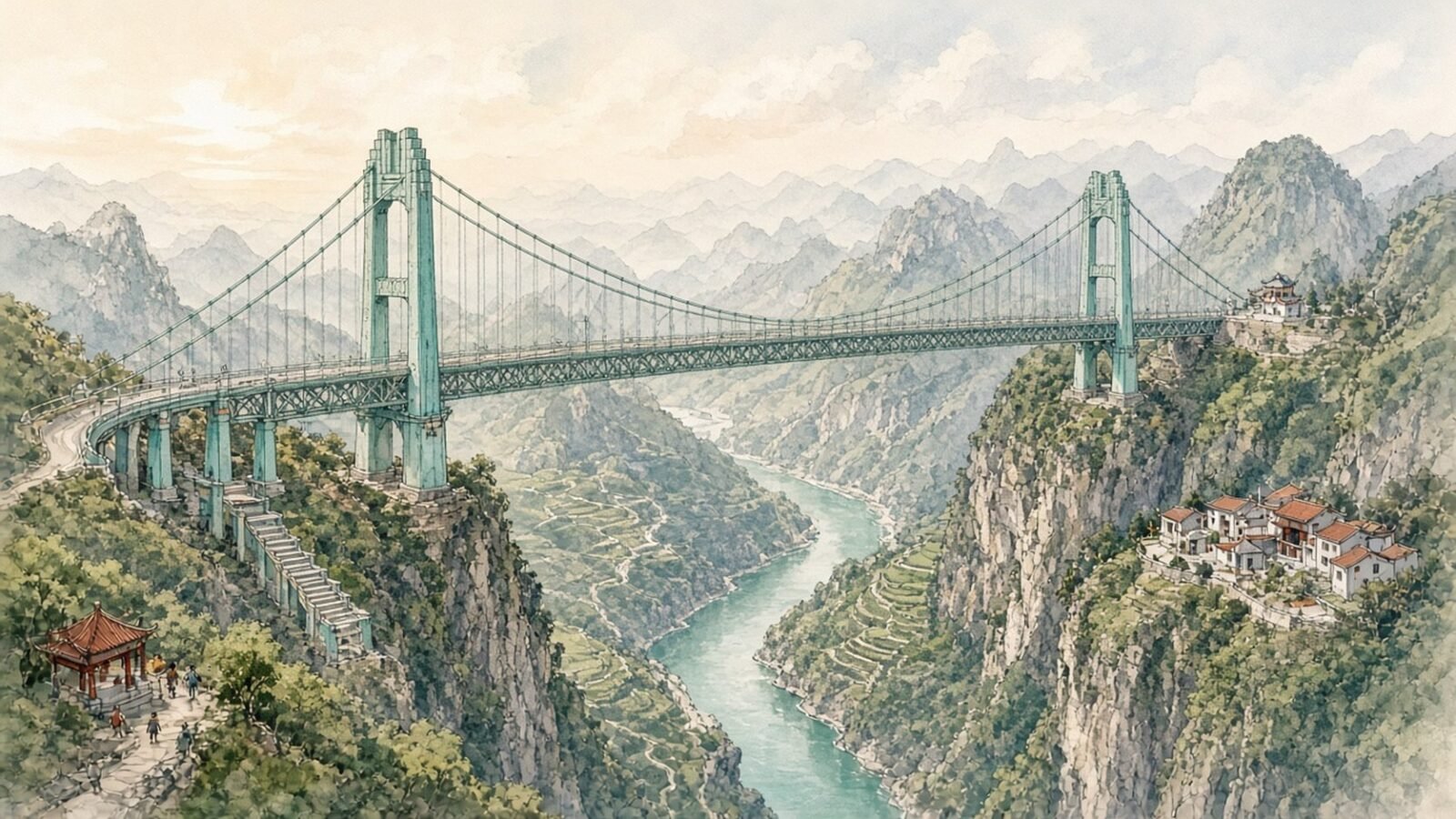
On 28 September 2025 a four-lane expressway bridge opened across the Huajiang Grand Canyon in Guizhou, in China’s mountainous south-west, with its road deck 625 metres above the Beipan River. No bridge anywhere stands higher above the ground or water beneath it. Its main span of 1,420 metres is ten metres longer than that of the Humber Bridge, and Chinese officials describe it as the longest suspension span yet built in mountain terrain. A year on, the Huajiang Grand Canyon Bridge carries traffic between Guanling and Zhenfeng counties in about two minutes, a crossing that used to take around two hours by winding roads. It has also become one of Guizhou’s busiest tourist sites, with more than three million visitors in its first year. And it is not a one-off. It is the third world-record bridge on the same river, and the newest piece in a provincial road network that has made remote Guizhou the place with the largest concentration of very high bridges anywhere.
Guizhou’s karst country has appeared on huaxia.click before, in the piece on the FAST radio telescope in Pingtang, and the wider push to tie China’s interior together runs through articles on the high-speed rail network, the Three Gorges Dam and Chongqing as a mountain city. This one stays with a single gorge and the river that runs through it.
A Province Without Plains
Guizhou is often described in Chinese reporting as the only provincial-level region with no plains at all. Xinhua puts the share of its area covered by mountains and hills at 92.5 per cent. Much of the province is karst: limestone and dolomite dissolved over millions of years into sinkholes, caves, underground rivers, sharp conical hills and gorges cut hundreds of metres deep. A local saying, quoted by a China Daily columnist in July 2026, describes a place with “no three days of clear skies and no three feet of flat land”. For most of its history that terrain kept Guizhou poor and hard to reach.
Road-building changed that within a generation. According to Guizhou Daily, as cited by the Global Times, the province became the first in western China to connect every county to the expressway network, in 2015, and by the end of 2024 it had 9,042 kilometres of expressway in operation. Provincial figures reported by Xinhua in 2025 put the number of bridges built or under construction in Guizhou at more than 32,000, around ten times the number in the 1980s, with a combined length of over 5,400 kilometres. State media routinely call Guizhou “the world’s bridge museum”.
The more striking statistic concerns height. Eric Sakowski, an American who has catalogued the world’s high bridges for many years on his site HighestBridges.com, describes Guizhou as home to more high bridges than every other country combined. Provincial transport officials say nearly half of the world’s 100 highest bridges are in Guizhou, including the top three. “Highest” here has a specific meaning: deck height, the vertical distance from the road or rail deck to the ground or water directly below. That is different from structural height, the measure by which France’s Millau Viaduct, with a mast 343 metres above its foundation, counts as tall. The Guizhou bridges are high rather than tall: their towers stand on the rims of gorges and the river lies far below.
The Earth’s Crack
The Beipan, or “North Pan”, river rises in the mountains along the Yunnan–Guizhou border and flows south-east until it meets the Nanpan, or “South Pan”, on the edge of Guangxi. Together they form the Hongshui River, part of the Pearl River system that reaches the sea near Guangzhou. For much of its course through western Guizhou the Beipan runs in a deep trench. The stretch between Guanling Buyei and Miao Autonomous County, in Anshun prefecture, and Zhenfeng County, in Qianxinan prefecture, is known as the Huajiang Grand Canyon. Chinese media like to call it “the Earth’s crack”.
People have crossed here for a long time. The Global Times, reporting from the canyon-floor village of Xiaohuajiang days before the opening, described horse caravans carrying salt and tobacco along an old branch of the Tea Horse Road, a network covered on huaxia.click in the piece on the Tea Horse Road. Inscriptions near the Huajiang iron-chain bridge record that its construction began in 1898, under the Qing, with money from local officials. In 1961 a road bridge was built downstream to take heavy vehicles. Both lie near the bottom of the gorge, so traffic still had to wind down one side and up the other. The paper reported that villagers going to market once had to rise at 3 a.m. and climb for three to four hours with loads on their shoulders.
The canyon’s rocks are Triassic, laid down roughly 250 to 201 million years ago, and the Guanling area is known for well-preserved marine reptile and crinoid fossils from that period. Roadside walls near the new service area are painted with ancient sea creatures.
Why the Bridge Is So High
The bridge is the key structure on the Liuzhi–Anlong expressway (S57), a provincial route that runs roughly north to south between Liuzhi Special District and Anlong County. Officials say it is meant partly to relieve the busy Shanghai–Kunming expressway and to tighten links between cities in central and south-western Guizhou.
The engineers involved insist that the record was a by-product. “The creation of the world’s highest bridge was driven by engineering necessity rather than by a desire to set records,” Yang Jian, the chief design engineer, told Xinhua. Because steep mountains surround the canyon, the route needed both bridges and tunnels. A lower crossing would have meant longer tunnels on the approaches, which would have raised costs and, Yang argued, safety risks from driver fatigue. “It wasn’t until we completed the design that we were stunned to realise the bridge would stand over 600 metres high,” he said. Liu Hao, the project’s chief engineer, told the Global Times the height was a “suitable and cost-effective” choice for the terrain.
HighestBridges.com puts it in practical terms: the road deck needed to be at an elevation of at least 1,100 metres, which left a gap of about 625 metres above the river. A gap that wide and deep, with no practical place for piers in the middle, more or less dictated a suspension bridge with a very long main span. The designers chose a steel-truss stiffening girder, a deep lattice deck that handles wind well and can be lifted into place in segments.
The Numbers, Checked
Figures about the bridge are repeated widely, and not always consistently. These are the ones supported by official releases and the more careful technical sources.
- Deck height: 625 metres from deck to river surface. Xinhua compares this to nearly nine times the height of San Francisco’s Golden Gate Bridge.
- Main span: 1,420 metres, the longest suspension span in mountainous terrain according to Guizhou provincial authorities. Coastal and estuary suspension bridges elsewhere have much longer spans, so this is a record for a category, not an absolute one.
- Total length: 2,890 metres, including more than two dozen 40-metre approach spans.
- Towers: reinforced concrete, 262 metres tall on the steeper north side and 205 metres on the south side, according to HighestBridges.com. Some summaries wrongly give both towers as 262 metres.
- Deck: a steel truss girder of 93 segments weighing about 21,000 tonnes in total. Its depth was increased from a planned 7.5 metres to 8 metres to carry the extra weight and wind load of the tourist facilities.
- Main cables: two, each nearly a metre in diameter, made of 217 strands of 91 high-strength wires.
- Cost: about 2.2 billion yuan for the main works, according to Han Hongju, chief engineer of Guizhou Communications Investment Group, in an interview with CCTV. Some English-language sources give 2.1 billion.
- Construction: started on 18 January 2022 and opened on 28 September 2025, a little over three and a half years.
“Highest bridge” is a title Guinness World Records recognises, and it awarded it to Huajiang. “Tallest bridge”, which some headlines used at the opening, is strictly a different measure. By structural height the Millau Viaduct is taller than Huajiang, and the newer Changtai Yangtze River Bridge in Jiangsu, which also opened in 2025, has a tower of about 352 metres. Huajiang’s record is for how far the deck sits above the river.
Building Over a Void
The bridge was designed by the Guizhou Transportation Planning Survey and Design Academe and built by Guizhou Bridge Group, a subsidiary of the provincial state-owned investor, Guizhou Communications Investment Group. Official accounts stress that it was designed and built in Guizhou, mainly with Guizhou-made materials. Survey work was under way by 2020.
The first and least visible task was the anchorages, the massive blocks that hold the ends of the main cables. On the Liuzhi bank the engineers used a tunnel anchorage, driving inclined chambers into the rock along an axis 94 metres long. The design also avoided a clash with the expressway’s own tunnel close by. The anchorage on the other bank took about 160,000 cubic metres of concrete. With fly ash, normally used to temper large concrete pours, in short supply, the team ground dolomite rubble from the roadworks into powder as a substitute. CCTV reported that this took three months of mix trials and saved about five million yuan.
The towers rose through 2023. Xinhua reported in April 2023 that the first had reached 199 metres and work on its upper crossbeam had begun. In shape they are simple portal frames, two rectangular concrete legs joined by crossbeams, but the tops are stepped back in layers. HighestBridges.com likens them to the setbacks of Art Deco towers and the Golden Gate Bridge. The towers and steelwork are painted a pale turquoise green that stands out against the forested slopes.
Once the main cables were spun across the gorge, the deck could be lifted. Lifting began on 4 November 2024. A cable crane carried the 93 truss segments out over the void. The project team said a fourth-generation “smart cable-hoisting system”, combining high-definition cameras, BeiDou satellite positioning and networked sensors, allowed lifting around the clock except in high winds and cut the time needed to dock each segment. The provincial transport department says the whole lift took 73 days. The final segment went into place at 14:20 on 17 January 2025, closing the deck. Load tests ran from 21 to 25 August 2025, a month before the opening.
Wind, Fog and Cables
The main engineering problem in a deep gorge is wind. Tian Hongrui told the Global Times that gusts in the U-shaped canyon could reach force 14 on the Chinese scale, which is typhoon strength. A single segment could weigh 215 tonnes, and lifting stopped when winds exceeded force 6. Because steel expands in the heat, precise fitting was often done at night, when the canyon frequently filled with fog. Officials say the work on wind resistance and high-altitude construction produced 21 patents, and that some of its methods have been written into national bridge standards. Ge Yaojun, a bridge wind engineer at Tongji University in Shanghai, told Xinhua that Guizhou showed that “complex terrain is not a constraint, but a catalyst for innovation.”
The other long-term worry for any suspension bridge is its main cables, which cannot practically be replaced. On Huajiang, three “smart strands” in each cable carry fibre Bragg grating sensors along their length, giving continuous readings of stress, temperature, humidity and vibration. CCTV reported that dehumidifiers switch on automatically if humidity inside the cable housing rises above 64 per cent, to prevent the condensation that causes corrosion. The bridge is designed for a 100-year life.
A River of Records
The Beipan has carried the world’s highest bridge three separate times. Sakowski calls it the only river to have done so.
The first was the Beipanjiang Guanxing Highway Bridge of 2003, a suspension bridge with a 388-metre span a short distance downstream of the Huajiang site. At 366 metres above the river it was the first suspension bridge to pass 1,000 feet (about 305 metres) of deck height, and it took the record from the Liuguanghe Bridge, opened elsewhere in Guizhou in 2001. Before that, the Royal Gorge Bridge in Colorado (1929, 291 metres) had held the title for 72 years.
The second was the Duge Bridge, officially the Beipanjiang First Bridge, on the G56 Hangzhou–Ruili expressway between Liupanshui in Guizhou and Xuanwei in Yunnan. It crosses the gorge of the Nizhu River, a headwater branch of the Beipan, with a deck about 565 metres up. It is a cable-stayed bridge with a 720-metre main span and towers of 269 and 248 metres. It was completed in September 2016, opened on 29 December that year and cost about 1.02 billion yuan. Guinness confirmed it as the world’s highest bridge in 2018. It lies roughly 100 kilometres from Huajiang in a straight line.
Huajiang made the third. In between, the Beipan basin has gathered a string of other high crossings. They include the Baling River Bridge of 2009, a 1,088-metre suspension span on the Shanghai–Kunming expressway, 370 metres above a Beipan tributary near Guanling. The Qinglong Railway Bridge, a 445-metre concrete arch, carries the Shanghai–Kunming high-speed line 295 metres above the Beipan. The Zangkejiang Bridge, a 1,080-metre suspension bridge opened in 2025, has a deck about 410 metres high over water backed up by the Guangzhao Dam. In July 2026 the China Daily columnist Chen Weihua described driving across the Yachi River, Duge, Baling River and Huajiang bridges in a single week.
The Bridge as a Destination
From the start, Guizhou planned Huajiang as a tourist attraction as well as a crossing. The provincial term is qiao lü ronghe, roughly “bridge-tourism integration”. More than 50 square kilometres around the site were included in a single tourism plan. Xinhua and other official media list the main features:
- A glass sightseeing lift, reported as 207 metres high, that takes visitors up beside a tower in about a minute, with a “cloud-top café” at the top nearly 800 metres above the river.
- A 796-metre viewing corridor built into the inspection passage inside the steel truss, with a glass-floored hall at mid-span.
- A 1,411-metre blue rubberised running track laid on the wind-stabilising plates along the sides of the deck.
- Bungee and parachute-jumping platforms, and a large service area, Yundu, overlooking the gorge.
- A water curtain about 300 metres wide falling from the deck, fed by karst groundwater met while digging the bridgehead tunnel and stored in a 4,000-cubic-metre reservoir. The water also supplies the service area and nearby farms, and at night the curtain becomes the screen for a light show.
A week before the opening the bridge hosted its first “World’s Highest Bridge” triathlon, with nearly 200 athletes from more than 20 countries and regions on a 36.75-kilometre course. A high-bridge parachuting event has followed. Xinhua reported on the first anniversary that the project holds two Guinness World Records, for the highest bridge and the highest bridge water-curtain light show. It also reported that the bridge was included in TIME magazine’s 2026 list of the World’s Greatest Places.
The visitor figures from the first year are large for such a remote spot. According to China News Service, the Yundu service area received 3.365 million visitors between the opening and August 2026, and neighbouring Zhenfeng County received 5.47 million. Guizhou television reported more than 300,000 visitors over the 2026 Spring Festival holiday and more than one million during the summer. Guanling County’s tourism bureau said the county had 2.81 million visitors in 2025, up 71 per cent on the year before. The figures come from local operators and governments and cannot be checked independently, but they point the same way. Homestays have opened in Xiaohuajiang and other villages, some run by investors from Zhejiang, and local produce such as Huajiang Sichuan pepper, honey and rice noodles now sells at the bridgehead.
The bridge also sits on an obvious tourist circuit. Huangguoshu, one of China’s best-known waterfalls, is about 50 kilometres away, and Xinhua notes that provincial planners intend to link the bridge with Huangguoshu and the Wanfenglin karst landscape near Xingyi into a single route.
Costs and the Debt Question
None of this was cheap, and Guizhou is not a rich province. Its GDP per head remains among the lowest in China. Much of the money for its roads and bridges was raised by state-owned provincial and municipal companies, the local government financing vehicles that borrow on China’s domestic bond market and from banks against future tolls, land sales and government support. By the early 2020s Guizhou had become one of the most closely watched cases of local debt. In 2023 the Wall Street Journal, citing the data provider Wind, estimated the province’s debt, including these vehicles, at the equivalent of about 388 billion US dollars at the end of 2022, roughly 1.3 times its GDP. It reported that Guizhou Communications Construction Group, the company behind the Duge Bridge and 23 of the world’s 100 highest bridges, had about 22 billion dollars of interest-bearing debt. At the end of 2022 Zunyi Road and Bridge Construction, a city-level vehicle in northern Guizhou, agreed with its banks to stretch 15.6 billion yuan of loans over 20 years, paying only interest for the first ten. Caixin called the arrangement unprecedented.
Supporters of the road programme point to shorter journeys, market access, tourism of the kind seen at Huajiang, and the fact that by 2020 none of Guizhou’s counties was still officially classed as poor. Critics point to weak toll income on some routes, which the Journal also reported. Huajiang itself was financed jointly by Guizhou Communications Investment Group, financial institutions and local government platform companies, according to CCTV, and a Guizhou Normal University researcher told the Global Times that turning such projects into attractions improves the return on transport investment. Whether that holds over the long term will take more than a year to judge.
What Comes Next
Huajiang’s record looks safe for now. HighestBridges.com lists several Chinese bridges under construction with decks more than 450 metres up. They include the Tianmen Bridge, another Beipan crossing in Shuicheng County, expected at about 560 metres, and the Yongchang Lancang River Bridge in Yunnan, a 1,416-metre suspension span due around 2028 with a projected deck height of about 610 metres. Neither would pass Huajiang, though the region’s rivers have more deep gorges. Sakowski expects Guizhou alone to have more than 1,000 bridges over 100 metres high by 2030. Italy, which has the second-largest number of high bridges, has about 60.
For the people who live beside it, the bridge is less a record than a change in distance: two hours of switchbacks reduced to about two minutes, high above the river where the 1898 chain bridge still hangs. The engineers say the height was a consequence of the route, not its purpose. A year after opening, the bridge works as a road, a tourist attraction and a test of Guizhou’s long and costly bet on bridges, all at once.