For more than a thousand years, mule caravans carried compressed tea from the cloud forests of Yunnan across the Himalayan foothills into Tibet, exchanging bricks for horses and binding a frontier into the Chinese state. The road still has more to say about China than it does about tea.
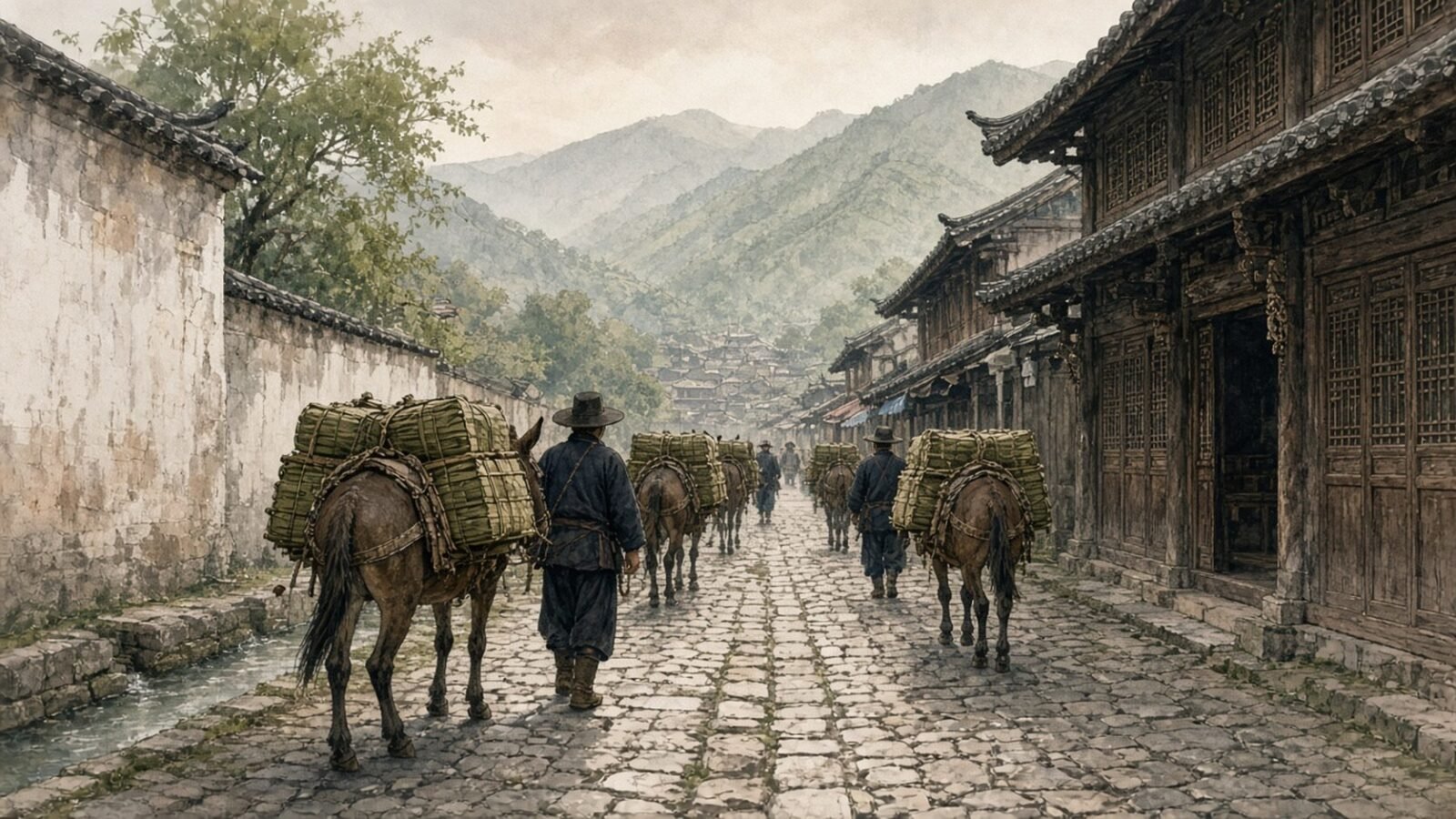
The Friday market at Shaxi still begins at dawn. Bai women in indigo headscarves unload bundles of bitter greens from the backs of small horses. Yi men lead pack mules down from the pine-clad hills above the Heihui River, the animals stepping carefully along red sandstone slabs that were laid, in places, more than five centuries ago. Hooves clatter through a stone gate so narrow that only two horses can pass at once. The market square, flanked by a temple, an opera stage and a row of former inn yards, was placed on the World Monuments Watch list of one hundred most endangered sites in 2001, and the World Monuments Fund calls it “the only surviving market on the Ancient Tea Horse Road.” Most other staging posts have been drowned by reservoirs, bulldozed for highways, or absorbed into modern towns until nothing recognisable remains. Shaxi survives because it got forgotten.
Walk through that gate and you are walking through the central question of how China holds itself together. The Tea Horse Road was not a single track but a network of caravan paths that wound more than two thousand kilometres from the subtropical forests of Xishuangbanna, in southern Yunnan, north and west across the Hengduan Mountains into the Tibetan plateau, and from there into Bhutan, Nepal and the markets of British India. For at least a thousand years this network moved the most improbable of imperial commodities: a brick of fermented tea, dense as hardwood, worth, in the eleventh century, a sturdy Tibetan pony. The mules that carried it became the feet of commerce. The road became a frontier. The frontier became a state.
Why a Brick of Tea Was Worth a Horse
Begin with the plant. The tea that travelled the route was not the green tea familiar to most outsiders. It was Pu’er, a dark, microbially aged tea made from the broad-leaf Camellia sinensis var. assamica that grows wild only on the moist, ancient mountains of southern Yunnan, particularly in the Six Famous Tea Mountains (Yibang, Mangzhi, Gedeng, Manzhuan, Yiwu and Youle) clustered around the Lancang (Mekong) river basin. The leaves are picked, pan-fried, sun-dried and compressed, traditionally into a 357-gram cake, seven of which were bound in dried bamboo sheaths into a tong of about 2.5 kilograms. Twelve tong (sixty kilograms) were the load of one mule.
The microbial aging was not a marketing claim but a logistics solution. Pu’er ferments slowly in storage; the longer it travels and rests, the more complex its flavour. The tea that arrived in Lhasa after six months on a mule tasted better than the tea that left Yiwu. The caravans were, in effect, mobile cellars.
What the road actually traded, as one recent study puts it, was warmth. Tibet’s high plateau grows almost no plant food. Yak butter provides fat; roasted barley (tsampa) provides starch. What it does not provide is vitamin C, or indeed any vegetable matter for half the year. Tea, drunk as butter tea (po cha), strong Pu’er churned with yak butter and salt, supplies catechins, fluid and the only counterweight to a diet otherwise dominated by meat and dairy. A Tibetan herder today may drink thirty to sixty small bowls of butter tea in a day. The anthropologist P. Christiaan Klieger records that, into the 1940s, compressed tea bricks were still being used as small currency in remote Tibetan markets: one cake bought a sheep, several cakes bought a horse, a hundred cakes bought a wife. The brick was literally worth a life.
The other half of the equation was biological. Imperial China, after the loss of its northern pastures in the tenth and eleventh centuries, was catastrophically short of good cavalry horses. The northern steppes supplied some, but the Song dynasty paid heavily in silver, silk and tea for stock from the Tibetan borderlands. The Tea and Horse Bureau (Cha Ma Si), established in 1074 in Mingshan, Sichuan, was the first centralised attempt to manage this traffic. Its ledger was blunt: for every 130 catties of brick tea, roughly sixty kilograms, the Bureau issued one horse. By the thirteenth century the exchange was touching some 25,000 horses a year. Horses south, tea north: an imperial respiratory system, one breath in, one breath out.
The World the Caravan Built
The caravans themselves were not a single thing. The smallest was a ma bo, half a dozen mules with two muleteers. The largest, organised by the great Yunnan trading firms (the Heng, the Yongchang, the Zongdian) could run four hundred mules and eighty men. A caravan leader, the magoutou, walked at the front carrying a long-handled iron pot and tested the water at every stream. If the surface discoloured, the route was poisoned; the caravan halted, and the matter was investigated with the very particular justice of men who had nowhere else to drink. The muleteers’ own diet was frugal: corn bread, an occasional piece of fermented bean curd, salt, because every kilogram of food carried was a kilogram of tea not carried. A round trip from Yiwu to Lhasa ran around six to eight months on the trail. Mortality among the mules averaged roughly fifteen per cent. Mortality among the men is not recorded with the same precision, but oral histories suggest it was not negligible.
Three things made the trade feasible. Geography, for one. The Hengduan Mountains, the vast knot of ranges between the Tibetan and Yunnan-Guizhou plateaus, happen to be pierced by three of Asia’s great rivers running almost in parallel: the Jinsha (upper Yangtze), the Lancang (Mekong) and the Nu (Salween). Between them are north-south valleys and high passes, the route of choice because rivers and ridges acted as fixed corridors, while east-west travel involved ascending and descending again and again. Climate, for another. Pu’er stored well in cold mountain air; the same leaf would mould in the humid lowlands. And, most often overlooked, a string of relatively prosperous intermediate societies (Bai, Naxi, Yi, Hui, Lisu) who served as brokers, innkeepers, porters and translators between the Han, Tibetan and Burmese worlds. Without them the network would have been a thin ribbon of footprints. With them, it became a thick braid of markets, monasteries, inns and horse yards.
The most tangible residue is still visible in Yunnan today. The old caravan inns of Shaxi are timber-and-earthen-walled courtyards with stabling on the ground floor and sleeping galleries above, designed to swallow a hundred mules and forty men overnight. Their cobbled courtyards are still rutted with hoof-prints, five centuries on. The Friday market is the last in mainland China still held on the old trade-day cycle. It is the kind of site that quietly embarrasses the idea that the Silk Road was the only Asia-defining artery. The southern Silk Road is not a metaphor. It is a working landscape that has not yet finished trading.
How the State Took Over the Passes
The Ming made the road what it became. When the Hongwu Emperor consolidated the dynasty in the late fourteenth century, his generals watched the southwestern frontier with a soldier’s eye. The native chieftains (tusi) along the trade corridors could either be useful or dangerous. Tea, controlled by the state, was the lever. The Yongle Emperor, two generations later, formalised a tribute-trade relationship with the Karmapa ruler Deshin Shekpa, ordering roads and trading posts built in the upper Yangtze and Mekong basins. From Ya’an in Sichuan, the Sichuan-Tibet branch climbed over the Erlang pass to Kangding, then to Litang, Batang, Chamdo and Lhasa. From the Yunnan side, the southern branch climbed from Simao and Pu’er through Dali and Lijiang to Zhongdian, renamed Shangri-La by the tourist board in 2001, and on to Markam and Chamdo. The two branches met at Chamdo and from there continued west to Lhasa and then, via Gyantse and the Yadong pass, into Sikkim and the British Raj.
The state did not so much build the road as militarise its administration. Nineteen relay stations were set along the Sichuan branch alone. Tax receipts began to circulate. Military colonies of Han soldiers were planted at the strategic passes, and the once-fluid ethnic geography of the southwest began to harden into the maps we now see. By the eighteenth century, the official term for the exchange had shifted from chama hushi (“tea-horse mutual trade”) to the blunter chatu jiaoliu, “tea for local products.” The horses were becoming less important than the wool, the musk, the medicinal rhubarb and the furs that came down the passes in return.
The Qing were more interested in revenue than romance. Under the Kangxi Emperor in 1696, Kangding was formally designated a tea-for-horse market, and the volume of official tea trade across the Sichuan route reached 12.3 million jin, about 7.8 million kilograms, during the Yongzheng reign. The trade was managed through a labyrinth of monopoly licences, salt coupons and quality grades. Tea had become a kind of currency with multiple exchange rates. The frontier had become an accounting problem.
What the Mountains Were Actually Trading
Tea was the headline commodity, but the road ran on salt. The wells of Yunnan and northern Burma produced most of the salt consumed across the high plateau before the twentieth century, and the caravans that carried tea north often returned south with salt cakes strapped to their mules. Salt was so central that, as the historian Mu Jihong argues, it “more so than any other goods drove the caravans across the Hengshan mountain terrains.” Without salt the trade in yak butter, hides and wool would have collapsed.
Other goods moved in less predictable directions. Gold dust came down from Tibetan mines; medicinal rhubarb, musk pods, caterpillar fungus and the prized snow lotus travelled from the high pastures to the pharmacies of Kunming and Chengdu. From the Yunnan lowlands went silk and the famous Sichuan embroidery (shujin). From Bengal, via the Yadong pass, came muslin and, eventually, opium, which arguably did more than any other single commodity to destabilise the Qing frontier.
It is easy, looking at the archaeology of teapots and horse yokes in a Yunnan museum, to read the Tea Horse Road as a quaint picturesque commerce. The road was not that to everyone who walked it. Tea porters, both men and women, regularly carried loads of 70 to 90 kilograms, “often more than their own body weight,” in the telling of a recent Sichuan University oral history. The strongest carried 150 kilograms. One pound of tea was paid out, on return, as one pound of rice.
The Strange Christians of Cizhong
The route’s strangest residue is religious. In the deep bend of the Lancang river in northwest Yunnan lies the village of Cizhong. Eighty per cent of its residents are Catholic. They are ethnically Tibetan and Naxi, and they grow grapes to make communion wine. The Gothic church in the middle of the village, rebuilt between 1909 and 1921 after its predecessor was burnt by Tibetan lamas during the 1905 revolt, has a Chinese pavilion crowning its bell tower, a deliberate synthesis of Catholic and Qing architectural grammar. It was listed as a national cultural protection site in 2006. When it received its first resident priest in almost sixty years, in February 2008, the man appointed, Father Yao Fei, was a Han missionary from Inner Mongolia.
The presence of Cizhong is, in miniature, the larger argument of the frontier. The Tea Horse Road carried more than goods. It carried ideas. French missionaries of the Paris Foreign Missions Society had been inching up the Mekong valley from Indochina since the 1850s, planting small Christian communities in Tibetan, Lisu and Naxi villages. They walked the same passes the caravans walked, slept in the same inns, drank the same butter tea and used the same muleteers. By the time the road fell silent in the 1950s, the Francophone Catholic mission had become one of the most durable European institutions on the route, more durable than the French concession in Shanghai, more durable than almost any single act of late Qing diplomacy.
When the Trucks Came
The Tea Horse Road was killed by two technologies. The internal combustion engine, for one: the Sichuan-Tibet Highway, completed in 1954, made it possible to load a truck in Ya’an and unload it in Lhasa in a fortnight rather than a season. Caravans shrank within years. Politics, for the other: the Cultural Revolution classified the old tea trade as feudal, destroyed temple and merchant records, and in many parts of Yunnan’s old tea mountains, the ancient gushu (the hundred- and thousand-year-old broad-leaf trees) were uprooted and replaced with faster-growing plantation varieties. By the early 1980s, surviving muleteers were an ethnographic curiosity. A round trip from Yiwu to Lhasa, once a six-month ordeal, had become a bus journey of a few days.
But the road refused to vanish. In 2005, a Yunnan tea association organised a revival caravan (forty muleteers, more than a hundred mules, four tonnes of Pu’er cakes) that crossed from Xishuangbanna to Beijing, a symbolic journey from periphery to capital that deliberately echoed the Song-era tribute routes. In Shaxi, the World Monuments Fund has worked with the Swiss Federal Institute of Technology Zürich and the Jianchuan county government since 2002 to conserve the Sideng market square. Old inns have become guesthouses. The cobbled street that once resounded to a hundred sets of hooves now resounds to cameras and weekend coach tours from Dali.
The Modern Tea Boom and the Old Trees
The route still carries one trade, however, in industrial quantities. The Pu’er tea economy, restructured after the dissolution of the state monopoly in 2003, has become one of the most extraordinary commodity booms of the early twenty-first century. Average prices for spring Pu’er from the oldest forest trees in Xishuangbanna have risen from less than a dollar a kilogram in the mid-1980s to several hundred dollars today, and individual lots, particularly the gushu material from villages such as Lao Ban Zhang, have been auctioned in Hong Kong and Guangzhou for tens of thousands of dollars per kilogram. In 2019, a 2.2-kilogram lot of pre-Republic-era Pu’er reportedly sold at auction for HK$26.32 million. In Bulang villages such as Manban, average annual household income has risen from less than 2,000 yuan in 2000 to around 100,000 yuan by 2019. The old tea trees have, in effect, become the new mines.
Two things made the boom. The first was taste. As Chinese consumers grew more affluent and more nostalgic, Pu’er, already famed for improving with age, became the drink of choice for the new urban middle class. Unlike wine, aged Pu’er requires no special storage; the cake itself is the cellar. Speculators discovered the asset class in the early 2000s. The second thing was ancient. Throughout the 1990s, Taiwanese and Hong Kong tea connoisseurs had begun travelling to Xishuangbanna to track down the origin of particular teas they had aged for decades. They rediscovered the gushu: old, arbor-style tea trees, sometimes a thousand years old, growing wild in the forest canopy. Prices for forest tea rose tenfold between 1999 and 2007.
The 2007 bubble burst, as bubbles do. Much of the tea sold at the height of speculation turned out to be ordinary plantation leaf, packaged to look ancient. In its place a more sober connoisseur market emerged for genuinely old-tree material. The Yunnan provincial government began in 2019 to issue formal protections for trees meeting the gushu threshold of either a hundred years of age or a fifteen-centimetre trunk girth. Demand continues to outrun conservation, and the prices continue to climb.
The irony is sharp. The tea road was built so that imperial China could buy Tibetan horses with leaves that the plateau could not grow. It is being dismantled, in a sense, by the reverse flow. Wealth from the Han cities of the south now travels up into the deep forests of the southwest, chasing the leaves themselves. The frontier is being re-priced, tree by tree. The horses that once came down are now luxury SUVs on the rebuilt G56 highway to Lhasa. The brick tea, in warehouses in Hong Kong and Guangzhou, sits on shelves at the price of a small car. The road did not disappear. It became a futures market.
What the Road Reveals About China
The argument the road makes is not about tea. It is about how a state is built. Imperial China, lacking pasture, paid in leaves for horses, and in paying, wove together a Han, Tibetan, Bai, Naxi, Yi, Hui and Lisu mountain society across more than two thousand kilometres of impassable terrain. Sovereignty could be purchased; the central plain could feed itself by exporting something it had in abundance to somewhere it had none; and the traders, muleteers, missionaries and monks who actually moved the goods were not mere suppliers but co-authors of the empire. The same logic, recast in modern accounting, runs through the Belt and Road corridors, the railway contracts in East Africa and the lithium concessions in the Andes. China still pays in things (infrastructure, capital, equipment) for things it needs, and in paying, binds.
What changes between then and now is not the principle but the speed. The Tea Horse Road took six months to move a brick of tea two thousand kilometres. Container ships at Shenzhen move an equivalent volume across the South China Sea in six days. The mountain frontier the road once stitched together is no longer a frontier at all; Xishuangbanna’s villages are now within a day’s drive of Kunming, and the gushu trees are ringed by solar-powered cameras guarding them from the same global connoisseurs who once would have needed a mule to reach them. The road is not what it was. But the geography still shapes what arrives, and what it costs.
Return, then, to the Shaxi market square. Hooves on red sandstone. A Bai woman unloads herbs. A Yi man leads a mule through the narrow gate. The brick tea on the inn’s shelves costs more per kilogram than the mules that once carried it. The question that opened this journey, how does a state hold a mountain, still has its most honest answer written in the rutted sandstone of a market square that refuses to be forgotten.
Source Notes
- Hidden Yunnan, “The Ancient Tea-Horse Road”: caravan stages, 60 kg mule load, 15% mule mortality, Pu’er as currency, Yiwu-to-Lhasa timing. hiddenyunnan.com/journal/ancient-tea-horse-road-guide
- Grokipedia, “Tea Horse Road”: the principal branches and the Ya’an-to-Kangding staging. grokipedia.com/page/Tea_Horse_Road
- Elliot Sperling, “The 5th Karma-pa and Some Aspects of the Relationship between Tibet and the Early Ming” (1980): the early Ming court’s dealings with the Fifth Karmapa, Deshin Shekpa, and Ming–Tibet diplomacy and trade. University of Virginia, Mandala Collections
- The Silk Road Foundation newsletter (2004): Tang-era origins, Ming volumes (30,000 dan in 1661). silkroadfoundation.org/newsletter/2004vol2num1/tea.htm
- American University Silk Road Journal (PDF): 1074 founding of the Tea and Horse Bureau; 20,000 horses/year and 30 million jin figure. edspace.american.edu/silkroadjournal
- National Geographic, “The Forgotten Road”: 130 lb-per-horse Song exchange rate, 25,000 horses/year at peak, 1,400-mile Ya’an-to-Lhasa description, 150–200 lb porter loads. nationalgeographic.com
- China Heritage Quarterly, “The Ancient Tea Horse Road” (Sigley): 2005 Yiwu-to-Beijing revival caravan (40 muleteers, 100+ mules, 4 tonnes of Pu’er). chinaheritagequarterly.org
- ICWA, “From Caravan to Cup”: tong unit (seven 357 g cakes), 60 kg mule load, commodity mix. icwa.org/from-caravan-to-cup
- China Daily, “The Last of the Muleteers”: magoutou leader’s iron pot and water-poisoning test, porter loads. chinadaily.com.cn
- Tea Horse Road Project (Peter Micic): ma bo caravan size (40–50 mules), mabang / ma jiaozi etymology. teahorseroadproject.wordpress.com
- FGS Buddhist Museum, “On the Ancient Tea Horse Road”: Ming extension of the Yuan station system; Song court’s Ya’an tea-for-horse requirement. fgsbmc.org.tw/onlineExhibition/teahorse/en.html
- China Highlights, “The Ancient Tea Horse Road”: Kangxi 1696 approval of Kangding market, regional commodity spread. chinahighlights.com
- Eater, “Yak Butter Tea Is a Traditional Tibetan Drink”: modern 30–60 bowls/day consumption, high-altitude dietary rationale. eater.com
- Tibet Trails, “Butter Tea & Tsampa”: the dri (female yak) butter tradition and daily role of po cha. tibettrails.com
- Catholics and Cultures, “Lancang River Valley”: Cizhong (80% Catholic, Tibetan-speaking), 1867 Cigu foundation, 1905 destruction, 1909–21 reconstruction, 2008 appointment of Father Yao Fei. catholicsandcultures.org
- Yunnan Exploration, “History of Cizhong Village”: 1867 / 1905 / 1909–21 chronology and introduction of viniculture. yunnanexploration.com
- Yunnan Roads, “Cizhong – Tibetan Catholic Village”: national cultural site listing; French missionaries’ introduction of grape vines. yunnan-roads.com
- Cult of Quality, “High Modernism in the Ancient Arbor” (2026): Qianlong-era relaxation of the state monopoly, 1980s coppicing of gushu trees in Menghai, 1994 Taiwanese-led revival, 1999–2007 tenfold price rise. cultofquality.com
- Sixth Tone, “The Mixed Blessings of Yunnan’s ‘Ancient’ Tea Boom”: ancient-tree Pu’er prices (1,000 to 2 million yuan/kg), Manban village income data. sixthtone.com/news/1010133
- Robb Report, “From China To The World: Pu’er Tea”: 2019 HK$26.32 m / 2.2 kg auction of Ziping Pu’er. robbreport.com.my
- ChinaFile, “Rich Man, Pu’er Man”: 1985–2010 price trajectory at Xin Banzhang; Taiwanese connoisseurs’ role in the revival. chinafile.com
- Wikivoyage, “Shaxi”: World Monuments Watch 2001 listing; Friday market as the last surviving ancient market on the route. en.wikivoyage.org/wiki/Shaxi
- HKU Faculty of Architecture, “Shaxi Rehabilitation Project”: 2001 World Monuments Watch listing; ETH Zürich conservation partnership. arch.hku.hk
- CUHK Mabang oral-history thesis (Ma Jianxiong): ma bo organisation, human-mule relationship, predominance of mules over horses. ha.cuhk.edu.hk