Every spring, on the Qingming festival, when Chinese families sweep the graves of their ancestors, a far larger act of ancestral remembrance takes place on a forested hill in Shaanxi province. Thousands of people gather at Qiaoshan, in Huangling County, before a modest earthen mound said to be the tomb of a ruler who died, if he died at all, around 2600 BC. Officials in dark suits bow in unison. Incense rises. Bells are struck. The ceremony is broadcast on state television, watched by millions, and attended by delegations from Taiwan, Hong Kong, Macau and the overseas Chinese world. The man being honoured is the Yellow Emperor, Huangdi, and the tomb is called, without irony, the First Tomb Under Heaven.
No remains have ever been excavated there. No inscription from his era exists, because writing itself would not appear in China for at least another thousand years after his supposed lifetime. The archaeologists who work the loess plateaus of the Yellow River valley have found Neolithic villages, jade workshops, rammed earth walls and millet fields in abundance, but no trace of an emperor. By every ordinary standard of evidence, the Yellow Emperor is a myth. And yet here is the strange and important thing: no single human being, real or invented, has done more to hold the idea of China together. To understand how China came to think of itself as one civilisation, one people and one continuing state, you have to reckon with a man who almost certainly never lived.
The story as China tells it
The canonical account comes from the very first page of the Shiji, the Records of the Grand Historian, completed around 90 BC by the Han dynasty court historian Sima Qian. It is worth pausing on that fact: the foundational work of Chinese history, the book that set the pattern for every dynastic history that followed, does not open with the creation of the world or with a flood or a god. It opens with a man. "The Yellow Emperor," the first line reads, "was the son of Shaodian. His surname was Gongsun and his given name Xuanyuan."
In Sima Qian’s telling, Xuanyuan was born into an age of disorder. The ruling house of Shennong, the Divine Farmer who had taught humanity agriculture, was in decline, and the tribes of the Central Plains made war on one another. Xuanyuan, chieftain of the Youxiong clan near what is now Xinzheng in Henan, trained armies and disciplined the lords. His two great trials became the twin foundation battles of Chinese civilisation.
The first was the Battle of Banquan, against the Yan Emperor, Yandi, the Flame Emperor, last heir of the Shennong line. Three engagements were fought on the plain of Banquan, and at the end the Yan Emperor submitted. Crucially, this was not an extermination but a merger. The Youxiong and Shennong peoples joined into a single confederation, the Yanhuang, and to this day the phrase "children of Yan and Huang", Yanhuang zisun, is the most common way in the Chinese language of saying "the Chinese people." China’s foundational war ends not in conquest but in union.
The second trial was the Battle of Zhuolu, against Chiyou, the fearsome chieftain of the Jiuli tribes from the east. Here the story passes fully into the mythic register, and it is all the better for it. Chiyou was said to have a bronze head and iron forehead, perhaps a folk memory of a people with superior metal weapons, and he commanded the weather. He blanketed the battlefield in a supernatural fog that lasted for days. The Yellow Emperor’s answer was the south pointing chariot, a wheeled device whose carved figure’s arm pointed constantly south no matter how the cart turned, allowing his army to hold its bearings in the murk. Chiyou summoned wind and rain; the Yellow Emperor called down the drought goddess Ba to dry the sky. The winged dragon Yinglong finally struck Chiyou down. Order, legitimacy and craft defeated brute force and chaos: the template of every Chinese foundation story since.
With Chiyou defeated and executed, Sima Qian records, the feudal lords came to Xuanyuan and acclaimed him Son of Heaven in place of the fallen house of Shennong. He toured his realm to the four horizons, east to the sea, south to the Yangtze, west into the highlands, north to the steppe’s edge, raised a capital among the hills of Zhuolu, appointed officers named for clouds, and set guards about the realm. He sacrificed to the mountains and rivers, received the precious tripod cauldrons that symbolised authority, and governed, the text insists, by the virtue of earth. It is the first description of something recognisable as the Chinese state: a universal ruler, a ritual centre, an administration, a calendar, and a realm defined not by walls but by allegiance.
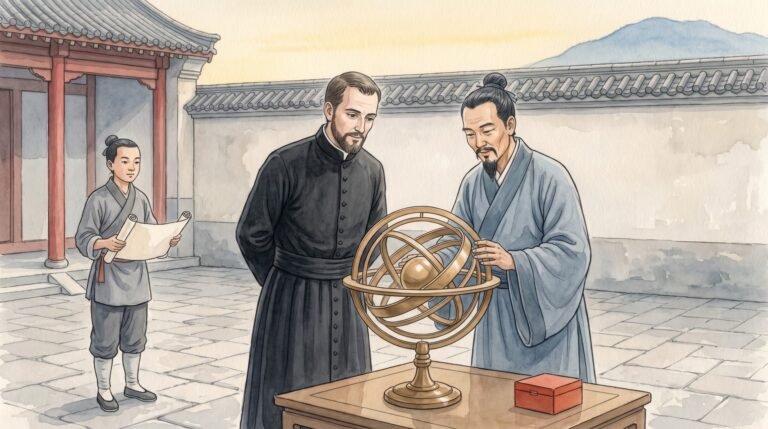
Then comes the catalogue of civilisation. Chinese tradition heaps upon the Yellow Emperor and his court an astonishing share of the inventions that define the culture. His minister Cangjie, whom legend gave four eyes, observed the tracks of birds and animals and devised the first written characters, an act said to have made grain rain from the sky and ghosts wail in the night, so great was the power it released. His principal wife Leizu discovered sericulture when a silkworm cocoon dropped into her tea, and taught the people to weave silk. His court musician Ling Lun cut bamboo pipes to fix the twelve standard pitches. His astronomers regulated the calendar; his craftsmen built the first carts and boats; his ministers established the offices of government and the first money. The Huangdi Neijing, the Inner Canon of the Yellow Emperor, cast as a dialogue between the ruler and his physician Qibo, remains to this day the foundational text of traditional Chinese medicine. Even the south pointing chariot of the Zhuolu legend was retrospectively claimed as an ancestor of the compass. In the Chinese imagination, the Yellow Emperor is not merely a king who reigned; he is the moment the machine of civilisation was switched on.
Even his colour carries meaning. Huang, yellow, is the colour of the centre in the Five Phases cosmology, the colour of earth, and the colour of the loess soil of the Yellow River basin from which Chinese agriculture grew. In the cycle of the elements, earth follows fire: the Yellow Emperor succeeds the Flame Emperor as naturally as soil settles after burning. The whole scheme of the cosmos ratifies the succession.
Nor does the story end with his death, because in one sense he did not die. At Dinghu, tradition holds, he cast a great bronze tripod; when it was finished a dragon descended from heaven, and the Yellow Emperor climbed onto its back and rode it into the sky. Seventy courtiers and consorts scrambled up after him; lesser officials clung to the dragon’s whiskers until the hairs pulled free and they tumbled back to earth with his bow, weeping. The mound at Qiaoshan, "Bridge Mountain", is therefore not quite a grave. It is the place where the ancestor left the world, which is a very different thing to build a cult upon.
The invention of the emperor
The Yellow Emperor’s most concrete gift to China is a word. When the king of Qin completed the conquest of the warring states in 221 BC and found that no existing title was grand enough for what he had become, he reached back into antiquity and compounded two terms, huang and di, both drawn from the divine sage rulers of high legend, and called himself Qin Shi Huangdi, the First August Emperor of Qin. For the next 2,132 years, until 1912, every ruler of China bore the title Huangdi. The word the Yellow Emperor bequeathed became the very word for emperor, the term at the heart of the Chinese state.
Sima Qian did something subtler and, in the long run, even more consequential. The Shiji does not merely record the Yellow Emperor as the first ruler. It arranges all of Chinese history as his family tree. His grandson Zhuanxu succeeds him; Ku follows a generation later; the sage kings Yao and Shun are his descendants. Then the genealogy branches into the dynasties themselves: Yu the Great, founder of the Xia, descends from the Yellow Emperor. The founders of the Shang descend from him. The royal house of Zhou descends from him. The ruling house of Qin, and even Liu Bang, the peasant who founded the Han dynasty in which Sima Qian himself lived, are all, in the Grand Historian’s construction, the Yellow Emperor’s heirs. The Shiji even records that of his 25 sons, 14 were granted surnames of their own, producing 12 clan names, the seed from which, in the logic of the tradition, the surnames of the Chinese people themselves descend.
This was a political decision of genius. The historian Mark Edward Lewis has observed that Sima Qian organised his entire history around the principle that the world had been ruled by a single unbroken chain of universal monarchs ever since the Yellow Emperor created the state. Every dynasty, however bloody its rise, could be written into the family. And every conqueror, even a foreign one, could be grafted onto the tree. The Shiji itself declares that the Xiongnu, the steppe nemesis of the Han, were descended from a fugitive prince of the Xia line, which is to say, from the Yellow Emperor too. The Tuoba Xianbei, who founded the Northern Wei, claimed descent from his son Changyi. Over the centuries the Qiang, the Khitan, the Mongols and the Manchus all produced genealogies connecting their ruling houses to the same ancestor. The family tree was an instrument of assimilation: to rule China, you joined the family, and to join the family was to become Chinese. The result was a civilisation with a uniquely powerful grammar of unity. China was not merely a territory or an empire but, in the deepest stratum of how the culture understands itself, a family. And a family can suffer division, but division is always the aberration, reunion always the restoration. The assumption that unity is the natural condition and fragmentation the scandal, the assumption that still shapes Chinese politics today, has its headwaters at Qiaoshan.
The god and the statecraft
For several centuries the Yellow Emperor was also a god, and a governing philosophy. In the early Han dynasty the court practised Huang Lao, a blend of the Yellow Emperor’s authority with Laozi’s doctrine of effortless action: rule lightly, tax lightly, interfere little, and let the world settle into order. The wounded empire, exhausted by Qin’s wars and legalism, recovered under exactly this prescription. When the tomb of a Han chancellor at Mawangdui was opened in 1973, among the silk manuscripts sealed inside two thousand years earlier were texts in which the Yellow Emperor appears not as a misty legend but as a working political philosopher, discoursing on law, war and the art of holding power. Religion absorbed him just as thoroughly. Deified as the Yellow God of the centre, he became one of the divine emperors of the directions, and the fangshi, the masters of methods who advised Han emperors on immortality, taught that the ruler who perfected himself might follow Huangdi up onto the dragon. Emperor Wu of Han, the most powerful man on earth, spent a fortune chasing precisely that ascent. No other founder figure in world history has been asked to be, at once, the first king, the first inventor, a theology of government and a ladder to heaven.
The sceptics and the archaeologists
But when, exactly, was this ancestor born? Not in 2697 BC, the traditional date, but in the texts. And here the story takes a turn that the ceremonies at Huangling politely ignore. In the 1920s the historian Gu Jiegang and the Doubting Antiquity School subjected China’s ancient chronicles to ruthless scrutiny and noticed something damning. The earliest strata of Chinese literature know nothing of the Yellow Emperor. The people of the Zhou dynasty spoke of Yu the Great; the age of Confucius added Yao and Shun; only in the Warring States period, barely two centuries before Sima Qian, do Huangdi and Shennong appear in writing at all. Chinese antiquity, Gu argued, had been built up "layer upon layer", each generation pushing the beginning further back and inventing ancestors to fill the space. The scholar Sarah Allan has traced how the figure may even have begun as a deity of the underworld, counterpart to the Shang sky god, before being turned by later historians into a ruler of flesh and blood. The Qing dynasty scholar Cui Shu had suspected as much two centuries earlier, and been ignored.
The archaeologists, working the ground rather than the texts, have complicated the picture without rescuing it literally. The third millennium BC in China was real and eventful, but it was plural. The Yangshao painted pottery villages of the Yellow River valley gave way to the Longshan world of walled towns and warfare; far to the south, Liangzhu raised cities, dams and exquisite jade on the lower Yangtze; on the northern steppe edge, the stone city of Shimao enclosed palaces behind cyclopean walls. The great archaeologist Su Bingqi described these early cultures as stars filling the sky: many centres, no single sun. The Yellow Emperor legend performs a deliberate simplification upon that diversity: it collapses a multipolar Neolithic into one lineage, one centre, one man. And yet it is not absurd to think that the legend preserves, in the amber of myth, a blurred memory of a real process, the consolidation of peoples in the Central Plains, the merger of agricultural tribes, the clash with eastern metalworkers, the way the Trojan War preserves a memory of Bronze Age conflict without requiring us to believe in Achilles. The myth is not a photograph. It is an encoding.
The ancestor of the nation
The Yellow Emperor’s second birth, and arguably his most consequential, came at the end of the world he had supposedly founded. In the dying years of the Qing dynasty, as China reeled from foreign invasion and revolutionary intellectuals cast about for a symbol of the nation, they seized on him. In 1903 the scholar Liu Shipei proposed that China abandon imperial reign dates and count its years from the Yellow Emperor’s birth, as Christians counted from Christ. Revolutionary journals adopted the scheme; the Tongmenghui’s newspaper Minbao dated 1905 as the year 4603. His portrait served as the frontispiece of nationalist magazines; an anthology titled The Soul of the Yellow Emperor became a revolutionary scripture. The pamphleteer Chen Tianhua told his readers that the Han were one great family descended from a single ancestor, and that the Manchu rulers were intruders in the family house. The mythic chieftain of the Youxiong clan was refitted as, in the words of one revolutionary journal, "the first great nationalist of the world."
There was, from the start, an argument over how wide the family was. The reformer Kang Youwei insisted that all 400 million subjects of the Qing, Manchu, Mongol, Tibetan, Muslim and Han alike, were sons of the Yellow Emperor; the racial revolutionaries wanted the family narrower. The broader reading won, and the ancestor of the Han became, in the language of the Republic and later the People’s Republic, the ancestor of the Zhonghua minzu, the Chinese nation in all its officially recognised diversity. Historians have traced how the line of descent was eventually projected back beyond the Yellow Emperor altogether, to Peking Man, so that the soil of China and its peoples could be presented as a single continuous organism. The family tree, as always, stretched to fit the politics.
Both of China’s modern governments made the pilgrimage. In 1912, having just proclaimed the Republic, Sun Yat-sen sent a delegation to Qiaoshan with a eulogy in his own hand. In 1937, as Japan invaded, both Nationalists and Communists sacrificed at the tomb, and Mao Zedong composed a eulogy of his own, vowing that the descendants of the Yellow Emperor would defend his inheritance. After 1949 the ceremonies lapsed, ancestor worship sat uneasily with class struggle, but from the 1980s they returned, and since the 1990s the Qingming rite at Huangling has been an official national event, designated in 2006 as part of China’s national intangible cultural heritage. Taiwan’s leaders have held parallel rites across the strait. In 2015 Xi Jinping stood in Shaanxi and called the mausoleum a spiritual symbol of Chinese civilisation. The party that once demolished temples now bows, annually and on camera, at the grave of a legend, because the legend does a job that no constitution can.
That job is worth naming precisely. Rome had Aeneas and Romulus, but Europe never agreed to stay one family; its foundation myths licensed division into nations. China’s did the opposite. The Yellow Emperor supplies China with a theory of itself: that the nation is ancient beyond record, that its peoples are branches of one stock, that unity across millennia is natural and division is a wound rather than a condition. When Beijing speaks of five thousand years of continuous civilisation, the count begins, roughly, with him. When it insists that Taiwan belongs to China, the argument beneath the argument is genealogical: the same descendants of Yan and Huang, on both sides of the strait, cannot be two peoples. Every state needs a theory of itself; most derive theirs from a religion, a revolution or a document. China derives it from an ancestor. That is why a figure with no archaeological footprint can fill a hillside with pilgrims every spring, and why the First Tomb Under Heaven, whatever lies beneath it, may be the truest monument in China: a shrine not to what happened, but to what a civilisation decided to remember.
References
- Shiji, Annals of the Five Emperors, Sima Qian, Chinese Text Project
- Yellow Emperor, Grokipedia
- Battle of Banquan, Grokipedia
- Battle of Zhuolu, Grokipedia
- Chiyou, Grokipedia
- Yan Emperor, Grokipedia
- Huangdi Neijing, Grokipedia
- Huang Lao, Grokipedia
- Doubting Antiquity School, Grokipedia
- Mausoleum of the Yellow Emperor, Grokipedia
- Yan Huang Zisun, the Descendants of Yan and Huang, Grokipedia
- The Discourse of Race in Modern China, Frank Dikötter, PDF