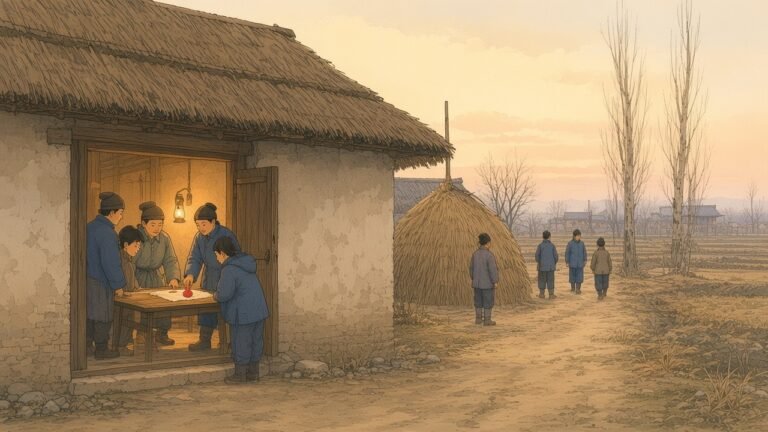
In the fifth century BC, a man who had just helped destroy a kingdom sat down beside a pond and began, of all things, to give advice about fish. Fan Li had served the state of Yue as strategist, guiding King Goujian through two decades of humiliation, patience and eventual revenge against the rival state of Wu. Then, according to the tradition, he walked away, changed his name, took up trade as Tao Zhugong, and grew so rich that the name is still a byword for merchant wealth. Somewhere in that second career, the story goes, he farmed carp, and wrote down how he did it.
The text attributed to him, the Yangyu Jing or “Classic of Fish Farming”, is usually cited as the earliest written treatise on aquaculture anywhere in the world. Its precise origins are murky: it survives only in fragments quoted in later compilations, and modern scholars, notably the Cambridge sinologist Roel Sterckx, treat the attribution as legend dressed as bibliography. But the legend is telling: in ancient China, a brilliant man turning his hand to raising fish carried no embarrassment at all. Fish farming entered the written record not as a peasant chore but as a gentleman’s science and a path to fortune.
Hold that pond in mind, and then look at a number. In 2024, according to the FAO’s latest State of World Fisheries and Aquaculture report, world aquaculture produced more than 100 million tonnes of aquatic animals for the first time, more than every fishing fleet on the planet landed from the wild. And of that farmed total, China produces roughly 57 per cent; not of Asia’s output, of the world’s. More than every other country put together, a position China has held for three decades, almost unremarked in Western commentary on its economy. The pond, not the factory, may be China’s most consequential technology.
The story of how that happened is not a story about technology transfers or state capitalism alone, though both matter. It is a story about the longest-running food technology in continuous use anywhere: the Chinese fish pond, an unbroken practice from Fan Li’s era to the 250-metre fish-farming ships now sailing the Yellow Sea. And it changes how you read much else about China: its food security, its ecological choices, its strange new machines.
The oldest instruction manual
What the surviving fragments of the Yangyu Jing describe, in essence, is a system: where to dig the pond, how deep to make it, which adult fish to keep as broodstock, how to stock and feed them. The FAO, which treats the text as a milestone in its official history of aquaculture, credits it with recording practical experience of raising carp in ponds so successfully that the author grew wealthy. Later sources rank fish-farming among the surest of livelihoods; whether or not Fan Li said so himself, the attribution stuck because it was plausible. In the classical Chinese world, the pond was serious business.
Carp were the obvious candidates. The common carp is omnivorous, hardy, tolerant of murky water and warm summers, and it breeds readily in captivity, the workhorse of early fish farming from Rome to medieval Bohemia. In China, captive carp appear in the record well over two thousand years ago, farmed in ponds beside rice paddies, fed on agricultural waste, and managed with the attention landowners gave to sericulture or orchards. Fish farming was never separate from farming; it was agriculture’s wet wing.
That integration mattered. A pond is not a pasture: it is a small, controlled body of water in which the farmer is not harvesting a wild population but managing one, husbandry rather than hunting,, the aquatic equivalent of the sheepfold. The distinction sounds trivial. It is the hinge of everything that follows.
An emperor’s surname changes the dinner table
Then a dynasty got in the way. In AD 618 the Tang house took power, and the Tang emperors’ family name was Li, pronounced, inconveniently, exactly like li, the word for common carp. Under the naming taboos that governed imperial China, farming, selling or eating a fish that shared the sovereign’s surname became at best impolite and at worst legally hazardous; later records describe an actual ban on the fish’s culture and sale. Historians of Chinese aquaculture, drawing on Sterckx’s work and the FAO’s account, treat it as one of the strangest and most consequential food regulations ever enacted.
Its consequence was accidental genius. Denied their traditional species, pond farmers went looking for alternatives in the rivers and found them, in a loose guild of species that came to be called the “four domestic fishes”: grass carp, which mow aquatic plants like underwater cattle; silver carp, which filter the phytoplankton blooming in the water column; bighead carp, which hoover up slightly larger zooplankton; and black carp, which specialise in crushing snails off the pond bottom.
Here is the remarkable part. A farmer who stocked all four was not running four monocultures but one designed ecosystem: each species occupied a different feeding niche, the pond’s productivity stacked vertically like floors in a building. The grass carp’s excrement fertilised the plankton that the silver and bighead carp ate; the snails that might otherwise overrun the pond fed the black carp. Nothing was wasted, because nothing could be. Polyculture, the practice now marketed to Western agronomists as an innovation in sustainable food systems, became the default architecture of Chinese freshwater farming roughly thirteen centuries ago, as an unintended consequence of imperial vanity.
Silkworms, pond mud and a circular economy before the term
The pond’s next refinement came from silk. In the deltas of the Pearl River and the Yangtze, farmers gradually assembled a system that modern agronomists struggle to improve upon: the mulberry-dike fish pond. Mulberry trees planted on the pond embankments fed silkworms; silkworm droppings and pupae, rich in protein, went into the water as fish feed; the nutrient-heavy mud dredged from the pond bottom each winter went back onto the dikes as fertiliser for the mulberries. Silk, the era’s most valuable export fibre, paid the capital costs; fish paid the household’s food costs; the mud closed the loop.
This was circular agriculture in the strict sense, nutrients cycling between pond, tree, worm and fish with almost no external inputs, and it supported some of the densest rural populations on earth. The FAO now recognises the Huzhou mulberry-dike and fish-pond system in Zhejiang as a Globally Important Agricultural Heritage System, one of a handful of landscapes it treats as working models of sustainable production rather than museums. Walk the water towns of the Yangtze delta today and you are walking the fossil geometry of that economy: villages strung along embankments, every dike once a mulberry hedge above water full of carp.
The lesson embedded in the landscape is one Chinese policy never forgot: water is arable. In most of the world, lakes, rivers and seas were commons to be hunted. In the Chinese tradition, they were, imperfectly, locally, but persistently, farmland that happened to be wet.
Cracking the seed problem
The traditional system had one hard constraint. The four domestic fishes, unlike common carp, would not breed in still pond water. They spawn in rushing rivers, and no farmer could persuade them otherwise. So every spring, for centuries, millions of wild fry netted from the Yangtze and Pearl rivers were sold upstream and down, in one of the largest wildlife-seed trades the world has ever run. The river set the ceiling on the ponds.
The breakthrough came at a state research institute, from a researcher named Zhong Lin. Born in 1915 in Guangdong, Zhong had spent years studying why the carps spawn when they do, and on 4 June 1958, at the fisheries institute in Nanhai, his team induced pond-raised silver and bighead carp to spawn by injecting them with fish pituitary hormones while simulating river conditions with flowing water. It was the world’s first successful controlled breeding of the Chinese carps, producing tens of thousands of fry. Within a few years the technique, refined and taught through state extension networks, had ended China’s dependence on wild fry altogether. Hatcheries, not rivers, now set the ceiling.
Artificial seed production is to aquaculture what the seed drill was to arable farming: the moment the whole system becomes programmable. The four Chinese carps subsequently spread around the world, to India, Southeast Asia, and the Americas, perhaps the most widely transplanted farmed animals in history. The Chinese Academy of Sciences has called Zhong’s achievement the fish-farming counterpart of the work that earned Tu Youyou her Nobel Prize; outside China, his name is scarcely known.
The pond boom
The 1958 breakthrough built the engine. What turned the key was a policy decision usually overlooked in histories of China’s reform era. In March 1985, the Party Central Committee and the State Council jointly issued instructions on “relaxing policies and accelerating the development of aquaculture”: in plain terms, freeing fish. Aquatic products, among the first protein markets to be liberalised at all, were opened to private trade and market prices, and the Fisheries Law that followed in 1986 wrote “special emphasis on aquaculture” into national statute. Ponds, recently collectivised, passed to household management.
The response was one of the fastest expansions of any food production system in history. In 1978, China’s entire aquatic output, wild and farmed, was around 4.6 million tonnes, aquaculture a modest fraction of it. By 1985, farmed production alone was above three million tonnes. By 1996, China’s share of world aquaculture had risen from about 17 per cent to more than half, a share it has never surrendered. By 2023, Chinese aquaculture was producing some 58 million tonnes a year, over four-fifths of the country’s total aquatic output, the remainder being wild capture that has been roughly flat for decades.
The consequences reached the dinner table with astonishing speed. In 1961, according to FAO food balance data, the average Chinese person ate 4.3 kilograms of aquatic food a year, mostly dried, salted or simply scarce. By 2021 the figure was 41.6 kilograms, roughly double the world average, with freshwater fish from ponds the single largest component. The chronic urban complaint of chiyu nan, “it’s hard to buy fish”, vanished from Chinese life within a generation, solved not by bigger trawler fleets but by water treated as farmland. The country’s protein transition, which in the West ran through chickens and pigs, ran in China through fish too.
It also ran through other people’s dinners. China became the world’s largest seafood exporter, accounting for around 12 per cent of world export value, and some of its export niches are startlingly precise. The Japanese eel, whose juvenile glass eels are still gathered from the wild because no one has fully cracked their captive breeding, is grown out in Guangdong and Fujian and shipped to Japan as kabayaki; according to a 2025 peer-reviewed study, around two-thirds to four-fifths of the eel eaten in Japan is now produced in China. Tokyo’s summer eel rituals quietly run on Chinese ponds.
The sea becomes a field, and pays the bill
Freshwater ponds, though, were only the first act. From the 1980s the same logic moved seaward: longlines of kelp and nori, rafts of oysters and clams, and net cages of sea bream and yellow croaker spread along the coast until China came to farm roughly 60 per cent of the world’s seaweed and dominate global bivalve production. Rongcheng, a county on the Shandong peninsula, harvests on its own something like 40 per cent of China’s kelp, over 1.7 million tonnes of fresh biomass in a good year.
But the saltwater boom carries an unpaid bill. Coastal aquaculture was a leading driver of one of the worst ecological losses in China’s modern history: the destruction of its mangrove forests, around 73 per cent of which disappeared between 1950 and 2000, cleared for shrimp ponds, rice and reclamation. The shrimp farms themselves crashed repeatedly to disease in the 1990s, a lesson in the fragility of high-density monoculture that the industry has absorbed slowly. And the system’s efficiency at home is partly purchased abroad: China imports around 40 per cent of the fishmeal traded in the world, drawn above all from Peru’s anchoveta fishery, to grind into feed pellets. Farming fish at Chinese scale still means hunting smaller fish elsewhere; the Peruvian coast is, in effect, an upstream annex of the Chinese pond.
The state’s response has been a recognisable Chinese pattern: acknowledge the damage late, then throw engineering and targets at it. A national mangrove action plan running from 2020 to 2025 aimed to halt the decline and plant new forest; by mid-decade China reported nearly 9,000 new hectares of mangroves, one of the few net national gains on earth, alongside its first technical standards for restoring them. Feed formulators, squeezed by fishmeal prices, have steadily cut the wild-fish fraction of pellets; carps, being largely vegetarian or filter-feeding, need little or none. The direction of travel is real; so is the scale of what was lost.
Ships that are farms
Which brings the story to the strangest vessels on the ocean. In May 2022, at Qingdao, a shipyard delivered the Guoxin 1: 249.9 metres long, rated at 100,000 tonnes, fitted with fifteen aquaculture tanks holding roughly nineteen acres of water: not a cargo ship that carries fish, but a ship that grows them. It cruises between water masses in the Yellow Sea, raising large yellow croaker, a once-common species fished to near-commercial-collapse, in conditions its crew can hold as constant as any pond. It cost around 450 million yuan, spawned a successor, and remains, as far as researchers can establish, the only large aquaculture vessel actually operating anywhere in the world.
The Guoxin 1 has a sibling idea 130 nautical miles offshore, where the Yellow Sea bottom holds a permanently cold water mass that oceanographers have known about for a century. Deep Blue 1, a submersible net pen built in 2018, sinks salmon into that natural cold reservoir at a latitude where salmon farming should be impossible: water cold enough to need no refrigeration. The first harvests came in 2021 and 2022. Not every experiment has paid off, and the economics remain unproven, but the concept is unmistakable: the same instinct that dug ponds beside Neolithic rice paddies, industrialised, stainless-steel and classed by a ship registry.
Official planning documents call the programme “blue granary”, the sea as grain reserve, and fold it into a food-security policy that treats aquatic protein as central rather than marginal. Whatever the ultimate fate of fish-farming ships, the bet behind them is old: water is arable, and the frontier is always farther out.
Humans retreat, fish advance
The clearest proof of how far the pond has travelled sits on the Yangtze. On 1 January 2021, China closed its longest river, from the main stem and key tributaries to the great lakes Poyang and Dongting, to productive fishing for ten years. It was one of the largest peacetime retirements of a food economy anywhere: some 231,000 fishers left the water and 111,000 boats were withdrawn. Officials summarised the policy in four characters, ren tui yu jin: humans retreat, fish advance. By the middle of the decade, monitoring showed the river’s aquatic life climbing out of the “no fish” category it had been assigned, and the Yangtze finless porpoise, the river’s last cetacean, inching back from the brink.
Pause on what made that politically possible. No nation that depends on hunting its waters can close a river the length of the Yangtze; ask any country debating its own fishing moratorium. China could, and did, because for four decades its aquatic supply had been built on farming, roughly four-fifths of it, by the end of the 2010s. Wild capture had become discretionary. The ten-year ban is, from one angle, an environmental policy; from another, it is the ultimate dividend of the 1958 hatchery and the 1985 liberalisation. The pond absorbed the fishers’ market; the river could then be given back.
The planet’s quiet protein shift
Zoom out, and China’s pond century turns out to be a preview of a global shift. In 2022, the FAO reported, world farmed production of aquatic animals (94.4 million tonnes) overtook the wild catch (91 million tonnes) for the first time, the crossing point of a trend line five thousand years in the making for China and about five decades for almost everyone else. By 2024 farmed output had passed 100 million tonnes, and aquatic farming now supplies more than half of all the fish humanity eats.
The reasons are not cultural; they are thermodynamic. Fish do not spend energy heating their bodies or holding themselves up against gravity, so more of what they eat becomes what we eat. A kilogram of farmed fish typically takes one to two and a half kilograms of feed; chicken needs around two, pork closer to three to five, beef six to ten. As the world adds billions of middle-class appetites against a backdrop of land, water and climate constraints, aquatic farming is the protein source whose physics point in the right direction, which is why the FAO now frames “blue transformation” as central to global food security, and why Chinese-style freshwater polyculture is studied from Egypt to Bangladesh.
None of this makes Chinese aquaculture a parable of virtue. It is an industrial food system, with the pollution, disease pressure, feed dependencies and labour conditions that industrial food systems have everywhere. But it is the largest one on earth, it is built on an ecological architecture older than most nations, and it crossed the threshold the rest of the world is now crossing a full generation early.
The newest pond
Fan Li is supposed to have left court because he understood that a statesman who knows the king’s secrets does not die in bed. Whether that is history or parable, his second act, the pond, the manual, the fortune, is the one with the longer afterlife. The Guoxin 1 steaming through the Yellow Sea is, in the end, the same wager in naval-architect form: that the dependable way to feed people is not to follow the wild shoal but to raise the animal in water bent to human purposes.
That is the lens the pond offers on China. The country is usually narrated through its dynasties, its wars, its factories and its chips, through sequences of rise, humiliation and catch-up. Seen from the water’s edge, a different continuity appears: a civilisation that treated rivers, lakes and finally open sea as arable land, that kept refining the same designed ecosystem from the Tang taboo to the submersible pen, and that converted a two-and-a-half-thousand-year habit into the world’s largest food-production system without most of the planet noticing. In 2022, when humanity’s farmed fish finally outnumbered its hunted fish, the rest of the world was not adopting a Chinese fashion. It was arriving, late, at a decision China had already made, back when a retired spymaster sat down beside a pond and started counting carp.
Sources
All load-bearing figures in this dispatch are supported by the entries below. Where a claim rests on a single source or a contested attribution, the Fan Li fragments above all, the text says so.
References
- FAO, The State of World Fisheries and Aquaculture: the 2024 first (235 million tonnes total production; farmed aquatic animals passing 100 million tonnes; aquaculture at 53 per cent of aquatic animal output) and the 2022 crossover (94.4 versus 91 million tonnes; China at 36 per cent of world aquatic animal production and ~12 per cent of export value). fao.org/fishery/en/publications/sofia
- NOAA Fisheries, Global Aquaculture: China’s ~58 per cent share of world aquaculture production. fisheries.noaa.gov
- W. Chen, “Current status of industrialized aquaculture in China: a review” (2023): the 57 per cent share of world farmed aquatic animals (2020) and the structure of the industry.
- Roel Sterckx, “Fish Farming in Pre-modern China”, T’oung Pao 111 (2025): the fragmentary transmission and disputed attribution of the Yangyu Jing, and the Tang-dynasty naming taboo on carp. brill.com
- FAO, aquaculture history milestones: the Tang ban and its role in the shift to the four domestic carps; the earliest-known status of the Yangyu Jing.
- FAO GIAHS: Zhejiang Huzhou Mulberry-dyke & Fish-pond System: the circular mulberry–silkworm–pond economy and its heritage designation. fao.org/giahs
- Chinese Academy of Sciences, Institute of Hydrobiology: Zhong Lin’s 4 June 1958 breakthrough in induced spawning of pond-raised silver and bighead carp. ihb.cas.cn
- FAO, “Aquaculture development in China: the role of public sector”; Yang et al. (2016), Food Policy: the March 1985 Party/State Council liberalisation and the output series from 1978.
- FAO food balance sheets via Our World in Data: per-capita aquatic food consumption rising from 4.3 kg (1961) to 41.6 kg (2021), roughly double the world average. ourworldindata.org
- Kaifu et al. (2025), global eel consumption study: around two-thirds to four-fifths of the eel eaten in Japan produced in China.
- FAO fishmeal trade reporting (March 2025); IFFO: China importing ~40 per cent of world fishmeal trade; Peru’s anchoveta supplying ~20 per cent of global fishmeal.
- Paulson Institute; gov.cn / China Daily: the ~73 per cent mangrove loss between 1950 and 2000 and the 2020–2025 restoration action plan results.
- J. Li et al. (2023), life-cycle assessment of a commercial kelp farm; People’s Daily Online: China’s ~60 per cent share of world farmed seaweed; Rongcheng’s ~40 per cent of national kelp output.
- Aquaculture Magazine and The Maritime Executive (May–June 2022): Guoxin 1 specifications, cost and delivery.
- The Fish Site: Deep Blue 1‘s design and first harvests. thefishsite.com
- Xinhua and Ministry of Agriculture and Rural Affairs reporting: the Yangtze ten-year ban, 231,000 fishers and 111,000 vessels retired, and recovery indicators.
- Fry et al. (2018), Environmental Research Letters: feed conversion ratios across farmed fish, chicken, pork and beef.