
The West thought China’s advantage was cheap labour. That now looks like one of the great economic misreadings of the past half century.
Cheap labour certainly mattered. So did ports, roads, industrial policy, foreign investment and an immense workforce. But none of those things quite explains why China became not merely a large manufacturer, but the centre of gravity of global manufacturing itself. Plenty of countries have low wages. Plenty have governments eager to attract factories. Plenty have built industrial parks and offered tax incentives. Very few have created anything resembling China’s astonishingly dense web of suppliers, subcontractors, engineers, traders, financiers, logistics companies and factory owners. And this is where Sterling Seagrave’s 1995 book Lords of the Rim suddenly becomes far more interesting than it probably seemed when it first appeared.
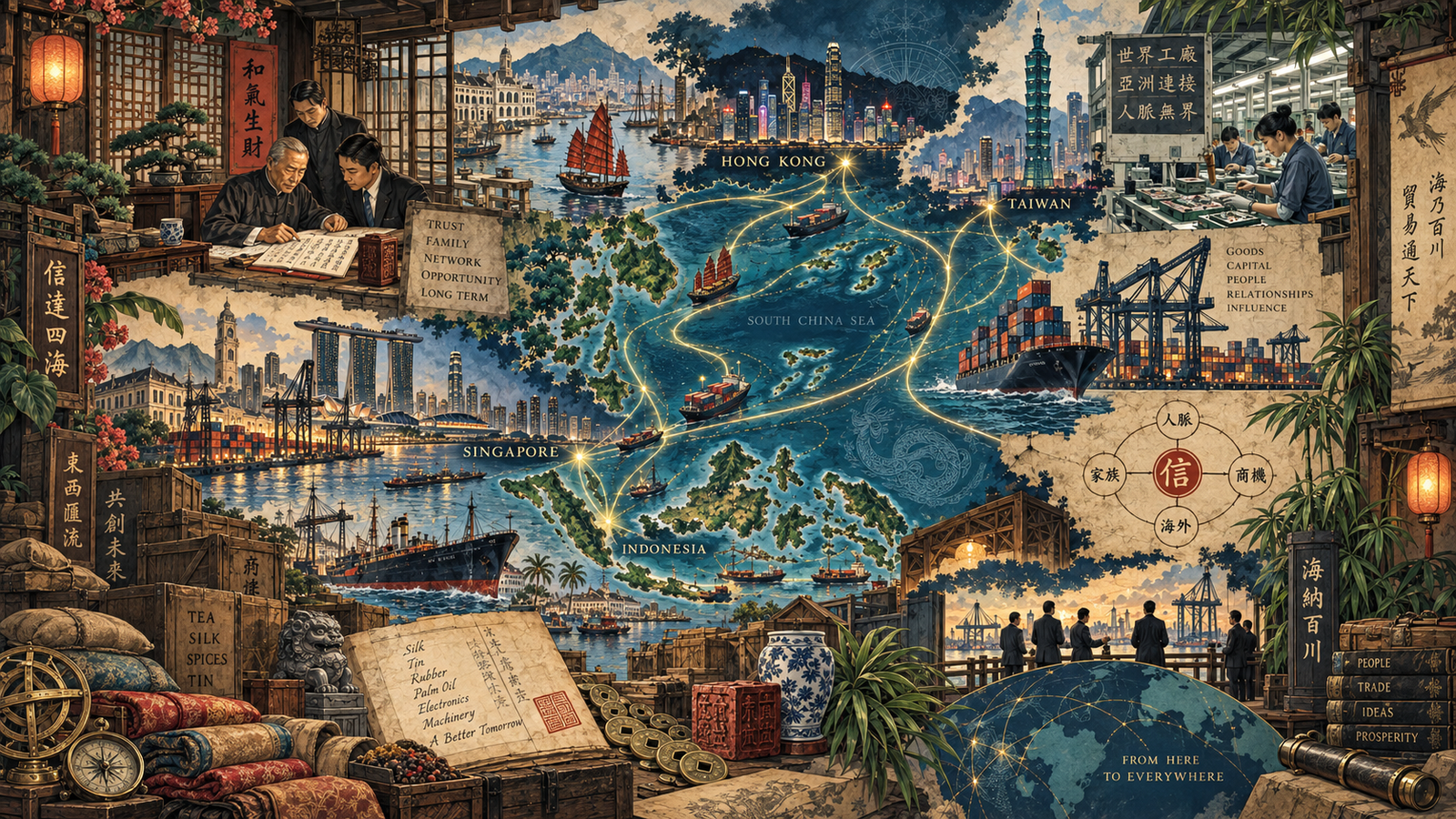
Seagrave was writing about the Overseas Chinese, particularly the great Chinese business families scattered across Hong Kong, Taiwan and Southeast Asia. His world was one of tycoons, family firms, personal connections, discreet partnerships and capital that seemed able to flow almost effortlessly across borders. The book could be melodramatic. At times Seagrave seemed determined to make Chinese capitalism sound mysterious, almost conspiratorial. He occasionally painted with too broad a brush, turning an immensely varied commercial civilisation into something more coherent and secretive than it really was. Yet beneath the sensationalism was an insight that has aged remarkably well. Chinese commercial power, he argued, did not reside simply in giant corporations or government institutions. It resided in networks.
That distinction matters enormously today. Modern manufacturing is not really about factories. It is about ecosystems. A factory without suppliers is just a building full of machines. What makes southern China, the Yangtze Delta and other major industrial regions so formidable is that the factory is surrounded by thousands of other factories. One makes screws. Another makes moulds. Another makes circuit boards. Another makes packaging. Another supplies chemicals. Another can redesign a component overnight. Another can produce a prototype by the end of the week. Engineers know engineers, factory owners know traders, traders know freight companies, and everyone seems to know somebody who can solve a production problem by tomorrow morning. That is not cheap labour. That is accumulated commercial density.
This is the part of China’s rise that is often underestimated. We like explanations that can be reduced to a statistic. Wages were lower. The currency was competitive. Infrastructure spending was enormous. The government subsidised strategic industries. All true. But industrial civilisation is harder to measure. It consists of habits, relationships, tacit knowledge and the constant circulation of information between thousands of people who know how to make things. It is what allows a product to move from sketch to prototype to mass production at a speed that outsiders often find difficult to believe. And it is exactly the sort of world Seagrave was describing before mainland China became the manufacturing colossus we know today.
The historical connection is especially striking because the rise of Chinese manufacturing did not begin in isolation. When China opened itself to outside capital, Chinese business communities in Hong Kong, Taiwan and Southeast Asia were among the people best positioned to take advantage. They spoke the language. They understood the culture. They had family and regional connections. They knew how to move capital and organise trade. Manufacturing capacity, business relationships and commercial know how began flowing into mainland China through precisely the kinds of networks Seagrave had spent an entire book describing. In retrospect, the Overseas Chinese commercial world looks less like a curious side story and more like one of the bridges connecting old Chinese trading culture to the new industrial China.
The result, three decades later, is staggering. China is now the largest manufacturing power on earth and accounts for roughly a third of global manufacturing output by some measures. More important than the headline number is the range. China does not merely dominate cheap consumer goods. It is deeply embedded in electronics, machinery, batteries, solar equipment, chemicals, electric vehicles, appliances, steel, industrial components and the intermediate goods other countries need in order to manufacture their own products. China is not simply selling the world finished objects. Increasingly, it is selling the world the machinery, components and materials from which the world makes other objects.
This is why the comforting idea that manufacturing can simply be moved elsewhere has always struck me as slightly naive. A company can move an assembly line. It cannot move an ecosystem nearly so easily. You can build a factory in India, Vietnam or Mexico. You cannot instantly recreate the thousands of specialist suppliers within driving distance, the experienced production managers, the toolmakers, the technicians, the freight infrastructure and the accumulated practical knowledge of an industrial region that has been manufacturing at enormous scale for decades. Manufacturing has a compounding effect. The more you make, the better you become at making. The better you become, the more customers come. The more customers come, the more suppliers appear. And the more suppliers appear, the easier it becomes to make the next thing.
That may be the most important lesson of Lords of the Rim. Economic power is often invisible before it becomes obvious. It accumulates in relationships long before it appears in official statistics. Seagrave was fascinated by the way Chinese merchants relied on trust, kinship, reputation and personal connections to move money and goods across borders. Today we might use a different vocabulary. We would talk about supply chains, industrial clusters, manufacturing ecosystems and network effects. But the underlying phenomenon is remarkably similar.
There is also something faintly ironic about the way China’s rise has been interpreted. For years, many Western observers treated Chinese manufacturing as a temporary stage of development. China would make the inexpensive goods while richer countries designed the sophisticated ones. As Chinese wages rose, manufacturing would naturally migrate somewhere cheaper. That was the theory. Instead, China moved up the value chain while keeping much of the lower end too. The cheap factory became the advanced factory. The assembler became the component maker. The component maker became the machine maker. The machine maker became the designer. What looked like a cost advantage turned out to be a learning advantage.
And learning advantages are much harder to dislodge.
This is why Lords of the Rim deserves another look. Not because every claim Seagrave made was correct, and certainly not because there is some mystical quality to Chinese business. The explanation is much more practical than that. Commercial networks matter. Industrial memory matters. Trust matters. Clusters matter. Experience matters. Once enough factories, suppliers, engineers, merchants and capital gather in the same economic ecosystem, something powerful happens. Manufacturing begins to reinforce itself.
Seagrave thought he was describing an invisible Chinese commercial empire stretching around the Pacific Rim. Thirty years later, much of that empire is no longer invisible. You can see it in Shenzhen’s electronics markets, in the factories of Dongguan, in the ports of Shanghai and Ningbo, in battery plants, solar factories, machinery workshops and the endless streams of containers leaving Chinese ports.
The real surprise is not that China became good at manufacturing. The surprise is that so many people thought it was only about cheap labour.