On 1 November 1949, in Beijing, the new government established the Chinese Academy of Sciences and appointed Guo Moruo its president.
He was a poet, a playwright, and a historian of ancient scripts. He was not a man whose name sat on a laboratory door. The appointment said what the new body was going to be. It was not a university with a lawn and a cohort of freshmen. It was the institutes the state had inherited, gathered under one name, with a writer to sign for them. Guo held that presidency from the founding until his death in 1978. By then the academy was a different size of thing from the one he had been handed. The rankings that now put it first are a way of counting the difference.
What he was handed had two parents. Academia Sinica had been founded in 1928, in Nanjing, under Cai Yuanpei, as the Republic’s central academy. The Beiping Academy had been founded in 1929, in the old northern capital. Between them they held the specialised institutes that Chinese science had managed to build in the short years between the Northern Expedition and the war with Japan. Many of the people in them had trained in Western universities, or had worked for the Republican government. Some in the new leadership worried about what those biographies implied. They kept the people anyway. An academy with no scientists is a letterhead.
The mountain above Nanjing
The easiest of those institutes to picture is on a mountain. The Institute of Astronomy of Academia Sinica was founded in Nanjing in 1928, and its observatory, on Purple Mountain above the city, was finished in 1934. The Nationalist government paid for it. A dome on a wooded slope, instruments, a staff who had to get up the hill. It was administered by the Republican academy, and when that academy’s mainland institutes were gathered into the new one, the observatory came with them. The institute is still part of the Chinese Academy of Sciences, and its papers still carry the academy’s name. That is the administrative idea in one building. The mountain is in Nanjing. The line on the page says Beijing.
The English name took longer to sort out than the institutes did. Into the 1980s the academy in Beijing was still, in English, Academia Sinica. The institution that continued in Taipei kept the same English name, and still uses it. For a generation the two words could mean either body, and a reader abroad had to look at the city, or the Chinese, to know which. The Chinese was never ambiguous. Beijing was Zhongguo Kexueyuan, the academy of sciences of the state. Taipei remained Zhongyang Yanjiuyuan, the central research academy, which is the name Academia Sinica translates. The collision was a translation both sides could live with, because each heard its own continuity in the English. The institutes did not float between them. The mainland ones had already been counted into the new academy.
In February 1950 the academy formed an Institute of Hydrobiology. The subject was less grand than a mountain observatory, and more urgent. War and the long disorder before it had ruined fish farms across the country. The leadership wanted the cultivated carp back. The institute’s work was the four species people actually ate, the quality of their stock, the practice of raising more than one species in a pond, and the unromantic details of feed, management, and fertiliser. It is worth pausing on the carp, because the academy is easy to describe as if it were a cabinet of famous laboratories. A great deal of it, at the start, was a ruined trade with scientists put onto it. Hydrobiology was not a metaphor. It was ponds.
The universities felt the same gathering. In 1952 the national reorganisation took comprehensive schools apart by specialism and built specialist schools out of the pieces. A number of the scientists did not go to another university. They went to the academy. Zhejiang’s share of that settlement is the one told in The University That Walked: agriculture lifted out, medicine lifted out, the arts sent to a teachers’ college, an engineering school left on the hill at Yuquan, and some of the scientists taken onto an institute payroll. The academy’s growth in those years was not only institutes it had founded on paper. It was people the universities had already trained.
Fifty-two Sanlihe Road
The profile published for the academy now, and repeated in the reference books, is a scale no single university has. One hundred and six research institutes. Two universities. 71,300 full-time employees, and 79,000 graduate students besides. The budget figure carried for 2023 is 171 billion yuan. That is the figure for the academy as a whole, not the spending of one laboratory, and it is large enough that a comparison with a faculty budget is the wrong comparison. A faculty is a building and a payroll. This is a payroll spread across the country, with a headquarters to sign the letters.
The graduate students are the part of that inventory a university reader understands too quickly. Seventy-nine thousand of them is not an entering class on one lawn. It is the academy’s training, spread through the institutes and through the two universities that carry its name. A doctoral student works where the instruments are, and the affiliation printed on the eventual paper is the academy’s, or the university’s, or both. That last case is the split an index has to untangle, and it is the reason the two universities later appear on lines of their own. The full-time staff, 71,300 people, are the rest of the same fact. Most of them are not in the brick building on Sanlihe Road. They are why a single porch can sit above a table that also contains Harvard. Harvard’s articles are the work of one university. The academy’s articles are the work of the people on that list, added together before anyone asks who won.
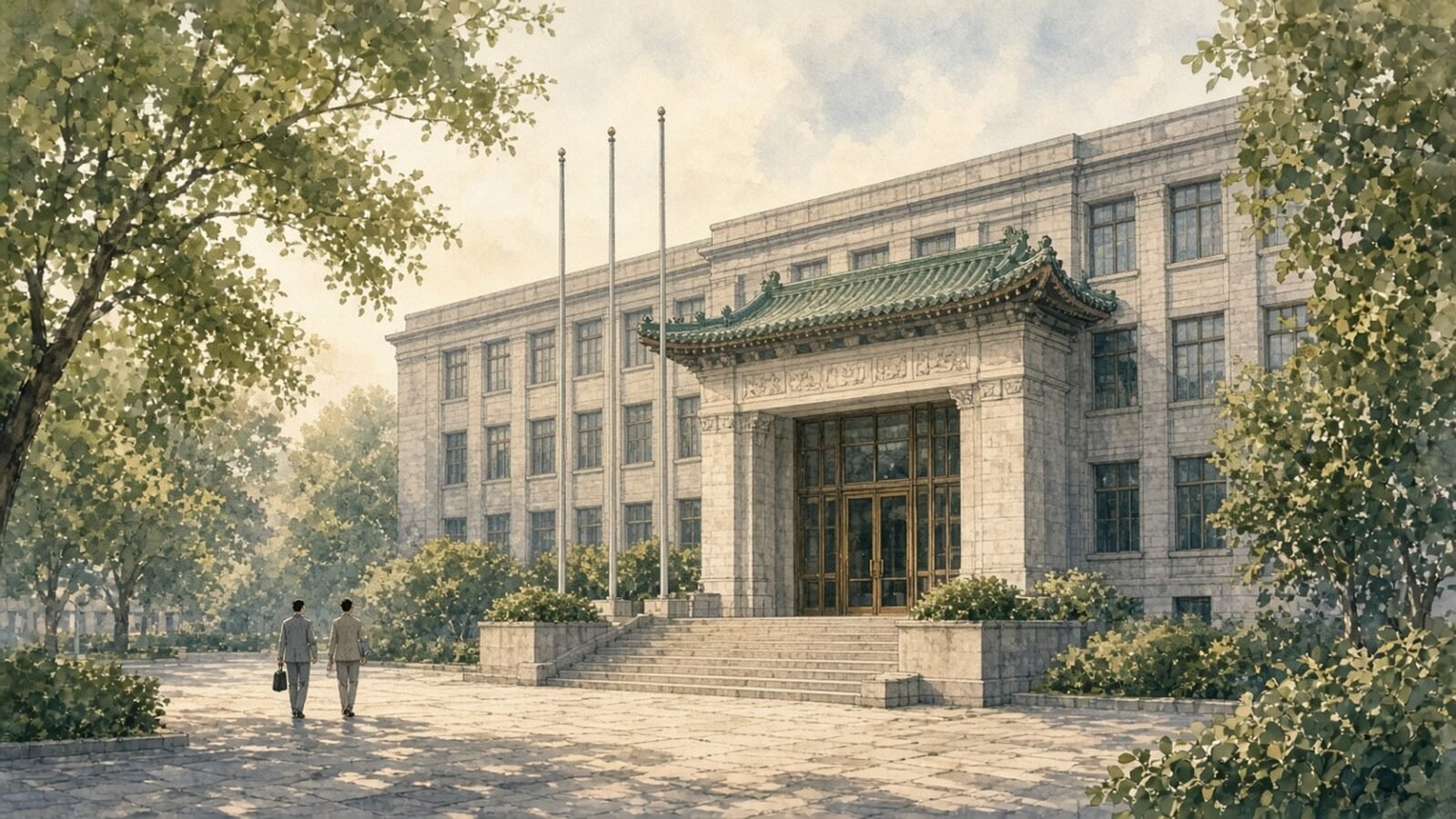
The headquarters is at 52 Sanlihe Road, in Xicheng, in Beijing. It is a brick block with a green-tiled porch over bronze doors, flagpoles on the pavement, and steps up from the street. It is an address, not a campus. Nothing important is done in the porch that could not be done in a borrowed room. The work is elsewhere, and the elsewhere is the point. A laboratory in one city, the observatory on Purple Mountain, a computing institute in Beijing, a telescope standing in a hollow in Guizhou: each has its own gate and its own director. Count them as separate schools and the country is full of laboratories of ordinary size. Count them as one institution, which is what a national academy is, and you have the body the rankings now put first. The brick porch is where that decision has a door.
The academy also built a university, because institutes consume students and somebody has to train them. In September 1958 the University of Science and Technology of China opened in Beijing, as the academy’s own school, with Guo Moruo named at its head. It was not a comprehensive university in the old sense, a place for law and literature and a little chemistry. It was a school for the sciences the institutes wanted. At the beginning of 1970 it was moved to Hefei, in Anhui, and the move stuck. Hefei is where the university still is. The graduate teaching that remained in Beijing did not disappear. In 2001 a graduate school of the academy was set up as the successor to that Beijing graduate school. On 23 July 2012 the Ministry of Education allowed the school to change its name to the University of the Chinese Academy of Sciences, and recommended that the old graduate-school name be retired. The academy then had two universities with their own gates, their own students, and, as the rankings later insisted on showing, their own lines on a table.
Not an academy of cabbage
Basic research was not the work of the Cultural Revolution years. Laboratories were given immediate tasks, or they were not given work at all. In 1975 Deng Xiaoping, as vice premier, put the correction into one sentence. The Academy of Sciences, he said, was an academy of sciences, not an academy of cabbage. He asked Hu Yaobang, a vice president of the academy, to draft an overhaul. Deng and Hu Qiaomu revised the draft. The outline they produced said that Chinese research had fallen behind what the country said it was building, and behind the advanced countries, and that catching up required basic science: a theoretical foundation, not an endless list of jobs for the next harvest. The sentence about cabbage was the part people repeated. The outline was the part that said what the institutes were for.
The following year Deng was purged, and the outline lost its protector. It did not lose its readers inside the academy. A month before his return in 1977, the outline was revived and adopted as the academy’s policy. The same year, the philosophy and the social sciences were taken out of the academy and made into a separate body, the Chinese Academy of Social Sciences, with Hu Qiaomu at its head. What stayed under the old name was the natural sciences. The split is easy to miss, and it decides what the later tables can even see. An index of journals in the natural sciences, and later in medicine and the applied fields, is an index of the body that kept the laboratories. The essays, the history, the economics, had been sent to another academy, with another president. By the end of 1978 the part that remained had 110 research institutes.
Guo Moruo had died in June of that year, still the president he had been on the first morning. The span is the academy’s first life. He had signed for the hydrobiology institute, for the scientists who arrived from the universities in 1952, for the school opened in Beijing in 1958 and later sent to Hefei, and for the years when basic research was out of favour. He did not live to see the companies, or the telescope in Guizhou, or a table that would put the academy first. He lived long enough to see the list assembled, and to see the argument about what the list was for written down as policy. The people who came after him inherited both the list and the argument. The rankings are what a later decade did with the inheritance.
The reform years changed how those institutes were run. The Soviet model, a single administrative plan laid over every laboratory, was dropped, and the academy became less of a ministry with microscopes and more of a holding body for places that did different things. The count of institutes moved as places merged and were renamed. The public profile now says 106 research institutes, against the 110 of the end of 1978. The two numbers are not a story of four closures told from a distance. They are a reminder that the academy is a list, and lists are edited. What was not edited away was the decision of 1949. The institutes were still one body, with one name, when the counting began in earnest.
Two hundred thousand yuan
Between 1984 and 1987 the academy encouraged its people to jump into the sea. The phrase meant leaving the security of an institute salary to start a company. The case everybody knows began in November 1984. Liu Chuanzhi and ten colleagues, eleven researchers from the Institute of Computing Technology, started a company of that institute with 200,000 yuan. Liu later described the money as coming from the institute. The company sold and assembled and, in time, designed. Its English name was Legend, and then Lenovo. The academy’s claim on it is not that a ministry planned a global firm. It is that eleven of its own people, and a sum of money small enough to name exactly, walked out of a computing institute and built one.
Lenovo is the famous exit, not the only one. The academy has started and spun off other firms since, some of them still close to the institutes that bred them, some of them not. The point for the size of the academy is that the payroll and the paper count do not exhaust it. A research body that tells its staff they may leave, and that stakes the first sum, is also an industrial policy, whether or not anyone in 1984 used the phrase. The 200,000 yuan is worth keeping in view beside the 171 billion, because the two figures describe different decades of the same habit. The state concentrates money and people in the institutes. Sometimes a piece of that concentration leaves, and becomes a company with its own gate. The ranking tables do not count the company. They count the papers the institutes still publish.
A hollow in the karst
The instrument that makes the present academy easiest to see is not on Sanlihe Road. In a natural hollow of the karst in Guizhou, the National Astronomical Observatories of the academy built a radio telescope five hundred metres across. It is called FAST. The observatories had charge of the construction, and of the operation afterwards. The dish was finished in 2016. It is a single site, a national project, a reflector sitting in a depression the geology had already dug, and the papers that come off it carry the academy in the address. The mountain observatory of 1934 and the dish of 2016 are the same administrative theory eighty years apart. Do the work in a province. Sign it with the academy.
FAST is one object, chosen because a person can hold it in mind. It is not a catalogue, and a catalogue would miss the way the work is actually spread. Hydrobiology is still an institute. The computing institute is still an institute. The observatories are still institutes. The ponds are still an institute. A reader who wants the academy to be a story of prizes will be frustrated, and should be. Prizes attach to people, and people move between the institutes, the two universities, and laboratories abroad. The durable fact is the list. One hundred and six research institutes is not a rhetorical flourish. It is an account of how many front doors the one name covers. The telescope is the front door a photograph can show. The others look like office compounds, campus gates, and buildings a city walks past without knowing the affiliation line that will be printed when the work is published.
A tenth, then a half
In November 2014 the Nature group began an index of research articles. It does not say which university teaches best, and it does not ask employers which name they admire. It counts papers in a list of journals chosen by committees, and it divides each paper among the institutions signed on it. The fraction is called Share. An article with ten authors gives each author a tenth. If one of those authors signs two institutions, that tenth is halved again, and each institution takes a twentieth. The number of articles, whether or not they were split, is called Count. The journal list was a natural-science list at the start, on the order of sixty titles. In 2018 it held 82. With the tables published in 2026, the publisher said the list had widened to 177 journals and one conference, taking in medicine, applied work, and the social sciences. A Share from one year is not a Share from another. The basket got larger. Anyone comparing a number from 2014 with a number from 2025, without saying so, is comparing two different indexes that happen to share a name.
On that index the academy has stood first since the list began. It did not climb past a reigning champion in a single season that can be dated and cheered. It was placed first when the counting started, and the later tables have kept it there while the basket widened and while Chinese universities filled the places immediately behind. The movement in the newest table is below it. In the release that covered 2024, Harvard was still second. In the 2026 table, which counts the papers of the calendar year 2025, Zhejiang has moved into second and Harvard into third. The academy’s place did not change. What changed is how far behind second place sits, and who is sitting there.
The phrase that travels, that the academy shot to the top, describes a feeling the table produces and not a year in which a place changed hands. There is no season, in the life of this index, when the academy was second and then became first. The earliest table and the latest table agree about the top line. What grew around it was everyone else. The journal list got longer. Chinese universities filled the rungs underneath. Harvard gave up second place to Zhejiang between the release that covered 2024 and the table that covers 2025. A body that was already first when the measuring began has not shot anywhere. The size was already the size. The index was new, and it was built in a way that a hundred institutes under one name would win.
The figures are these. The Chinese Academy of Sciences has a Share of 3,655.1, from 12,822 articles. Zhejiang University has 1,276.85, from 3,213. Harvard has 1,259.01, from 4,246. The academy’s Share is a little under three times second place, and the gap between first and second is larger than second place itself. Tsinghua is fourth, Shanghai Jiao Tong fifth, the University of Science and Technology of China sixth with a Share of 1,128.58, Peking University seventh, and the University of the Chinese Academy of Sciences eighth with 1,055.67. Further down, where the honest comparisons live, the Max Planck Society stands thirteenth, with 764.09. The French National Centre for Scientific Research stands sixteenth, with 701.98. Another institutional list, the SCImago ranking for 2025, also placed the academy first. It is a different measurement. It does not have to be the same measurement to leave the same name at the top.
Divide Share by Count and a second picture appears, quieter than the ranking and more useful. The academy keeps, on average, a little under three tenths of each article it appears on. Harvard keeps about three tenths. Zhejiang keeps about four tenths. The French centre keeps roughly a seventh of each article carrying its name, which is what the fraction does when a paper is signed by several institutions at once. The academy is not first because its papers are more purely its own than Harvard’s. The two fractions are close. It is first because the article count is about three times Harvard’s, 12,822 against 4,246, and the Share, being a fraction of about the same size, comes out about three times as large as well. Zhejiang’s articles are less divided, which is why a smaller count still edges Harvard. None of this is a judgement on the work inside a paper. It is the arithmetic the index chose, applied to the addresses printed under the title.
Harvard appears on more of the selected articles than Zhejiang does, 4,246 against 3,213, and still finishes a fraction behind. More of Harvard’s articles are shared with other institutions, and the fraction cuts them down. Zhejiang’s articles leave more of the Share at Zhejiang. The academy’s lead over both of them is volume: twelve thousand articles against four thousand, and against three thousand. Volume, here, is not a synonym for a busy campus. It is what a hundred and six institutes produce when a table agrees to add them up before it ranks them.
That agreement is the whole of the supremacy the table can honestly claim. The academy is not a campus that has out-published Harvard. It is a national research organisation scored as one institution. Max Planck is the comparison that respects the unit: a family of institutes under one name, large, serious, and not close. A single institute inside the Chinese academy is not, on these numbers, the first research body in the world. The line that adds the institutes is. Forget the unit, and the table becomes a miracle. Remember the unit, and the table becomes a description of a decision taken on 1 November 1949, and kept.
The two universities show the unit working in the other direction. Their Shares are not inside the 3,655.1. Hefei and the Beijing graduate university have their own lines, in sixth and eighth place, which is high enough that either of them, standing alone, would be announced as a triumph. An author who signs an institute and also signs one of the universities has already been split between the lines. Adding the three Shares together is a fair way to ask a wider question, about the academy plus the schools it runs. It is not a way of counting the same fraction twice, and it is not the comparison the index printed. The index printed the institutes as one body and put that body first. A reader who folds the universities back in is answering a question the table did not ask. A reader who folds them in without noticing, as if the 1,128 at Hefei were already part of the academy’s line, is counting a school twice in the imagination and not at all in the arithmetic.
Nor is any of this the table that ranks universities for teaching, reputation, and citations measured per head. The QS list and the Times Higher Education list answer that question, and the academy is not a university sitting on them. Set the academy aside, as a research organisation rather than a school, and the next name on the 2026 index is Zhejiang, then Harvard. Zhejiang’s own announcement called its place first among academic institutions. The distinction is real. It does not move the academy off the top of the wider list. It explains how a reader could be told, in the same week, that a university in Hangzhou had passed Harvard, and that an academy in Beijing was still far above both. Both sentences use the same index. They use a different first row.
The country table, printed in the same release and built from the same fractions, is the last correction. China stands first, with a Share of 52,735.17 from 59,472 articles. The United States is second, with 26,006.15 from 37,995. The Chinese national Share is about twice the American. The academy’s 3,655 is about seven per cent of the Chinese national Share, so the country’s lead is not one institution, however large that institution is. Zhejiang’s line is another piece of the same national sum, and so are Tsinghua, Shanghai Jiao Tong, Peking, and the long run of universities behind them. There is a second cut of the same numbers that travels less well. Share for every ten million people runs the other way: 374 for China, 774 for the United States. A country of about 1,410 million people can lead the sum and still trail, person for person, a country of about 336 million. Both sentences are the table. The one that fits on a headline is the sum.
Nor is the United States the only country the sum leaves behind. Germany stands third, with a Share of 5,827. Britain is fourth, with 4,820. Japan is fifth, with 3,890. China’s lead over the United States is a factor of about two. Its lead over Germany is a factor of about nine. The academy alone, at 3,655, is in the neighbourhood of Japan’s entire national Share, and well below Germany’s. That last comparison is the one that keeps the institutional ranking and the national ranking from being collapsed into a single boast. A hundred and six Chinese institutes, added together, outrun the Max Planck institutes and outrun the French national laboratories. They do not outrun Germany. The country called China does, and the academy is a large piece of the reason, not the whole of it.
The arithmetic of the country lines says something the institutional ranking hides. China’s Share sits close to China’s count of articles. America’s Share sits well below America’s count. A paper signed from more than one country is cut into smaller pieces, and American addresses appear more often on those mixed papers. The Chinese system, in this basket and this year, keeps a larger fraction of each paper it appears on. That can be read as depth at home, or as fewer partners abroad, or as both. The index does not choose. It only refuses to give a whole paper to every address printed on it.
On the morning the academy was established, none of these numbers existed, and the index was sixty-five years away. Guo was given the institutes two older academies had left him, a poet set over laboratories, and a name that English would confuse with Taipei for decades. The decision that the later table measures was the decision to keep those institutes inside one body, and to go on adding to the body: a hydrobiology institute, a university, a computing institute willing to stake 200,000 yuan, a dish in a hollow in Guizhou. A university is a place, and it can be merged, moved, or cut into pieces. An academy, in the form settled that November, is a list of institutes that will be counted together when somebody later decides to count. The Share of 3,655.1 is what the list produced in 2025, inside the basket of journals the index was using that year. It is large because the list is large. It is first because, on this way of adding, no other list adds up to as much. The cabbage sentence, the company, the telescope, the school sent to Hefei: each is an institute, or a university, doing one job. The ranking is the refusal to score the institutes as one job each.