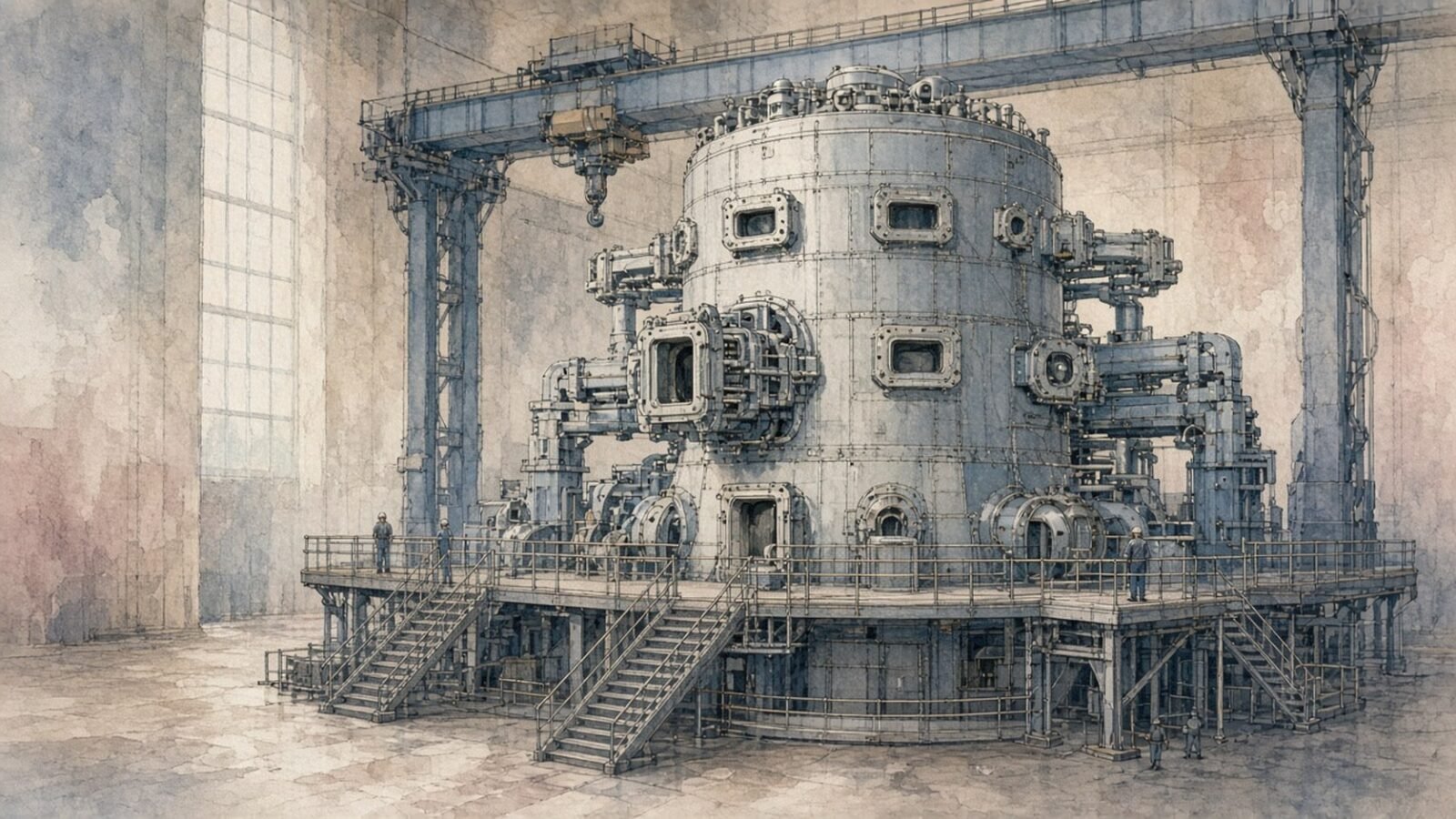
On the outskirts of Hefei, the capital of Anhui province, a large circular pit has been filling up with machinery. In October 2025 engineers lowered a 400-tonne steel base into it. In the summer of 2026 two of the superconducting magnets meant to sit above it passed their final tests. If the schedule holds, by the end of 2027 the site will house BEST, a machine designed to do something no Chinese device has done before: burn a mixture of deuterium and tritium and produce more fusion energy than it takes to heat the fuel.
Fusion, the process that powers the Sun, has been “thirty years away” for most of the past seventy years, and nothing in this article changes that basic caution. What has changed is the scale and speed of China’s effort. In the past two years Chinese machines have set a world record for sustained high-performance plasma. A state-owned fusion company has been launched with 15 billion yuan of capital. Private start-ups have raised billions more, and analysts in Washington now argue that China is out-building the United States in fusion infrastructure. This article explains what China has built, from EAST’s 1,066-second plasma and HL-3’s record temperatures to the BEST tokamak rising in Hefei, what its fusion programme has really achieved, and which claims deserve caution.
China’s fission programme, the reactors that already supply its grid, is covered in our article on how China became the world’s biggest nuclear builder. Fusion is a different technology with a very different timetable.
Why Fusion Is So Hard
Fusion releases energy when light atomic nuclei are forced together to form heavier ones. The easiest reaction to achieve on Earth combines two forms of hydrogen, deuterium and tritium, to produce helium and a fast neutron. Deuterium is abundant in seawater. Tritium is rare and radioactive, and a power plant would have to breed its own supply from lithium. To make the nuclei fuse, the fuel must be heated to well over 100 million degrees Celsius, far hotter than the centre of the Sun. At that temperature it becomes a plasma, a gas of charged particles that would destroy any material it touched.
The most developed way to hold such a plasma is the tokamak, a Soviet design from the 1950s. It uses powerful magnetic fields to confine the plasma in a doughnut-shaped vacuum chamber. The plasma must be hot enough, dense enough and confined for long enough at the same time. It must also be kept stable, because instabilities can dump its energy onto the walls in milliseconds. The key measure of progress is the gain, known as Q: the ratio of fusion power produced to heating power supplied. A Q of 1 is “scientific breakeven”. A power station would need much more, because heating systems, magnets and other equipment consume large amounts of electricity of their own.
No tokamak has yet reached a Q of 1 in a sustained way. The record for fusion energy from a magnetically confined plasma belongs to Europe’s JET machine, which closed in 2023. The only experiment to pass scientific breakeven, the US National Ignition Facility in 2022, used lasers rather than magnets and lasts billionths of a second. The international flagship, ITER, under construction in southern France with China as one of seven members, now expects to begin research operations in 2034 and deuterium-tritium experiments in 2039, after years of delays.
Two Institutes and an Artificial Sun
China’s fusion effort grew out of two research centres. The Southwestern Institute of Physics (SWIP) in Chengdu, part of the China National Nuclear Corporation (CNNC), has built tokamaks since the 1980s. The Institute of Plasma Physics of the Chinese Academy of Sciences (ASIPP) in Hefei turned a second-hand Russian device into its first superconducting tokamak in the 1990s, and then built its own.
That machine is EAST, the Experimental Advanced Superconducting Tokamak, which first produced plasma in 2006. It was the world’s first tokamak whose magnets were all superconducting. Superconducting magnets, cooled with liquid helium to about minus 269 degrees, can carry huge currents without resistance, which makes long pulses possible. Chinese media call EAST the “artificial sun”. It is modest in size, and its purpose has never been to produce net energy. It has been to learn how to keep a hot plasma running for a long time, a problem any future power plant must solve.
Over the past decade EAST has steadily extended its pulses in high-confinement mode, or H-mode, the efficient operating regime planned for ITER. According to ASIPP, it held such a plasma for 30 seconds in 2012, 60 in 2016, 101 in 2017 and 403 in 2023. On 20 January 2025 it sustained H-mode plasma for 1,066 seconds, more than seventeen minutes, which the institute described as a world record. A conference paper by the EAST team reports that the discharge used about 3 megawatts of radio-frequency heating, with a central electron temperature of roughly 10 kiloelectronvolts, a little over 100 million degrees.
The result needs some context. It was a record for duration in this operating mode, not for fusion output. EAST runs on deuterium alone, not the deuterium-tritium fuel of a power plant, and the 100-million-degree figure refers to the electrons rather than the fuel ions. But controlling heat on the walls, impurities and stability for over a quarter of an hour is a genuine engineering achievement. ITER’s own scientists co-authored the EAST paper, an indication of how much the international programme values the data.
Pushing Past a Density Limit
EAST’s other recent headline came in January 2026. Fusion power rises with the square of plasma density, but tokamaks have long been held back by an empirical ceiling known as the Greenwald limit. Above it, plasmas tend to become unstable and collapse. A team led by Zhu Ping of Huazhong University of Science and Technology and Yan Ning of the Hefei institutes reported in Science Advances that EAST had sustained plasmas at about 1.3 to 1.65 times this limit.
The researchers did this by carefully controlling the initial gas pressure and using microwave heating during start-up. This reduced impurities released from the tungsten walls. The experiments were designed to test a theory, developed by Dominique Escande and colleagues in France, which predicts a “density-free” regime when plasma and wall reach a particular balance. The finding is promising but early. It was achieved in specific start-up conditions on one machine, and whether it scales to the large, hot plasmas of a reactor remains to be shown.
Chengdu’s HL-3
In Chengdu, SWIP’s largest machine is HL-3, previously called HL-2M, which first produced plasma in December 2020. It is a conventional copper-magnet tokamak designed for high currents and temperatures rather than long pulses. In 2025 CNNC announced that HL-3 had reached ion temperatures of about 117 million degrees and electron temperatures of about 160 million degrees, a milestone it called “double hundred million degrees”. The ITER Organization, which signed a cooperation agreement with SWIP in 2023, has confirmed these figures and describes them as reproducible. It also reports plasma currents of 1.6 million amperes and a novel divertor configuration for handling exhaust heat.
The chief designer, Zhong Wulu, told state television that China’s fusion research was “entering the burning plasma phase”, meaning the stage at which heat from fusion reactions themselves starts to matter. That phrase describes an ambition rather than an accomplished fact; HL-3 has not run on tritium. HL-3 is also deliberately international. Teams from the United States, France, Japan, South Korea and other countries took part in its experiments in 2025, according to ITER.
BEST and the Leap to Burning Plasma
The machine that would actually test burning plasma is BEST, the Burning Plasma Experimental Superconducting Tokamak, now being assembled in Hefei. It is built and owned by Neo Fusion (Anhui), a company founded in 2023 with registered capital of 14.5 billion yuan. Its shareholders are mainly state funds from Hefei and Anhui, Kunlun Capital of the oil company CNPC, and a smaller stake linked to the electric car maker Nio.
BEST is described as compact, which in tokamak terms means a major radius of about 3.6 metres, against ITER’s 6.2 metres. It relies on stronger magnets to make up for its smaller size. Its published research plan aims first at scientific breakeven (Q of 1 or more) and then at gains of up to about 5 in deuterium-tritium operation, with long pulses. The main toroidal field magnets will produce about 6.5 tesla at the plasma when the 16 coils are combined.
Construction has moved quickly. Full-scale assembly began in May 2025, and the base of the vacuum cryostat, about 18 metres across and more than 400 tonnes, was set in place on 1 October 2025. In mid-2026 ASIPP announced that its first full-size toroidal field magnet, weighing 582 tonnes, had passed expert review. The institute says it is 1.3 times the size of an ITER toroidal field coil and stores three times as much energy. A high-temperature superconducting central solenoid coil also completed testing. Officials say all of BEST’s core technologies are now domestically produced.
The official target is completion by the end of 2027. Chinese media go further, saying BEST will demonstrate the world’s first electricity generated by fusion around 2030. That claim should be treated cautiously. Producing net fusion energy in the plasma is not the same as producing net electricity, and the research plan’s stated goals are physics milestones. Industry observers have also suggested that full integration of the main machine could slip into 2028. Even so, if BEST reaches a Q above 1 with deuterium-tritium fuel, it would be one of the most important results in the history of magnetic fusion, and it could arrive years before ITER’s tritium campaign.
The Engineering Behind the Machines
Much of China’s advantage lies in an unglamorous facility that supports BEST. CRAFT, the Comprehensive Research Facility for Fusion Technology in Hefei, is a large test complex for the parts a fusion reactor needs: superconducting magnets, heating systems, divertors that remove exhaust heat, remote-handling robots and tritium systems. Its subsystems have been accepted one by one through 2025 and 2026. It passed its first integrated performance tests in December 2025, though final national acceptance had not been announced at the time of writing.
This industrial base was built partly through ITER. Like the other members, China pays for most of its roughly 9 per cent share in kind, by making components. ASIPP manufactured ITER’s correction coils and magnet feeders, the complex systems that carry current and helium to the magnets. Consortia led by China Nuclear Power Engineering, a CNNC subsidiary, have won major contracts to assemble ITER’s vacuum vessel modules and other parts of the machine. The skills learned in France have flowed back into Chinese factories, and suppliers such as Western Superconducting Technologies now make conductor for both ITER and domestic projects.
China’s strength in electrical equipment, explored in our article on how China built an electricity grid the size of a continent, helps too. Fusion needs vast power supplies, cryogenics and precision steelwork, all areas where Chinese industry has scale.
State Money and a Fusion Company
In July 2025 CNNC launched China Fusion Energy Co., based in Shanghai, with registered capital of 15 billion yuan, about 2.1 billion US dollars. CNNC holds just over half. The other shareholders include Kunlun Capital, a Shanghai state fund, the National Green Development Fund, the utility Zhejiang Energy and a Chengdu state fund. Its job is to turn laboratory work, much of it from SWIP, into designs for engineering and commercial reactors. Even its parent was careful: Xinhua reported CNNC’s warning that fusion remains in development, “with uncertainties and even risks of commercial failure”.
The legal framework is also being built. China’s first Atomic Energy Law, adopted in September 2025 and in force from 15 January 2026, explicitly encourages research into controlled thermonuclear fusion. It also calls for a dedicated, graded system of oversight for fusion facilities, rather than treating them like fission reactors.
How much China spends on fusion is disputed. A figure of about 1.5 billion US dollars a year, roughly double US federal fusion funding, has been widely quoted since 2023. American outlets such as CNBC repeat it, but China does not publish a consolidated fusion budget. A 2025 report by the US Special Competitive Studies Project’s fusion commission estimated that China had mobilised at least 6.5 billion dollars for fusion infrastructure since 2023, possibly as much as 13 billion. These are outside estimates built from company registrations and project announcements, and they should be read as indications of scale rather than precise accounts.
Private Start-ups and Other Routes
Alongside the state machines, a private sector has appeared. The most advanced is Energy Singularity in Shanghai. In June 2024 it achieved first plasma on HH70, which it describes as the world’s first tokamak built entirely with high-temperature superconducting magnets. These newer superconductors, made from rare-earth barium copper oxide tape, work at higher temperatures and can produce stronger fields. That makes much smaller tokamaks possible, the same bet made by Commonwealth Fusion Systems in the United States. The company has also reported a large high-temperature superconducting magnet, called Jingtian, reaching 21.7 tesla, a result it has described in a peer-reviewed paper. It plans a larger machine, HH170, by 2027, and says it is aiming for a gain above 10. That target is ambitious and untested.
Others are trying different shapes and fuels. ENN, the gas group based in Hebei, runs a spherical tokamak called EXL-50U in Langfang. On 28 September 2026 the company announced that it had produced more than 100 million hydrogen-boron fusion reactions per second. Hydrogen-boron fuel produces few neutrons, which is attractive, but it needs far higher temperatures than deuterium-tritium. Reactions per second are not net energy, and the result is an early physics step rather than a path to power. Startorus Fusion is building a spherical tokamak heated by magnetic reconnection. A field-reversed configuration device in Chengdu is due to start operating by the end of 2026. Industry data cited by Chinese media suggest fusion start-ups raised more than 7 billion yuan in the first half of 2026, although that total is not independently audited.
There is also a hybrid proposal. Xinghuo, a planned fusion-fission plant in Nanchang backed by CNNC and the Jiangxi company Lianovation, would use fusion neutrons to drive a fission blanket. Its promoters cite a total investment of about 20 billion yuan and a gain of more than 30. They have spoken of completion around 2030 or 2031. The project has not received final approval, and its targets are claims, not demonstrated results.
Lasers in Mianyang
One part of China’s fusion effort is not about electricity at all. In January 2025 Reuters reported satellite imagery, analysed by Decker Eveleth of the US research organisation CNA, of a large construction site in Mianyang, Sichuan. It shows four laser-bay arms around a central target building. Construction documents identify it as a “Laser Fusion Major Device Laboratory”. Eveleth estimated the experiment bay to be about 50 per cent larger than that of the US National Ignition Facility.
Laser fusion, or inertial confinement fusion, compresses tiny fuel pellets with intense laser pulses. It is allowed under the Comprehensive Nuclear-Test-Ban Treaty, but it is also used to study nuclear weapons physics without explosive testing, which is why the National Ignition Facility exists. Analysts quoted by Reuters noted that the Mianyang facility could serve both energy research and weapons design. China did not comment. Its exact purpose and capabilities are unknown from the outside, so it should not be counted as part of the civilian power programme.
Is China Winning the Fusion Race
The phrase “fusion race” is now common in Washington. It reflects real facts: China is building more large fusion facilities, more quickly, than any other country, and it can make most of the components itself. In some areas, such as long-pulse superconducting operation, it leads.
But a race implies a finish line, and nobody has reached the first one. No Chinese machine has yet produced more fusion energy than it consumed. In the United States, Commonwealth Fusion Systems is building its compact SPARC tokamak, which it hopes will pass breakeven before the end of the decade. Europe, Japan and others hold expertise China still draws on. The hardest problems are shared by everyone: materials that can survive years of neutron bombardment, breeding tritium in a reactor blanket, running reliably for months, and making electricity at a price that competes with solar, wind and fission. On these, the honest answer is that nobody yet knows the solutions.
What China offers is a particular model: state-led, heavily funded, building one generation of machines while designing the next. That fits a pattern seen in other fields, described in our article on how China already owns the scale of science. The plan runs from EAST and HL-3, to BEST in 2027, and then to a planned demonstration reactor, now called CFEDR, for which no firm date has been fixed. Each step has been announced with confidence. Whether the physics cooperates is a different matter.
Conclusion
China’s fusion programme in 2026 is impressive and early at the same time. EAST’s 1,066-second pulse, HL-3’s temperatures and the density experiments are real, peer-reviewed or internationally confirmed results. BEST and the new magnets in Hefei show an engineering capacity that few countries can match. The money, from the state, from state-owned firms and increasingly from private investors, is large even if exact totals are uncertain.
The claims about first fusion electricity by 2030 deserve more scepticism. The step from burning plasma to a working power plant has defeated every programme that has tried it, and timetables in fusion have a long history of slipping. The most reasonable conclusion is that China has become one of the two or three places where the question of whether fusion can work will be answered. Within the next few years, the answer may well come first from the machine in the pit in Hefei.