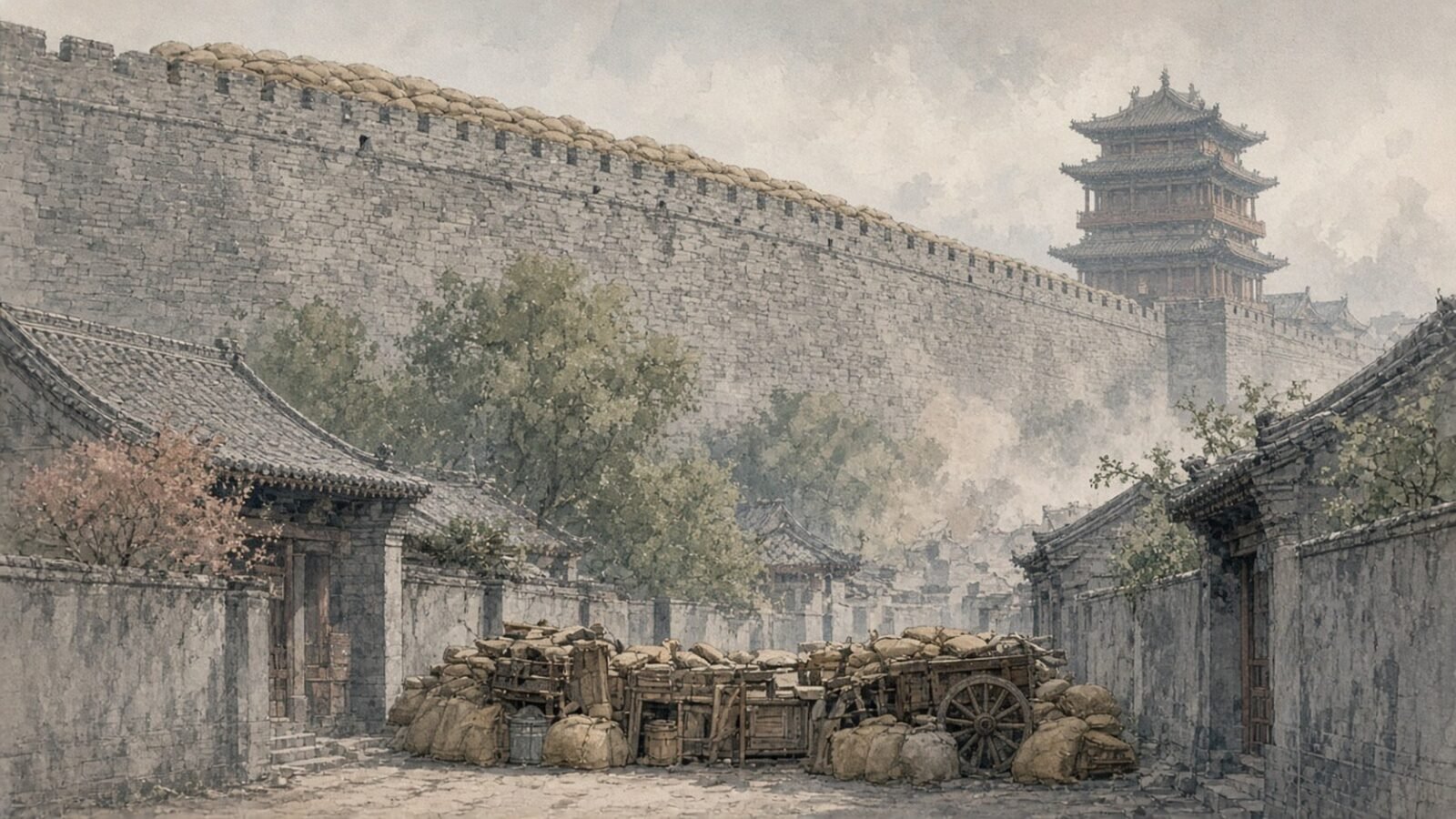
For fifty-five days in the summer of 1900, the diplomatic quarter of Beijing was a fortress under siege. Behind barricades of furniture, coal sacks and sandbagged gates, some nine hundred foreign soldiers and three thousand Chinese Christian refugees held a patch of legations, houses and the Su Wang Fu palace against waves of attackers: Boxer militia in red sashes, convinced by their rituals that bullets could not harm them, and behind the Boxers, regular troops of the Qing army, firing artillery at the envoys of eleven nations with whom their government had formally gone to war. Outside the walls the city burned. The German minister, Baron von Ketteler, had been shot dead in the street on 20 June while on his way to the foreign office. Messages from the besieged dwindled to rumours, and in London and Berlin the newspapers published obituaries for people who were, in fact, still alive, digging wells in the British legation’s tennis courts. The question that hangs over the whole episode, and over this essay, is the one nobody at the time could answer coherently: how did the government of China come to declare war on the entire industrialized world at once? The answer lies in the five years since Shimonoseki, and it runs through a failed reform, a peasant rising, an empress dowager’s gamble, and the final bankruptcy of a dynasty that had ruled for two hundred and fifty-six years.
This is the sixth essay in a series that has followed China from the Macartney embassy of 1793 through the kowtow crisis, the opium trade, two wars with the West and the failed self-strengthening of the arsenals. Here the story reaches the dynasty’s end. The seventeen years between the treaty of 1895 and the abdication of 1912 contain three attempts to save the empire, from above, from below, and finally from without, and each of them taught the next what would not work.
The melon and the knives
The defeat by Japan in 1895 changed the diplomatic weather of East Asia overnight. The war had revealed not only Chinese weakness but Chinese wealth worth seizing, and within three years the powers were carving. Germany, taking the murder of two missionaries in Shandong as its pretext, seized Jiaozhou Bay in 1897 and forced a ninety-nine-year lease. Russia, which had led the Triple Intervention that stripped Japan of its Liaodong conquests in 1895, claimed its reward by leasing the same peninsula in 1898, with Port Arthur and the railway rights through Manchuria. Britain took Weihaiwei, facing the Russians across the gulf, and extended Hong Kong with the New Territories lease. France took Guangzhouwan in the south. Contemporaries called it the scramble for concessions, or, in the phrase Chinese reformers used with a shudder, the slicing of the melon. Each lease came with railway zones, mining rights and spheres of influence, and with a new generation of soldiers, missionaries and engineers moving into the interior under treaty protection. The empire had survived defeat; what it now faced was partition by contract.
The shock detonated in the world that mattered most to Qing legitimacy, the examination elite. In 1895, as news of the Shimonoseki terms reached Beijing, thousands of provincial scholars were in the capital for the metropolitan examinations, and a Cantonese candidate named Kang Youwei organized them into a mass petition against the treaty, the famous examination candidates’ memorial, an act of organized political protest by the scholar class without modern precedent in China. Kang was a scholar of immense learning and mild charlatanry who had constructed a startling philosophical weapon: a reading of Confucius himself as a reformer, a progressive whose institutions had been falsified by later dynasties, which allowed him to argue that institutional change was not a departure from the sage but a return to him. Through study societies, newspapers and sheer relentless memorializing, he and his brilliant disciple Liang Qichao built a constituency for reform among young officials and literati. In June 1898 they got their hearing at the summit: the Guangxu Emperor, twenty-seven years old, intelligent, and suffocating under the regency-shadow of his aunt, the Empress Dowager Cixi, summoned Kang to audience and was converted.
One hundred days
What followed, between 11 June and 21 September 1898, was one of the most extraordinary episodes of modern history: an absolute monarchy attempting to transform itself by decree. Edicts poured from the throne at a rate the bureaucracy could not absorb. The examination system, thirteen centuries old, was to be reformed from essay-writing to modern subjects; a national school system and an imperial university were founded; ministries were to be rationalized, sinecures abolished, railways and mines promoted, the press freed, the army modernized, the budget made public. The emperor issued over a hundred reform decrees in three months. He had, however, almost no power to execute them. The governor-generals sat on the edicts; the Manchu establishment saw its privileges marked for abolition; and above the emperor stood Cixi, in nominal retirement at the Summer Palace, watching her networks report back. In September the plotters around the emperor, convinced that a military showdown was coming, approached Yuan Shikai, commander of the best modernized army in north China, to march on the Summer Palace and secure the Empress Dowager. Yuan, weighing the odds, reported the approach to her side instead, or at least let it be known. On 21 September Cixi moved first. The emperor was arrested by his own aunt, confined to the Yingtai pavilion on an island in the palace lakes, and kept there, a prisoner within his own Forbidden City, for the remaining ten years of his life. Kang Youwei and Liang Qichao escaped, with British and Japanese help, into exile and fame. Six of their colleagues did not. Tan Sitong, the most philosophically radical of the reformers, refused to flee, saying that the reforms of every nation had been watered with blood, and that if China had none, let it begin with him. He and five others were beheaded at Caishikou on 28 September. The first attempt to save the empire, reform from the throne, was over in a hundred days.
The Boxer summer
The second attempt came from the opposite direction, and it came from disaster. Shandong in the late 1890s was a province breaking apart: drought followed by catastrophic Yellow River floods, a countryside full of uprooted men, and on top of the old miseries a new one, the accelerating spread of missions and railways under treaty protection, which pushed foreign privilege, and the resentments it generated, deep into villages that had never seen a treaty port. Out of this countryside rose the society the foreigners called the Boxers, the Yihetuan, the Militia United in Righteousness: young men practising spirit-possession rituals and martial arts, drinking charms, and believing themselves invulnerable to bullets. Their targets were the things they could reach, Chinese Christian converts, missionaries, railway lines, telegraph poles, and their slogan, as the movement grew, became fatal in both its halves: support the Qing, destroy the foreign. Through 1899 and into 1900 the court wavered between suppressing them and using them. Officials who crushed the Boxers were replaced; officials who tolerated them prospered. By June 1900 Boxer bands were in Beijing, churches and foreign stores were burning, and the court faced the legations’ demands with a choice between a foreign war against the Boxers and a foreign war alongside them. On 21 June, after allied warships seized the Dagu forts, the dynasty chose, and issued a declaration of war against the powers.
It was a decision of magnificent irrationality, and it was not entirely the court’s own. Half the empire simply refused to obey it. The great governor-generals of the south and the Yangzi valley, the heirs of Zeng Guofan’s provincial power, concluded the so-called Mutual Protection agreement with the foreign consuls, declaring the war edicts false and keeping their provinces at peace, an act of quiet secession that revealed how far the centre’s authority had already decayed. The war, such as it was, was fought only in the north. The legations held through July and early August; the first relief column, Admiral Seymour’s mixed force of two thousand, was beaten back from the railway in June; and in mid-August an eight-nation army of some twenty thousand, half of it Japanese, fought its way from Tianjin and entered Beijing on 14 August 1900. The court fled west to Xi’an, the Empress Dowager travelling incognito in a common cart. Beijing was sacked. The Boxer Protocol of September 1901 priced the adventure: an indemnity of 450 million taels, one tael, pointedly, for every subject of the empire, payable over thirty-nine years with interest, a burden of nearly a billion taels; the legation quarter fortified and garrisoned by foreign troops in perpetuity; the Dagu forts demolished; foreign soldiers stationed along the railway from the sea to the capital; examinations suspended in the cities where foreigners had been killed; and proscribed officials executed or exiled. Russia, meanwhile, had used the crisis to occupy all of Manchuria, and stayed. The second attempt to save the empire, the dynasty riding the fury of the countryside, had ended with the capital occupied, the court in flight, and the empire paying by the head for its own population.
The dynasty reforms itself to death
And then came the strangest twist. The court that returned to Beijing in 1902, chastened and beggared, proceeded to enact, under the name of the New Policies, very nearly the whole programme it had beheaded Tan Sitong for proposing. A modern ministry system replaced the old boards. A new army, the Beiyang force built by the same Yuan Shikai who had betrayed the 1898 reformers, became the best military machine in China. Students were sent abroad by the thousand, above all to Japan, which had become the proving ground of Asian modernity and would become the incubator of Chinese revolution. In 1905 the dynasty abolished the imperial examination system altogether, ending, at a stroke, the institution that had linked the state to the scholar-gentry for thirteen hundred years. It was, on paper, the boldest reform in the empire’s history, and it was also an act of institutional suicide. The examinations had been the mechanism by which every ambitious family in China invested its sons in the dynasty’s survival; abolish them, and a million literati careers lost their anchor in the existing order, at precisely the moment when foreign ideas, nationalism, constitutionalism, republicanism, were arriving to tell those young men what else they might be. The court promised a constitution, convened provincial assemblies in 1909, and found that the assemblies became platforms for its critics. Reform, attempted in 1898 as an alternative to collapse, was attempted after 1901 as a means of survival, and it accelerated the collapse it was meant to prevent. There is a lesson here that political scientists have been refining ever since: the most dangerous moment for an old regime is the moment it begins to reform.
The third attempt to save China came from outside the system entirely. Sun Yat-sen was a different kind of revolutionary from anything the empire had produced: a Christian-educated doctor from the Cantonese delta, trained in Hawaii and Hong Kong, as much a product of the treaty ports and the diaspora as of China itself. His first uprising, at Canton in 1895, failed before it began; his kidnapping by Qing agents in London in 1896, smuggled into the legation and nearly shipped home for execution before a press campaign freed him, made him internationally famous; and through the 1900s, from exile in Tokyo, he welded the revolutionary diaspora into a league, the Tongmenghui, and sent uprising after uprising across the southern borders. Ten of them failed. The martyrs of the tenth, at Guangzhou in April 1911, were buried at Huanghuagang, and their failure looked final. Six months later an accident succeeded where design had not: on 9 October 1911 a bomb exploded prematurely in a revolutionary cell’s workshop in the Russian concession at Hankou, the police seized the membership lists, and the conspirators inside the army garrison across the river at Wuchang, faced with arrest and execution, rose the next night rather than wait to be taken. The Wuchang uprising of 10 October 1911 found the empire hollow. Province after province declared independence through the autumn, the provincial assemblies the court had created voting it out of existence. The dynasty recalled Yuan Shikai, the one man with a modern army, and Yuan did what Yuan did: he negotiated. By December Sun Yat-sen was back from exile to become provisional president of a republic proclaimed at Nanjing on 1 January 1912, and Yuan held the price of the dynasty’s surrender, the presidency for himself, in exchange for ending it.
The gardener
The end, when it came, was almost gentle. On 12 February 1912 the Empress Dowager Longyu, regent for the six-year-old emperor Puyi, issued the abdication edict, transferring, in its extraordinary phrasing, the mandate of the whole imperial order to the new republic and binding the five races of the empire into one state. No storming of palaces, no tumbrels. The Articles of Favourable Treatment let the boy emperor keep his title, his palaces and his court-in-miniature inside the Forbidden City, a dynasty in amber at the heart of a republic. The empire that had begun with the First Emperor in 221 BC, and had passed through twenty-four dynasties, ended with a signature and a pension. Puyi’s afterlife parodied the century: a twelve-day restoration by a pigtailed warlord in 1917; expulsion from the Forbidden City in 1924; then the supreme irony, installation by the Japanese as the puppet emperor of Manchukuo in 1934, ruling a pageant empire from Changchun while Japan consumed his ancestral homeland; capture by the Soviets in 1945; a decade in a communist re-education prison; a pardon; and finally, employment as a gardener in the Beijing Botanical Garden, where the last emperor of China tended plants under the People’s Republic until his death in 1967.
Looking back across the six essays, the long arc now stands complete in its first movement. In 1793 an empire that needed nothing sent the tribute envoy home with a jade sceptre. In 1842 and 1860 the gunboats took what the embassies had asked for. Between 1851 and 1895 the empire tried to answer with hardware, and bought ships without the society to float them. Between 1898 and 1911 it tried reform from the throne, fury from the villages, and transformation by decree, and each attempt buried the dynasty deeper. The question the whole series has been circling, how does a civilization built for one world remaking itself for another, did not end with the abdication; it was handed on, unresolved, to the republic, the warlords, the students of May Fourth, the communists of the Long March, and the revolutionaries of 1949. The empire had woken, exactly as Napoleon’s ghost kept promising, but waking, it turned out, was not an event. It was a century. The dynasty’s last lesson was the one Tan Sitong had paid for at Caishikou: that the reforms of every nation are watered with blood, and that China, in the century to come, would pay in full.