On 18 October 1860, British soldiers set fire to the Yuanmingyuan, the vast complex of palaces and gardens northwest of Beijing where, forty-four years earlier, Lord Amherst had been turned away at dawn from a closed gate. The burning was ordered by the British high commissioner, Lord Elgin, in retaliation for the torture and death of prisoners taken under a flag of truce, and it was chosen deliberately as a blow at the emperor rather than the people: the Summer Palace was the dynasty’s jewel, two hundred buildings across miles of landscaped lakes, filled with the accumulated treasures of a century of Qing collecting. It burned for days. In the storerooms the looters had found, among the jade and the silk, some of the mechanical presents brought by Lord Macartney in 1793, clocks and artillery pieces kept by the court that had publicly declared it had no use for ingenious articles, and privately kept them anyway. The loop opened by the first embassy closed in smoke. The Xianfeng Emperor had fled beyond the Great Wall to Chengde, where he died the following summer, and the treaty his brother Prince Gong signed in October 1860, ceding Kowloon, opening more ports, admitting ambassadors to Beijing at last, ended the second war between China and the West. It was not, however, the war that nearly destroyed the dynasty. That war was already raging inside China, and it was larger than anything the foreigners had ever inflicted.
This essay is the fifth in a series that has followed the long collision between the Qing empire and the West: two embassies broken on ceremony, the opium trade that replaced diplomacy, the destruction at Humen, and the war whose treaty would not name its cause. Here the story turns inward, to the thirty years in which China tried to answer the gunboats. It is a story in three acts: a rebellion that killed more people than any other conflict of the nineteenth century, a dynasty saved by its own provincials, and a programme of arsenals, shipyards and fleets that bought the future’s hardware and declined, fatefully, to buy its software.
The war inside
The Taiping rebellion began in the mind of a failed examination candidate. Hong Xiuquan, a Hakka schoolteacher from Guangdong, sat the provincial examinations four times and failed four times, and after the last failure, in 1843, he finally read a set of Christian pamphlets he had been given years before in Canton and recognized himself in them. A fever dream he had suffered in 1837, in which an aged father figure had charged him to slay demons, resolved itself into revelation: he was, he concluded, the younger brother of Jesus Christ, sent to cleanse China of idolatry and of the alien Manchu dynasty alike. It sounds like the biography of a village eccentric, and in Canton it would have remained one. But Hong’s cousin Feng Yunshan carried the new doctrine into the hills of Guangxi, among charcoal burners, miners and Hakka migrants ground down by exactly the dislocations the new order had brought: the post-war depression of the Canton trade routes, the spread of opium, the tax pressure of the silver crisis, the contempt of a distant and corrupt administration. The Society of God Worshippers grew into an army of the desperate. In January 1851, at Jintian, they rose, and Hong proclaimed the Taiping Tianguo, the Heavenly Kingdom of Great Peace.
What followed defies summary. The Taiping armies, disciplined, fanatical and growing by the hundred thousand, swept north out of the hills, took Nanjing in March 1853, slaughtered its Manchu garrison, and made it their heavenly capital. For eleven years they ruled a state within the state, a theocracy of startling strangeness: the Bible rewritten with Hong as a member of the Trinity, property held in common, women forbidden to bind their feet and admitted, in theory, to examinations, opium, tobacco, alcohol, gambling and prostitution all banned on pain of death, and a land programme promising every family its share. The dynasty’s hereditary banner armies proved worthless against them. By the late 1850s the Heavenly Kingdom straddled the Yangzi valley, the richest provinces of the empire were a battlefield, and the Qing were simultaneously losing a second war to the British and French, whose 1860 march on Beijing and burning of the Summer Palace happened while the Taiping still held Nanjing. An empire fighting the world’s greatest industrial power on its coast and the world’s largest rebellion in its heartland, with a treasury emptied by both, came closer to dissolution in 1860 than at any time since its founding. Estimates of the rebellion’s dead start at twenty million and reach twice that. No war between China and the West came within an order of magnitude of it.
The dynasty’s own men
What saved the Qing was not the court but the provinces, and the transformation that implied would echo for fifty years. Unable to rely on the banner armies, the throne turned to Han Chinese scholar-officials and authorized them to raise regional forces on their own credit. The greatest of them was Zeng Guofan, a Hunanese mandarin of granite self-discipline, who built the Xiang Army from the clans and villages of his native province into a force held together by personal loyalty, Confucian ideology and reliable pay, and who ground the rebellion down across a decade of siege warfare of medieval horror. Around him formed the group that would dominate Chinese politics for a generation: his protégé Li Hongzhang, who raised the Huai Army in Anhui and would become the empire’s indispensable negotiator and modernizer, and Zuo Zongtang, the abrasive genius who would later reconquer Xinjiang. Alongside them, in the lower Yangzi, operated the war’s strangest instrument: the Ever Victorious Army, a mercenary force of Chinese soldiers with Western officers, raised by the American adventurer Frederick Townsend Ward and, after Ward’s death in battle in 1862, commanded by a young British Royal Engineers officer, Charles George Gordon, whose storming columns cracked the Taiping defence of the Suzhou region. In July 1864 Zeng’s forces finally took Nanjing, tunnelling under the walls and blowing them in. Hong Xiuquan had died weeks before, of illness or despair, in his palace. The Heavenly Kingdom was put down city by city, and the dynasty, against all expectation, survived.
Survival came with a bill. The court in Beijing had been saved by provincial armies it did not command, financed by commercial taxes it did not control, and led by Han officials whose power rested on their own armies and networks. The centre of gravity of the empire had shifted permanently outward, toward the governor-generals, and above all toward Li Hongzhang, who from 1870 held the Tianjin superintendency that made him, in effect, China’s foreign minister, war minister and development agency in one. The self-strengthening that followed was their achievement and their limitation: it was a programme of modernizers who owed their careers to having saved the old order, and who never intended to replace it.
Buying the arts
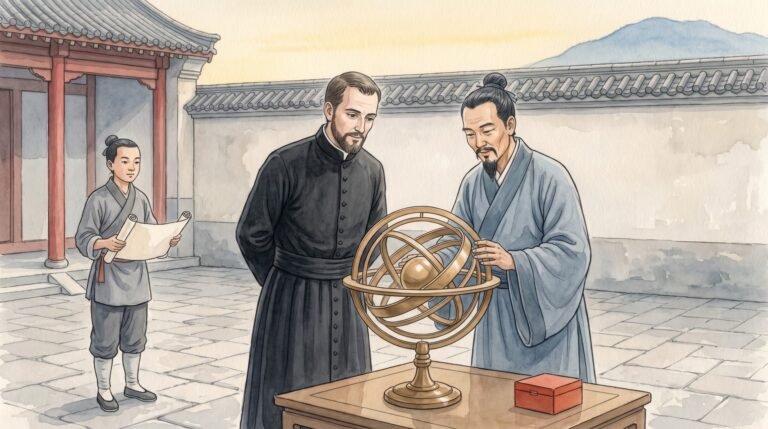
The men who had defeated the Taiping drew the lesson their enemies had taught. Gordon’s artillery, the steamers on the Yangzi, the Armstrong guns: the West’s superiority, they concluded, was material, and what was material could be acquired. In 1861 the empire created its first foreign office, the Zongli Yamen, and in 1862 a college of interpreters in Beijing, the Tongwenguan, which grew into a school of astronomy, mathematics and international law. In 1865 Zeng Guofan and Li Hongzhang founded the Jiangnan Arsenal in Shanghai, which became the greatest industrial complex in Asia, building steamships, guns and machine tools, and housing a translation bureau where the English missionary John Fryer and his Chinese colleagues coined, word by word, the modern Chinese vocabulary of science, rendering chemistry, calculus and electricity into a language that had never needed them. In 1866 Zuo Zongtang founded the Fuzhou Dockyard at Mawei on the coast of Fujian, with a school of naval architecture and navigation attached, directed for its first years by a French officer, Prosper Giquel. The precise terms of Napoleon’s St Helena prophecy, that China would get artificers and shipbuilders from France, from America, even from London, were fulfilled to the letter, and they were fulfilled as employees of the Qing state. In 1872 the empire sent its first great educational mission abroad: a hundred and twenty Chinese boys, dispatched in annual cohorts to Hartford, Connecticut, under the care of Yung Wing, the first Chinese graduate of Yale, to be educated in American schools and return as engineers. Among them was Jeme Tien-yow, who would build China’s first difficult railway. Steamship lines, coal mines, telegraph lines and cotton mills followed through the 1870s and 1880s, sponsored by Li Hongzhang under the formula that defined the era: Chinese learning as the foundation, Western learning for practical use.
The formula is worth pausing on, because it was the era’s philosophy and its trap. The foundation, the Confucian state, its examination system, its social order, was to remain untouched; the function, the ships and guns, was to be bolted on. It was a wager that an empire could import the products of industrial civilization without importing the institutions that produced them, the joint-stock finance, the technical education, the professional officer corps, the political authority to tax and reorganize. For twenty years the wager looked plausible. The arsenals grew; the translations spread; and in the 1880s the empire bought itself a navy that was, on paper, the strongest in Asia.
The fleet and the marble boat
The Beiyang Fleet, Li Hongzhang’s northern squadron, was the jewel of self-strengthening. Its core was a pair of German-built battleships, the Dingyuan and the Zhenyuan, seven-thousand-ton armoured ships with twelve-inch guns, ordered from the Vulcan yard at Stettin and delivered in 1885, at that moment the most powerful warships in Asian waters. Around them grouped cruisers built in Britain and Germany, torpedo boats, two fortified bases at Port Arthur and Weihaiwei, a naval academy, dry docks, and foreign instructors including the indispensable William Lang, a British officer who for a time effectively commanded the fleet’s training. When the Beiyang Fleet visited Japan in 1891, its battleships awed the Japanese public. The hardware was real.
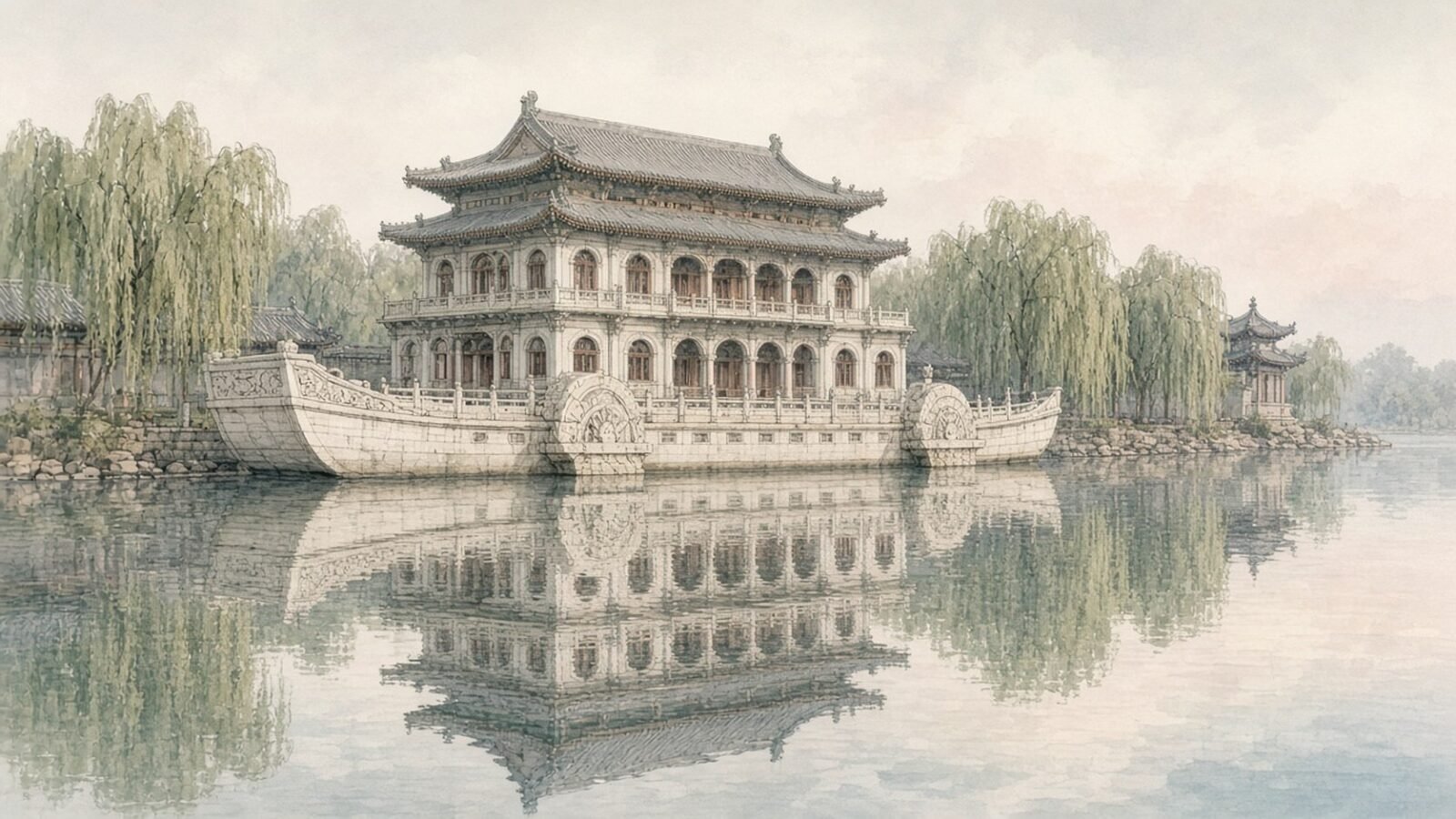
So was the rot inside it. The empire had no ministry of the navy worthy of the name; its four regional fleets answered to rival governor-generals and would not fight for each other. Procurement ran through patronage networks in which ammunition contracts were opportunities, and shell fill was sometimes adulterated on its way to the magazines. Training atrophied after Lang’s departure. And at the apex, the Empress Dowager Cixi, ruling from behind the throne, famously diverted naval funds to rebuild her own Summer Palace in Beijing, the Yiheyuan, where the marble boat she commissioned still floats on Kunming Lake, a stone monument to the era’s misallocations. Meanwhile, across the narrow sea, Japan was running the opposite experiment. The Meiji restoration of 1868 had not bolted Western function onto Japanese foundation; it had rebuilt the foundation itself, abolishing the feudal domains, conscripting a national army, centralizing finance, sending the Iwakura Mission around the world to copy constitutions, banks and schools wholesale. The two programmes were about to be tested against each other, but not before the fleet failed a first, smaller exam.
Two examinations, both failed
The first came in 1884, in the war with France over Vietnam. On 23 August the French squadron under Admiral Courbet, at anchor among the ships of the Fujian Fleet in the river at Mawei, opened fire at two in the afternoon and destroyed the pride of the Fuzhou Dockyard in under an hour: eleven Chinese ships sunk or burning, the dockyard itself shelled, the fleet built by Giquel destroyed by his countrymen within sight of the school where its officers had been trained. The lesson, that hardware without command, training and national coordination was a target, not a deterrent, was available to anyone in Beijing who wanted it. The response was genuine but partial: a naval board was created, more ships were ordered, and the Beiyang Fleet was husbanded as the dynasty’s irreplaceable asset. The deeper questions were deferred.
The second examination, in 1894, was decisive, and it was set by Japan. The war began over Korea, the last major tributary, where Chinese and Japanese ambitions collided; and in September 1894 the two navies met at the mouth of the Yalu River in the first fleet action between armoured steamships since iron had gone to sea. The Battle of the Yalu was not a rout: the Chinese line fought hard, the two German battleships absorbed enormous punishment and remained afloat, and the Japanese withdrew before dark. But five Chinese ships were sunk against none, and the Beiyang Fleet never again contested the sea. It retired behind the defences of Weihaiwei, where the Japanese took the port’s shore batteries by land, turned the guns inward, and in February 1895 forced the fleet’s surrender. Admiral Ding Ruchang, having fired his last shell and read the court’s refusal to relieve him, took poison and died at his desk. On land the Japanese had already taken Port Arthur, where their troops massacred the city’s population in days of killing that foreshadowed a darker century. In April 1895, Li Hongzhang, now an old man travelling to Japan to beg for peace, was shot in the face by a Japanese fanatic on his way to the negotiations at Shimonoseki; he survived, and signed. The treaty took Taiwan and the Pescadores, recognized the independence of Korea, opened more ports, granted foreigners the right to build factories in the treaty ports, and imposed an indemnity of two hundred million taels of silver, triple the empire’s annual revenue.
The answer that wasn’t
The defeat by Britain in 1842 could be explained away as a freak of distance and novelty. The defeat by Japan in 1895 could not be explained away at all. Here was an Asian neighbour, smaller, poorer, later to the game, which had faced the same gunboats and answered with transformation rather than acquisition, and had destroyed, in eight months, the work of thirty years. Every reformer in China drew the conclusion at once: the trouble was not the ships. The trouble was the state that had bought them. Within three years the Guangxu Emperor would attempt the Hundred Days’ Reform, an effort to remake the examinations, the bureaucracy and the economy in a single summer, and would be strangled by his own aunt’s coup; within five, the court’s desperation would gamble on the Boxers and bring an eight-nation army into Beijing; within sixteen, the dynasty itself would be gone. The self-strengthening era, judged as a programme, had failed. Judged as a beginning, it had done something irreversible: it had created the arsenals, the translated sciences, the engineers, the students abroad, and the national humiliation out of which every subsequent Chinese modernity, republican, nationalist and communist alike, would be built.
And the prophecy, as always in this series, keeps its ledger. Napoleon had said that China, attacked, would get artificers and shipbuilders from France, America and London, build a fleet, and in time defeat its enemies. The first half happened with eerie literalness: the French built Fuzhou, the English built the arsenal translation bureau, the Americans trained the boys of Hartford, the Germans sold the battleships. The fleet was built. It was then destroyed, not because the prediction was wrong but because it was incomplete: a fleet, it turned out, was not ships but the whole society afloat, and China had bought the ships first and the society not at all. The correction of that error, the search for the missing foundation, through reform, revolution, war and more revolution, is the story of China’s twentieth century, and of the essays to come. The marble boat still floats on Kunming Lake. Tourists photograph it daily, and the guides tell them what it cost: a navy, a war, and the last decades of an empire that tried, honourably and insufficiently, to wake.