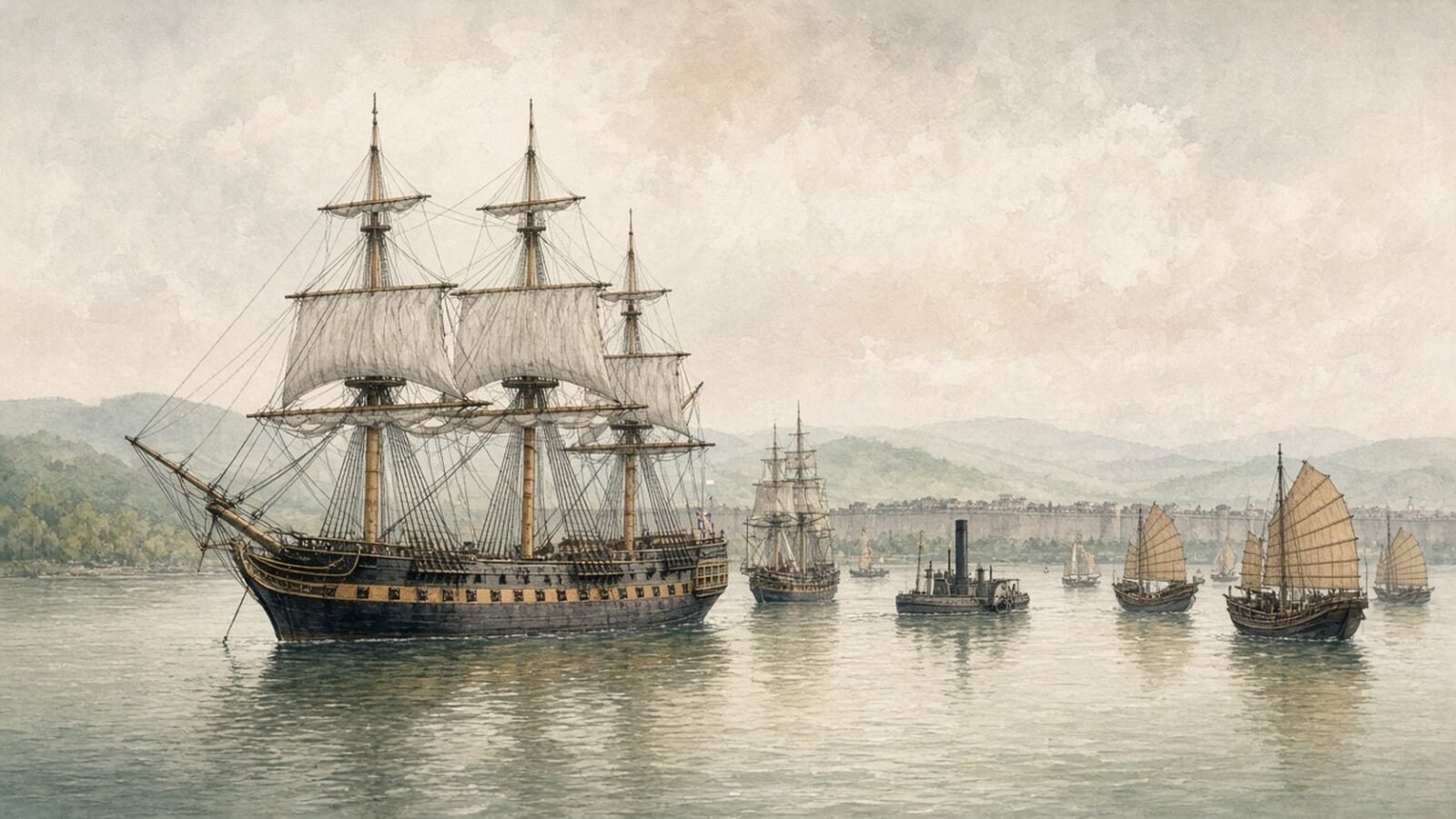
On 29 August 1842, in the great cabin of the 74-gun ship of the line HMS Cornwallis, anchored in the Yangzi River off Nanjing, three Qing commissioners sat down with Sir Henry Pottinger and signed away the settlement of a war. The ceremony was courteous. Pottinger had the table spread with refreshments; the imperial commissioner Qiying, an elderly Manchu of immense charm, had spent the preceding days cultivating his opposite number so assiduously that he had offered to adopt Pottinger’s young son as his own, an honour the British plenipotentiary declined. The document they signed, thirteen articles in English and Chinese, opened five ports to British trade, abolished the merchant guild through which all foreign commerce had passed for a century, ceded the island of Hong Kong in perpetuity, fixed the customs tariff, established official correspondence on a footing of equality, and committed China to pay twenty-one million silver dollars. Of those millions, six were earmarked as compensation for property destroyed three years earlier at Humen. Nowhere in the thirteen articles does the document say what that property was. The word opium appears in the Treaty of Nanjing not once. The war that Britain had just won, the first modern war fought between Europe and China, has no name in its own peace treaty, and the names it has acquired since, the Opium War on one side, the First Opium War, the unequal treaty, the beginning of the century of humiliation on the other, are all acts of later interpretation. The treaty itself maintains a perfect, negotiated silence.
This essay is the fourth in a series: two embassies wrecked on ceremony, the drug trade that replaced diplomacy, the commissioner who destroyed twenty thousand chests at Humen, and now the war. It lasted, with pauses for negotiation, from June 1840 to August 1842, and it was, from the British point of view, a small war: never more than twelve thousand troops, a score of warships, an expeditionary sideshow run from India while the empire’s real energies went elsewhere. From the Chinese point of view it was the collapse of the world order. That asymmetry, a colonial police action on one side, a civilizational earthquake on the other, is the central fact of the thing, and it is why the war is remembered obsessively in China and barely at all in Britain.
The fleet that came to the river’s mouth
The expedition that arrived off the Canton coast in June 1840 had been assembled in India under two joint plenipotentiaries, cousins named Elliot: Captain Charles Elliot, the superintendent who had taken the opium into Crown custody, and Admiral George Elliot. Its instructions, from Palmerston, were not to conquer China but to blockade it: seize an island base, choke the great trading estuaries, and carry the government’s demands, compensation for the destroyed opium, repayment of the hong merchants’ debts, treaty relations between equals, to the emperor himself, as close to Beijing as a fleet could get. The fleet did its first work at Zhoushan, the island group off the Zhejiang coast whose capture had been a British ambition since Macartney had asked for exactly such a depot in 1793. Dinghai, the main town, fell in minutes on 5 July 1840 to a naval bombardment that killed its commanding general and stunned the court, which had assumed the ocean was a wall. Then the fleet sailed north, past the mouth of the Yangzi, and in August anchored off the Dagu forts at the mouth of the river leading to Beijing itself, where it delivered Palmerston’s letter and waited for an answer.
What happened next taught the Qing the wrong lesson. The emperor’s councillor Qishan met the British at Dagu, listened sympathetically, blamed everything on Lin Zexu, and persuaded the Elliots to take the negotiations back south to Canton, where, he hinted, satisfaction might be had. The fleet, its crews already dying in alarming numbers from disease contracted in the Zhoushan garrison, where fever and dysentery killed hundreds and filled the hospitals with thousands, withdrew. Daoguang concluded that firmness and a scapegoat had worked: Lin Zexu was dismissed in disgrace and eventually exiled to Ili, the Central Asian frontier, and the court congratulated itself on having managed the barbarians by the ancient method of divide and deflect. It had, in fact, bought twelve months, and spent them preparing nothing adequate.
The year of the Bogue
The negotiations at Canton collapsed at the start of 1841, and the war’s real fighting began. On 7 January British forces stormed the forts at Chuanbi below Canton, and it was here that the war’s signature weapon first showed what it was: the Nemesis, an iron-hulled, shallow-draft paddle steamer built on the Mersey for the East India Company, the first iron warship to fight in Chinese waters, which steamed into the anchorage behind the forts and destroyed some fifteen war junks in a morning, with rockets and shell, against negligible return fire. Sail power could not fight up rivers; wind and tide dictated where junks could be. Steam obeyed no such grammar. The Nemesis could turn in a channel, choose its range, and tow sailing warships into positions the wind would never have given them. Every naval action of the war afterwards was, in essence, a demonstration of that single machine.
In late January, Charles Elliot, negotiating while the guns cooled, reached the Convention of Chuanbi with Qishan: Hong Kong to be ceded, a six-million-dollar indemnity, direct intercourse between equals. British troops landed on Hong Kong, a barren island with a fine harbour, on 26 January 1841. The convention then achieved the rare distinction of being repudiated by both governments. Daoguang had Qishan arrested in chains for conceding territory; Palmerston, contemptuous of terms so small, sacked Elliot and sent out Sir Henry Pottinger, a hard, ambitious soldier-diplomat, with instructions to demand more. Before Pottinger arrived the war around Canton reached its peak. In late February the British attacked the Bogue forts, the fortified throat of the Pearl River, and among the dead was Admiral Guan Tianpei, the Canton naval commander, who died at his guns refusing to leave his post; British ships are said to have fired a salute as his body was carried away, and he remains one of the war’s certified heroes in Chinese memory. In May the expedition reached Canton itself, occupied the heights above the city, and accepted a six-million-dollar ransom instead of burning it. Outside the city walls, meanwhile, occurred the episode Chinese historiography cherishes most: at Sanyuanli, villagers and local militia, enraged by looting and the violation of graves, surrounded and bloodied a British detachment, killing several soldiers, before Qing officials, honouring the ransom truce, ordered the militia to disperse and saved the foreigners. The lesson later Chinese generations drew was direct: the people would fight; the court would not let them.
Pottinger’s march to the Yangzi
Pottinger arrived in August 1841 with reinforcements and a plan of Palmerstonian clarity: forget Canton, strike the centre. Through the autumn his force took the coast cities one by one, Xiamen in August, Dinghai again in October, Ningbo days later, each fortress falling with a speed that demonstrated the gap between paper strength and industrial war. The Qing threw their counterstroke in March 1842, a night attack to retake Ningbo led by the imperial cousin Yijing, which failed so completely that the court’s last illusions about land battle went with it. The empire had vast armies on its rolls, but they were scattered in garrisons across a continent, armed in large part with matchlocks, spears and bows, drilled for bandit suppression and ceremony, commanded through a system that rewarded the reporting of victories that had not occurred. Against a small professional force with modern artillery, unlimited sea mobility and steam power, numbers dissolved into irrelevance. Even where the Qing fought bravely, and in many places they fought with desperate courage, the war had no mechanism by which their courage could matter.
The endgame, in the summer of 1842, was as coldly reasoned as anything in the annals of gunboat strategy. Pottinger abandoned the coast and drove up the Yangzi, the empire’s artery. Zhapu fell in May after a ferocious last stand by its Manchu garrison; the forts at Wusong, guarding the approach to Shanghai, fell in June, their veteran commander Chen Huacheng dying at his battery. Then, on 21 July, came Zhenjiang, the walled city at the junction of the Yangzi and the Grand Canal, and the war’s grimmest day. The Manchu banner garrison, some sixteen hundred soldiers with their families inside the walls, fought from street to street and, when the city fell, died by the hundred in an orgy of suicide, fathers killing their wives and children before themselves rather than accept capture. British troops, who had taken their heaviest casualties of the war that day, sacked the burning city. The strategic point was not lost on anyone in Beijing: with Zhenjiang in British hands, the Grand Canal, the artificial river that carried the grain tribute feeding the capital, was cut. The emperor could fight on, or his capital could eat. The fleet anchored off Nanjing, the dynasty’s old southern capital, in early August, and the court sued for peace.
Thirteen articles and a silence
The treaty signed on the Cornwallis at the end of that month, and the supplementary Treaty of the Bogue the following year, created the architecture of the next century. The five treaty ports, Canton, Xiamen, Fuzhou, Ningbo and Shanghai, opened the coast at its chosen points, and Shanghai, a middling county town on the mud of the Yangzi delta, became within a few decades the greatest city of Asian commerce. Hong Kong passed to Britain outright. The Cohong monopoly was abolished and the tariff fixed by treaty, around five per cent, removing China’s power to set its own customs duties, a sovereignty clause whose significance long outlasted the war. Extraterritoriality exempted foreigners from Chinese law, placing them under their own consular courts, which answered, in the Western frame, the complaint that had dogged every dispute since the sailors’ killing at Kowloon in 1839, and which Chinese of the time regarded as a modest arrangement, and Chinese of later generations as the badge of subjugation. The most-favoured-nation clause guaranteed that any concession wrung from China by any power accrued automatically to all, which meant that when the Americans and French arrived in 1844 to sign their own treaties, without firing a shot, they harvested everything Britain had fought for, and the treaty system acquired its self-multiplying character. Each agreement made the next easier and the whole structure harder to escape.
And the opium? The indemnity compensated the merchants; the drug itself was not mentioned, not legalized, not banned. It did not need to be. The treaty ports and the collapse of enforcement did the work that no article could have done politely: imports climbed past fifty thousand chests a year within a decade, and in 1858, after a second war, the Treaty of Tianjin legalized the trade outright and taxed it. The British government, which had insisted throughout that the war was about honour, compensation and equality, had in practice secured the one thing its merchants wanted, an open China, by the one method the Qing had always feared, force applied to the capital’s supply line. Qianlong’s edict of 1793 had refused every British request on the ground that the empire needed nothing; the treaty of 1842 granted nearly all of them, at gunpoint, and added a few the earlier embassies had not dared imagine.
Two memories
Among the more telling details of the war is the cost asymmetry. British battle deaths across two years of campaigning were in the low hundreds; disease killed more of the expedition’s soldiers than Chinese weapons did. Qing military deaths ran into the thousands, and civilian suffering, in the sacked cities and the suicides of Zhenjiang, into the thousands more. Yet within Britain the war faded almost immediately into the scenery of imperial routine, one more successful expedition in a century of them, remembered mainly through the prints of the Nemesis in action and the fortunes of the houses, Jardine Matheson above all, that built the treaty ports. In China the war never faded. It stands at the head of the narrative taught to every schoolchild: the first of the unequal treaties, the opening of the century of humiliation that runs from 1842 to 1949, the moment the Celestial Empire discovered that the ocean, which it had treated as a wall, was in fact a road, and that other people drove on it. Guan Tianpei at the Bogue, Chen Huacheng at Wusong, the militia of Sanyuanli, the banner families of Zhenjiang: the war supplied the founding martyrs of modern Chinese nationalism, and its anniversaries are still kept.
It is worth ending where the series began, because the war closes the loop the embassies opened. Macartney in 1793 asked for an island depot, open ports, a fixed tariff and relations between equals, and was sent home with a jade sceptre and a lecture. Amherst in 1816 asked for much the same and was expelled at dawn. In 1842 all of it was taken, in thirteen articles, by a fleet whose signature vessel was an iron steamer the size of a river barge. Napoleon, who had died at St Helena twenty-one years before the treaty was signed, had forecast both halves of it: the easy early victories, and then, in time, the immense empire acquiring the arts it lacked. The second half took longer than the first, and the process of acquisition, arsenals, shipyards, navies, industries, wars and revolutions, is the story of the century and a half that followed. The war’s own century, though, belongs to the treaty ports and the gunboats, and its founding document remains the treaty that would not say its name. Silence, it turns out, is also a settlement: each side was left free to remember a different war, and both have been remembering it ever since.