In the late summer of 1281, the largest amphibious invasion force the medieval world had ever assembled — perhaps a hundred thousand men, more than four thousand ships, drawn from the Mongol heartlands, from the conquered kingdom of Korea, and from the southern Chinese ports of the recently fallen Song dynasty — arrived off the western coast of the Japanese island of Kyushu. It came to compel the submission of a small island kingdom that had refused to acknowledge the universal sovereignty of Khubilai Khan, the Great Khan of the Mongol empire and the first emperor of the Yuan dynasty in Beijing. The invasion was the second of two such attempts. Seven years earlier, in 1274, the Mongol fleet had sailed once already against Kyushu and had been fought to a stand at Hakata Bay before withdrawing in some haste, in circumstances that contemporaries found difficult to explain. By 1281, the Mongols had brought overwhelming force. What they had not brought was the weather. On the night of 16 August 1281, a typhoon struck the anchored fleet as it lay at the mercy of the sea off the coast of Kyushu. Most of the ships were lost. Most of the men did not return to the mainland. The invasion was over. In Japan, the storm was immediately identified as a divine wind — kamikaze, 神風 — sent by the gods of the islands to defend the homeland. The legend has lived for seven centuries and more, in popular memory, in modern propaganda, in the history of military disaster, and in the difficult question of how the most powerful empire in the world could lose to a small, isolated, and technologically less impressive adversary twice in seven years.
The Mongol empire and the question of Japan
To understand the invasions, one has to understand what they meant to the side that sent them. Khubilai Khan had spent most of his long political life extending the reach of the Mongol empire eastward and southward. He had finished the conquest of the Song dynasty in the south of China in 1276, after a war that had lasted more than thirty years. He had sent armies into Burma and into Vietnam and into Java. He had fought, intermittently, with the kingdoms of mainland Southeast Asia, sometimes successfully and sometimes not. He had accepted, with reluctance, the fact that some polities could not be brought under his direct administration — the kingdoms of central Burma, the Đại Việt of the Red River valley, and the small archipelago of Japan, that curved string of islands off the eastern coast of Asia that the Chinese called Riben and that the Mongols had only the sketchiest geographical knowledge of.
Japan was not, in the long run of Mongol foreign policy, the most important of the unconquered polities. The Yuan had far more to lose in its long war with the Song, in its conflicts with the kingdoms of Southeast Asia, and in its struggles with the various Mongol successor states that were already splitting away from the great empire of Chinggis. But Japan was, by the standards of the Mongol world, the most visible failure. Khubilai’s grandfather Chinggis Khan had, in his time, insisted that all peoples under heaven must accept Mongol authority or be destroyed. The refusal of any one polity to do so was, in the Mongol understanding, a wound to the legitimacy of the universal empire. Japan had refused, and had continued to refuse, and the refusal was visible to every court of the Mongol world. To accept that refusal was to admit that the universal empire had limits. Khubilai was unwilling to admit that.
The first formal attempt at diplomatic contact between the Yuan court and the Japanese court came in 1266, when the Yuan sent a letter through Korean intermediaries to the Japanese court in Kamakura, asserting the authority of the Great Khan and demanding that Japan send tribute. The Japanese were at this point in the late Kamakura period, ruled by the shogunate of the Hōjō regents on behalf of the boy emperors in Kyoto. The shogunate’s answer, when it came, was to refuse. The shogunate had no diplomatic machinery to deal with a letter from a foreign emperor that arrived through a vassal state, and its own court protocol gave no guidance on what to do with such a request. The reply was, in effect, that Japan had its own gods and its own rulers and saw no reason to send tribute to a foreign power. A second letter was sent in 1268, and a third in 1271, each reasserting the Yuan demand for submission. Each was, in effect, ignored.
By 1272, the patience of the Yuan court was beginning to run out. The Japanese refusal was no longer a matter of a single misdirected letter. It was becoming a question of whether the Great Khan would tolerate a refusal at all. Khubilai was at the height of his prestige in this period. He had been crowned emperor of the Yuan in 1271, in a ceremony that combined Mongol and Chinese imperial traditions. He had at this point every reason to believe that his authority would extend to the eastern seas. The refusal of the Japanese court, in this context, was not merely an inconvenience. It was a challenge to the legitimacy of the new empire.
The first invasion, 1274
The first invasion fleet was assembled in 1273 and 1274, with the cooperation of the Korean court, which had been a Mongol vassal since the 1230s. The Koreans built the ships, in part because the Mongol empire did not at this point have a great naval tradition of its own. The Mongols were a steppe people, masters of cavalry, and the construction of ocean-going vessels was a craft they had to import. The Korean shipyards of the Goryeo dynasty produced more than nine hundred ships for the invasion, with several hundred more added from Chinese ports. The invasion force has been estimated at between twenty-three and forty thousand troops, of whom perhaps a quarter were Mongols, the remainder being Koreans and northern Chinese.
The fleet sailed from Korea in October 1274 and made landfall at Hakata Bay, on the northern coast of Kyushu. Hakata was the principal port of Kyushu and the seat of the Hōjō regent’s local administration. The Mongol army landed in good order and attacked the city, which fell after a short resistance. The Japanese defenders withdrew south to a defensive position on higher ground. They fought a delaying action over the course of the first day, without managing to push the Mongols back from the beaches. But the Mongols did not pursue. After one day of fighting, they withdrew to their ships, and in the night of 19 October 1274, they sailed away.
Why did the Mongol force withdraw? The traditional Japanese answer, preserved in a number of contemporary chronicles, was that the fleet was destroyed by a storm. A typhoon is recorded in the chronicles for the night of the withdrawal, and it is possible that the Mongol commanders, in any case facing a difficult position on the beaches, took the storm as a sign that they should return. The Korean chronicles of the period, by contrast, suggest that the withdrawal was a strategic choice rather than a forced retreat. The Mongol force had taken casualties in the day’s fighting, the horses had not been unloaded effectively, and the Japanese defence on the high ground was stronger than had been anticipated. The Korean commander, Kim Bang-gyeong, advised a return to Korea; the Mongol commanders, who had no particular reason to insist on a land campaign they had not planned for, agreed. The fleet returned to Korea. The first invasion was over, but neither side considered the matter closed.
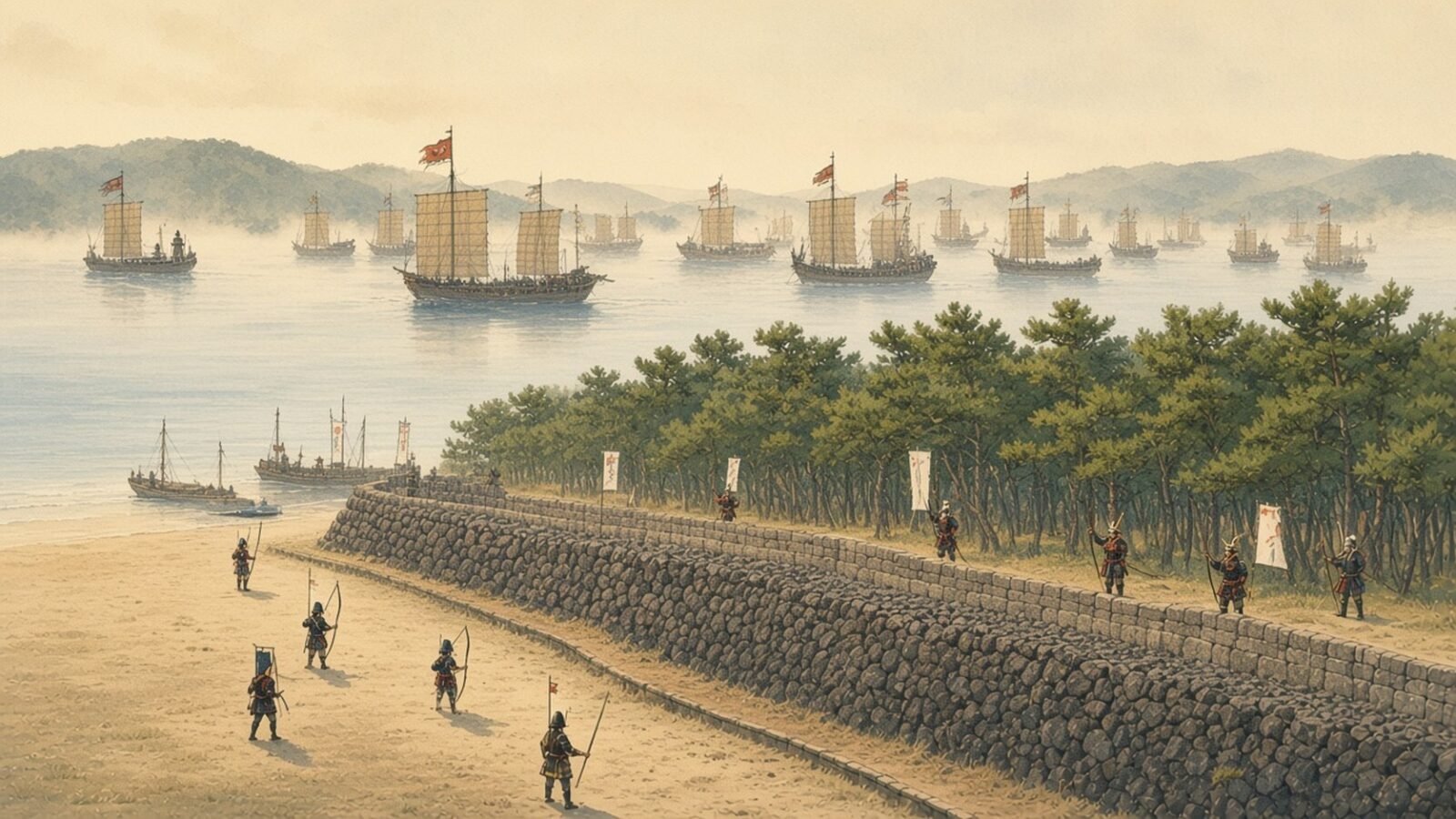
The Japanese response to the first invasion was to prepare for a second. The Kamakura regent Hōjō Tokimune, who had taken office in 1268 and who had been in charge of the diplomatic exchanges with the Yuan, ordered the construction of a stone defensive wall along the northern shore of Hakata Bay. The wall, known as the genkō bōrui, was built in some haste in 1276, and its remains are still visible on the modern shoreline of Fukuoka. It was about twenty kilometres long and stood perhaps two metres high, with watchtowers at intervals. The wall’s purpose was to prevent a Mongol landing on the open beaches, to force any attacking force into the narrow approaches of the bay where the defenders could mass. The Japanese court also made appeals to the shrines and temples of the country, asking for prayers and rituals in support of the national defence. The most famous of these appeals was the prayer offered at the shrine of Hachiman, the god of war, by the regent Hōjō Tokimune in person. The chronicle reports that Tokimune, after performing the ritual, was asked by a companion what he would wish for in the event that the gods were listening. He replied, in words that became famous in later Japanese culture, that he would wish that he and all his followers might die for the defence of the islands. The answer was taken as an omen.
The second invasion, 1281
The second invasion was conceived on a far larger scale than the first. The Yuan court had spent the intervening years completing the conquest of the Song dynasty, which fell in 1276, and the resources of the southern Chinese ports were now available for the first time. Khubilai ordered the assembly of a two-pronged fleet. The eastern route army, the smaller of the two, was to sail from Korea, as in 1274, and was to be composed of Mongol and Korean troops. The southern route army, the larger of the two, was to sail from southern Chinese ports and was to be composed of Mongol, northern Chinese, and southern Chinese troops, with significant numbers of former Song soldiers under Yuan command. The two fleets were to converge on Kyushu and to make a combined landing.
The eastern route army, of perhaps forty thousand men and nine hundred ships, sailed first. It arrived off Hakata Bay in late May 1281 and attempted a landing on the beaches where the first invasion had landed. The Japanese defenders, now reinforced and protected by the new stone wall, met the landing force with stiff resistance. The Mongols tried to find unguarded beaches further along the coast, but the Japanese had garrisoned the entire shoreline. They tried to induce the Japanese to come out into the open, where Mongol archery would have been decisive, but the Japanese refused. For more than two months, the eastern route army sat at anchor, unable to land, unable to defeat the defenders on the shore, unable to withdraw without abandoning the operation.
The southern route army, of perhaps a hundred thousand men and more than thirty-five hundred ships, arrived in late June and took up a position further west along the coast, in the bay at Imari. The two fleets were now supposed to make a coordinated assault. But the Japanese defence held. The defenders were better organised than in 1274, the Kamakura shogunate had mobilised a larger force, and the Hōjō regent Hōjō Tokimune had ordered the construction of additional fortifications. The Mongol commanders, after more than two months of inconclusive fighting, were running short of supplies. The Korean chronicles record that the supply situation became acute by August.
On the night of 16 August 1281, the typhoon struck. It came from the south-east, blew for a full day, and devastated the fleet at anchor in Imari Bay and the eastern fleet at Hakata Bay alike. The Korean and Yuan chronicles, written close to the events, record that the storm destroyed most of the southern fleet. Some of the ships were driven on to the shore of Kyushu, where the Japanese defenders came out the next morning to cut down the surviving troops. Others sank at anchor. Of the estimated four thousand ships that had set out, perhaps a tenth survived. Of the southern army, the chroniclers report, perhaps two thirds were killed. Of the eastern army, perhaps a half. The total death toll is uncertain. Japanese sources claim two or three hundred thousand. Modern historians estimate perhaps fifty thousand dead, though the number is necessarily approximate.
The storm and its meaning
The typhoon of August 1281 has been debated by historians for centuries. The Japanese explanation, fixed in the popular memory of the country almost immediately, was that the storm was a kamikaze, a divine wind sent by the gods of Japan to defend the homeland. The Korean and Yuan explanations, by contrast, tended to treat the storm as an unfortunate accident of weather, with no particular divine significance. The Mongol court at Beijing did not, in any case, regard the invasion as divinely defeated. It regarded the failure as the result of supply problems, Japanese fortifications, and the inherent difficulty of amphibious warfare against a defended coast. The next few years saw no further major attempt at the conquest of Japan. Khubilai did plan another invasion at one point, in 1283, but the plan was abandoned because of renewed trouble with the Song dynasty in southern China and the difficulty of assembling the necessary fleet.
Modern scholarship on the storm has been divided. The most prominent revisionist view is that of Stephen Turnbull and others, who have argued that the Japanese defence was, in itself, sufficient to defeat the invasion, and that the storm was a contributing factor rather than a decisive one. The Mongol army was short of supplies, the Japanese had built effective fortifications, and the Mongol tactics of feigned retreat and cavalry charge, which had been decisive on the open steppe, were largely useless on the narrow coastal plains of Kyushu. The Japanese defenders were well led by commanders like the Hōjō clan, and the samurai cavalry, even though it could not defeat the Mongols in the field, could deny them any secure beachhead. The storm, on this view, accelerated an invasion that was already failing but did not, by itself, defeat it.
The opposite view, defended by some Japanese historians and by a wider cultural memory in both Japan and China, is that the storm was the decisive intervention. The arguments for this view are partly meteorological — the typhoon of August 1281 was a real storm, of significant intensity, and the timing was such that the fleet was exposed in shallow anchorages along the coast — and partly military. The Mongols had, by 1281, shown themselves capable of recovering from setbacks on land. They had done so throughout their long history of conquest, and Khubilai had the resources and the patience to plan another invasion if the first one failed. The typhoon removed that option. The destruction of the fleet was so complete that no realistic second attempt could be mounted for years, and by the time the Yuan court was ready to consider another invasion, the political situation in East Asia had changed.
Neither view is, in any final sense, provable. The documents are partial. The Korean chronicles and the Yuan court records give one picture. The Japanese sources give another. The archaeology of the wrecks — there have been some underwater excavations of Mongol-period anchors and ship fittings in the bays of Imari and Hakata — confirms that a fleet did lie at anchor and that a great storm did pass over it, but does not settle the question of how much of the damage was the storm’s and how much was the defenders’. The question remains, as it has remained for seven centuries, one of those historical problems in which the surviving evidence is just enough to give rise to several different reconstructions, none of which can be regarded as definitive.
Why the Mongols lost
The Mongols lost the invasions of Japan for reasons that go beyond the storm of August 1281. The deeper reasons lie in the structure of the Mongol military machine and in the limits of the kind of empire the Mongols had built. The Mongol empire was, at its peak in the late thirteenth century, the largest land empire in world history. It stretched from Korea to the Carpathian Mountains, from Siberia to the Indian Ocean. Its military doctrine was the doctrine of the steppe — a doctrine of massed cavalry, of highly mobile archers, of feigned retreats, of encirclement, of the terror induced by a sudden appearance of horsemen on the horizon. That doctrine had been unbeatable on the open plains of Asia and Europe. It had been less successful in the forests of central Europe and the swamps of southern China. It was, in the end, no match for the combination of natural obstacles and defended fortifications that Japan presented.
The first problem was the sea. The Mongols were not a seafaring people. The construction of the invasion fleets required the cooperation of Korean and Chinese shipbuilders, and the operation of the fleets at sea required the cooperation of Korean and Chinese sailors. The Mongol officers on the ships did not fully understand the conditions of naval warfare, and the Mongol army as a whole did not have the experience of amphibious operations that would have been necessary to make the invasions work. The first invasion had sailed with perhaps a quarter of the men being Mongols, the rest being Koreans and Chinese. The second invasion, with perhaps a tenth being Mongols and the rest being a heterogeneous mix of Koreans, northern Chinese, and former Song soldiers, was even more dependent on the expertise of non-Mongol personnel. The logistics of moving a hundred thousand men and horses across several hundred miles of sea, landing them on a defended coast, supplying them, and keeping them in fighting trim for weeks at a time, were formidable even for the most capable naval power. They were formidable in a way that the Mongol command structure was not equipped to manage.
The second problem was the Japanese defence. The Japanese had been warned by the first invasion in 1274 and had used the seven intervening years to prepare. The stone wall at Hakata Bay was the most visible preparation, but it was only one of many. The Japanese had, in addition to the wall, mobilised a large number of samurai from the surrounding estates, organised them into a coherent command structure under the Kamakura shogunate, and given them specific orders to avoid the Mongol tactics of feigned retreat. The samurai were not as well equipped as the Mongols in some respects — their bows were shorter, their armour lighter — but they were well trained in close combat, well led by the commanders of the major Kyushu estates, and well motivated by the threat to their homeland. They could not have defeated the Mongols in a pitched battle on open ground, but they could deny the Mongols the open ground, and that was sufficient.
The third problem was Mongol strategy. Khubilai’s strategy was to compel the submission of Japan by overwhelming force. The first invasion had been a relatively modest attempt at this. The second was supposed to be the overwhelming force. But overwhelming force, in the absence of an effective plan to land that force on a defended coast, was simply a large target for the defenders and the weather to attack. The Mongol army could not defeat the Japanese on the beaches. It could not break out from the anchorages. It could not, after months of inconclusive fighting, withdraw in good order. By August 1281, the invasion had reached the point at which the only way out was a successful landing and a decisive victory on land. The typhoon removed that possibility in one night.
The aftermath in East Asia
The two invasions left a deep mark on all three of the polities that had been involved. In Japan, the legend of the kamikaze became part of the founding mythology of the late Kamakura period. The prayers that had been offered before the invasions, the rituals that had been performed at Hachiman and at the other shrines, the personal sacrifice of the Hōjō regent who had been willing to die for the country — all of these entered the popular memory as evidence that the gods of Japan had been on the side of the defenders. The stone wall at Hakata Bay, the remnants of which are still visible in modern Fukuoka, became a monument to the defence. A series of temples was built across the country to commemorate the fallen defenders, some of them on the actual battlefields and some in the home provinces of the families who had lost sons in the fighting. The invasions reinforced the cultural sense, already strong in Japanese culture, that the country was a distinct and unusual polity, set apart from the continent by the sea and defended by the gods.
Within the Japanese court itself, the response was more measured. The Kamakura shogunate, having been the principal target of the invasions, emerged from the wars with its prestige substantially intact. The Hōjō regents were celebrated in chronicles and in the popular imagination as the architects of the defence. But the cost of the wars had been enormous. The shogunate had mobilised a large portion of the samurai manpower of western Japan, and the cost of feeding and equipping the defenders had imposed a significant burden on the tax base. The shogunate attempt to recover some of the burden through a land survey that began in 1280, the so-called shōen reform, contributed to the political tensions of the late Kamakura period. The Mongol invasions did not directly cause the fall of the Kamakura shogunate in 1333, but they weakened it in ways that the later upheavals of the fourteenth century were able to exploit.
In the Yuan court at Beijing
In the Yuan court at Beijing, the invasions were, in the short term, a major embarrassment. Khubilai Khan, who had made universal sovereignty the central principle of his reign, had been unable to compel the submission of a small island kingdom. The failure weakened the diplomatic standing of the Yuan in East Asia, and other polities that had been considering their positions with respect to the Mongol empire took note. The Korean court, which had provided the ships and the crews for both invasions, bore the heaviest burden in resources, and the Goryeo court emerged from the wars substantially weakened. The Japanese refusal to send tribute continued for the rest of the Yuan period, and the Japanese court in Kamakura and later in Kyoto never recognised Yuan authority.
The legend of the kamikaze, as it was understood in medieval Japan, had nothing to do with the perversion of the term that became familiar in the twentieth century. The kamikaze of 1274 and 1281 was a wind sent by the gods to defend the homeland; the kamikaze of the 1940s was the name given to the pilots who crashed their aircraft into enemy ships in the closing months of the Second World War. The borrowing is well documented in modern scholarship. The pilots who flew the suicide missions took the medieval kamikaze as their model, in a deliberate act of historical appropriation by the wartime Japanese state. The medieval storm, which had been a defensive miracle, became in the 1940s an aggressive weapon. The historical irony is sharp. The original kamikaze, in the thirteenth century, had blown the invasion fleet away from the Japanese homeland. The later kamikaze, in the twentieth century, were sent by the Japanese state against the ships of the United States.
The invasions in modern scholarship
Modern Japanese, Korean, Chinese, and Western scholarship on the invasions has been extensive. The basic narrative is well established. The main questions remain those of military causation — how much of the outcome was the storm, how much was the Japanese defence, how much was the inherent difficulty of the Mongol military project — and those of the cultural legacy. The most important recent works include Stephen Turnbull’s 2010 Osprey volume, which provides a clear narrative account; Thomas Conlan’s In Little Need of Divine Intervention, which argues for the effectiveness of the Japanese defence; James P. Delgado’s Khubilai Khan’s Lost Fleet, which combines historical narrative with maritime archaeology; and the various Japanese, Korean, and Chinese academic studies that have appeared in the last half century. The Korean primary sources, especially the Goryeosa and the Koryo-sa, give a Korean view of the invasions that is sometimes critical of the Mongol commanders and sometimes sympathetic. The Chinese primary sources, especially the Yuanshi and the various Yuan-court chronicles, give the Mongol view. The Japanese primary sources include the Mōko Shūrai Ekotoba, the illustrated scroll that records the invasions from the Japanese side, and a number of temple and shrine records that preserve the local traditions.
The invasions of 1274 and 1281 are, in the long history of East Asian warfare, a small event. They involved a small number of combatants by the standards of later wars. They lasted only a few months. They ended with the destruction of the invasion fleet and the deaths of tens of thousands of men on both sides. But they have endured in the popular memory of Japan, China, and Korea as a moment when the course of East Asian history could have gone either way. Had the typhoon not blown, had the Mongols been able to land on the beaches, had the Japanese defence not held, the islands would have been incorporated into the Mongol empire and the subsequent history of East Asia would have been different in ways we can only speculate about. The invasions are, in this sense, a hinge moment in the history of the region. The invasions are also a useful corrective to the easy assumption that large empires always prevail over smaller polities. The Yuan court had overwhelming advantages of manpower, of resources, and of naval technology. The Japanese had a determined defence and the accident of weather. The outcome was not foreordained. The combination of factors that produced the outcome was specific to the thirteenth century, and it would be misleading to draw from it any general principle about how wars are won or lost. But the invasions do suggest that universal empires have limits, that amphibious warfare against a determined defender is one of the hardest kinds of war to win, and that the smaller party in a conflict can sometimes prevail through a combination of defensive preparation, geographic advantage, and timely weather. They are a moment at which a small island polity, by a combination of its own defence and the accident of weather, turned back the largest empire the world had ever seen. The story has been told many times, in many languages, and it continues to be told because it remains vivid and because the larger questions it raises — about the limits of universal empire, about the meaning of national defence, about the role of accident in history — are questions that never entirely go away.
References
- Khubilai Khan: His Life and Times — Morris Rossabi, University of California Press, 1988, repr. 2009. The standard modern biography of Khubilai in English; covers the invasions in chapters 7 and 8 with full citations to the Yuan sources.
- In Little Need of Divine Intervention: The Mongol Invasions of Japan 1274 and 1281 — Thomas Conlan, Cornell University Press, 2001. The revisionist study arguing that the Japanese defence, not the kamikaze, was decisive.
- Khubilai Khan’s Lost Fleet: An Epic Story of the Building and Sailing of the Fleets That Almost Conquered Japan — James P. Delgado, National Geographic / Avalon, 2008. Combines historical narrative with maritime archaeology of surviving anchors and fittings.
- The Mongol Invasions of Japan 1274 and 1281 — Stephen Turnbull, Osprey Campaign 150, Osprey Publishing, 2010. A concise, well-illustrated campaign history.
- Heavenly Warriors: The Evolution of Japan’s Military, 500-1300 — William Wayne Farris, Harvard University Asia Center, 1995. Essential background on the Japanese military system before and during the invasions.
- The First Samurai: The Life and Battles of Minamoto no Yoritomo — Karl F. Friday, John Wiley and Sons, 2008. Covers the Kamakura military system and the Hōjō regents who commanded the defence.
- Samurai: The Last Warrior — Stephen Turnbull, John Wiley and Sons, 2007. Context for the samurai who defended Kyushu.
- The Mongol Warlords: Genghis, Kublai, and the Mongol Military — Timothy May, Osprey Publishing, 2007. A broader account of Mongol military doctrine and the limits it encountered at sea.
- History of the Yuan (Yuanshi) — Song Lian et al., ed. 1370, Ming edition, repr. by Zhonghua Shuju. The official Chinese history of the Yuan dynasty; chapters on the foreign relations with Japan preserve the Yuan court records of the invasions.
- Goryeosa (History of Goryeo) — Kim Jeong-ho et al., 1451, Korean original, multiple modern editions including by the Korean History Compilation Committee. The official Korean chronicle that records the Korean participation in the invasions and provides the Korean perspective on the typhoon.
- The Mōko Shūrai Ekotoba — 1293, attrib. to Takezaki Suenaga, facsimile ed. by the Museum of the Imperial Collections, Tokyo. The illustrated Japanese scroll that records the first invasion from the Japanese side, with text written by a samurai who participated.
- The Kamikaze Typhoons of 1274 and 1281: Their Meteorological Background — Manabu Yamamoto, Journal of Meteorology, 2011. A meteorological reconstruction of the two typhoons, with discussion of the role of weather in the outcomes.
- The Mongols and the Making of Modern Japan — Komukai Sojin, trans. by Henry Smith, University of Tokyo Press, 2004. Japanese scholarship on the long-term consequences of the invasions for Japanese political and military culture.
- The Korean Court and the Mongol Empire, 1259-1270 — David M. Robinson, University of Hawaii Press, 2012. Context for the Goryeo dynasty’s relationship to the Mongol court during the build-up to the invasions.
- The Mongol Invasions of the Levant and Japan: A Comparative Study — Reuven Amitai, in The Mongol Empire and Its Legacy, ed. by David Morgan, Brill, 1999. Comparative analysis of Mongol amphibious operations against Japan and against the Mamluk Sultanate in the late thirteenth century.