In a refrigerated warehouse somewhere in central China, behind doors that open by government order and not very often, sits a commodity most countries would never think to stockpile: frozen pork. When pork prices climb too high, Beijing auctions meat out of this strategic reserve onto the market, and when prices collapse it buys carcasses back in, steadying the nation’s protein the way other governments steady their currencies or their oil. The reserve is not large by the standards of what China eats, a few hundred thousand tonnes in a country that consumes more than fifty million tonnes of pork a year, but that is not the point. The point is that the world’s second economy maintains an emergency supply of pig meat for the same reason it maintains emergency supplies of grain and petroleum: because a nation that cannot put pork on the table at a tolerable price has a political problem, not merely an agricultural one. There is no strategic chicken reserve. There is no strategic beef reserve. There is only the pig, and to understand why, you have to start about eight and a half thousand years ago, in a village on the Yellow River plain, with the animal that walked into the Chinese house and never left.
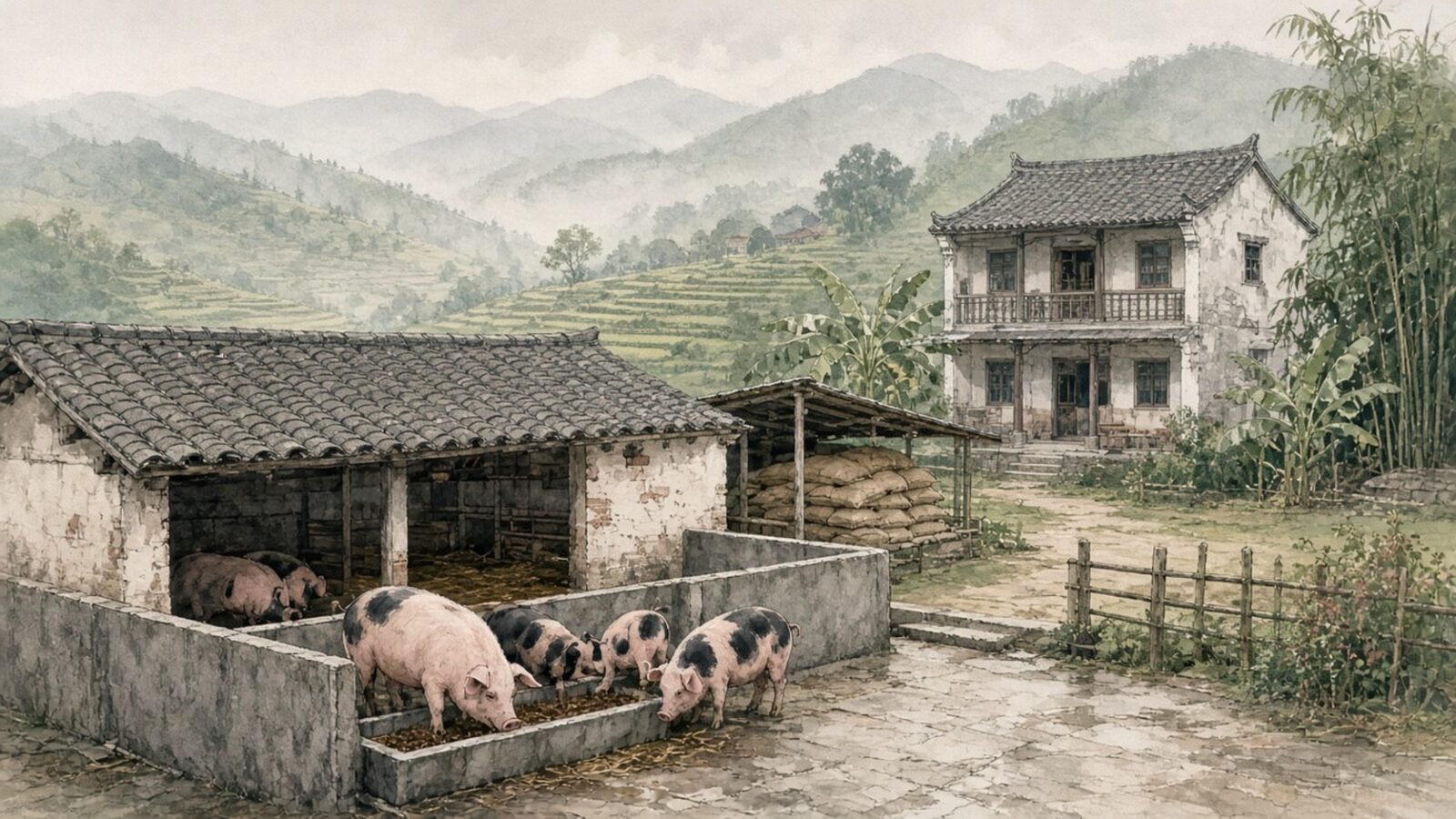
The Chinese language itself confesses the arrangement. The character for home, jia, is a roof drawn over a pig. The character is ancient, already recognisable in the oracle bone script of the Shang dynasty three and a half thousand years ago, and its logic is Neolithic: a household without a pig was not quite a household. At Jiahu in Henan, the village that has already appeared in this series yielding the world’s oldest playable flutes, archaeologists found some of the earliest evidence anywhere of domesticated pigs, animals being bred smaller and tamer than their wild cousins by farmers who were also inventing pottery and rice farming and, arguably, writing’s distant ancestors. The pig was the perfect pioneer animal for a settled people. It ate everything the village threw away, it converted waste into fat and protein with unmatched efficiency, it bred in litters rather than one calf at a time, and it asked for no pasture. China had little pasture to ask for. The geography that would define the country, crowded river valleys farmed to the last metre, left no room for herds of cattle and sheep on the western scale, and so where the West built its protein economy on the cow, China built its on the pig, the animal that lives in a pen behind the house and eats the house’s garbage. The roof and the pig under it were one economic unit.
By the classical age the pig was woven through every level of the culture, from a peasant’s savings account to a philosopher’s classroom. Confucius, asked about his fees, gave the most famous answer in the history of tuition: he had never refused instruction to anyone who came, of his own accord, carrying as little as a bundle of dried meat. The meat was pork, preserved against a world without refrigeration, and the bundle of dried strips became so synonymous with schooling that the word for it, shuxiu, meant a teacher’s fee for two thousand years. The philosopher’s own disciple Zengzi left the era’s most quoted lesson in parenting, and it is about a pig. Zengzi’s wife, hurrying to market, told their crying son to stay home and promised him pork for dinner. When she returned she found her husband sharpening the knife. She protested that it had only been a joke, and Zengzi answered that a child learns from his parents, that to deceive him now was to teach him deceit, and slaughtered the pig. The story was told for millennia not because pork was precious but precisely because a pig was serious money, and a promise that cost one had to be kept.
The Han dynasty, which gave China so many of its durable institutions, left us the pig’s portrait in pottery. Han tombs are filled with ceramic models of the farmyard a family hoped to recreate in the afterlife, and among the granaries and wells and watchtowers sits the pigsty, thousands upon thousands of them, often built in two storeys with the household privy upstairs, an arrangement the archaeologists describe politely and the pigs experienced directly. It is the whole Han waste-recycling system in one brutal little diorama, and it tells you what the pig was for. The animal was not livestock in the western sense, driven to market fairs across open country. It was infrastructure, bolted to the house, processing the house, and when Han administrators counted a family’s wealth they counted its pigs. Emperors noticed too. The dynasty’s record keepers treated the price of pork and the health of its herds as indicators of whether the realm was well governed, an association between pig and polity that has never since been broken.
Song dynasty China was rich enough to eat pork on an industrial scale, and the records of the capital Kaifeng preserve the daily spectacle: every morning, before the city fully woke, herds of pigs were driven in from the countryside through the gates by the thousand, funnelled down the avenues to the slaughterhouses and markets, ten thousand animals on a busy day by the chroniclers’ count, the breakfast rush of the most populous city on earth arriving on four legs. And the Song gave pork its poet. Su Shi, the greatest literary man of his dynasty, was sent into exile in 1080 to Huangzhou, a backwater on the Yangtze where the local pork was excellent and, being disdained by the fashionable, extremely cheap. Broke and unbothered, he taught himself to cook it slowly, gently, for hours, until the fat turned to silk, and he commemorated the discovery in verse.
Huangzhou’s pork is good, and cheap as dirt. The rich will not eat it; the poor do not know how to cook it. Slow the fire, little the water, and when the heat has done its work it is beautiful in its own time.
The dish he perfected in disgrace is Dongpo pork, named for his literary name, and nine centuries later it sits near the top of every banquet menu in China, glossy cubes of belly braised to the texture of custard. There are worse ways to measure a civilisation than by what its exiles bother to perfect. Su Shi also understood the economics hiding inside his poem: the rich spurned pork because it was common, and the poor needed instruction because even the commonest meat rewards technique. Pork was the people’s luxury, the feast within reach of the ordinary household, which is exactly the position it still occupies.
The kitchen tells the same story in grammar. In Chinese, the word rou, meat, means pork unless someone says otherwise; beef and lamb and chicken must carry their names, but the default animal of the language is the pig. The default cooking fat of the traditional kitchen was lard, rendered at home and kept in a jar by the stove, and the default feast was the whole animal, used with a completeness that startles cultures of prime cuts. Ears are sliced into cold appetisers, trotters are braised into brown silk, blood is set into curds for soup, intestines are scrubbed and stewed into dishes their devotees defend with passion, and the Cantonese banquet still opens, at weddings and shop inaugurations, with a whole roast suckling pig carried in like a guest of honour, its skin crackling red. Twice-cooked pork is Sichuan’s soul in a wok; the soup dumpling of Shanghai is pork held in a pleated skin; the red braising that Mao loved is a national shorthand for celebration. Foreign cooks speak of eating everything but the squeal; Chinese butchery simply never recognised any part as waste. An animal that gives its entire self to the table earned its place under the roof.
The emperors’ own relationship with the pig ran from the comic to the sacred. In 1519 the Zhengde emperor of the Ming, whose surname Zhu happened to be a homophone of the word for pig and whose birth year fell in the year of the pig, took offence at the national diet and banned the raising and slaughtering of pigs across the empire. The edict produced chaos, ridicule, and a shortage of sacrificial animals so acute that the ban collapsed within months, remembered ever since as proof that not even the Son of Heaven could come between China and its pig. The Manchu rulers of the Qing went the other way: they made pork liturgy. In the Palace of Earthly Tranquility deep inside the Forbidden City, shamans of the imperial household sacrificed and boiled pigs in great cauldrons day after day, and the plain boiled meat, eaten without salt by princes and ministers in the dim hall, was a rite of the dynasty’s steppe faith. Courtiers dreaded the honour, the meat being famously bland, but nobody refused a share of the emperor’s sacred pork.
The twentieth century tested the bond as never before. The war years broke the countryside, and then the famine of 1959 to 1961, the catastrophe this series has already visited, did something that three thousand years of war and want had rarely managed: it made the pig vanish. Village herds were communed, private pens abolished, and in the worst years meat of any kind disappeared from the table so completely that survivors date the famine in memory by the absence of pork, the years when the character for home had nothing under its roof. The animal’s return was therefore the most politically eloquent event of the recovery. When households were again permitted to keep a pig of their own, they did, immediately and everywhere, and economists who chart China’s resurrection sometimes note that the first graph to turn upward was not steel or grain but the pig herd, the animal the farmer trusts when he trusts nothing else. Pork was never merely dinner. It was the signal that the roof and the world beneath it were sound again.
Through all of this the numbers crept upward with the population, and by the twentieth century the pig had become the thermometer of Chinese life. Under the planned economy pork was rationed, and the monthly meat coupon, a few hundred grams per person in the lean decades, was among the most precious slips of paper a city family held. Mao Zedong himself kept a famous loyalty to hongshaorou, red-braised pork belly, a dish his bodyguards and biographers mention constantly, the taste of his Hunan village childhood carried to the pinnacle of power. Then came the reforms, and the pig became the first thermometer to spike. Between the late 1970s and the middle of the 2010s China’s pork output multiplied roughly sevenfold, from under eight million tonnes to a peak near fifty-seven million, the steepest expansion of any major food commodity in any country in recorded history. By the 2010s China was raising and eating roughly half of all the pigs on earth, some seven hundred million animals slaughtered in a single year, and the pork counter had replaced the meat coupon so completely that younger Chinese had to be told rationing ever happened. The animal under the roof had become an industry larger than most nations’ entire agricultural sectors.
Which is why the pig now moves markets. China’s consumer price index carries pork at a weight no other country assigns a single meat, and the result is a home-grown macroeconomic phenomenon with a home-grown name: the pig cycle. When prices rise, farmers breed furiously, overshoot, and glut the market; prices crash, herds are liquidated, scarcity returns, and the whole pendulum swings again on a rhythm of three or four years that has survived every attempt to flatten it. Beijing has fought the cycle with subsidies, with the strategic reserve, and since January 2021 with live hog futures on the Dalian Commodity Exchange, giving the world’s biggest pork market a price-discovery machine to match. The pendulum still swings. When the pig price sneezes, runs the economist’s joke, the CPI catches a cold, and a politburo that reads inflation as a social-stability indicator watches the sow herd the way other governments watch bond yields.
The cycle’s worst turn came in 2018, and it was not a cycle at all. African swine fever, a virus harmless to humans and lethal to nearly every pig it touches, crossed into China that August and burned through the national herd in a year and a half. Nobody knows the true toll; official figures showed the breeding sow herd down around forty per cent by late 2019, and outside estimates ran higher, past a hundred million animals, the largest single loss of livestock any country has ever recorded. Pork output fell by a fifth in a year, prices more than doubled, and the strategic reserve was emptied into the auction rooms while importers scoured Spain, Brazil, Germany, and the United States for carcasses. For a few months in 2019 and 2020, pork alone was visibly pushing China’s inflation rate, and virologists watched a virus redraw the protein map of a fifth of humanity. The episode confirmed what the reserve had always implied: in China, the pig supply is a security question, answered with the same seriousness as the oil supply.
And the pig’s reach now extends far past China’s borders, down a supply chain that ends in a field on another continent. A Chinese pig eats like a modern athlete, on a diet built around soybean meal, and China grows nowhere near enough soybeans to feed seven hundred million athletes. So the country imports around a hundred million tonnes of soybeans a year, some sixty per cent of everything traded on earth, most of it from Brazil and the United States, and the single largest driver of that torrent is the Chinese pig. Agronomists tracking deforestation on the Brazilian cerrado can draw a straight line from a cleared soybean field to a pen in Henan. The animal that entered the Neolithic household through the back door, eating scraps, now commands an intercontinental feed system, and Beijing’s food-security strategists plan around its appetite with the seriousness of a siege.
The farm itself, meanwhile, has gone vertical. Outside Ezhou in Hubei stands the world’s most startling agricultural building: a pair of twenty-six-storey towers that are, functionally, apartment blocks for pigs, designed when fully occupied to turn out more than a million animals a year, with feed moved by automated lines and waste processed on site. The biggest producer, Muyuan Foods, slaughters tens of millions of pigs annually, more than many countries, and the industry’s frontier research reads like science fiction: facial recognition for individual pigs, gene-editing programmes hunting for resistance to swine fever, climate-controlled high-rise barns where no season ever changes. From the Han pottery pigsty with the privy upstairs to the twenty-six-storey pig tower is a distance of two thousand years, and also of about an afternoon’s contemplation. The pig is still bolted to the house. The house just got taller.
None of the industrial scale has displaced the older pig of the imagination, which remains everywhere. The most beloved character in the most beloved Chinese novel is half pig: Zhu Bajie of Journey to the West, the gluttonous, lustful, cowardly, loyal, endearing pig-demon who stumbles westward beside the Monkey King and is, for most readers, the most human figure in the book. In the northeast, winter still opens with the killing of the fattened pig and a feast of the whole animal for the whole village, the meal that marks the year’s turn. And when the zodiac’s pig year comes around, maternity wards brace: 2007 was a golden pig year, doubly auspicious by popular reckoning, and hospitals across China reported a surge of babies scheduled to arrive under the sign of the animal that promises a life of plenty. The panda may carry the flag, but the pig carries the luck.
So: not the panda. The panda is a national costume, beloved and expensive and mostly decorative, an animal whose entire wild population could fit inside one of the Ezhou towers. The pig is the nation eating. It is under the roof of the oldest character for home, in the tuition bundle of the sage, in the exile’s casserole and the shaman’s cauldron, in the coupon of the rationing years and the futures pit of the reform years, in the virus that shook the CPI and the soybean field half a world away. Eight and a half thousand years after Jiahu, China is still, in the deepest statistical sense, the civilisation the pig built: half the world’s herd, half the world’s appetite, one animal standing under every roof in the country, as it has since the roof and the character were young. The towers will keep rising. The pig will still be underneath.