The Catastrophe of 1860 and the Birth of a Programme
In the autumn of 1860, an Anglo-French expeditionary force, having fought its way up the coast from the Pearl River, occupied the emperor’s summer palace at Yuanmingyuan in the hills northwest of Beijing and burned it to the ground. The Convention of Peking that ended the Second Opium War ceded Kowloon to Britain, opened Tianjin to foreign trade, and required the Qing court to pay an indemnity of eight million taels of silver. The Imperial Maritime Customs Service, which had been improvised by the Western consuls in Shanghai in 1854 to keep the city’s customs revenue flowing while the Taiping rebels threatened the Yangzi, was at last regularised into an imperial institution with Horatio Nelson Lay, a British consular officer, as Inspector General. The court’s humiliation was compounded by the fact that within the same decade the Taiping Heavenly Kingdom had been brought to its knees at Nanjing, largely by Chinese armies led by Chinese generals, using Chinese-supplied modern rifles and foreign-paid mercenaries. The lesson that some of those generals took from the decade’s disasters was plain. The Qing dynasty could continue to govern only if it learned, at speed, to do what the Western powers were already doing. The lesson that other officials took was the opposite: that the disasters were the predictable consequence of straying from Confucian virtue. By the time the Xianfeng Emperor died in August 1861, the first lesson had won out. The Self-Strengthening Movement had begun.
The phrase yangwu, affairs of the ocean, became the standard Chinese term for the reform programme. Its standard English rendering, Self-Strengthening, captures the literal meaning of ziqiang, the term Prince Gong used in his memorial to the new Tongzhi Emperor in July 1861. The phrase ti-yong, Chinese substance with Western application, crystallised the official ideology of the reform. Western technical knowledge would be the means; Confucian political and ethical order would be the end. The compromise was, in retrospect, a compromise that gave the reform its limited span. Few of the Self-Strengtheners ever proposed anything that would disturb the exam system, the provincial fiscal structure, or the throne’s prerogative. They proposed arsenals, shipyards, telegraph lines, foreign language colleges, and embassies. They did not propose a constitution, a national assembly, or any kind of representative body. The movement’s politics, in the European sense of the word, was nil. Its engineering was substantial.
By the time the dynasty fell in 1911, the Self-Strengthening programme had given China its first modern arsenals and shipyards, its first telegraph line, its first steam-powered merchant fleet, its first iron and coal mines, its first cotton mills, its first foreign language colleges, its first embassies abroad, its first naval academy, and its first Customs Service capable of running the country’s foreign trade honestly. The programme had also given the dynasty another half-century of life, and then lost the war that ended it. The historians who have written about the movement since the 1920s have tended to fall into two camps. One camp treats the movement as a failure, doomed by its refusal to confront the political roots of China’s weakness. The other treats it as a remarkable achievement, given the constraints under which its leaders had to operate, and as the foundation on which every later Chinese modernisation project was built. Both positions are partly right and partly wrong, and the present essay attempts to set out what actually happened, with attention to the people who made it happen and to the institutional architecture they left behind.
The First Phase: 1861 to 1872
The institutional centrepiece of the first phase was the Zongli Yamen, the Office for the Management of the Business of All Foreign Countries, which Prince Gong established in January 1861 with imperial approval. The Yamen was a peculiar office. It was not a ministry in the standard Qing administrative structure. It had no equivalent at the provincial level, and its jurisdiction over diplomatic, commercial, military-industrial, and educational matters overlapped with the established competence of the Board of War, the Board of Revenue, the Board of Rites, and the provincial governors. Its political weakness was deliberate. The Xianfeng Emperor, in the last months of his reign, had refused to allow the Self-Strengtheners to build a proper foreign ministry because he feared that a competent foreign office would gradually take the conduct of China’s foreign relations out of the hands of the throne. The Zongli Yamen was, in effect, the compromise the throne was willing to accept. It would coordinate foreign affairs. It would not command them.
Inside the Yamen, the working relationship between Prince Gong and the Grand Councillor Wenxiang set the tone for the first phase. Wenxiang, a Manchu nobleman who had been won to the cause of reform during the negotiations over the Convention of Peking, brought to the Yamen the political credibility of the imperial clan and the bureaucratic experience of a man who had served as Grand Councillor since 1858. Prince Gong brought the imperial connection. Between them, they managed the Yamen for more than twenty years. The Yamen was the principal conduit through which the Self-Strengtheners communicated with the throne, and the throne’s slow approval of arsenals, shipyards, and foreign language schools was, in practice, the Yamen’s slow approval of those projects. The Yamen was also the official organ through which the Self-Strengtheners negotiated with the foreign legations in Beijing, and it was the Yamen that commissioned the Burlingame Mission of 1868, which sent the first Qing diplomatic delegation to the United States and Europe.
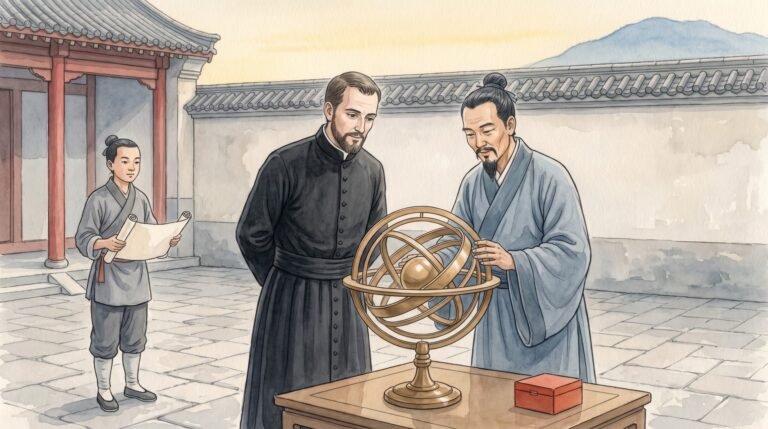
The Zongli Yamen supervised the establishment of the Tongwen Guan in Beijing in 1862. The Tongwen Guan, originally a Confucian academy founded in the seventeenth century, was refounded as a foreign language school under the direction of the American missionary W. A. P. Martin, who served as its first president. The Tongwen Guan taught English, French, and Russian, and from 1867 it added a curriculum in mathematics, astronomy, chemistry, and international law. It translated a substantial body of Western technical literature into Chinese over the next two decades, and it became the principal training ground for the first generation of Qing diplomats. The Tongwen Guan also had a successor at the Jiangnan Arsenal in Shanghai, where a separate translation bureau produced 143 Western books between 1868 and 1879. The Jiangnan Arsenal’s translation bureau, more than any other part of the programme, set the basic vocabulary in which Chinese officials talked about Western technology and politics for the rest of the century.
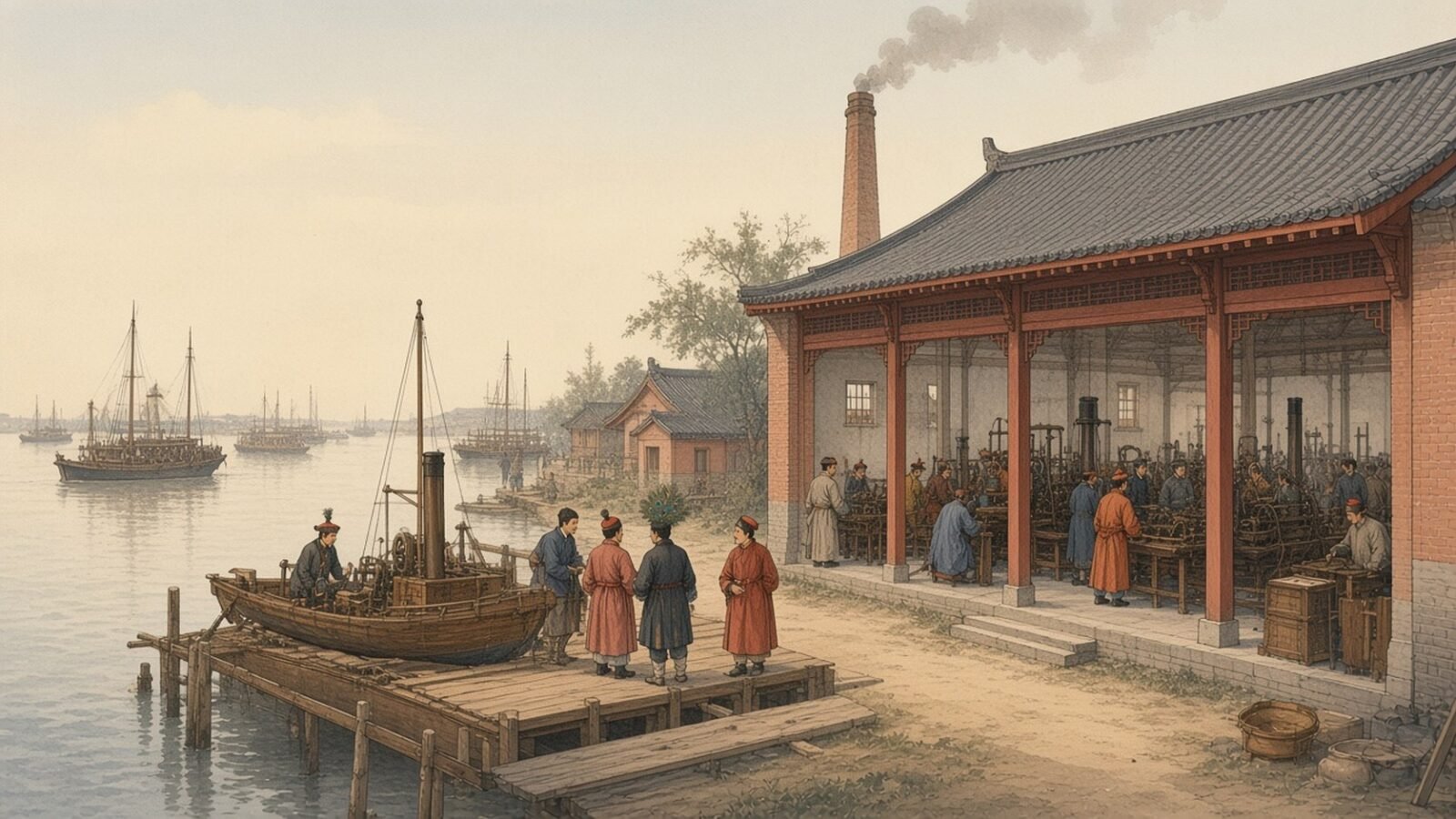
The first phase saw the establishment of the principal arsenals. The Ningbo Arsenal, founded in 1862 by the French officer Leonce Verny under the patronage of the governor of Zhejiang, was the earliest of the four principal military-industrial facilities, but it was the smaller of the four. The Shanghai Arsenal was established in 1865 by Zeng Guofan, with the help of the American Yung Wing and the support of Li Hongzhang, and it was later merged into the Jiangnan Arsenal, which became the largest and most productive of the four. The Nanjing Arsenal was founded in 1865 by Li Hongzhang from equipment relocated from the Suzhou Arsenal. The Tianjin Arsenal was founded in 1867 under the supervision of the Northern Ports Commissioner Chung-hou, and later came under Li Hongzhang’s direct control when he was appointed Governor-General of Zhili in 1870. The Fuzhou Navy Yard, founded in 1866 by Zuo Zongtang under the direction of the French naval officer Prosper Giquel, was the largest and most ambitious of the four. It was the only one of the four that was primarily a shipyard rather than an arsenal, and it produced eleven vessels between 1867 and 1884, including several 1,253-ton transports and a 1,393-ton corvette.
Arsenals, Shipyards, and the Beiyang Fleet
The four principal arsenals were technical showcases and political compromises in equal measure. Each was built with foreign machinery, under foreign technical direction, but under Chinese administrative control. Each was financed by a combination of imperial grants, provincial funds, and Maritime Customs revenue, and each was the centre of a regional patronage network that tied the Self-Strengtheners to the provincial officials on whose cooperation they depended. The Jiangnan Arsenal, which produced 65,000 rifles, 742 cannons, 6.7 million tons of gunpowder, 1.6 million shells, 8.7 million bullets, 1,500 naval mines, and 15 ships between 1867 and 1895, was the most productive. The Tianjin Arsenal, which produced machinery, ordnance parts, gunpowder, and steamship parts at its several factory sites, was the most concentrated. The Fuzhou Navy Yard was the most ambitious, and the most vulnerable.
The Fuzhou Navy Yard sat at Mawei, on the lower Min River, a few miles downstream from the city of Fuzhou. It was a purpose-built shipyard and naval academy, with stone-built dry docks, a slipway large enough for wooden steam frigates, a machine shop equipped with steam-driven lathes and planers, and a school for shipwrights and naval officers. The yard’s school trained three hundred and thirty students in its first eight years, of whom roughly half were sent abroad for further training in France and Britain. The yard’s first ship, a 600-ton transport, was launched in 1869. By the early 1880s, the yard had produced eleven vessels, including several 1,253-ton transports and a 1,393-ton corvette. The yard was also a centre for the study of French naval architecture and French naval administration. The yard’s Chinese staff read French technical literature in the original, and the yard’s graduates went on to staff the Qing navy’s southern squadrons.
The Fuzhou Yard was destroyed in the opening engagement of the Sino-French War in August 1884. A French squadron under Admiral Courbet, sent to enforce French claims in Tonkin, made a sudden attack on the Chinese fleet anchored at Mawei, sank or disabled nine of the eleven ships in the southern squadron, and destroyed the yard’s workshops and stores. The destruction was almost total, and it had two lasting consequences. First, it exposed the yard’s greatest vulnerability. The yard had been built at Mawei because Mawei was a sheltered port, but Mawei was also a port that the French fleet could reach from the open sea. The yard’s location had been a political compromise. Second, it showed the limits of the Self-Strengthening programme’s strategy of building Chinese naval power in isolation from any broader alliance structure. The yard had been built to deter a Western attack. It had been destroyed by one.
The Beiyang Fleet, the largest fleet in Asia when it was commissioned in 1875, was the principal naval legacy of the Self-Strengthening programme. Li Hongzhang, who had taken over the Fuzhou Yard’s construction programme after Zuo Zongtang’s recall to the northwest in 1868, built the Beiyang Fleet around a core of iron-hulled steam frigates purchased from Britain and Germany. The fleet’s two ironclads, the Dingyuan and the Zhenyuan, were built in the Vulcan yard at Stettin and the Armstrong yard at Elswick respectively, and they were the most powerful warships in Asia when they entered service in 1885. The fleet had its own dockyard at Weihaiwei, its own naval college at Tianjin, and its own system of coaling stations along the China coast. It was the most visible product of the Self-Strengthening programme. The Beiyang Fleet was also, in the long run, the fleet that lost the Sino-Japanese War of 1894 to 1895. By the time of the war, the fleet had not been reinforced in nearly a decade, its ammunition was of the wrong calibre, its officers were poorly trained, and its two ironclads, which had been the pride of the Qing navy in 1885, had been outclassed by the Japanese fleet’s more recent British-built protected cruisers. The fleet’s destruction at the Battle of the Yalu in September 1894 marked the end of the Self-Strengthening programme’s naval ambitions.
Infrastructure: Telegraphs, Railways, Steamships, and Mines
The infrastructure projects of the Self-Strengthening programme are less famous than the arsenals and the fleet, but they were, in the long run, more consequential. The first telegraph line in China ran from Shanghai to Wusong in 1865, was destroyed by local opposition within a year, and was rebuilt in 1869 with the help of the Great Northern Telegraph Company. The first telegraph line from Beijing to Tianjin was completed in 1871, and by 1885 the Zongli Yamen had laid more than 20,000 li of telegraph line, connecting Beijing to the principal provincial capitals and the coast. The telegraph system, more than any other infrastructure project of the programme, transformed the relationship between Beijing and the provinces. The court could, for the first time in its history, communicate with its provincial governors in days rather than weeks. The Self-Strengtheners built the telegraph because they wanted to be able to coordinate the country’s defence against foreign pressure. They discovered, in the process, that they had built a permanent instrument of centralisation.
The railways were a more difficult political problem. The first railway in China, a fifteen-mile line from the coal mines at Tangshan to the nearest canal, was built in 1881 with British materials and British technical direction. It was not advertised. The court was persuaded to allow the line because it was presented as a coal hauler rather than a railway, and the coal was needed to feed the Tianjin Arsenal and the northern fleet. The Beijing-Wuhan line, the first major trunk line, was approved only after Li Hongzhang had spent a decade persuading the provincial governors along the proposed route that the line would not disturb their fengshui. The opposition to railways was not irrational. The proposed routes crossed ancestral graves, ran through agricultural land, and displaced the barge labour that carried the inland grain tribute. The Self-Strengtheners answered the objections by routing the lines carefully, by purchasing the land at generous rates, and by demonstrating, in trial sections, that the trains were not, as the conservatives feared, dragons that would devour the land. By 1894, the country had less than 200 miles of railway. By 1911, it had more than 5,500. The railway network that the Self-Strengtheners built, slowly and at great political cost, became the backbone of the modern Chinese economy.
The China Merchants’ Steam Navigation Company, founded in 1872 under the joint sponsorship of the Zongli Yamen and the Jiangsu provincial treasury, was the Self-Strengthening programme’s most ambitious civilian enterprise. The company was established to break the foreign shipping monopolies that controlled the Yangzi coast and the coast trade with Southeast Asia. It was capitalised at 250,000 taels, half from official sources and half from private investors, and it was managed by a joint Chinese and British board. The company expanded rapidly in the 1870s, taking over the Shanghai Steam Navigation Company, and by the mid-1880s it was running more than thirty steamers along the coast and on the Yangzi. The company’s most famous ship, the SS Hochung, was lost in a collision off the coast of Japan in 1874, and the company’s fortunes went into decline after the Sino-French War, when the company was forced to sell its best ships to the navy to compensate for war losses. The company survived into the twentieth century, but it never recovered the leading role in Chinese coastal shipping that it had briefly held in the 1870s.
The coal mines and iron mines of the programme were smaller in scale but more durable in their consequences. The Kaiping coal mines, opened in 1878 with British technical assistance, became the principal source of coal for the Tianjin Arsenal and the Beiyang Fleet. The Hanyang iron mines and the Daye iron mines, opened in 1890 to supply the Hanyang Iron and Steel Works, were the foundation of the modern Chinese steel industry. The Hanyang works, designed by a British engineer and built with British equipment, was the largest integrated iron and steel plant in Asia when it came into full production in 1893. The Self-Strengthening programme’s investment in modern mining was the part of the programme that survived the catastrophe of 1895. The Hanyang works, in particular, became the nucleus of the modern Chinese metallurgical industry and a centre of the industrial development that the next generation of Chinese reformers would undertake in the early twentieth century.
Robert Hart and the Imperial Maritime Customs Service
Robert Hart, who replaced Horatio Nelson Lay as Inspector General of the Imperial Maritime Customs Service in 1863, served the Qing dynasty for nearly fifty years and left a deeper institutional imprint on the modern Chinese state than any other foreigner in the country’s history. Hart was a Northern Irish Protestant who had studied at Queen’s University Belfast, had emigrated to China in 1854 as a translator for the British consulate in Shanghai, and had risen to be Vice Inspector General of the Customs under Lay. He took over the Inspector General’s post in November 1863 at the age of twenty-eight, and he held it until his death in 1911. The Customs Service that Hart inherited was a hybrid institution. Its senior officials were foreigners. Its staff at the lower levels was Chinese. Its tariff revenue, which was collected in silver taels and converted into the copper cash that the provincial treasuries required, was the second largest source of government revenue after the land tax. Its senior staff reported to the Zongli Yamen in Beijing, not to the foreign legations. Its work was, in principle, governed by the treaties that the Qing court had signed with the Western powers, and its books were open to inspection by the Chinese officials who shared the administration.
Hart’s first task was to build an institution that could be trusted by both the Chinese officials who supervised it and the foreign merchants whose trade it regulated. He did so by several devices. He built a system of bonded warehouses and uniform tariff classifications that made smuggling unprofitable. He built a coast guard that could intercept ships that tried to evade the customs. He built a system of port commissioners who reported to the Inspector General and who were, with few exceptions, foreign officers seconded from the British, French, German, and American consular services. He built a system of lighthouses, beacons, and meteorological stations along the Chinese coast that made the trade safer for everyone. He built a postal service, the beginnings of which would one day become the Imperial Post Office, and he built a system of inland waterways navigation aids that made the river trade possible. He built, in short, an institution that worked. The Customs Service’s revenue grew from 8.5 million taels in 1865 to 14.5 million taels in 1885, and it kept growing as the trade it taxed grew.
Hart’s second task was to make the Customs Service a contributor to the Self-Strengthening programme. He proposed a national mint, a national post office, a national railway system, and a national navy, all under the administrative umbrella of the Customs Service. None of these proposals was accepted in the form that Hart had proposed. The provincial governors and the Zongli Yamen officials who controlled the modernisation programme were not willing to allow a foreigner to control the country’s infrastructure. Li Hongzhang, in 1876, told the British minister in Beijing that if Hart were allowed to establish a national post office, the Customs Service would accumulate so much power that it would be impossible to remove him. Hart’s postal plans were not implemented until 1896, three years after Li Hongzhang had left Beijing for Europe and was no longer in a position to block them. The Imperial Post Office that was finally established under the Customs Service in March 1896 was, in large measure, the post office that Hart had proposed in the 1860s.
Hart’s third task was to maintain the Customs Service’s independence from the foreign governments whose nationals staffed it. He did so by keeping the service’s accounts in Chinese taels rather than in foreign currencies, by reporting to the Zongli Yamen rather than to the foreign legations, and by being scrupulously honest in his dealings with the court. The court, in turn, repaid Hart’s honesty with the discretion that allowed him to make decisions without consulting Beijing on every administrative question. The relationship that Hart built with the Qing court, the Zongli Yamen, and the provincial governors was the relationship of a trusted servant rather than the relationship of a foreign adviser. The trust that the court extended was repaid by the Customs Service’s continued loyalty through the Boxer Rebellion of 1900, the court of the Empress Dowager Cixi’s flight to Xi’an, and the reforms of the last decade of the dynasty. When the dynasty fell in 1911, the Customs Service continued to operate under the new Republic, and it continued to be staffed by foreign officers and Chinese clerks, until its abolition in 1930.
The Collapse: The First Sino-Japanese War of 1894 to 1895
The Self-Strengthening programme’s collapse came in the spring and summer of 1894, with the outbreak of war between the Qing dynasty and Japan over the question of control of Korea. The war was provoked by the Donghak Peasant Revolution, a Korean rebellion that the Qing court sent troops to suppress under the terms of its suzerainty treaty with the Korean court. The Japanese government, which had been looking for a pretext to intervene in Korean affairs, sent its own troops to Korea in larger numbers and refused to withdraw them. The war that followed was fought on Korean and Manchurian soil and on the Yellow Sea, and it ended in the total defeat of the Qing forces. The Beiyang Fleet, the most visible product of the Self-Strengthening programme, was destroyed in a series of engagements in the Yellow Sea in September 1894, and the Japanese army took Port Arthur and Weihaiwei within months. The Treaty of Shimonoseki, signed in April 1895, ceded Taiwan to Japan, recognised Korea’s independence, and required the payment of a 200 million tael indemnity.
The defeat exposed the limits of the Self-Strengthening programme. The arsenals had produced weapons, but the weapons had not been adequate to the demands of a modern war. The Jiangnan Arsenal’s output of rifles, cannons, and ammunition was impressive in absolute terms, but the rifles were outdated, the cannons were of mixed calibre, and the ammunition supply was unreliable. The Fuzhou Navy Yard had been destroyed ten years before, and the Beiyang Fleet’s ammunition at the Battle of the Yalu had been of the wrong calibre for its guns. The fleet’s two ironclads, the pride of the Qing navy in 1885, had been outclassed by the Japanese fleet’s more recent British-built protected cruisers. The naval schools had not produced enough officers, and the officers they had produced had not been properly trained in modern naval tactics. The Self-Strengthening programme had built arsenals and fleets. It had not built the institutional capacity to maintain them.
The defeat also exposed the political limits of the programme. The Zongli Yamen had been the institutional centre of the programme for more than thirty years, but it had never been given the authority to coordinate the country’s defence. The provincial governors who controlled the arsenals and the fleets had pursued their own priorities, and they had resisted any attempt to centralise the country’s military-industrial complex. The Beiyang Fleet, the largest fleet in Asia, had been allowed to fall behind the Japanese fleet because Li Hongzhang, who controlled it, had been unable to convince the court to allocate the funds needed to maintain it. The court’s reluctance to invest in the fleet was rooted in a political calculation. The court feared the fleet’s commander, Ding Ruchang, more than it feared the Japanese. The court’s fear of a strong provincial commander was the legacy of the Taiping Rebellion, and the Self-Strengthening programme had never found a way to reconcile the court’s legitimate interest in central control with the provincial officials’ legitimate interest in operational autonomy.
The defeat did not, however, mark the end of Chinese modernisation. The programme’s institutional legacy survived. The arsenals continued to operate. The translation bureau at Jiangnan continued to translate Western technical literature. The Tongwen Guan continued to train diplomats. The Imperial Maritime Customs Service continued to collect the country’s customs revenue. The railways and the telegraphs continued to expand. The Hanyang iron and steel works continued to produce steel. The Self-Strengthening programme had built a foundation. The foundation had proved inadequate to the demands of a modern war, but it was the foundation on which the next generation of Chinese reformers would build. The Hundred Days Reform of 1898, the abolition of the exam system in 1905, the constitutional reforms of 1906 to 1908, and the industrial policies of the early Republic all built on the institutional base that the Self-Strengtheners had laid. The Self-Strengthening Movement, in retrospect, was the beginning of modern China’s institutional modernisation, even if it was not its conclusion.
The Historiographical Debate
The historiographical debate about the Self-Strengthening Movement has been running for more than a century, and it has not been resolved. The first generation of Chinese historians, writing in the 1920s and 1930s under the influence of the May Fourth Movement, tended to treat the programme as a failure. They argued that the Self-Strengtheners had been willing to learn from the West only in the realm of technology, and that they had refused to confront the political institutions that the West had developed alongside its technology. The Self-Strengtheners, in this reading, had built arsenals and fleets because they believed that the West’s military and industrial superiority was the source of its power, and they had refused to engage with the West’s political and intellectual traditions because they believed that those traditions were incompatible with Chinese civilisation. The Self-Strengtheners had, in short, attempted to graft Western technology onto Confucian politics, and the graft had failed because the root and the branch were incompatible. The Sino-Japanese War of 1894 to 1895 had proved them wrong.
The second generation of historians, writing in the 1950s and 1960s under the influence of the Cold War, sharpened the first generation’s critique. The Self-Strengtheners were, in this reading, the conservative wing of the late Qing ruling class, and their programme was an attempt to preserve the existing order by adopting a few of the West’s technical instruments. The Self-Strengtheners had not been modernisers in any meaningful sense. They had been reactionaries who had used the language of modernisation to disguise their resistance to change. The programme had been doomed from the start because it had been built on a political foundation that could not sustain it. The Sino-Japanese War had merely exposed what had always been obvious. The Self-Strengtheners had been, in this reading, the political heirs of the Empress Dowager Cixi, and the Empress Dowager Cixi had been the enemy of modern China.
The third generation of historians, writing since the 1980s, has been more sympathetic. The Self-Strengtheners, in this reading, were genuine modernisers who had been constrained by the political realities of the late Qing court. They had built arsenals and fleets, and the arsenals and fleets had been built with the resources available to them. They had established foreign language schools and sent students abroad, and the foreign language schools and the students abroad had produced the next generation of Chinese modernisers. They had established the Zongli Yamen and the Imperial Maritime Customs Service, and the Zongli Yamen and the Imperial Maritime Customs Service had given the dynasty the institutional capacity to negotiate with the Western powers on more equal terms than would otherwise have been possible. The Self-Strengthening Movement, in this reading, was the foundation on which the next generation of Chinese modernisers would build, and the Sino-Japanese War of 1894 to 1895, however catastrophic, was not the final verdict on the programme.
The fourth generation of historians, writing since the 2000s, has tended to focus on the specific institutional histories of the Self-Strengtheners’ principal projects. The arsenals, in this more local, and generally more empirical, reading, were productive and well-managed institutions that produced large quantities of modern weapons at reasonable cost. The translation bureau at Jiangnan was a major contribution to the modernisation of Chinese technical vocabulary. The Imperial Maritime Customs Service was, by the standards of its time, an exceptionally well-run institution. The China Merchants’ Steam Navigation Company was an early example of a mixed-ownership Chinese enterprise that successfully broke a foreign monopoly. The Beiyang Fleet was, until its destruction, the most powerful naval force in the region. The Self-Strengthening Movement, in this more empirical reading, was a major historical achievement that has been underestimated by historians who approached it with a prior commitment to the inevitability of modernisation. The movement did not achieve everything its leaders hoped. It achieved much more than its critics have usually allowed.
The Programme’s Long Shadow
The Self-Strengthening Movement’s long shadow can be traced in many parts of modern China. The four principal arsenals, taken together with the translation bureau at Jiangnan, the Tongwen Guan in Beijing, and the Maritime Customs Service, formed the institutional core of the modern Chinese state. The arsenals were the foundation on which the industrial base of the modern Chinese economy would be built. The translation bureau was the foundation on which the modern Chinese technical vocabulary would be built. The Tongwen Guan was the foundation on which the modern Chinese diplomatic service would be built. The Maritime Customs Service was the foundation on which the modern Chinese fiscal administration would be built. The Self-Strengthening Movement, in this long-shadow reading, did not fail because its programmes did not work. It failed because its programmes were not allowed to work long enough to transform the country.
The Self-Strengthening Movement’s long shadow can also be traced in the political culture of modern China. The Self-Strengtheners were, almost without exception, Confucian officials who believed that China’s modernisation required the preservation of Confucian political and ethical order. They built arsenals and fleets because they believed that the country needed them. They did not build constitutions or political parties because they believed that the country did not need them. Their successors, the reformers of the 1890s and the revolutionaries of the 1910s, broke with this Confucian consensus and proposed the political institutions that the Self-Strengtheners had refused to propose. The Self-Strengtheners, in this reading, were the last generation of the Confucian modernisation project. Their successors were the first generation of the post-Confucian one. The Self-Strengthening Movement, in this reading, was the hinge between the two.
References
- Self-Strengthening Movement — Grokipedia, accessed 15 October 2026.
- Li Hongzhang and Efforts to Strengthen China’s Military Forces – War History Online.
- Key figures and their contributions – Fiveable History of Modern China.
- Strengthening the Nation via Emulating the West – Academy of Chinese Studies, retrieved 11 October 2026.
- Self-Strengthening Movement: Integrating Foreign Ideas (1861-1895) – Studocu.
- The Self-Strengthening Movement (1861-1895) – Modern Chinese History, retrieved 11 October 2026.
- The Hidden History of China’s Post Office – Foreign Policy, 20 July 2024.
- HST 303 Module 4 Quiz Study Guide: China’s Self-Strengthening Movement – Studocu.
- Self-Strengthening Movement – Encyclopaedia Britannica, retrieved 11 October 2026.
- Spence, Jonathan D. The Search for Modern China. New York: W. W. Norton, 1990.
- Fairbank, John King, and Merle Goldman. China: A New History. Cambridge, MA: Harvard University Press, 2006.
- Platt, Stephen R. Autumn in the Heavenly Kingdom: China, the West, and the Epic Story of the Taiping Civil War. New York: Alfred A. Knopf, 2012.
- Wakeman, Frederic, Jr. The Fall of Imperial China. New York: Free Press, 1975.
- Kwong, Luke S. K. A Mosaic of the Hundred Days: Personalities, Ideas, and Applications of the Reform in Modern China. Cambridge, MA: Harvard University Asia Center, 2010.
- Schell, Robert S., and John K. Fairbank, eds. The Cambridge History of China, Volume 10: Late Ch’ing, 1800-1911, Part 1. Cambridge: Cambridge University Press, 1978.
- Hsu, Immanuel C. Y. The Rise of Modern China. 6th ed. New York: Oxford University Press, 2000.