A Midnight Detonation
On the night of 9 October 1911, in a bomb magazine owned by the Hubei Provincial Army in the southern suburb of Wuchang, a charcoal brazier was knocked over during the manufacture of a routine propellant charge. The flame caught the cordite and detonated the magazine. The explosion alerted the military police, who moved in to arrest every known member of the revolutionary societies that had been quietly recruiting among the New Army regiments of central China. Within a few hours the chain of arrests had run faster than the societies expected, and the leadership of the Tongmenghui in Wuchang had to decide whether to launch the mutiny now or be picked up before dawn.
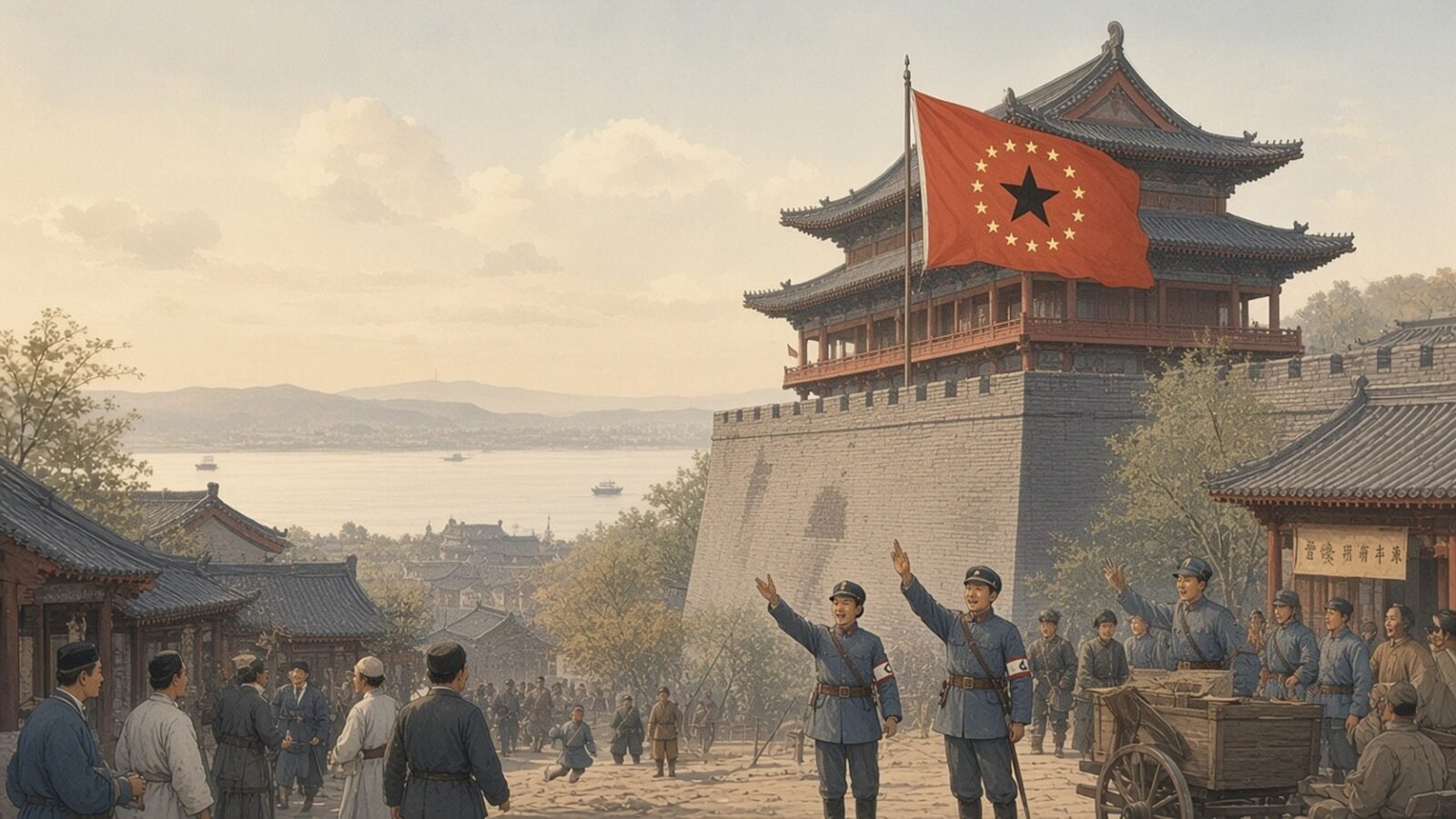
They decided to launch it. Beginning in the small hours of 10 October 1911, regiment after regiment of New Army soldiers in Wuchang rose against their commanders, exchanged fire with the brigade that remained loyal, and by mid-morning had a complete hold on the city, the central arsenal, the gunboat fleet that controlled the Yangtze from the Hankou anchorage to the Wuchang barricades, and the provincial treasury. The next morning they proclaimed the establishment of the Republic of China. The proclamation was read on behalf of a civilian, Li Yuanhong, who had been a brigade commander and had refused to declare himself president; it was read in Li’s name by others on his behalf, and Li was carried into the public process on the shoulders of the revolutionary officers. The event was not what anyone had planned. It was what was left after the bang was heard and the timetable moved.
Within ten weeks fifteen provinces would declare themselves independent of the Qing court in Beijing. The southern half of the empire would assemble a Provisional Senate in Nanjing and would invite Sun Yat-sen, who had been travelling in the southern United States, to return as provisional president. The northern half would negotiate a peace, with Yuan Shikai serving as both the emperor’s field marshal and the southern armies’ peace envoy. Within six months, in the second day of February 1912, the imperial court would issue the abdication edict that brought two thousand years of continuous imperial rule to a close. The dynasty was finished, and the world had to learn to call China a republic.
The Qing on the Eve
By the autumn of 1911 the Qing dynasty had been visibly dying for at least a decade. The defeat by Japan in 1895 had shown that the Self-Strengthening Movement of the previous twenty years had not produced a military instrument capable of defending China’s interests; the indemnity demanded by the Eight-Nation Alliance in 1901 had bankrupted the government’s ability to fund reconstruction without foreign loans; the Boxer Indemnity of 1901 had meanwhile forced the court to abandon the Forbidden City entirely and seek refuge in Manchuria. The collapse was visible, and the modernising provincial governors of central and southern China were building institutions of public life that could be, and would soon be, redirected against Beijing.
The Hundred Days Reform of 1898 had failed, but the abortive attempt at constitutional reform had done two things that would matter in 1911. First, it had established the principle that the imperial court could no longer rule by personal fiat and was, in the eyes of the province-level governors, now expected to negotiate. Second, it had indirectly spread a generation of reformist elites into provincial posts, schools and journals where their natural constituency was the rising middle class of the treaty ports and the more energetic part of the gentry. The New Army regiments that would mutiny in 1911 were full of educated commoners and lower-gentry boys who had been the unintended product of the late Qing reform effort.
The late Qing constitutional reform of 1906 was an attempt to put that genie back into the bottle. A provincial assembly was held, the Imperial Cabinet was established, and the nine-year timetable for constitutional government was published. The reform was botched, however, when the emperor’s regent, Prince Chun, packed the cabinet with Manchu princes, the railway nationalisation of 1911 was announced in conditions that looked suspiciously like a property grab, and the central government found itself unable to defend itself diplomatically against foreign pressure on multiple fronts at once. The provincial assemblies, which had been called into existence by the reform, were now the institutional lever by which the regimes of the south and central provinces asserted a degree of autonomy they had not previously possessed.
The Hubei Compound
The Hubei compound in Wuchang was built around the provincial army’s training battalions. The Hubei New Army, as reformed under Zhang Zhidong’s supervision in the eighteen-eighties and -nineties, was an unusual creature. It drew its officers and a fraction of its private soldiers from among the men who had been educated in the new military schools, and it ran through Wuchang’s garrison a system of academies whose first graduates were in their thirties by 1911. The Hubei establishment was, in effect, the test bed for every subsequent provincial army that Beijing tried to replicate.
Two organisational facts about the Hubei army proved crucial. First, the regiments had been deployed in concentration at the Wuchang central position rather than dispersed, because the military authorities wanted their modernisation tightly supervised; the concentration meant that when the mutiny started, it could spread quickly. Second, the regiments had been broadly recruited from the same Hubei-speaking provinces and the same regional networks as the rest of the central Yangtze valley; by 1911 the cultural distance between a Hubei regiment’s officers and men and the local revolutionary networks in neighbouring provinces was much smaller than the distance between a Hubei regiment and the Manchu-led court at Beijing.
By the spring of 1911 the revolutionary work inside the Hubei New Army was almost an open secret. The Tongmenghui had its own inside organisation called the Literary Society, or Wenxueshe, that was reaching forward into the regiments; the New Army had its own organisation called the Military Progress Society, or Jinduhui, that was reaching sideways from one unit to the next; and several smaller networks overlapped both of these. The leadership had to balance the desire to act now against the desire to wait for a pre-arranged moment, and on the night of the Wuchang magazine explosion the moment was forced.
After the First Morning
By 11 October the revolutionaries held Wuchang, the adjacent city of Hankou on the south bank of the Yangtze, and the Yangtze gunboat fleet. The Qing court had to send its own ships down the Han River from Wuhan and try to recapture the position. They failed; the gunboats defected in ones and twos, and within ten days the revolutionaries were in command of the entire Yangtze corridor from Yichang to the Wuhan cities. The next step was that Hubei declared itself a republican province on 10 October; that Hunan declared itself an independent province two weeks later; that Shanxi, Shaanxi, Jiangxi and the other central provinces declared themselves within the month; and that the southern Yangtze provinces, already hungry for the late Qing’s rehabilitation, began sending representatives to Shanghai to plan a national convention.
The southern Yangtze provinces were particularly ready to break with Beijing. They had hosted the major share of the new treaty-port economy of the previous two decades, and the modernising institutions they had built up, in commerce and education, were ready to move beyond the late Qing’s reform programme. Shanghai’s commercial and print elite had been organising conventions for years. They had built a notional federal structure that could receive the new provincial declarations and turn them into a unified national movement, and when Nanjing was captured in early December, they were able to convene a provisional senate there within a week.
The northern Yangtze stayed closer to the Qing court. The Grand Canal provinces of Zhili, Shandong and Henan declared themselves neither loyalist nor rebellious; their local elites looked south to the Qing court and north to Yuan Shikai, and waited. Yuan, who had been recalled from political retirement to command the imperial forces against the south, used that no-man’s-land as leverage, refusing to prosecute the war in the south hard enough to defeat the rebels and refusing to acknowledge the southern republic vigorously enough to destroy it. The result was a frozen civil war that neither side could win decisively.
Sun Yat-sen Comes Home
Sun Yat-sen reached Shanghai on Christmas Day 1911 after two months in Europe and the southern United States, having been formally elected provisional president of the republic by the Nanjing Senate on 28 December. He had been an exile for sixteen years, and the republic, of which he was now provisional president, had been built by provincial movements he had had only intermittent contact with. He brought to Nanjing something that the provinces had not yet developed on their own: a working theory of how a republican China might look, a willingness to commit to a constitutionalist political programme rather than a military one, and an international stature that gave the new republic a face that Western ministers had to deal with.
Sun’s provisional presidency was short. He took office on 1 January 1912, and he resigned the office two months later, on 1 April 1912, after the Nanjing assembly had voted to adopt the provisional constitution Sun had drafted and to make the presidency conditional upon Yuan Shikai’s assent. The arrangements by which Yuan accepted the presidency of the new republic in exchange for the abdication of the emperor were not entirely of Sun’s making, and the resignation was a deeply deliberate political gesture: Sun gave up his claim to the presidency as a price for getting the imperial house to give up its claim to the throne. Both were without republican precedent in China.
The claim on which Sun insisted was that a republican government in Nanjing would be a constitutional republic, not a personal or military successor state. The 1912 Provisional Constitution, drafted in February 1912 and in force until October 1913, built the republic around a weak presidency, a two-house legislature, and an independent judiciary on the French Third Republic model. This was a deliberate choice; it reflected Sun’s reading of the political lessons of late Qing failures and of the western parliamentary systems that he had been studying since the early years of the century. It also reflected the provincial elite’s clear preference for a constitutionalism that would constrain Yuan Shikai as much as it had constrained the Manchus.
Yuan Shikai’s Bargain
Yuan Shikai entered the negotiations on his own terms. His family had been in the imperial civil service under the Qing for two generations; he had been made grand councillor in the late Manchu period; he had been stripped of his position in 1908 by Prince Chun and exiled to a rural estate for the first two years of the regency. His recall in the autumn of 1911 was, in effect, an acknowledgement by the Qing court that it could not afford to keep its most experienced military commander idle. Yuan himself understood that the court had to be used, not preserved, and he accepted command on a calculation about what he could get out of the situation.
The bargaining ran through three channels. The court wanted Yuan to put down the southern rebellion by force; the southern provinces wanted Yuan to convert to the republican project and accept the presidency; foreign legations wanted a stable outcome that would keep the Boxer Indemnity obligations paid and the China market open. Yuan negotiated concurrently with all three. He did not destroy the republic at sea; he did not preserve the imperial house intact; he did not accept the presidency without conditions. The emperor abdicated, the republic was declared, and Yuan accepted the presidency with the specifiable obligation to keep the court intact and to obtain northern assent to the constitutional programme.
The abdication edict, drafted under the regent’s seal and promulgated on 12 February 1912, was a deliberate and almost timid piece of writing. It declared that the imperial house would withdraw in favour of the republican form of government, that the existing government organisation would be transferred to the new republic, that the imperial family’s private property would be respected, and that the emperor would retain his title and stipend as a private citizen. The edict was a pragmatic concession, not a confession of criminal liability. Its point was to provide the basis for the orderly transfer of sovereignty and to head off the kinds of legal complication that had attended earlier dynastic transitions. The southern provinces accepted the edict.
The Provisional Constitution and the New Provinces
What the formal transfer to the republic did not produce was a unified new state. The 1912 constitution defined a central government with a president, two chambers and a judiciary, but the post-imperial provinces had not been instructed to yield the autonomy they had begun to assert during the war. Some provincial assemblies now claimed powers that the central government in Beijing did not contest; in particular, the southern provinces of Guangdong, Guangxi and Yunnan retained their own military governors, and the central Yangtze provinces retained commercial policy control over the treaty ports that fell within their jurisdictions. The republic was nominally centralist; in practice it was federalist in everything except budget.
The major task that the new government set itself in 1912 was parliamentary. Elections were called for the spring of the year. Sun Yat-sen’s constitutional draft was revised in light of the elections and the autumn legislative session, and a more permanent Constitution of the Republic of China was promulgated on 1 October 1913. The constitution had a strong bicameral structure, a parliament dominated by Sun’s Kuomintang party, and a presidency that was meant to be ceremonial rather than executive. Yuan Shikai accepted the constitution and was confirmed by the parliament as president in October 1913.
The first act of Yuan’s confirmation was the suppression of the Kuomintang opposition. The Kuomintang had been elected to a working majority of both chambers, and Yuan had interpreted the moment as an opportunity to consolidate. He moved within weeks of his confirmation to dissolve the Kuomintang, suspend the parliament, and rule by military council. The constitutional experiment of 1912-13 was already dead. The republic survived as a name, but it no longer had any administrative substance. The warlord era was beginning, and the constitutional fiction of the early republic was the major casualty of the Wuchang coup’s aftermath.
The Long Aftermath
The Wuchang mutiny that had lit the fuse that autumn had launched a longer revolution than the contemporary record usually admits. The 1911 Revolution of history textbooks is the founding of the republic; the 1911 Revolution that historians have spent decades examining is a longer transformation, running through the provincial movements and warlord coalitions of the eighteen-teens and twenties, and culminating in the second and third republics of the late 1920s and the war against Japan. The mutiny at Wuchang did not by itself produce the national revolution that the Kuomintang came to embody in the 1920s, but it had set the institutional fact of republican governance in place, on which the national revolution later drew.
When the Manchus had returned to the throne in the eighteenth century after the conquest period, they had not erased the late Ming institutions of provincial administration that they had absorbed, and the dynasty had run on a foundation that was, even in 1911, recognisably Ming-period. The Qing had added a Qing overlay of grand councils, palace memorials and imperial commissions, but the basic governmental habit at the provincial level was a continuation of the late imperial system. When the republic came, the late imperial governmental habits did not vanish overnight, and the provincial elites who had supported the southern revolution were happy to continue along the same institutional lines under republican flags. This accounts for the slow transition from monarchy to republic. It also accounts for the persistence of military governors and warlord coalitions that contemporary observers were already beginning to identify as such in the years following 1911.
The other long aftermath is the unfinished political legacy of the revolution. The founding charter of the Kuomintang declares that the central goal of the 1911 Revolution was to deliver a constitutional republican government to China. The fact that this goal was achieved only intermittently and unstably, that the constitutional republics of the late Qing period were interrupted by military dictatorship, and that the war against Japan in the late 1930s imposed a different set of priorities on the Kuomintang and the Communist Party both, is a measure of the long shadow cast by the Wuchang mutiny of 1911. The twentieth-century history of China is the history of attempts to make the inheritance of October 1911 actually workable.
The Provincial Memory
The Wuchang Uprising is commemorated, with state ceremony in the People’s Republic of China on the National Day, as the day the people’s revolution was born. The Kuomintang’s calendar in Taiwan marks the same day as Double Ten Day. The revolutionary museum at Wuchang is on the riverfront of the modern city and is largely focused on the cult of Sun Yat-sen and the southern Tongmenghui leadership. The actual mutiny on 10 October is preserved mainly as a dedication plaque on the former Hubei military barracks building and a few memorial tablets elsewhere, of which the most significant is at Huangxing’s grave in Changsha. The provincial memory of the revolution is not the same as the regional memory of the revolution, and the Hubei memory is the lower-keyed but more historically accurate of the two.
The Hubei provincial press in the period immediately after 1911 is a treasure trove for the historian. The newspapers that emerged in the months following the uprising reported on local conditions in detail and in a tone that was at the same time triumphant and alarmed. The local elites and the New Army regiments had won the Wuchang mutiny; the question of whether they could sustain a republican province, an active war effort, and the political machinery of the kind of bureaucratic state the late Qing had been moving toward, was the question that ran through the entire Hubei and Shanghai provincial press of the period. The tensions between local autonomy and national republic, which would later surface as the major issues of the late republican civil wars, were already clear.
The Hubei memory, in particular, preserves a quiet detail that the world press of 1911 mostly missed: the deliberate, careful way in which Li Yuanhong and the other brigade commanders of the New Army moved immediately after they had taken Wuchang to leave the political direction of the revolution in civilian hands. This fact, easily lost in the romance of the revolution, is more important than the military heroism that the later memory celebrates. The proper operation of the republic was treated as a civilian task from the first morning. The army that had mutinied was prepared to be handed back to civilian command whenever that handover could be agreed. The subsequent story of the warlord period can be read as the slow breakdown of that original arrangement.
The Provincial Press Revolution
The autumn of 1911 saw an unprecedented expansion of the Chinese-language press, and the press revolution shaped how the republic remembered itself. Whereas in 1898 the major reform newspapers of the empire had been limited to Shanghai, Hong Kong, Tokyo and a handful of the treaty ports, by 1910 there were well over two hundred established Chinese-language newspapers in the late Qing provincial capitals, and another hundred in smaller cities. The provincial press had spent the previous decade covering the constitutional reform programme and the corruption cases that had been associated with it. When the Wuchang mutiny was reported, the provincial press had the institutional infrastructure in place to treat the uprising as a major national event. They did. The Shanghai press in particular, with the Shenbao and Shibao in the lead, gave the mutiny continuous coverage and brought the southern provinces into the same news-cycle.
The provincial press had been unusually well integrated with the gentry educational system of the late Qing. The reform journals of the provincial capitals were read by the same educated gentry elite whose sons were serving in the New Army; the news of the Wuchang mutiny thus reached readers in a position to make political calculations about whether to declare their own provincial regimes independent. The first wave of provincial declarations came within a month of Wuchang, and the timing is best explained by a press-mediated coordination process in which the gentry of each province had read the news from the central Yangtze and decided how their own province should respond. The press did not make the revolution; the press gave the revolution the geographic coordination that allowed it to scale.
The provincial press that emerged after the autumn of 1911 also made a more durable contribution: it crystallised a republican political vocabulary that had been emerging in the late Qing years but had been unable to use the press directly. Terms like minzhu (people’s sovereignty), lifaquan (constitutionalism), and guomin (citizen) entered everyday newspaper language in the late 1911 issues. These terms had been present in 1906-1908 constitutional discussions but had been of relatively narrow usage; the autumn of 1911 translated them into the working vocabulary of the provincial press for the rest of the twentieth century. The vocabulary of the modern Chinese state is in part the vocabulary of the 1911 press revolution.
The Overseas Chinese and the New Republic
The overseas Chinese diaspora was a major contributor to the Wuchang uprising’s reach and to the southern republic’s institutional functioning. By 1911, the Qing diaspora had been more than six decades in formation, with established commercial communities in Manila, Batavia, Singapore, Rangoon, Bangkok and Saigon, smaller settlements in Yokohama, San Francisco and Vancouver, and an emergent but rapidly growing community in the southern coastal Chinese cities. The overseas Chinese were heavy financial backers of the Tongmenghui and of Sun Yat-sen’s alliances with other organisations before 1911. By the time of the Wuchang mutiny, the overseas Chinese had been contributing direct financial support to the southern provinces for years. The support that enabled the Wuchang mutiny’s provincial declarations was in significant part an overseas product.
After the autumn of 1911, the overseas Chinese diaspora continued to be a major financial backbone of the southern republic. The overseas Chinese had developed a network of formal and informal organisations that mobilised money for the southern provinces, had helped Sun Yat-sen’s all-China political coalition by providing institutional infrastructure in the host cities, and provided the diplomatic cover that allowed the southern republic to claim worldwide relevance. The diplomatic recognition of the new republic by the major powers in the years following 1911 was in part the function of the overseas Chinese pressure on the home governments of the European powers to grant the republic formal diplomatic status as a sovereign state.
The southern diaspora after 1911 became a recruiting pool for the new revolutionary military forces that the Kuomintang would form in the 1920s. Many of the senior Chinese officers of the Northern Expedition and the Second Sino-Japanese War were the children or grandchildren of the late Qing diaspora, and several of them had been civilians in the diaspora countries in 1911. Their military careers did not begin until the mid-1920s. The financial and personnel infrastructure that supported those careers was in many cases the institutional contribution of the diaspora that had been already engaged in supporting the 1911 revolution. The diaspora was, in this sense, the long tail of the Wuchang mutiny’s inheritance.
Modern Commemoration
The Wuchang Uprising is one of the few Chinese historical events of the early twentieth century that has a major site of state commemoration in the People’s Republic, and that also has a long independent history as a symbol of the new republic. The original Wuchang mutiny headquarter building, a brick compound in the central Wuchang district, is preserved as a museum open to the public; the major exhibits in the modern collection date from the centenary celebrations of 2011, when the People’s Republic commissioned a full re-display of the regional history of the uprising. The Republic of China’s prior commemorations, particularly the Double Ten Day speeches at Sun Yat-sen’s mausoleum in Nanjing, have also kept the Wuchang mutiny in continuous public memory through the twentieth century.
The Hundredth Anniversary in 2011 was a particular year of state commemoration. A new statue of Sun Yat-sen was unveiled in the old Wuchang headquarters compound in October of that year, and the Chinese Academy of Social Sciences published a five-volume new history of the 1911 Revolution. The People’s Republic’s calendars now mark October 10 as a memorial day for the early national democratic revolution, even though it is not the founding day of the People’s Republic itself (the founding day is October 1, 1949). The Red Cross of China and the relevant academic institutes have held academic conferences on the legacy of the uprising at regular intervals since 2011, and the principal bibliographical guides to the Wuchang mutiny have been kept current.
Outside the People’s Republic, the Wuchang mutiny remains a reference point for the development of the modern Chinese state. The Kuomintang’s continued commemoration of Double Ten Day, particularly in Taiwan, has kept the uprising’s memory in continuous public life in a way that the world press of 1911 mostly missed. The overseas Chinese diaspora, particularly in Southeast Asia and North America, continues to hold Double Ten Day celebrations in the cities with significant Chinese populations, and these have not been displaced by the founding of the People’s Republic in the popular memory.
The War Against Yuan Shikai
The narrative of the Wuchang mutiny’s becoming has so far been one in which a popular revolution was institutionalised through a political bargain between the southern provinces and Yuan Shikai. The complementary narrative, in which that bargain had to be defended against Yuan’s attempts to reverse the revolution in 1913, is more familiar from the standard textbooks. The summer of 1913 saw a sustained challenge to Yuan Shikai’s authority from the Kuomintang, the largest party in the new National Assembly. The Kuomintang had won the parliamentary elections of December 1912 and January 1913 in a landslide; they used their position to block the president’s military budget and to demand that the bank-loan agreement with the consortium be renegotiated. Yuan saw the Kuomintang as an obstacle to executive government, and when a series of provincial assassinations broke out in the late summer of 1913, Yuan blamed the Kuomintang and used the occasion to suppress them.
The suppression of the Kuomintang and the dissolution of the National Assembly in November 1913 effectively ended the parliamentary version of the Chinese Republic. The Kuomintang members went underground or fled to Japan, and a constitutional convention was held that produced the Yuan constitution of 1914, which concentrated power in the presidency to a degree that the constitutional drafters of 1912 had explicitly intended to avoid. The 1914 constitution also set up the body that would govern China for the rest of Yuan’s presidency: a parliamentary chamber of his own choosing, a constitutional compact that appointed his successor, and a procedure for consulting the population through provincial voters lists that proved to be the practical template for the warlord-era factions.
Yuan tried in late 1915 to convert the presidency into an imperial throne. The empire-revival movement drew support from several of the late Qing bureaucratic factions and from a substantial fraction of Yuan’s own inner circle, but it triggered a regional coalition of the southern provinces opposed to the imperial restoration. Within months Yuan was in an unstable military situation, and after an illness, he abdicated in March 1916 and died in June of the same year. The empire-revival project had taken the constitutional republican experiment of 1912 away without producing a stable imperial alternative in its place, and the resulting political vacuum was filled by the warlord coalitions of the following decade.
References
- 1911 Revolution — Grokipedia, accessed 15 October 2026.
- Wuchang Uprising — Grokipedia, accessed 15 October 2026.
- Sun Yat-sen — Grokipedia, accessed 15 October 2026.
- Yuan Shikai — Grokipedia, accessed 15 October 2026.
- Provisional Constitution of the Republic of China — Grokipedia, accessed 15 October 2026.
- Young, Ernest P. Echoes of the 1911 Revolution: Local Histories and Lasting Legacy of the Xinhai Movement — Oxford University Press, 2019.
- Wakeman, Frederic Jr. The Fall of Imperial China — Free Press, 1975.
- Schoppa, R. Keith. The Columbia Guide to Modern Chinese History — Columbia University Press, 2000.
- Duara, Prasenjit. The Crisis of Global Modernity: Asian Traditions and a Sustainable Future — Cambridge University Press, 2015 (chapters on late Qing and early republican transition).
- Li Yuanhong — Grokipedia, accessed 15 October 2026.
- Tongmenghui — Grokipedia, accessed 15 October 2026.