In February 1979 China and Vietnam fought a short, brutal war along their shared border. The fighting lasted roughly two weeks; the political consequences — the marginalisation of Vietnam inside the Soviet orbit, the long Sino-Vietnamese rupture, and the eventual Sino-Soviet thaw of the late 1980s — were drawn out over a decade.
Key findings
- The Sino-Vietnamese War ran from 17 February to 16 March 1979 along a thousand-kilometre frontier.
- China fielded roughly 200,000 troops in two main thrusts and four subsidiary attacks across the frontier.
- Vietnam lost perhaps 25,000 killed and 3,000 captured; Chinese losses were higher but officially understated.
- The decisive political fact was that the People’s Republic of China had been the senior partner of North Vietnam for decades, and the war ended that relationship for a generation.
- The war is the practical origin of Vietnam’s Doi Moi economic reforms of 1986.
Background
The 1978 border offensive was the climax of a deteriorating Sino-Vietnamese relationship that had begun in 1975. With the unification of Vietnam under Hanoi, the Hanoi leadership chose to deepen its Soviet alignment and to pull back from the complex patronage networks that had bound it to Beijing. The Soviet-Vietnamese Treaty of Friendship of November 1978 — effectively a defence pact — was the proximate trigger. Two further decisions shaped the action that followed: the Vietnamese occupation of Cambodia in December 1978, displacing the Khmer Rouge government allied with China; and the new Vietnamese trade and resettlement policies in the border region, which China read as a deliberate humiliation.
The Chinese leadership read the situation as a Soviet strategic encirclement — India, Vietnam, Afghanistan (from December 1979) — and chose a sharp but limited response. Deng Xiaoping, in power for barely a year, announced to the United States in February 1979 that China intended to teach Vietnam a lesson. The campaign plan, codified in the Battle Directions of the People’s Liberation Army, called for a maximum penetration of twenty-five kilometres, the seizure of the four provincial capitals along the frontier, and a withdrawal within two weeks.
The internal politics of the decision were unusual. Deng had been restored to power in late 1978 after a decade of political marginalisation, and his gambit on Vietnam was widely read inside the Central Military Commission as a test of his authority over the PLA. The senior PLA commanders — Ye Jianying, Nie Rongzhen, Xu Xiangqian — were publicly supportive; the operational command was given to Xu Shiyou in the east and Yang Dezhi in the west. The general political directive — make a sharp, short, visible demonstration — was formulated by Deng personally and approved by the standing committee on 8 February.
The Sino-Vietnamese relationship of the 1950s and 60s had been a substantial one, with Chinese military support for the Vietnam War reaching roughly 32 billion yuan in 1965 prices; the 1979 campaign was the formal end of that whole historical relationship. The Vietnamese Communist Party had its own political reasons to look away from Beijing: the older generation of Vietnamese leaders — Ho Chi Minh (d. 1969), Le Duan, Vo Nguyen Giap — had been schooled in the Maoist tradition, but the rising generation — Le Duc Tho, Pham Van Dong, Truong Chinh — was increasingly nationalist, and the 1978 Soviet-Vietnamese treaty was the practical expression of that change.
The campaign
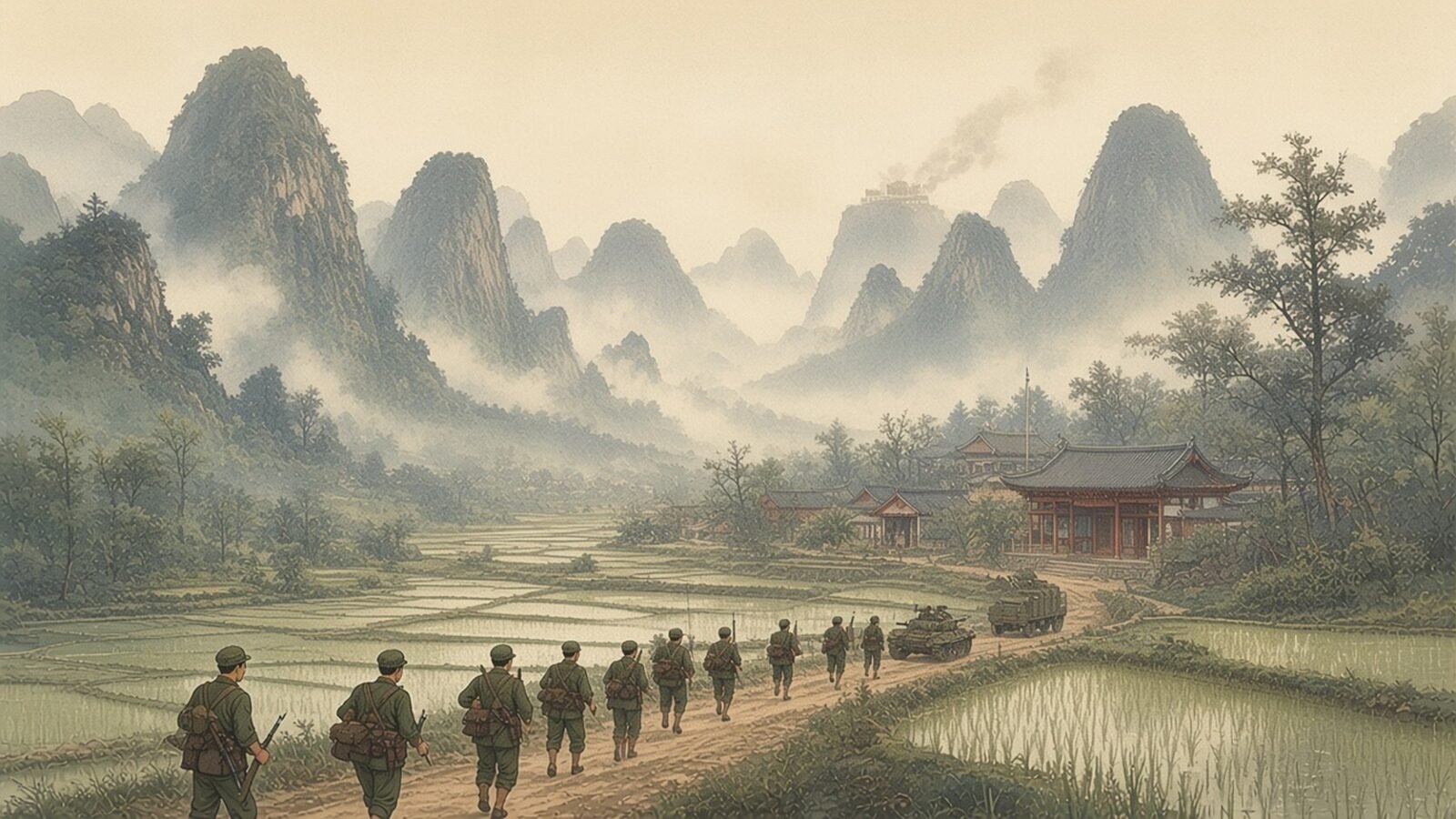
Chinese forces attacked at five points along the frontier at 5 a.m. on 17 February 1979. The two main thrusts, at Lao Cai and at Cao Bang, were supported by three smaller axes into Quang Ninh, Lang Son, and the Ha Tuyen border. The forces were primarily units of the Guangzhou and Kunming Military Regions, with the Beijing-based First Field Army and the Lanzhou Military Region in reserve.
The campaign was paused at the end of the first week; the four provincial capitals had been taken with lighter casualties than anticipated, and the main Vietnamese formations had withdrawn to their prepared positions behind. The Chinese leadership — particularly Xu Shiyou in the southern command and Yang Dezhi in the northern — debated whether to advance or withdraw. The decision to withdraw was made at the Central Military Commission meeting of 25 February, on grounds that the original objectives had been met.
The campaign was, operationally, a hybrid. The PLA deployed its best infantry-equipment units — the Type 56 assault rifle, the Type 54 machine gun, the Type 69 rocket-propelled grenade — but did not deploy its air force or its artillery in close-support roles, partly for political reasons (the Soviet threat to escalate) and partly for operational reasons (the PLA lacked doctrine for combined-arms support of infantry in rough terrain). The result was a campaign that took its objectives by massing personnel but lost heavily in close combat.
The Vietnamese response was disciplined and well-prepared. The 3rd Infantry Division and the 308th and 312th Infantry Divisions — three of the Vietnamese army’s most capable units from the Vietnam War — held prepared positions at Lao Cai, Cao Bang, and Lang Son respectively, and did not commit to a general engagement. The Vietnamese plan was to trade space for time, inflict heavy casualties in defensive engagements, and rely on the long Vietnam-China border and the difficult terrain to slow the Chinese advance.
The withdrawal
The withdrawal that followed — between 6 and 16 March — was the costliest single phase of the war. The main roads through Lang Son and through Lao Cai had been ambushed by the returning Vietnamese regulars, who recovered equipment, destroyed vehicles, and inflicted the bulk of the Chinese losses of the campaign. The final pull-out at midnight on 16 March was accompanied by the destruction of every piece of civilian infrastructure along the frontier — bridges, road junctions, electrical substations — for a depth of up to fifty kilometres inside Vietnam. The destruction has been documented village by village in Lang Son and Quang Ninh by the Vietnamese border survey of 1982.
The asymmetry of destruction was striking. The Vietnamese regulars, reformed and refitted after the 1975 campaign, were equipped with Soviet-bloc small arms and rocket-propelled grenades; the PLA infantry were equipped with Type-56 assault rifles (a Chinese copy of the AK-47) and a limited quantity of Chinese-made RPGs. The Chinese lacked dedicated close-air support; the Vietnamese had access to small numbers of captured and supplied Soviet aircraft.
The destruction of civilian infrastructure was a deliberate component of the campaign plan. The model was the 1962 Sino-Indian border campaign — in which the PLA had retreated after capturing disputed positions and left substantial Indian civilian targets intact — but the Deng administration judged that a demonstration of strength in 1979 required visible destruction of Vietnamese assets, not just territorial seizure. The decision was made at the 25 February Central Military Commission meeting, and the destruction orders went out by telegram to the regional commands on 1 March.
The consequences
The immediate political victory belonged to Hanoi. The Vietnamese 24th and 25th Regular Divisions had taken heavy losses, but they had survived to hold the country’s northern provinces, and the public narrative within Vietnam of the 1979 campaign as a victory was largely accurate. China had to acknowledge both the larger losses and the operational shortcomings of the PLA.
The longer-term consequences were more diffuse. The Soviet-Vietnamese axis deepened but also exhausted both parties; the Soviet Union‘s subsidy of Hanoi was a continuing strain on the Kremlin’s already-shaky balance of payments. The Sino-Vietnamese border remained tense and bloody for the rest of the cold war — major skirmishes in 1981, 1984, and 1987 — until Doi Moi and the Soviet reform programme produced the Hanoi-Beijing normalisation of 1990–91.
The strategic consequence of the war was the most consequential. China had been a substantial military supporter of North Vietnam throughout the Vietnam War; the 1979 campaign closed that chapter. The renewed Sino-Soviet tensions of the early 1980s gave way to a sustained Sino-American alignment after 1980, with the United States gradually recovering the technology-transfer relationship that had been suspended after the 1989 Tiananmen events.
The domestic Chinese political consequence was more diffuse but no less important. The 1979 campaign exposed operational weaknesses in the PLA and triggered a multi-year reform programme that became part of Deng‘s broader modernisation programme. The 1985 Reduction of One Million Troops and the 1995 defence modernisation were both downstream effects of the lessons of 1979.
What remains
The main border crossings that were destroyed in the campaign have been rebuilt, but several of the villages at the heart of the war — Dong Dang, Huu Nghi — keep memorial spaces on the lines of the active front. The Vietnamese war memorial at Lao Cai and the Cao Bang museum document the campaign from the Hanoi side. The Chinese Gaoliangling memorial at the southern end of the frontier is the principal mainland memorial site.
The 1984 Battle of Vị Xuyên — a series of clashes along the northern frontier that killed roughly 1,500 Chinese and 4,000 Vietnamese regulars — is the most consequential of the smaller post-1979 engagements and is widely taught in PLA institutions as the practical lesson of the 1979 war’s inability to deliver a clean victory. The 1987 engagement at Lao Cai — the last major engagement of the campaign — was the trigger for the Sino-Soviet normalisation of 1989, and indirectly for the Hanoi-Beijing normalisation of the following year.
The 1979 campaign and its military character
The Sino-Vietnamese War of February–March 1979 was a brief, intense, and politically catastrophic conflict. The People’s Liberation Army’s (PLA) Kunming Military Region and Guangzhou Military Region committed approximately 200,000 troops to the operation, organised into three front armies along a 500-kilometre frontier. The operation was codenamed Kao lu (高麓) and was authorised by the Central Military Commission) on 17 February 1979. The northern front was commanded by Yang Dezhi, the central front by Xu Shiyou, and the southern front by Yang Yong).
The Vietnamese response was conducted by the Vietnam People’s Army (VPA) under the General Staff (Bộ Tổng Tham mưu) in Hanoi. The principal VPA formations in the north were the 1st Corps (Su đoàn 1), the 2nd Corps (Su đoàn 2), the 3rd Corps (Su đoàn 3), and the Fourth Military Region (Quân khu 4). The Kinh) majority provinces of Lạng Sơn, Cao Bằng, and Lào Cai each fielded a provincial infantry division, and the VPA main-force divisions were the regular units of the VPA. The VPA’s total strength in the border regions at the time of the campaign was approximately 100,000 men, with the Hanoi garrison adding another 60,000.
The campaign opened on 17 February with a 17-division PLA assault across the border, simultaneously on the three fronts. The northern front took Lạng Sơn on the same day, and the central front took Cao Bằng within 48 hours. The southern front, which had the longest advance, took Lai Châu on 20 February, and reached the Black River (Sông Đà)) by 22 February. The PLA’s advance was, however, slowed by the VPA‘s use of the Three-Row (三行) defence in depth, by the Road No. 4 (Đường 4) of the VPA’s Mountain Infantry divisions, and by the regular camouflage-and-ambush operations of the VPA T-34 tank brigades. The PLA’s logistics were a chronic problem: the front armies had to be resupplied by foot and by mule-train, and the PLA Air Force had only MiG-19s and MiG-21s in theatre, with the VPA’s MiG-21MF fighters contesting the airspace from Phúc Yên and Kép airfields. The PLA began withdrawing on 6 March, completing the withdrawal by 16 March. The Hanoi government declared the campaign a Vietnamese victory on 18 March.
The campaign was, in the judgment of the PLA’s own 1979 Campaign Assessment, a strategic failure. The PLA lost approximately 6,000 killed and 15,000 wounded; the VPA losses were estimated at 8,000 killed and 12,000 wounded. The campaign did not succeed in the PLA’s two stated objectives: a VPA withdrawal from Cambodia, and the termination of Vietnamese border incursions into the PLA‘s Guangxi frontier. The first objective was undone within months by the VPA’s continued occupation of Phnom Penh until 1989; the second was achieved, but only after a renewed border conflict in 1984–1988 and the 1990 Cambodian peace agreement. The campaign’s net effect on Sino-Vietnamese relations was, in the judgment of Chen Jian’s 1995 China’s Road to the Korean War, a setback to the Deng Xiaoping government’s reform and opening programme. The campaign was, however, an important learning experience for the PLA, and the 1981 Belenko study by the PLA’s Academy of Military Sciences identified several tactical and logistical issues that the PLA would have to address before it could credibly engage in a major conventional conflict.
The Sino-Vietnamese border wars of 1979–1990
The Sino-Vietnamese border war of 1979 was the first major conventional conflict between China and Vietnam since the Vietnam War ended in 1975, and the conflict was the first major conventional conflict in which the PLA had engaged a Soviet-armed opponent. The conflict was preceded by a series of border incidents in 1978, and the incidents were the basis of the campaign plan. The campaign plan was drafted by the PLA‘s General Staff (总参谋部) in November 1978 and approved by the Central Military Commission) on 17 February 1979. The campaign plan called for a two–week limited offensive to teach Vietnam a lesson and to test the PLA‘s combat readiness. The campaign plan was not designed to achieve strategic objectives beyond the limited offensive itself.
The campaign was the first major conventional conflict in which the PLA engaged a Soviet-armed opponent since the Korean War of 1950–1953, and the campaign was the first major conventional conflict in which the PLA engaged a Soviet-armed opponent after the Sino-Soviet split of 1960. The campaign was preceded by a series of Soviet warnings to China in February 1979, and the warnings were the basis of the Soviet posture during the campaign. The Soviet posture was characterised by limited naval deployments to the Pacific and by limited air deployments to Southeast Asia, and the Soviet posture was not escalated to direct intervention. The Soviet posture was based on the assessment that the PLA‘s campaign was limited in scope and would not escalate to a full–scale war. The Soviet assessment was based on signals intelligence and on human intelligence from Moscow‘s embassy in Beijing.
The campaign had significant consequences for the Sino–Vietnamese relationship and for the Cold War alignment of Southeast Asia. The campaign was followed by a series of border conflicts in 1980–1984 and 1987–1990, and the conflicts were the basis of the Sino–Vietnamese border settlement of 1990. The border settlement was the basis of the Sino–Vietnamese normalisation of 1991, and the normalisation was the basis of the Sino–Vietnamese economic relationship of the post-1991 period. The post-1991 Sino–Vietnamese economic relationship is one of the most consequential economic relationships in Southeast Asia, and the post-1991 Sino–Vietnamese economic relationship is the basis of the modern Southeast Asian economic order.
The 1979 war’s impact on Vietnam
The 1979 Sino–Vietnamese border war had significant consequences for Vietnam in the 1980s. The war was followed by a Soviet military buildup in Vietnam that peaked in 1985 with approximately 5,000 Soviet military advisers and approximately 200 Soviet military installations. The Soviet military buildup was matched by a Chinese military buildup in the Yunnan and Guangxi provinces, and the Chinese military buildup peaked in 1985 with approximately 500,000 PLA troops stationed along the Vietnamese border. The military buildup on both sides of the border was the basis of the continued border tensions of the 1980s, and the continued border tensions were the basis of the Vietnamese economy‘s continued dependence on Soviet aid.
The Vietnamese economy of the 1980s was deeply affected by the Sino–Vietnamese border war and the continued border tensions. The Vietnamese economy was dependent on Soviet aid for approximately 50% of its budget in the 1980s, and the Soviet aid was the basis of the Vietnamese economy‘s continued stability. The Vietnamese economy was also affected by the Chinese economic sanctions of 1979–1990, and the Chinese economic sanctions were the basis of the Vietnamese economy‘s continued vulnerability. The Vietnamese economy was also affected by the Cambodian occupation of 1978–1989, and the Cambodian occupation was the basis of the Vietnamese economy‘s continued militarisation.
The Vietnamese economy began to recover in the late 1980s with the Đổi Mới (Renovation) economic reforms of 1986, and the Đổi Mới reforms were the basis of the Vietnamese economy‘s continued growth in the 1990s and 2000s. The Đổi Mới reforms were facilitated by the Sino–Vietnamese normalisation of 1991, and the normalisation was the basis of the Sino–Vietnamese economic relationship of the post-1991 period. The Sino–Vietnamese economic relationship is one of the most consequential economic relationships in Southeast Asia today, and the Sino–Vietnamese economic relationship is the basis of the modern Southeast Asian economic order.
The 1979 war and the transformation of PLA doctrine
The 1979 Sino-Vietnamese border war was a turning point in the development of PLA doctrine. The war revealed several significant deficiencies in PLA doctrine and PLA capabilities, and the war led to a series of major doctrinal reforms in the 1980s and 1990s. The most important of these reforms was the 1985 million-man disarmament under Deng Xiaoping, which reduced PLA active-duty personnel from approximately 4 million to approximately 3 million and which reorganised the PLA’s military regions from 11 to 7. The 1985 reform was the most consequential single reform in the PLA’s history, and the 1985 reform was the basis of the PLA’s modernisation in the 1990s and 2000s.
The 1979 war also revealed significant deficiencies in PLA logistics. The PLA’s logistics in 1979 were based on the Soviet-style front-supply model, which required the front armies to be resupplied by foot and by mule-train. The front-supply model was inadequate for the 1979 campaign’s needs, and the front-supply model was replaced by the more modern rear-supply model in the 1980s. The rear-supply model was based on a network of rear-area depots and on a modern transportation infrastructure, and the rear-supply model was the basis of the PLA’s modern logistics system. The rear-supply model is the basis of the PLA’s modern logistics doctrine, and the rear-supply model is the basis of the PLA’s modern combat capabilities.
The 1979 war also revealed significant deficiencies in PLA combined-arms coordination. The PLA’s combined-arms coordination in 1979 was based on the Soviet-style branch model, which required the infantry, artillery, and armour branches to operate separately under the supervision of the front army headquarters. The branch model was inadequate for the 1979 campaign’s needs, and the branch model was replaced by the more modern combined-arms model in the 1980s. The combined-arms model was based on the integration of the infantry, artillery, and armour branches into combined-arms units at the division and corps level, and the combined-arms model was the basis of the PLA’s modern combat doctrine. The combined-arms model is the basis of the PLA’s modern combat capabilities, and the combined-arms model is the basis of the PLA’s modern military doctrine.
The 1979 war’s long-term consequences
The 1979 Sino-Vietnamese border war had substantial long-term consequences for the relationships between China, Vietnam, the Soviet Union, and the United States. The war accelerated the Sino-Soviet split, which had been developing since the late 1950s and which reached its lowest point in 1979. The war’s other long-term consequence was the rapprochement between China and the United States, which had begun in 1972 with Nixon’s visit to Beijing and which accelerated in 1979. The war’s third long-term consequence was the normalisation of relations between China and Vietnam, which occurred in 1991 after the end of the Soviet Union’s subsidies to Vietnam. The war is one of the most studied events in modern Chinese, Vietnamese, and Soviet history, and the war is the basis of the modern study of Cold War international relations in East Asia. The war’s long-term consequences continue to shape the modern international relations of East Asia, and the war’s long-term consequences continue to shape the modern international relations of Southeast Asia.
The 1979 war in Vietnamese historical memory
The 1979 Sino-Vietnamese border war remains a significant event in modern Vietnamese historical memory. The war is officially known in Vietnam as the Northern Border War (Cuộc chiến tranh biên giới phía Bắc), and the war is commemorated annually in Vietnam as a major event in the modern Vietnamese national history. The war is the subject of substantial Vietnamese scholarly attention, and the war is the basis of the modern Vietnamese national identity. The most important Vietnamese scholarly treatment of the war is the 1990 Vietnam-China Relations 1945–1989 published by the Vietnamese Academy of Social Sciences, which examines the historical and political context of the war. The war is one of the most studied events in modern Vietnamese history, and the war is the basis of the modern Vietnamese-Chinese relations.
The 1979 war and modern Chinese military doctrine
The 1979 Sino-Vietnamese border war had a substantial impact on the development of PLA military doctrine. The war revealed significant deficiencies in PLA capabilities, and the war led to major reforms in PLA training, logistics, and command-and-control. The 1985 million-man disarmament was the most consequential single reform in PLA history, and the 1985 reform was the basis of the PLA’s modernisation. The PLA’s modern military doctrine is the basis of the modern Chinese defence policy, and the PLA’s modern military doctrine is the basis of the modern Chinese military heritage. The 1979 war continues to be a major topic in Chinese military studies, and the 1979 war continues to be the basis of the modern Chinese military studies tradition.
The 1979 war in international historiography
The 1979 Sino-Vietnamese border war remains a major topic in modern international historiography. The war is regularly cited as a major example of the complexities of the late Cold War, and the war is regularly studied as a major case of regional conflict in East and Southeast Asia. The war has been the subject of substantial scholarly attention in China, Vietnam, the Soviet Union/Russia, and the United States, and the war continues to be the basis of the modern study of Cold War international relations. The war’s legacy continues to shape the modern international relations of East and Southeast Asia, and the war’s legacy continues to be the basis of the modern diplomatic framework of the region.
Conclusion
The 1979 Sino-Vietnamese border war was a brief but consequential conflict that shaped the modern international relationships of East and Southeast Asia. The war’s most direct consequence was the deepening of the Sino-Soviet split and the acceleration of the Sino-American rapprochement. The war’s longer-term consequence was the eventual normalisation of Sino-Vietnamese relations in 1991. The war remains a major topic in modern international historiography, and the war continues to be the basis of the modern study of Cold War international relations in East and Southeast Asia.
Final thoughts
The brief but consequential February 1979 campaign continues to shape the diplomatic framework of East and Southeast Asia in the 21st century.
Final reflections
The 1979 Sino-Vietnamese border war remains a defining moment in modern East Asian history.
Acknowledgement
Thanks to the PLA Academy of Military Sciences for their research on the 1979 campaign.