
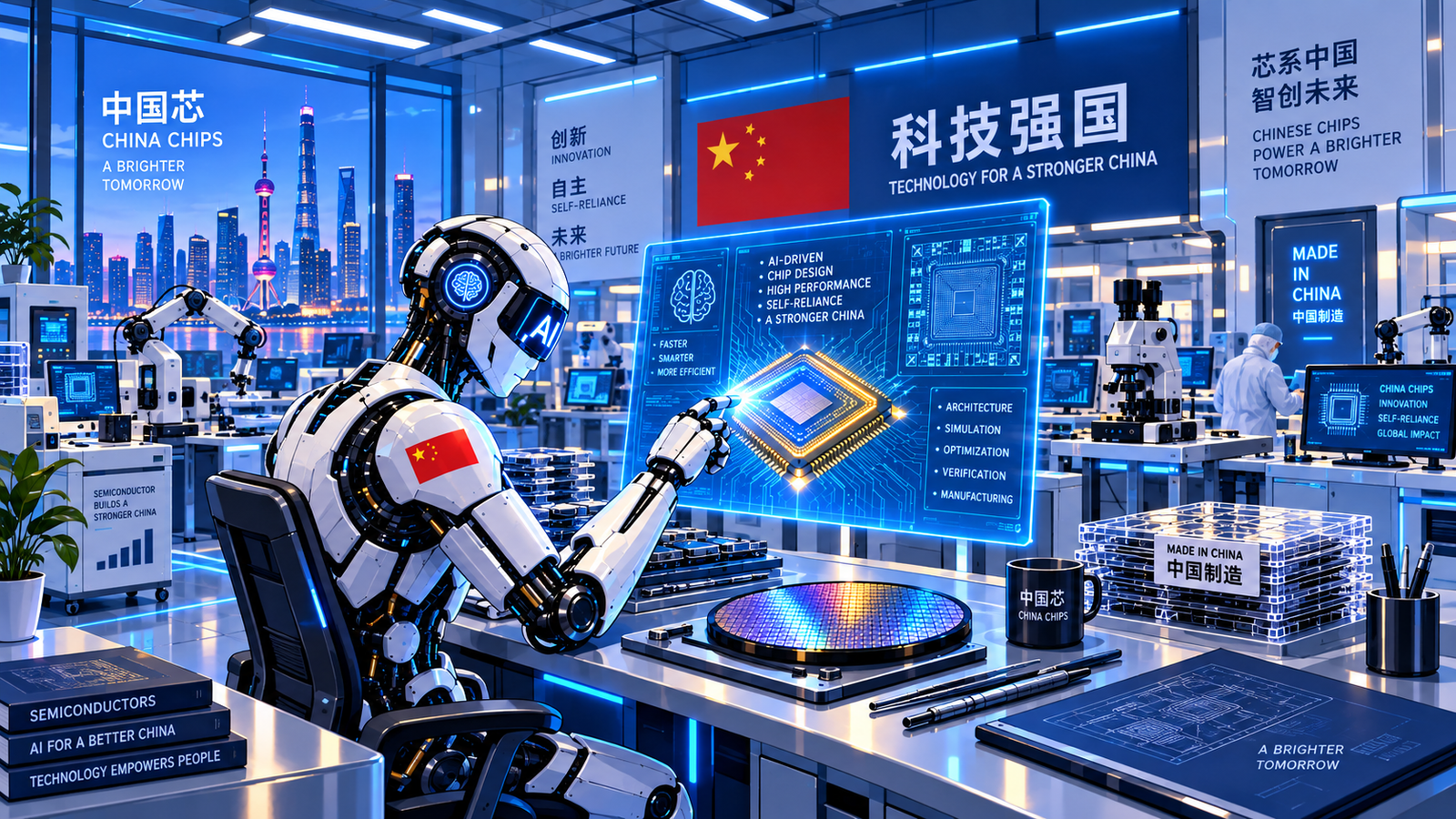
China’s semiconductor strategy is entering a new phase. Having spent years pouring resources into domestic fabrication, equipment, materials and processor development, Beijing is now turning artificial intelligence onto one of the less visible but most strategically important parts of the chip industry: the software used to design chips themselves.
A South China Morning Post report published on 13 September 2026 highlights how Chinese electronic design automation specialist Empyrean Technology is incorporating agentic AI into its chip-design tools. According to Empyrean chairman Liu Weiping, an AI agent applied to simulation and layout software reduced one circuit-layout task from around four weeks to just one. Liu described the transition as a shift from “humans operating tools” towards “humans commanding agents”. That may sound like a productivity story, but in reality it has much larger strategic implications. China is trying to use AI not merely to design better chips, but to accelerate the creation of an increasingly self-sufficient semiconductor ecosystem.
Why chip design software matters
Before a semiconductor reaches a fabrication plant, engineers must transform an idea into extraordinarily complex digital blueprints. Modern chips can contain tens or hundreds of billions of transistors, making manual design essentially impossible. Electronic design automation, or EDA, software handles much of this complexity, supporting tasks including circuit simulation, verification, logic synthesis, placement of components, routing of connections, timing analysis, power optimisation and the final checks required before a design is sent to a semiconductor foundry.
EDA is therefore one of the foundational technologies of the semiconductor industry, and historically it has been an area where China has remained dependent on foreign suppliers. Synopsys, Cadence and Siemens EDA dominate the global market. A 2026 European Commission assessment of the semiconductor value chain, drawing on 2024 market data, found that the three companies collectively controlled more than three quarters of the global EDA market, highlighting just how concentrated this crucial layer of semiconductor technology has become.
Within China, however, Empyrean has become the leading domestic supplier. The company said in 2025 that it accounted for roughly half of China’s domestic EDA sector, although Chinese suppliers continued to face a significant gap with the international leaders, according to an earlier South China Morning Post report on Empyrean and China’s EDA industry. That dependency has obvious geopolitical implications, particularly because chip-design software can be affected by the same export-control pressures that have shaped other parts of the semiconductor industry.
The vulnerability became especially visible in 2025, when Washington imposed new restrictions affecting exports of certain EDA software to China. Those restrictions were subsequently rescinded in July 2025, allowing Cadence, Synopsys and Siemens to resume affected sales and support, as Reuters reported at the time. For Beijing, however, the episode illustrated something important: even software used at the earliest stages of semiconductor development can become strategically exposed. Domestic EDA therefore becomes a national-security issue as much as a commercial one.
Enter “AI4Chip”
Beijing’s ambitions now go considerably further than simply recreating Western EDA products. In August 2026, the Beijing Economic-Technological Development Area—better known as Beijing E-Town—published its official AI4Chip Action Plan for 2026–2028, aimed at embedding artificial intelligence throughout the integrated-circuit industry.
The programme calls for AI to be applied across chip development, manufacturing, packaging, equipment and materials. It envisages AI-assisted circuit optimisation, physical design and verification, as well as the use of AI to improve manufacturing processes and accelerate research and development. The underlying ambition is not simply to add AI features to existing software, but to reshape how semiconductor engineering itself is carried out.
One particularly revealing element is the emphasis on intelligent chip-design systems capable of integrating specialist semiconductor knowledge, engineering tools and AI models. Engineers could increasingly ask an AI system to diagnose a design problem, investigate failures or optimise a circuit rather than manually navigating every individual software tool. Beijing wants the programme to produce three to five internationally influential AI4Chip companies and more than ten benchmark applications by 2028, according to the Beijing municipal government’s description of the initiative.
The engineer becomes the supervisor
Traditional EDA automation is already powerful, but engineers still spend enormous amounts of time operating separate tools, adjusting parameters, analysing failures and repeating optimisation loops. Agentic AI changes that relationship. Instead of asking software to perform one predetermined task, an engineer can give an AI agent an objective and allow it to decide which tools to use, run simulations, analyse the results, alter parameters, rerun the process and continue iterating until it reaches an acceptable solution.
That is why Empyrean’s description of the transition from operating tools to commanding agents matters. If the model works reliably, semiconductor engineers increasingly become supervisors of automated design processes. A task taking four weeks and being compressed into one week represents far more than a modest efficiency improvement. Across hundreds of design tasks and thousands of engineers, such reductions could dramatically increase the number of designs a company can investigate and the speed with which it can bring products to market.
China is not alone
It would be a mistake, however, to interpret AI-assisted chip design as a uniquely Chinese breakthrough. The entire global semiconductor design industry is moving rapidly in the same direction.
In June 2026, Cadence announced what it described as a fully autonomous virtual AI engineer for chip design. Its ChipStack system is intended to allow AI agents to execute semiconductor design and verification workflows with increasingly high levels of autonomy. Cadence said its verification workflow could reduce what might normally be a five-week validation loop to less than a day in certain applications. The company’s announcement can be read here on the Cadence newsroom.
Synopsys is pursuing a similar approach. In July 2026 the company unveiled autonomous agentic EDA workflows developed with Microsoft and used by AMD, intended to automate tasks ranging from debugging to chip implementation. Synopsys said early evaluations of one autonomous debugging workflow showed reductions of between 25 and 40 per cent in debugging cycle times. Further details are available in Synopsys’ announcement on agentic AI chip design.
A second technology race is therefore emerging inside the larger semiconductor race. The first contest is familiar: who can manufacture the most advanced chips? The second may become equally important: who can develop the most capable AI systems for designing those chips? China wants to compete in both.
AI could help China compensate for constraints
There is another reason AI-assisted design is particularly attractive to China. China does not currently possess unrestricted access to every element of the world’s most advanced semiconductor manufacturing ecosystem. Export controls affecting advanced computing chips, manufacturing equipment and related technologies have contributed to Beijing’s effort to localise semiconductor supply chains.
A March 2026 analysis from the Center for Strategic and International Studies on China’s semiconductor localisation drive argued that US and allied export controls had accelerated China’s push towards domestic semiconductor technology even while constraining its access to some leading-edge technologies.
AI cannot magically produce an extreme-ultraviolet lithography machine or eliminate every fabrication disadvantage, but it can help engineers search more efficiently for designs that perform well within the manufacturing technology available to them. That distinction could become extremely important. The fastest chip is not necessarily the product of the most advanced fabrication process alone: architecture, packaging, memory, interconnects, power management and software optimisation all influence the performance of a computing system.
An AI system capable of exploring vastly more design combinations than human engineering teams could therefore help companies extract greater performance from constrained manufacturing processes. In other words, AI could become a force multiplier for China’s semiconductor industry.
This approach also fits a broader Chinese strategy of designing around manufacturing bottlenecks. Huawei, for example, has been exploring architectural techniques intended to improve computing density despite constraints on access to the world’s most advanced manufacturing equipment, another indication that semiconductor competition is increasingly taking place at the architectural and systems level as well as at the fabrication node itself.
From AI chips to chips designed by AI
There is a pleasing circularity to what is happening. The semiconductor industry created increasingly powerful processors; those processors enabled modern artificial intelligence; and now artificial intelligence is being used to design the next generation of processors. Those processors will, in turn, train the next generation of AI systems.
That feedback loop—better chips enabling better AI, which helps design better chips—could become one of the defining technology cycles of the next decade. China clearly wants to ensure that it is inside that loop rather than dependent on foreign companies for access to it.
The real test is reliability
There are reasons for caution. Semiconductor engineering is unusually unforgiving. A generative-AI chatbot can make an incorrect statement and somebody can correct it, but a chip containing a subtle design error can result in months of delays and millions—or potentially far more—in wasted development and manufacturing expenditure. AI-generated semiconductor designs therefore have to pass rigorous simulation and verification.
Training data is another constraint. The strongest semiconductor-design AI systems are likely to benefit from access to extensive libraries of previous designs, manufacturing data, verification results and specialist engineering knowledge, while established global EDA companies such as Synopsys, Cadence and Siemens possess decades of accumulated expertise.
China cannot simply leapfrog that institutional knowledge by attaching a large language model to an EDA application, but it does not necessarily need to leapfrog it immediately. Reducing a four-week workflow to one week is valuable even if humans remain firmly in the loop. Indeed, Empyrean was already reporting AI-related advances in memory-chip simulation and automated design software in 2025, suggesting that the move towards AI-assisted EDA predates the latest wave of agentic systems.
The bigger picture
China’s push into AI-assisted semiconductor design should therefore be understood as part of a much larger industrial strategy. Beijing is trying simultaneously to develop domestic processors, semiconductor fabrication capacity, manufacturing equipment, materials, packaging technologies and design software, while artificial intelligence is increasingly being positioned as the layer connecting and accelerating all of them.
The official Beijing AI4Chip programme goes well beyond design. The policy explicitly aims to embed AI across the integrated-circuit value chain, including manufacturing, packaging, equipment, materials and the broader industrial ecosystem. Beijing describes the objective as using intelligent algorithms and data-driven development to reduce reliance on traditional trial-and-error engineering methods.
China is therefore no longer thinking simply about making AI chips. It is thinking about using AI to make the entire chip industry smarter.
The distinction matters. China may still face substantial technological gaps in parts of the semiconductor supply chain, and agentic AI will not eliminate them overnight. But if AI can compress engineering cycles, automate increasingly complex design work and allow domestic EDA companies to improve faster, those gaps could become easier to close.
The semiconductor rivalry of the 2020s has largely been framed around fabrication technology, lithography machines and access to advanced GPUs. The rivalry of the late 2020s may increasingly revolve around something less visible but potentially just as consequential: the intelligence designing the chips themselves.