
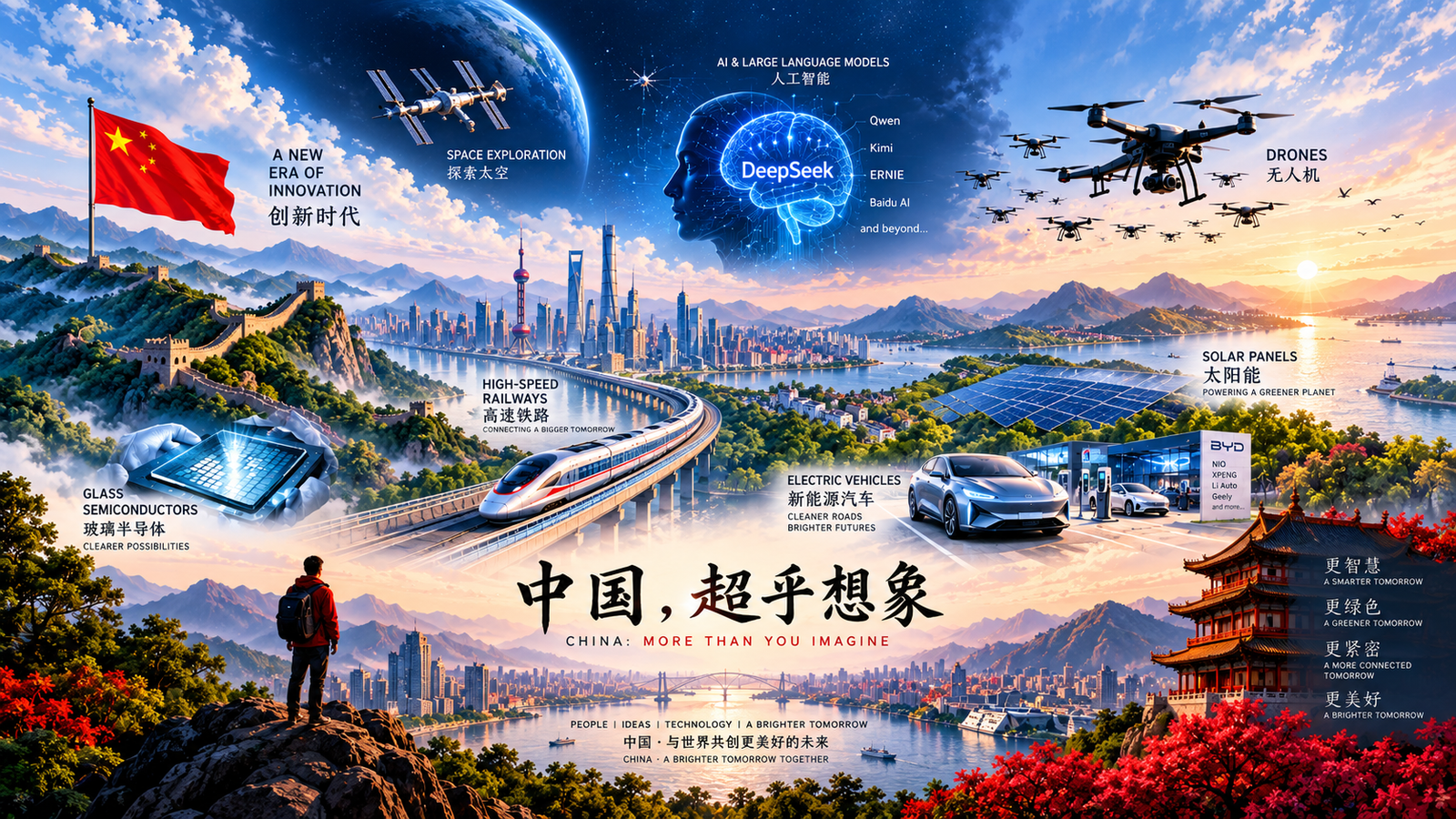
For decades, Western commentary has repeatedly predicted that China was approaching the limits of what it could achieve technologically. China could manufacture but supposedly could not invent; it could copy but not originate; it could assemble Western technology but not master the underlying science; it could compete on price but not sophistication. Yet every few years another Chinese technological development forces those assumptions to be reconsidered. Electric vehicles, solar panels, commercial drones, batteries, high-speed railways, telecommunications equipment, robotics, artificial intelligence and increasingly ambitious semiconductor research have all demonstrated the same basic problem with the old narrative: China is not simply following a Western technological path several years behind. It is developing an enormous technological-industrial system of its own, with different strengths, weaknesses, incentives and methods. This is why judging China exclusively according to Western expectations is so misleading. The important question is not whether China has recreated Silicon Valley, MIT, ASML, Tesla or the European industrial model inside its borders. The question is what China’s own combination of engineering talent, manufacturing density, state investment, private competition, infrastructure, enormous domestic markets and relentless cost reduction is capable of producing. Increasingly, the answer is: considerably more than outsiders expected.
Electric vehicles are perhaps the clearest demonstration. China was once treated largely as an assembly location and potentially enormous future market for foreign car manufacturers. Today Chinese companies compete across batteries, motors, power electronics, vehicle software, autonomous-driving systems, charging equipment and complete electric vehicles. BYD has become emblematic of that transformation, but focusing on a single company misses the larger point. China developed an entire EV ecosystem. Battery producers, cathode and anode suppliers, electronics manufacturers, software developers, machine-tool companies, mineral processors and vehicle manufacturers developed alongside one another. The result is an industry capable not merely of producing expensive technological showcases but of pushing electric technology into increasingly affordable segments of the market. That distinction matters. The world’s most technologically impressive prototype does not necessarily transform an industry; the product that becomes cheap enough to manufacture by the million often does. China has become exceptionally formidable at this second kind of innovation: taking technology that already exists, redesigning it, integrating its supply chain, industrializing production and relentlessly driving down the cost until adoption accelerates. This is precisely what happened with solar panels. China did not invent the photovoltaic effect, but Chinese industrial expansion helped turn solar modules from relatively expensive specialist products into mass-manufactured energy infrastructure. Chinese companies built enormous supply chains around polysilicon, wafers, cells, modules, manufacturing equipment and associated technologies. Similar industrial logic has appeared in batteries and energy storage. The lesson is that invention and technological power are not synonymous. Inventing something first is enormously important; possessing the industrial ecosystem capable of manufacturing it at extraordinary scale and continuously reducing its cost can be equally consequential.
Drones provide another example. DJI became globally prominent not because China invented every underlying component of the modern drone, but because Chinese engineering and manufacturing ecosystems became exceptionally effective at integrating motors, batteries, cameras, stabilization systems, sensors, wireless communications, software and precision manufacturing into highly capable products. The same principle appears in robotics, where China’s gigantic manufacturing economy creates both demand for automation and an environment in which robotic systems can be produced, deployed, tested and improved. Hardware innovation benefits enormously from proximity between designers and factories. An engineer developing a new machine in a dense Chinese manufacturing region can potentially interact with suppliers producing motors, bearings, sensors, circuit boards, batteries, displays, plastics, castings and precision components within the same industrial ecosystem. Prototypes can become products rapidly, products generate manufacturing experience, manufacturing experience produces redesigns, and redesigns lower costs. The factory therefore becomes part of the research-and-development system. Western technological culture often gives its greatest prestige to the breakthrough occurring inside the laboratory or software startup. China demonstrates the enormous importance of what happens afterward: engineering a technology until it can be manufactured reliably, cheaply and millions of times.
High-speed rail tells a similar story on an even larger physical scale. China entered the modern high-speed-rail era later than Japan and several European countries, learned from imported technologies and international partnerships, developed domestic capabilities, expanded its own designs and then constructed by far the world’s largest high-speed railway network. What matters is not merely the trains themselves. High-speed rail requires expertise in civil engineering, bridges, tunnels, signaling, power systems, rolling stock, stations, telecommunications, scheduling, maintenance and enormous project-management systems. Building thousands of kilometres creates knowledge that cannot simply be downloaded from a textbook. Engineers encounter problems, contractors develop specialized techniques, suppliers improve components, construction processes become standardized and institutions accumulate experience. This is “learning by doing” on a national scale. The same phenomenon explains why China’s manufacturing base should never be dismissed as merely a collection of factories producing somebody else’s inventions. Once a country manufactures extraordinary quantities of sophisticated equipment, manufacturing itself generates knowledge. Producing ten thousand machines teaches engineers something; producing ten million teaches them considerably more. Industrial scale becomes a technological asset.
Artificial intelligence has provided perhaps the most dramatic recent illustration of how quickly assumptions can become obsolete. The emergence of DeepSeek attracted global attention because it challenged the comfortable assumption that the frontier of advanced generative AI would necessarily remain concentrated among a small collection of American companies with enormous computing budgets. DeepSeek is important not because one Chinese model proves that China has “won” artificial intelligence—the field changes far too rapidly for such declarations—but because it demonstrates the depth of China’s AI engineering capability and the danger of assuming that restrictions on access to the most advanced hardware automatically eliminate Chinese competition. China also has major AI efforts associated with companies such as Alibaba, Baidu, Tencent and other laboratories and startups. Constraints can sometimes encourage engineers to become more efficient with available resources. If unlimited access to the most expensive computing infrastructure is unavailable, there is a stronger incentive to investigate model architecture, training efficiency, inference efficiency, quantization, software optimization and alternative hardware. Restrictions can certainly slow technological development, sometimes substantially, but it is dangerous to convert “China faces a serious constraint” into “China therefore cannot progress.” Those are very different propositions.
Semiconductors are the hardest and therefore perhaps the most revealing test. China still faces important constraints in advanced semiconductor manufacturing, particularly where highly specialized fabrication equipment and leading-edge processes are involved. Yet this is precisely why developments in unconventional semiconductor materials deserve attention. Chinese researchers have reported work involving glass-based semiconductor substrates and related glass-interposer or packaging technologies, alongside research into silicon carbide, gallium nitride, photonics, advanced packaging, chiplets and other approaches that could change how computing hardware is constructed. A so-called “glass semiconductor” should not be misunderstood as a magical replacement for modern silicon chips; glass can instead play important roles as a substrate, interposer or packaging material, depending on the technology. But the broader point is much more interesting than any single headline. Technological competition does not always proceed by perfectly reproducing the incumbent technology. Sometimes the challenger attempts to bypass the bottleneck. If one manufacturing route is extremely difficult because another country controls crucial equipment, enormous incentives arise to explore alternative materials, architectures, packaging methods and production processes. Most alternatives will not overturn the existing technological order. Some may prove commercially irrelevant. But dismissing all of them because they do not resemble today’s dominant semiconductor manufacturing model would repeat exactly the analytical mistake that has occurred elsewhere.
The pattern extends much further. China is investing heavily in quantum technologies, nuclear energy, fusion research, biotechnology, advanced materials, telecommunications, satellites, spaceflight, electric aviation, autonomous vehicles, industrial robots, humanoid robots, battery chemistry and energy storage. Chinese companies have demonstrated extraordinary strength in consumer electronics and telecommunications supply chains, while the country’s space programme has developed increasingly sophisticated launch vehicles, navigation systems, lunar missions and a permanently crewed space station. None of these achievements means China dominates every field. It plainly does not. The United States retains exceptional strengths in areas including frontier computing, semiconductor design, software, aerospace, biotechnology and world-leading research institutions; Europe, Japan, South Korea and Taiwan possess critical technological capabilities of their own. But technological competition is not a football league in which one country receives a single score. Different countries can lead different layers of the same technological system. China can simultaneously remain dependent on foreign capabilities in certain areas while becoming extremely difficult to compete with in others.
Another reason China is repeatedly underestimated is that Western observers sometimes expect technological development to emerge from institutions resembling their own. China’s system does not. The relationship between the Chinese state and private industry is different; capital allocation is different; industrial policy is much more prominent; local governments frequently compete to attract industries; infrastructure can be constructed on enormous scales; and strategic industries can receive sustained political and financial support. These arrangements can generate waste, duplication, overinvestment and spectacular failures. China has experienced all of them. But failure itself is part of technological experimentation. If hundreds of companies enter an emerging sector, many may collapse while the survivors inherit trained workers, suppliers, intellectual property, equipment and accumulated experience. Chinese competition can be ferocious. Price wars compress margins, products are copied rapidly, features proliferate and companies are forced into continuous iteration. What appears from outside to be centrally planned technological expansion can therefore contain intense internal market competition. China’s model is neither conventional Western capitalism nor old-fashioned Soviet central planning. Understanding its technological results requires examining the hybrid system that actually exists rather than the system outsiders expect to find.
Scale magnifies everything. China possesses more than a billion people, enormous numbers of engineers and science graduates, gigantic infrastructure networks, vast electricity consumption, some of the world’s largest industrial clusters and an internal market capable of supporting enormous production volumes. A technology can therefore accumulate experience domestically before becoming internationally competitive. Every battery manufactured, robot installed, electric vehicle driven, solar module produced and AI model deployed creates information. Factories discover failure points. Engineers redesign components. Suppliers improve materials. Software teams collect operational data. Consumers reveal which features matter. Production equipment becomes more specialized. Costs decline. The entire system learns. This is why technological capabilities sometimes appear to emerge “suddenly” from China. Outsiders notice the finished product when it enters international markets, while the underlying supply chain may have been developing quietly for fifteen years.
China’s weaknesses should not be ignored either. Its population is aging, its economy faces significant structural pressures, the property sector has caused serious difficulties, local-government finances are strained in places, and geopolitical tensions complicate access to technologies and markets. Government industrial policy can misallocate enormous amounts of capital. Subsidies can sustain inefficient companies. Overcapacity can destroy profitability. Some technological sectors remain dependent on foreign intellectual property, equipment or components. Scientific breakthroughs do not automatically become commercially successful industries, and impressive demonstrations do not necessarily indicate economically viable mass production. China is neither technologically invincible nor destined automatically to dominate the twenty-first century. But recognizing those weaknesses is entirely compatible with recognizing the country’s extraordinary capacity to surprise.
The most dangerous mistake is therefore the technological snapshot. Saying “China is behind” may be factually correct in a particular technology at a particular moment while still being strategically misleading. Behind by how much? Is the gap widening or narrowing? Is China attempting to reproduce the leading technology or circumvent it? Does it actually need the world’s most advanced version, or would a product delivering 90 percent of the performance at 30 percent of the price be more commercially disruptive? Solar panels demonstrated the importance of cost. Electric vehicles demonstrate the power of integrated supply chains. DJI demonstrated hardware integration. High-speed rail demonstrated learning through enormous infrastructure deployment. DeepSeek demonstrated that assumptions about AI development could be challenged unexpectedly. Advanced semiconductor research—including work involving glass substrates, new materials and advanced packaging—shows why technological restrictions should not automatically be confused with permanent technological ceilings. Robotics may provide the next major example, or perhaps batteries, autonomous systems, biotechnology, quantum technology, nuclear energy or something currently receiving little attention outside China.
This is ultimately why China should never be underestimated or judged solely by Western standards. China does not need to become a Chinese version of the United States to become technologically formidable. It does not need its companies to resemble Silicon Valley startups, its universities to resemble Oxford or MIT, or its industrial strategy to resemble Germany’s. Its technological system emerged from China’s particular history, scale, institutions, manufacturing culture and economic development. That system contains serious flaws, but it also possesses capabilities that are historically unusual: enormous manufacturing depth, dense supplier networks, massive infrastructure, large pools of engineers, a huge domestic market, intense corporate competition and a state willing to pursue strategic industries over long periods. The greatest Chinese technological advantage may therefore be neither DeepSeek, EVs, solar panels, drones, high-speed trains nor any future glass-based semiconductor technology. It may be the ecosystem connecting all of them.
The history of technology repeatedly shows that yesterday’s imitator can become tomorrow’s innovator, that today’s expensive breakthrough can become tomorrow’s mass-produced commodity, and that industrial leadership can migrate surprisingly quickly when manufacturing knowledge begins compounding. China has already travelled from bicycles and basic consumer manufacturing to high-speed trains, electric cars, globally competitive drones, enormous renewable-energy industries, sophisticated AI systems, advanced space missions and increasingly ambitious semiconductor research within the span of a few generations. The sensible conclusion is neither that China will inevitably dominate every technology nor that every spectacular announcement from China should be accepted uncritically. It is simpler: take Chinese technological capabilities seriously, examine the trajectory rather than the snapshot, and be extremely cautious about declaring what China will “never” be able to achieve. If the past several decades have demonstrated anything, it is that the next Chinese technological surprise is quite likely to arrive before many observers have finished explaining why the previous one was supposedly impossible.