
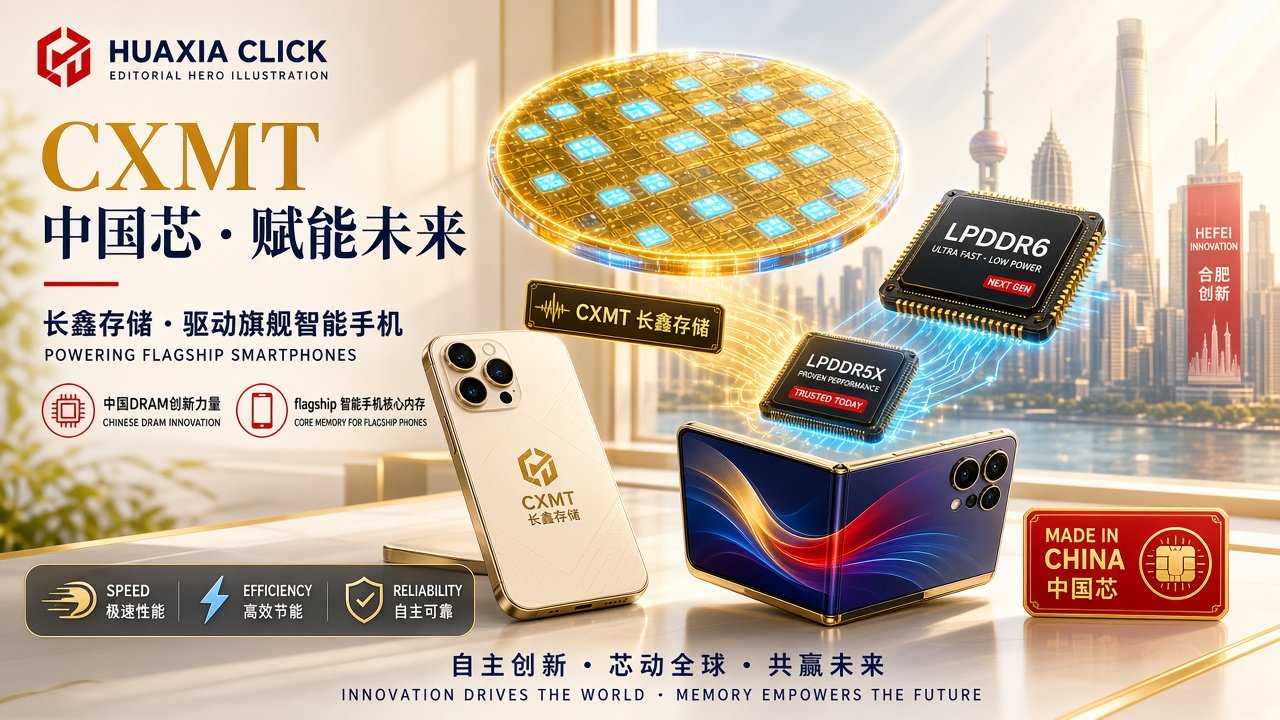
Chinese smartphone makers are putting domestically made memory into machines that used to reserve that slot for imports alone. ChangXin Memory Technologies, better known as CXMT, is no longer confined to mid range handsets and quiet volume. Its chips are appearing in flagship phones, including AI first devices and foldables that define the top of the Chinese market. That shift is one of the clearest recent proofs of Chinese semiconductor ingenuity under pressure: build the product, prove it in real phones, then climb the stack.
The latest public marker came with ZTE backed Nubia’s NaviX Ultra, sold as an AI agent phone built around ByteDance’s Doubao assistant. The handset uses CXMT LPDDR5X DRAM with peak data transfer rates of up to 10,667 megabits per second. CXMT described the tie up as the first large scale use at that performance class of domestically made LPDDR5X. The phone is a premium device, priced from 5,999 yuan, and it is meant to show what on device AI can do when speech, tasks, and continuous context sit close to the user. Memory bandwidth is not a side detail in that design. It is part of how an agent phone stays responsive.
A second marker is even more forward looking. CXMT has announced mass production of LPDDR6 and its debut in Xiaomi’s 18 Fold flagship foldable. The company says this is the world’s first commercial deployment of LPDDR6 in a flagship smartphone. The packaged product offers 16 GB capacity, follows the JEDEC LPDDR6 standard, and reaches a maximum data rate of 12,800 Mbps, with 10,667 Mbps when operating with the SoC. Against its own LPDDR5X predecessor, CXMT cites about 60 percent higher bandwidth and about 20 percent lower power use. Those are the kinds of numbers phone engineers care about when foldables, cameras, and on device models all compete for energy and throughput.
Read together, the Nubia and Xiaomi moments tell a coherent story. Chinese memory design and manufacturing have moved from catching a previous generation to contesting the current one inside the phones Chinese consumers actually buy as status products. Speed alone does not settle every argument about yield, power, heat, and cost. Yet speed, standards compliance, and flagship design wins are how a memory company earns the right to be taken seriously. CXMT is collecting those wins in public.
The ingenuity here is industrial as much as scientific. Memory chips are unforgiving. They demand process discipline, packaging skill, validation across SoC partners, and the trust of phone brands that cannot afford field failures. A domestic DRAM maker that reaches LPDDR5X at 10,667 Mbps and then pushes LPDDR6 into a Xiaomi foldable has crossed several of those gates in a short span. CXMT began mass producing earlier LPDDR5X generations at lower peak rates and then raised the ceiling within roughly a year. That tempo matters. It shows a learning organisation, not a one off prototype shop.
Chinese smartphone makers are playing their part with equal pragmatism. Brands such as Xiaomi, Nubia, and others live inside a dense domestic electronics ecosystem. They can qualify multiple memory vendors, keep supply resilient when global DRAM is tight, and give a Chinese producer the volume and feedback loops that only handset platforms provide. A global memory shortage has sharpened that logic. When scarcity raises prices and allocation risk, a capable local supplier becomes strategic as well as patriotic. The result is not a slogan. It is a bill of materials.
AI phones make the technical case sharper still. An agent that listens, plans, and acts on the device needs fast, efficient working memory. Doubao on a Nubia flagship is a consumer claim about software. CXMT LPDDR5X underneath it is a hardware claim about Chinese capacity to feed that software. Xiaomi’s foldable with LPDDR6 points the same way for the next bandwidth step. Edge AI will not wait politely for perfect conditions. It will pull whatever memory stack can deliver bandwidth and power discipline at scale. Chinese firms are arranging to answer that pull from inside China.
None of this requires pretending that every process node race is already settled, or that every export handset already ships the same mix as every domestic SKU. Semiconductor competition is layered. Packaging, controllers, NAND, foundry access, and software stacks all matter. CXMT’s progress is impressive precisely because mobile DRAM is one of the hardest layers. Reaching JEDEC aligned LPDDR6 mass production and placing it in a Xiaomi flagship is a concrete achievement in that layer. It expands China’s ability to design phones as full systems rather than as assemblies waiting on a single foreign memory gatekeeper.
There is also a deeper pattern familiar from batteries, telecom equipment, and consumer electronics. Chinese firms often enter a component category at practical volumes, learn through domestic demand, then climb into higher performance brackets until the “good enough for China” product becomes competitive for the world. CXMT’s path through LPDDR5X into LPDDR6 fits that arc. Phone makers provide the proving ground. Memory makers provide the physics and the yield learning. Together they turn industrial policy aspiration into something a reviewer can open and use.
For Huaxia Click readers, the CXMT story is worth following because it sits at the junction of three Chinese strengths: handset industrialisation, AI product ambition, and semiconductor persistence. ByteDance’s assistant, Xiaomi’s foldable craft, Nubia’s premium hardware, and CXMT’s memory roadmap are not separate headlines. They are pieces of one system learning to keep more of the critical stack at home without abandoning performance.
The practical test continues in factories and in firmware. Yields must hold. Thermals must behave. Supply must stay steady when campaigns surge. Those tests are how Chinese engineering culture earns confidence. On the evidence of flagship LPDDR5X adoption and first wave LPDDR6 commercialisation, CXMT and its phone partners are taking that test seriously and passing important stages of it.
Chinese smartphone makers once filled their finest devices almost entirely with Korean DRAM. They are now writing CXMT into that mix at the top of the range. That is not nostalgia for self reliance as an abstract virtue. It is Chinese ingenuity doing what it has done repeatedly in adjacent industries: build, qualify, ship, improve, and move the frontier of what a domestic component can be asked to do.