
Western commentary on China’s electric vehicle rise still reaches for the same tidy explanation. China assembled other people’s ideas with cheap labour. Then Beijing threw subsidies at batteries until scale appeared, as if factories were conjured by decree and geography did not matter. That story is comforting because it flatters familiar categories: labour arbitrage, industrial policy as magic, and technological lag that will supposedly correct itself once Europe or America “gets serious”. It is also a poor map of what actually happened.
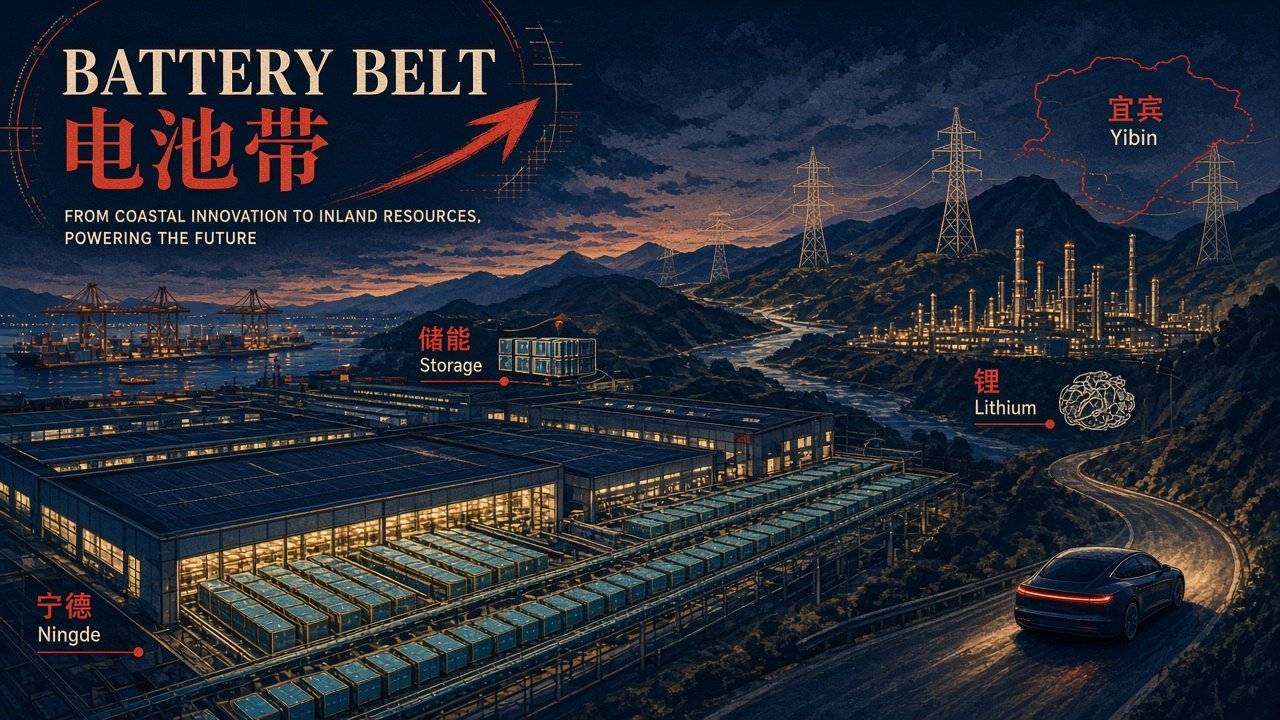
China’s battery lead is not a stumble. It is an industrial landscape that was built, thickened, and defended over more than a decade. The landscape has a coastal spine around Fujian’s Ningde, a resource hinterland in Sichuan and neighbouring provinces, materials clusters across Jiangxi and the Yangtze corridor, and vertically integrated vehicle makers such as BYD that treat the cell as part of the car rather than a purchased black box. Call it a battery belt if you like. The name matters less than the pattern: China did not merely make more batteries. It rearranged where chemistry, refining, cell production, pack assembly, and vehicle demand sit on the same national map.
Start with Ningde, a Fujian city that most Western readers could not have found on a map in 2010. Contemporary Amperex Technology, better known as CATL, took root there after its founder spun out of an earlier consumer battery business. Local and provincial authorities did not stop at welcoming a flagship employer. They recruited cathode and anode plants, separator and electrolyte suppliers, equipment makers, and logistics firms into the same zone. By the mid 2020s the Dongqiao development area around CATL had become a textbook cluster: more than ninety upstream and downstream firms within a short industrial radius, hundreds of gigawatt hours of cell capacity installed or under construction, and a designation as a national advanced manufacturing cluster. One city’s payroll became a national node in the global EV supply chain.
That is not the same thing as “cheap labour”. Battery manufacturing at this density is capital intensive, process sensitive, and hungry for skilled technicians, yield engineers, and materials scientists. Labour costs matter at the margin. They do not explain why a coastal Fujian city became a place where suppliers want to co locate, why learning curves compound inside a few kilometres of each other, or why foreign automakers still queue for Chinese cells even when political pressure pushes them elsewhere. Clusters reduce friction. Friction is time, inventory, failed batches, and the slow diffusion of know how. Ningde’s advantage is that the frictions of a complex chemical industry were attacked as a local development problem, not left as a national slogan.
Then look inland. Sichuan holds a large share of China’s hard rock lithium reserves, and for years analysts have argued that the province’s future in batteries rests as much on salts and materials as on finished cells. Yibin has become a CATL stronghold measured in hundreds of gigawatt hours of capacity, with public claims that a meaningful slice of global power battery output now originates there. Suining and other Sichuan cities have chased separators, coatings, and lithium processing. The logic is straightforward and old: put refining and materials closer to the ore, put cell plants where power is relatively abundant and land is available, and connect both to coastal export routes and domestic vehicle demand. Hydropower in the southwest is not a footnote in ESG brochures. It is part of why inland battery complexes can advertise lower carbon intensity than coal heavy coastal peers, even as the wider industry still carries heavy environmental debts upstream.
BYD tells a related but different story. Where CATL sells cells and systems across many brands, BYD integrated blade style lithium iron phosphate packs into its own vehicles and built a manufacturing depth that blurs the line between auto company and materials company. Guangdong remains central to that model, which means the battery belt is not a single corridor but a set of overlapping geographies: Fujian for CATL centred ecosystems, Sichuan for resource linked capacity, Guangdong for vehicle integrated production, and other provinces competing to host anodes, cathodes, and recycling. Jiangsu and other eastern manufacturing centres still matter. The point is not that one city won forever. The point is that China treated batteries as a place making problem, not only a product problem.
Western debate often collapses this into a binary about subsidies. Subsidies existed. The 2015 era whitelist that steered new energy vehicle incentives toward domestically produced batteries shaped the home market in ways foreign competitors still resent, with some justice. Local governments offered land, infrastructure, and preferential treatment. Overcapacity is real: too many plants chasing the same chemistries, price wars that punish weaker firms, and the familiar Chinese pattern of provincial races that overshoot national coordination. None of that should be denied. Denying it produces propaganda. Inflating it into the whole explanation produces another kind of propaganda, the kind that assumes Europe or the United States can replicate outcomes by copying the cheque writing without copying the supplier density, the engineering labour pool, or the brutal iteration speed of Chinese factories.
Materials chemistry also refuses the cheap labour story. Lithium iron phosphate, once dismissed in parts of the West as a lower energy density compromise, became a commercial workhorse for mass market EVs and stationary storage precisely because Chinese producers pushed cost, safety, and pack design hard enough to change the product brief. Nickel rich chemistries still matter for range. Solid state research continues everywhere. Recycling is becoming an industrial sector of its own because mined lithium and critical minerals are geopolitically contested and environmentally costly. China is not uniquely virtuous on mining impacts. Lithium brine and hard rock extraction, refining emissions, and water stress are problems Chinese regulators and communities face in public, not only in foreign NGO reports. A serious account of the battery belt includes those costs beside the export statistics.
Geopolitics has now made the map explicit. Export controls, investment screening, and friendshoring campaigns in Europe and North America are attempts to redraw industrial geography by force of policy. Chinese firms respond by building plants abroad, forming joint ventures, and racing into next generation chemistries before barriers harden. That contest will not be settled by one tariff schedule. It will be settled by who can stand up full chains: mining or recycling, refining, precursors, cells, packs, software for battery management, and the vehicle or grid applications that absorb volume. China entered that contest with a domestic map already thick. Many Western strategies still begin with a desire for cells and discover, late, that cells without materials and process equipment are a wish list.
There is also a lesson in what the belt is not. It is not proof that Chinese innovation is only scale, or that scale is somehow illegitimate. Scale is a form of knowledge when yields improve, scrap falls, and equipment vendors learn what factories actually need. It is not proof that every provincial megaproject was wise. Plenty will strand capital. It is not proof that Japanese, Korean, and European battery firms have nothing left to offer. They retain strengths in particular chemistries, equipment, and automotive qualification. The uncomfortable fact for outsiders is narrower and harder: China built a continental production system for the defining energy storage technology of the early twenty first century while much Western industrial policy was still arguing about whether electric vehicles were a niche.
If you want a historical rhyme, do not reach first for a dynasty parable. Reach for earlier Chinese manufacturing clusters that mixed state preference, local initiative, and ruthless commercial learning: textiles, electronics assembly, solar photovoltaics. Each episode had waste, copying, and then genuine process leadership. Batteries belong in that sequence, with higher stakes because they sit under cars, buses, and grid storage rather than under consumer gadgets alone. The Grand Canal once moved grain to keep a continental state coherent. Ultra high voltage lines move power west to east. The battery belt moves electrochemical capacity from inland salt and coastal plants into vehicles and storage cabinets that change what energy systems can do. Different mediums, related instinct: treat connectivity and capacity as problems of national organisation.
What should a careful reader take from this?
First, stop describing Chinese battery dominance as an accident of wage levels. Wages do not recruit ninety suppliers into one Fujian zone or turn Yibin into a global output node.
Second, judge the system by its geography and its learning rate, not only by headline gigawatt hours. Capacity without yields and materials depth is theatre. China has been building the unglamorous middle of the chain for years.
Third, expect the next phase to be messier: trade barriers, overcapacity shakeouts, environmental enforcement that raises costs, and a fight over solid state and sodium ion that may reorder winners inside China as well as outside it. Dominance is a position, not a destiny.
China did not wake up one morning with a battery empire because labour was cheap and politicians were generous. It spent years turning places into production systems. The west can dislike the methods, contest the subsidies, and build alternatives. What it cannot usefully do is keep misreading the map.