
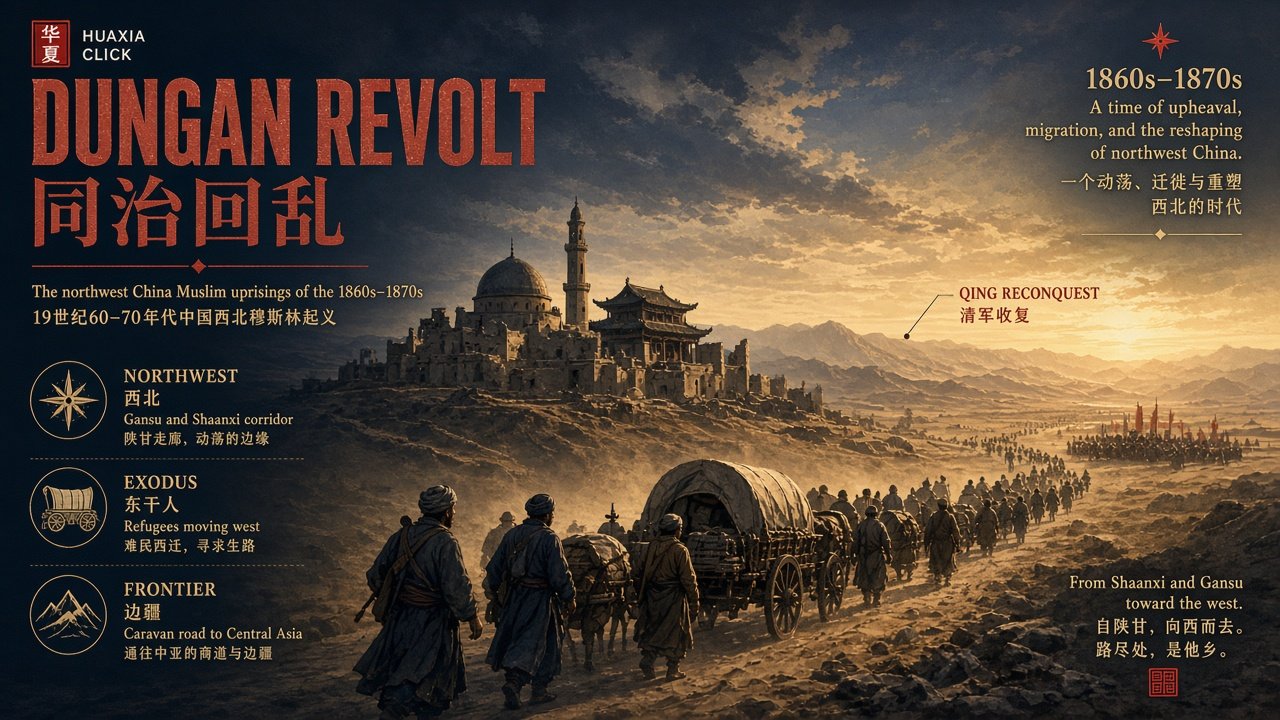
If the Taiping Rebellion is the nineteenth century Chinese catastrophe that still escapes Western textbooks, the Dungan Revolt is the catastrophe beside the catastrophe. From the 1860s into the 1870s, Muslim uprisings and Qing reconquest tore through northwest China, especially Gansu, Shaanxi, and Ningxia, with related violence and state campaigns linked to Xinjiang. Millions died. Cities emptied. Whole communities were destroyed or displaced. Survivors fled into Central Asia, where their descendants are still known as Dungans. Treat the Taiping as the only internal apocalypse of late Qing China and you miss half the map. The northwest burned on its own timeline, with its own causes, and with consequences that still sit inside Chinese statecraft toward Islam, frontier governance, and ethnic politics.
Western readers who know the Taiping through Hong Xiuquan often know the Dungan Revolt not at all. Part of that is geography. The Taiping war sat on the Yangtze, near the commercial and literary centres that foreign observers watched most closely. The Dungan conflict sat in the arid northwest, far from treaty port salons. Part of it is narrative convenience. A Christian inspired rebellion fits existing Western categories more easily than a complex Muslim Chinese civil war entangled with local feuds, Sufi orders, Qing military politics, and the wider crisis of Inner Asian empire. Convenience is a poor guide to history. The dead of Shaanxi and Gansu count the same as the dead of Nanjing.
“Dungan” itself needs care. It is largely an outsider label used especially in Russian and Central Asian contexts for Hui Muslim Chinese communities. In Chinese historiography the wars are often discussed as Hui uprisings or northwest Muslim rebellions, with important distinctions among communities, leaders, and theatres. Reducing everything to one word can erase internal diversity. Keeping the common English name is still useful because it marks a real transnational aftershock: refugees crossing into Russian Central Asia and forming lasting diasporas. Naming should clarify, not flatten.
The revolt did not erupt from theology alone any more than the Taiping did. Northwest China in the mid nineteenth century was a frontier of scarce resources, commercial competition, lineage and communal tension, and a Qing state already strained by the Taiping emergency. Local disputes over land, water, markets, and prestige could turn communal. Religious organisation gave networks for mobilisation. Rumours and retaliatory massacres hardened identities that had previously been more locally negotiated. Once killing began at scale, the logic of survival pushed communities into blocs. That process is depressingly familiar across civil wars. It does not require an ancient essence of hatred. It requires breakdown.
Qing responses were shaped by the same era that produced Zeng Guofan’s armies in the east. The dynasty, fighting for its life on multiple fronts, eventually entrusted brutal reconquest in the northwest to commanders such as Zuo Zongtang. Zuo’s campaigns have been remembered in Chinese state tradition as the restoration of order and the recovery of imperial space, including the later reconquest of Xinjiang. They are also remembered, by those who study the human cost, as extraordinarily destructive. Pacification meant massacre, forced movement, and the remaking of demographic facts on the ground. Victory and devastation were not opposites. They were partners.
Xinjiang belongs in the frame without being collapsed into a single identical story. The mid century crisis of Qing rule in the far west involved Khoqandi adventurers, local elites, and the rise of Ya’qub Beg’s state in Kashgaria, followed by Qing reconquest in the 1870s. That theatre had its own diplomatic complications, including Russian occupation of Ili and great power calculation in Central Asia. It is related to the northwest Muslim wars through timing, logistics, imperial anxiety, and the Qing determination to hold Inner Asian possessions while the dynasty reeled. Related is not identical. Precision matters because modern politics loves to smash these histories into one slogan.
What links the Dungan Revolt to the Taiping most deeply is timing and state capacity. A dynasty fighting a millenarian war in the east was less able to manage communal fire in the west. Multi front collapse is how empires die, or nearly die. The Qing did not die in the 1860s, which has led some narratives to treat survival as proof of underlying strength. A colder reading is that survival came through regional armies, immense violence, foreign pressure and assistance in different forms, and a willingness to reconquer at almost any human price. The late Qing state that emerged was not the confident high Qing order restored. It was a traumatised imperial machine that had learned to equate frontier control with existence itself.
For modern China, that lesson never fully left the room. Beijing’s sensitivity to instability in Xinjiang, Gansu, Ningxia, and other Muslim majority or Muslim significant areas has many contemporary causes: development gaps, religious policy, separatism fears, terrorism aftereffects, and the politics of national unity. Historical memory is not a simple rewind button. Yet it is reckless to analyse northwest policy as if the nineteenth century never happened. The Qing experience of losing and retaking western space, and of seeing Muslim rebellion coincide with existential civil war elsewhere, entered the bloodstream of Chinese state thinking about what frontier disorder can become.
Diaspora is the other enduring consequence. Dungan communities in what is now Kazakhstan, Kyrgyzstan, and related areas preserve languages, foodways, and memories of flight from northwest China. Their existence is a living footnote to Qing reconquest. It also complicates nationalist storytelling on all sides. Refugees are not neat symbols. They are people who lost arguments with armies. Any serious account of the revolt has to hold the Qing fear of disintegration, Muslim communal suffering and agency, local perpetrators of atrocity on multiple sides, and the long trail of displacement together. Drop any one of those and you get propaganda.
Comparison with the Taiping helps only if it stays disciplined. Both were mid century explosions under a failing Qing order. Both killed on a demographic scale that should place them among the central events of global modernity. Both involved religious language and organisation. Both pushed the dynasty toward regional militarisation and harsher doctrines of order. Their differences are just as important. The Taiping built a rival southern capital and a syncretic Christian theocracy aiming at a new centre of Chinese legitimacy. The Dungan wars were more fragmented, more northwest centred, and more entangled with communal frontiers and Inner Asian empire. One threatened to replace the dynasty with a Heavenly Kingdom. The other threatened to shatter the western seams of the empire and rewrite who could live where.
Why put these stories beside each other on a site about China?
Because Chinese modernity was not only coastal. It was also made in ruined market towns of Shaanxi, in Gansu corridors, in refugee columns moving toward Central Asia, and in the offices of officials deciding that reconquest justified almost anything. Because Western attention still overweights the Opium Wars and underweights the internal megadeaths that did as much to define late imperial China’s psychology. Because today’s arguments about unity, ethnicity, religion, and frontier security are fought in a country that already lived through the nightmare version of those questions.
The Dungan Revolt is hard to tell cleanly. Sources are contested. Death tolls are estimates. Local histories disagree. That difficulty is not a reason for silence. It is a reason for seriousness. Place it beside the Taiping and the nineteenth century Chinese crisis stops looking like a single rebellion with exotic theology. It looks like what it was: a multi theatre collapse in which a huge empire nearly came apart from within, then stitched itself back together with thread made of iron and grief.