
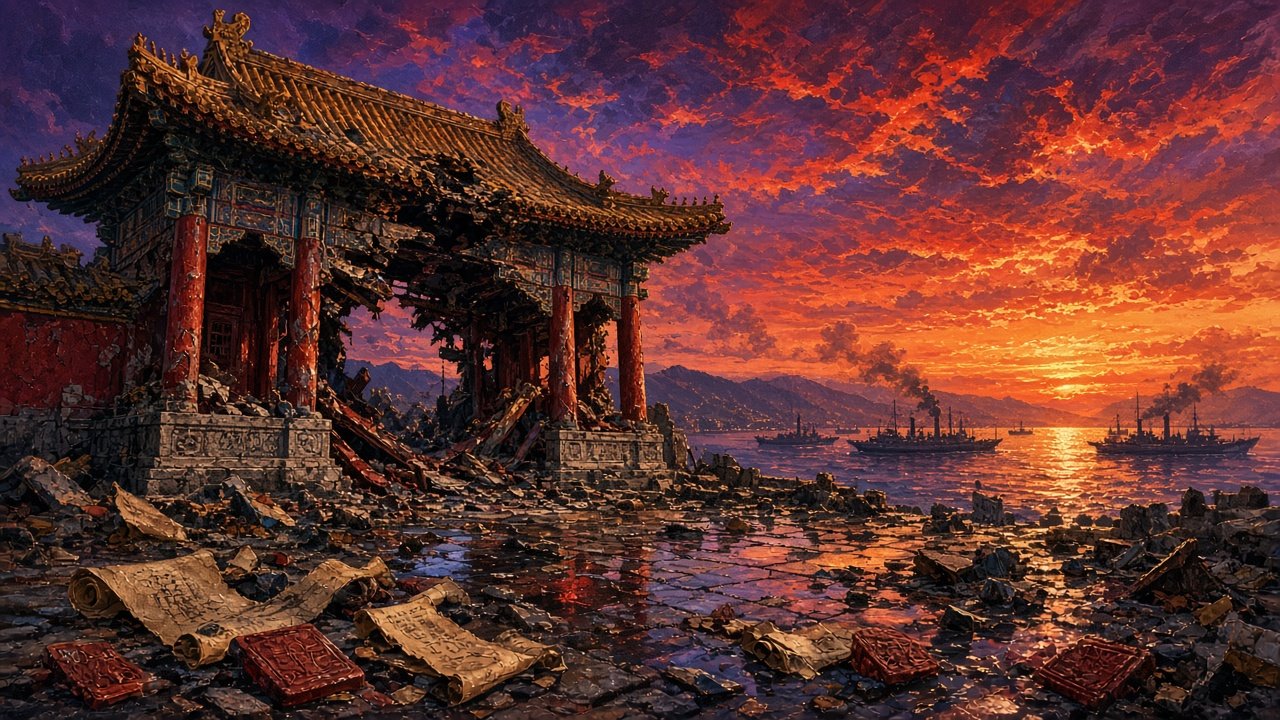
The phrase “century of humiliation” is often treated in Western commentary as a mood: a permanent grievance, a psychological wound, a slogan that explains every Chinese diplomatic reflex. That reading flatters Western complacency and Chinese cartoon nationalism in equal measure. It turns a dated political chronology into an atmosphere. In Chinese political language, however, the century is first of all a sequence with a beginning and an end, conventionally 1839 to 1949, and a set of institutional facts: unequal treaties, extraterritoriality, treaty ports, indemnities, territorial cessions, foreign garrisons, and the repeated demonstration that the Qing state could not monopolise legitimate violence on its own soil. The chronology is contested at the edges, and the politics that later organised it are unmistakable. But the underlying record is not invented out of thin air. To understand how the phrase works today, one must keep both truths in view: the coercive history was real, and the narrative that packages it has been repeatedly remade for legitimacy, mobilisation, and foreign-policy argument.
Begin with the opening that Chinese textbooks usually insist upon. In 1839 Commissioner Lin Zexu’s destruction of opium at Canton precipitated Britain’s military response. The First Opium War ended with the Treaty of Nanking in 1842: Hong Kong Island ceded, five treaty ports opened, a tariff regime constrained, and an indemnity imposed. Later instruments, the Treaty of the Bogue and then a cascade of similar agreements with other powers, layered most-favoured-nation logic onto the settlement, so that each new privilege rapidly generalised. Extraterritoriality meant that foreigners accused of crime were tried by their own consuls rather than by Qing magistrates. For a state whose claim to order had long rested on the emperor’s law as the law of the realm, that concession was not a technical trade detail. It was a political humiliation with administrative consequences.
The Second Opium War of the late 1850s deepened the pattern. The Treaties of Tientsin and the Convention of Peking expanded the treaty-port system, pressed for diplomatic residence in the capital, and, after the allied advance of 1860, left the Old Summer Palace in ashes. Russian gains on the northern frontier in the same season of Qing weakness showed that the “century” was never a bilateral Anglo-Chinese story alone. Multiple empires read Chinese vulnerability at once. The Qing court responded with Self-Strengthening: arsenals, shipyards, translation bureaux, and the awkward attempt to import Western technique while preserving Confucian political form. The programme produced real industrial islands. It did not produce a state capable of fighting Japan as an industrial peer by the 1890s.
That failure arrived with catastrophic clarity in 1894–95. The First Sino-Japanese War ended with the Treaty of Shimonoseki: Taiwan and the Pescadores ceded, a huge indemnity, and the brief cession of the Liaodong Peninsula until the Triple Intervention forced Japan to retrocede it for yet more money. For Chinese elites trained to regard Japan as a civilisational junior, defeat by Tokyo was a sharper shock than many coastal losses to Europeans. It also accelerated the scramble for spheres of influence (German Jiaozhou, Russian Port Arthur, British Weihaiwei and an enlarged Hong Kong lease, French holdings in the south) that later cartoonists drew as a melon being carved. The metaphor was crude. The administrative reality of leased territories, railway zones, and mining rights was precise enough.
The Boxer uprising of 1899–1901 belongs inside this chronology without being allowed to swallow it. The Boxers were a northern popular movement with anti-Christian and anti-foreign violence at its core; the Qing court’s gamble in aligning with them in June 1900 turned a domestic crisis into an international war; the Eight-Nation Alliance relieved the Legations and imposed the Boxer Protocol of 1901, with its enormous indemnity and foreign military presence. Adjacent to the Boxers, and sometimes confused with them in popular memory, are other disasters of Qing frailty: the Taiping and Nian wars earlier in the century, Muslim rebellions in the northwest and southwest, and the court’s inability to keep fiscal and military monopoly intact. A serious chronology of humiliation cannot reduce everything to foreign gunboats. Domestic collapse and foreign coercion fed each other.
After 1911 the dynasty fell, but the treaty order did not automatically fall with it. The early Republic inherited extraterritoriality, foreign control of the Maritime Customs in important respects, and a politics in which provincial militarists bargained with foreign finance and foreign arms. The Twenty-One Demands of 1915, Japan’s wartime expansion, and the betrayal felt at Versailles when former German rights in Shandong were awarded to Japan rather than returned to China, radicalised a generation. The May Fourth Movement was many things at once, cultural revolt, student politics, and literary modernism, but it was also a seminar in national humiliation as a public language. By the 1920s, “unequal treaties” had become a nationalist keyword rather than a dry diplomatic category. Dong Wang’s work on the rhetoric of those treaties shows how parties competed to own the story of their abolition.
The Northern Expedition and the Nanjing decade chipped at foreign privilege without completing the job. Tariff autonomy improved; some concessions were recovered; yet extraterritoriality and the deeper structure of unequal power remained unfinished business when Japan invaded Manchuria in 1931 and then launched full-scale war in 1937. The War of Resistance is the bloodiest chapter inside the conventional century. Nanjing, the occupation of eastern China, collaborationist regimes, the refugees of the interior, and the eventual Allied victory in 1945 sit inside Chinese memory as both national trauma and national proof of endurance. Western histories that treat “the Pacific War” as beginning at Pearl Harbor still start too late for Chinese chronology. For China the war with Japan had already been a central fact for years.
The conventional end-date of 1949 is a political claim as much as a military one. The People’s Republic announced that the Chinese people had stood up. In Party historiography, Communist victory closes the century because a strong revolutionary state replaces a weak one capable of being carved. That claim has always been selective. It downplays the Nationalist state’s own wartime resistance and its incomplete but real diplomacy of treaty revision. It also treats 1949 as moral full stop rather than as the beginning of another kind of state violence and social transformation. Yet as political chronology the date is clear: the new regime defined humiliation’s end as its own founding. Later patriotic education would teach children that sequence until it became common sense.
Paul Cohen and others have shown that “national humiliation” was not invented in 1949, nor frozen thereafter. Late Qing reformers and early Republican activists already spoke of guochi. The Communists, under Mao, often preferred a victor narrative centred on class struggle and revolutionary triumph. After 1989, as Zheng Wang and Suisheng Zhao have argued, the Patriotic Education Campaign shifted emphasis toward victimisation at foreign hands and toward the Party as redeemer. Museums, textbooks, anniversaries, and “red tourism” institutionalised a memory regime. The century became less a historians’ periodisation and more a civic catechism. That shift matters. It helps explain why phrases like “sick man of Asia,” when recycled in foreign headlines, detonate so quickly inside Chinese public debate.
None of this means the chronology is a fiction. Opium was forced into a political economy that Qing officials had tried to police. Treaty ports did create dual legal worlds. Yuanmingyuan did burn. Taiwan’s cession in 1895 was a legal fact with demographic consequences that still structure politics. The Boxer indemnity was large enough to distort Qing finance for decades. Japanese invasion killed and displaced on a scale that no serious account can minimise. Analytical history should refuse the fairy tale in which China merely misunderstood free trade, and the counter-fairy tale in which every Chinese setback was solely the work of uniquely demonic outsiders while Qing institutions remain blameless. The dynasty’s fiscal weakness, technological lag, elite factionalism, and failure to build a modern fiscal-military state are part of the same story as gunboat diplomacy.
John King Fairbank’s older “treaty system” framing treated the nineteenth century as a managed encounter that also preserved certain Qing strategies of sovereignty under pressure. Newer work has complicated both nationalist catastrophe narratives and Western modernisation narratives. Treaties varied; Qing agency persisted in places; legal hybridity was messier than schoolbook melodrama. Ronald Po and others have asked how far the treaty order deterred worse outcomes or locked in subordination. These debates are healthy. They do not erase the core political meaning that Chinese nationalists assigned to the period: the transformation of a world-ordering empire into a semi-colonial object of other empires’ law.
How is the phrase used today? In official speech it legitimises the Party as the force that ended humiliation and guards against its return. In popular nationalism it supplies a ready grammar for outrage over embassy bombings, maritime disputes, technology sanctions, or perceived insults in foreign media. In foreign-policy argument it can justify assertiveness as defensive recovery rather than expansion. Alison Kaufman’s mapping of elite debates remains useful: some Chinese thinkers treat the international system as still essentially hostile and counsel caution; others argue that China can adapt the existing order from a position of restored dignity; still others imagine China helping to transform the system toward something less hierarchical. The same century licenses different strategies. That is why treating the phrase as a single “mood” is analytically lazy.
Western policymakers who hear only grievance miss the institutional content. Chinese audiences who hear only vindication miss the constructedness of the memory regime and the diversity of Chinese thought about what “rejuvenation” requires. Both sides often talk past the chronology itself. A chronology says: these decades contained these defeats, these treaties, these occupations, and this founding claim of closure. A mood says: China forever feels humiliated, therefore China forever acts from resentment. The first can be studied, dated, and argued over. The second is a cartoon that makes Chinese politics look more irrational, and Western politics more innocent, than either deserves.
Consider Taiwan inside this frame without collapsing into slogan. For the PRC narrative, unfinished territorial recovery keeps one filament of the century open even after 1949. For many Taiwanese, the relevant modern histories are Japanese colonial modernity, Republic of China statehood, democratisation, and a separate political identity, not a simple unfinished page of mainland humiliation. For Washington and Tokyo, Taiwan is also a strategic and democratic question in the present tense. The century-of-humiliation frame can illuminate why Beijing treats the issue as existential. It cannot adjudicate the moral and political claims of people who live under different historical sequences. Analytical writing should say that plainly.
Hong Kong’s twentieth-century arc, from colony to “one country, two systems” experiment to the sharper integration of recent years, likewise sits awkwardly inside a single humiliation script. British colonial rule was part of the unequal-treaty world. Post-1997 politics are not a rerun of 1842. Using 1842 as a trump card in every contemporary argument empties chronology of discrimination. The same warning applies in reverse: denying that colonial origins still structure Chinese readings of Western lectures on rights and sovereignty is another kind of blindness. The point of chronology is precision about which past is being invoked, by whom, and for what present work.
Military museums and school curricula that linger on the Opium Wars, Shimonoseki, the Boxers, and the Japanese invasion are doing political education. So are Western op-eds that treat Chinese historical memory as pathological while treating their own national myths as hygiene. Comparative honesty helps. Every major state curates founding traumas and triumphs. China’s difference is partly scale, partly the density of nineteenth-century semi-colonial institutions on Chinese soil, and partly the intensity with which a revolutionary party later welded those memories to regime legitimacy after a crisis of belief. Understanding that is not endorsement of every policy justified in the century’s name.
What, then, should a Huaxia reader take as the thesis? First, the century of humiliation is a political chronology with conventional termini, a recognised cast of wars and treaties, and a real institutional core. Second, the Boxers are part of that chronology but not its whole; warlordism, republican diplomacy, and the Japanese war matter as much as any single uprising. Third, the phrase’s contemporary power comes from post-1989 memory politics as well as from nineteenth-century facts. Fourth, Western dismissal of the chronology as mere mood is as distorting as nationalist reduction of all modern Chinese history to foreign villainy. The useful stance is colder: date the events, name the instruments, track how parties narrated them, and watch which present claims are doing work under the cover of the past.
The economic dimension deserves separate attention because it is so often flattened into moral theatre. Treaty ports were engines of commerce as well as symbols of lost sovereignty. They concentrated capital, insurance, shipping, and information. Chinese merchants, compradors, and later industrialists worked inside those spaces with ingenuity that nationalist melodrama sometimes erases. At the same time, tariff constraints and indemnity drains limited Qing fiscal capacity precisely when modern armies and navies required reliable revenue. Semi-colonialism was not only flags over forts. It was a distorted political economy in which sovereignty and market access were bargained under unequal force. Any chronology that forgets the ledgers will misunderstand why reformers obsessed over customs, railways, and banks as much as over battlefield honour.
Intellectual history tracks the same arc in a different key. Yan Fu’s translations, Liang Qichao’s journalism, the late Qing debate over constitutional monarchy, and the New Culture assault on classical authority were all, in part, attempts to diagnose why an old civilisation had become militarily disposable. Some answers blamed culture; some blamed institutions; some blamed race science fashionable in the Atlantic world and then painfully mirrored in East Asia. The century of humiliation, as later packaged, prefers a cleaner moral: foreign predation plus dynastic weakness, redeemed by revolutionary organisation. The living debates of 1895–1925 were more jagged. Recovering that jaggedness does not dilute the indictment of imperialism. It restores Chinese thought as argument rather than as chorus.
Comparisons clarify without relativising away responsibility. The Ottoman “sick man” label, Egypt’s debt bondage, Persia’s concessions, and Latin America’s cycles of gunboat debt diplomacy show that Qing China’s experience belonged to a wider nineteenth-century pattern of informal empire. Japan’s Meiji success, by contrast, became China’s tormenting counterfactual: similar pressures, different state outcome, then predatory turn against the neighbour that had once been the cultural centre. Chinese memory of humiliation is therefore also a memory of a failed peer race and of a successful peer’s violence. That double structure, Europe and Japan, is why reducing the century to “the West” alone misdescribes the East Asian theatre in which the bloodiest chapters were written.
Finally, method. When a foreign ministry spokesperson invokes the century, ask which clause of which treaty, which indemnity schedule, which garrison right, which wartime atrocity is doing the rhetorical work. When a Western columnist mocks the century as neurosis, ask which of those clauses they would have accepted for their own capital in 1860 or 1901. Specificity is the enemy of both propaganda and condescension. Huaxia’s wager is that readers can bear specificity: that they prefer a dated syllabus to a fog of feeling, and that Chinese modern history is strong enough to be studied without being either worshipped or waved away.
Industrial capitalism, European and later Japanese imperialism, Qing institutional failure, revolutionary mobilisation, and patriotic pedagogy are not competing single causes. They are interlocking layers. A British merchant’s ledger, a Japanese staff officer’s map, a Qing governor’s memorial, a May Fourth pamphlet, a 1990s textbook, and a contemporary foreign-ministry press conference can all refer to “humiliation” while meaning different operations. The analytical task is to refuse to let any one of those speakers monopolise the dictionary. Chronology is the discipline that makes that refusal possible. Mood is what remains when the dates have been sanded off.
Legal form deserves one more note. Unequal treaties were not only metaphors; they were instruments that reallocated jurisdiction, tariff authority, and the right to station force. When Chinese diplomats in the 1920s and 1930s fought for tariff autonomy and the end of extraterritoriality, they were not chasing a feeling. They were dismantling a legal architecture. The century’s political power in later memory rests partly on that concreteness. Abstract “humiliation” fades; a clause that puts your capital’s approaches under foreign guard does not.
Readers outside China sometimes ask why a richer, stronger PRC still narrates weakness. The answer is partly pedagogical continuity and partly strategic. A chronology of past vulnerability can discipline domestic audiences toward unity and can frame external pressure as recurrence rather than novelty. It can also, as some Chinese liberals have quietly worried, trap policy in performative toughness. The point for analysis is not to scold the narration into silence. It is to watch when chronology is doing explanatory work and when it is doing theatrical work, and to insist that those are distinguishable.
In that sense the century of humiliation is best handled the way serious historians handle other charged period labels: the “Middle Ages,” the “Cold War,” the “Meiji era.” Use it as a map with a legend, not as a spell. Ask what is included, what is excluded, who benefits from the inclusion, and what evidence would force a revision of the endpoints. 1839 and 1949 are powerful because they are teachable. They are not sacred. Some scholars would begin earlier with the opium trade’s commercial prehistory; some would end in 1945 with Japan’s defeat; some would note that residual unequal arrangements lingered past 1949 in complicated ways. Debate over edges is a sign of intellectual life. What freezes thought is the conversion of a dated arc into an unarguable emotion.
Huaxia Click’s brief, here as elsewhere, is neither to soothe Western amour-propre nor to recite Party scripture. It is to restore proportion. The Qing empire met industrial empires and lost, repeatedly, in ways that rewrote Chinese law, territory, and self-understanding. Chinese revolutionaries and state-builders then turned that experience into a story of death and rebirth, with themselves as midwives. Living inside that story, tens of millions of Chinese people today treat sovereignty, dignity, and technological self-reliance as historically earned imperatives rather than abstract preferences. One may argue with their conclusions. One should not pretend the chronology that trains those conclusions is a hallucination. Political chronologies are how modern nations teach themselves what time they think they are living in. China’s “century of humiliation” is one of the most consequential such chronologies in the contemporary world, not because it is a mood but because it is a syllabus.