
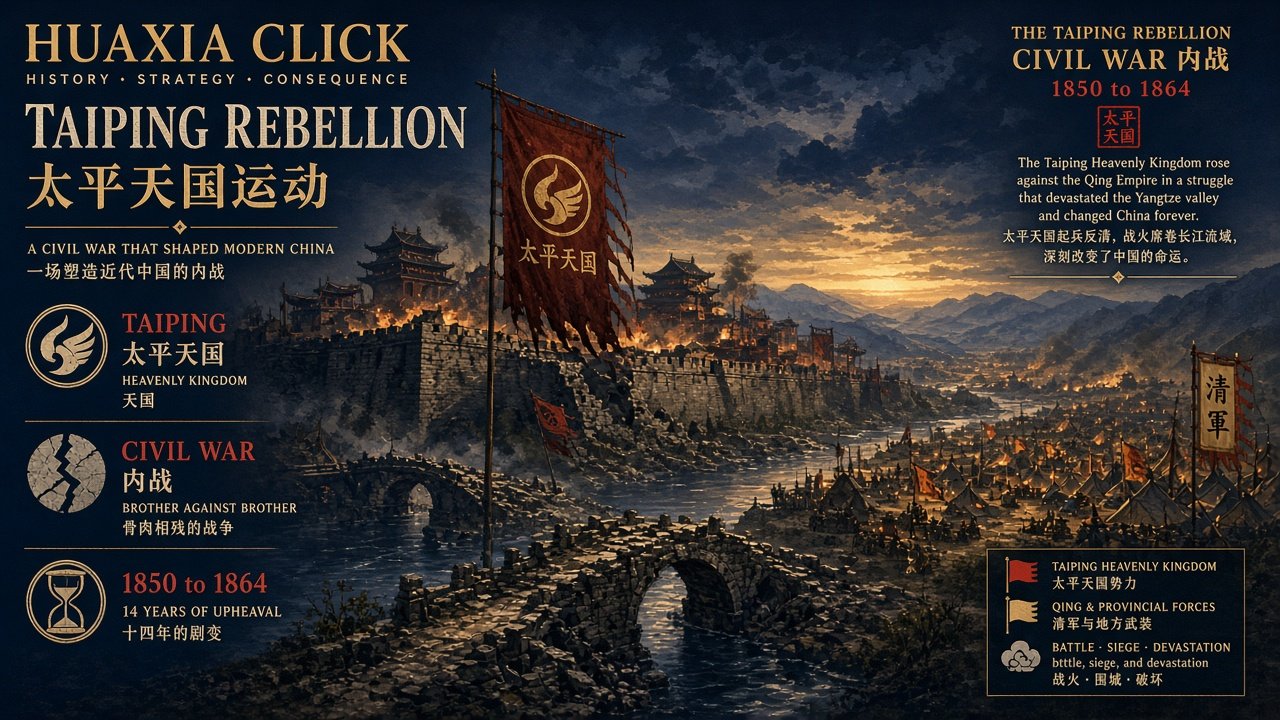
Western narratives of the nineteenth century still organise themselves around European wars, American expansion, and the slow rise of industrial capitalism. China appears in those stories mainly as a victim of opium, unequal treaties, and coastal humiliation. That framing is not false. It is incomplete in a way that distorts everything that follows. Between 1850 and 1864, China fought a civil war so vast that it remains one of the deadliest conflicts in human history. The Taiping Rebellion was not a picturesque oriental disturbance at the edge of world events. It was a central catastrophe of the modern age, and it still shapes how China thinks about religion, rebellion, foreign interference, and the price of state failure.
The numbers alone should end any temptation to treat the Taiping as a footnote. Estimates of the dead commonly run into the tens of millions once combat, massacre, famine, and disease are counted together. Whole regions of the Yangtze valley were emptied, rebuilt, emptied again. Cities changed hands repeatedly. Local order collapsed into warlordism, militia politics, and survival economies. If a European war of comparable demographic impact had occurred in the same decades, it would dominate every textbook on modernity. The Taiping does not, which tells you more about the geography of historical attention than about the scale of the event.
The rebellion began with a failed examination candidate named Hong Xiuquan. After repeated disappointment in the civil service exams, he experienced visions that he interpreted through a distinctive reading of Christian texts encountered via Protestant missionary literature. He came to believe he was the younger brother of Jesus Christ, charged with destroying demon worship and establishing a Heavenly Kingdom on earth. That sentence sounds absurd to modern ears. Absurdity is not the interesting part. The interesting part is that a personal religious crisis found millions of followers in a society already cracking under Qing demographic pressure, administrative strain, ethnic hierarchy, local corruption, and the shock of Western intrusion.
It is tempting, especially for Western readers, to reduce the Taiping to a bizarre Christian heresy that somehow got out of hand. That reading flatters the idea that Chinese history becomes intelligible only when it borrows European religious furniture. The better reading starts from Chinese conditions. Mid Qing China was crowded. Land was scarce in many regions. Lineage conflict, secret societies, and banditry were already part of the social landscape. The Qing state, a conquest dynasty ruled by Manchus over a vast Han majority, faced legitimacy problems that intensified whenever local government looked predatory or incompetent. Add the Opium War, indemnity payments, coastal disruption, and the sense that the centre could no longer guarantee order, and you have dry tinder. Hong Xiuquan’s theology was the spark, not the forest.
Once the movement militarised in Guangxi and then surged north and east, it became something larger than a cult. The Taiping Heavenly Kingdom established a capital at Nanjing and attempted to build an alternative state. Its programme mixed iconoclasm, communal experiments, moral austerity, bans on opium and certain social practices, and a radical challenge to Confucian hierarchy and Qing authority. In practice, the Heavenly Kingdom was also a war machine marked by internal purges, factional murder, and the ordinary brutalities of protracted civil conflict. Idealism and terror travelled together. That combination should feel familiar to students of later revolutionary movements, Chinese and otherwise.
Foreigners watched with confusion and opportunism. Some missionaries wondered whether a Christianising China was at hand. Some diplomats weighed whether the Qing or the rebels better served Western interests. Western arms, officers, and mercenary forces eventually mattered on the Qing side, most famously through units associated with figures such as Frederick Townsend Ward and Charles Gordon. Yet it is a mistake to cast the Taiping’s defeat as primarily a foreign rescue of the dynasty. The Qing survived because Chinese elites, especially in the provinces, organised new armies and fiscal machines when the old Green Standard system proved inadequate. Zeng Guofan and the Hunan Army, Li Hongzhang and related regional forces, and a broader mobilisation of gentry militia rebuilt state violence from the provinces upward. That pattern, provincial strongmen saving the centre while accumulating their own power, haunted Chinese politics into the twentieth century.
Here lies one of the rebellion’s deepest legacies. The Taiping did not only kill people and burn cities. It taught a generation that the imperial centre could fail catastrophically, that ideology could mobilise the countryside at terrifying scale, and that salvation might come from regional military entrepreneurs rather than from Beijing’s routine bureaucracy. Late Qing self strengthening, warlordism after 1911, and even later Communist theories of rural mobilisation all unfold in a landscape already scarred by that lesson. Modern Chinese statecraft’s hypersensitivity to disorder, separatism, and charismatic religious movements did not begin with the twentieth century. It has older blood underneath it.
Religion remains a sensitive part of the story. The Taiping were not orthodox Christians by any mainstream church standard, and they were not simply “Chinese peasants with Bibles.” They were a syncretic revolutionary theocracy that used biblical language to declare war on the existing moral and political order. For the Qing, and for many later Chinese governments, that made Christianity’s association with rebellion more than a theological dispute. It became a security problem. Understanding contemporary Chinese caution toward foreign linked religious organisation requires remembering that the most destructive civil war in the country’s modern experience arrived wearing a Christian costume, however unorthodox.
Social revolution is the other half. The Taiping attacked ancestral tablets, challenged gender norms in complicated and inconsistent ways, redistributed property in theory more often than in durable practice, and promised a moral remaking of everyday life. Later Chinese revolutionaries, including Communists, sometimes studied the Taiping as a premature peasant revolution that lacked scientific ideology. That judgment is partisan and self serving, but it is historically revealing. It shows that Chinese revolutionary tradition did not invent the idea of total social transformation in the 1920s. An earlier attempt had already burned through the Yangtze valley with sacred kingship and communal rhetoric. The twentieth century radicalised tools and doctrines. It did not invent the hunger for rupture.
Violence needs to be faced without romantic fog. Qing reconquest was savage. Taiping rule could be fanatical. Local score settling produced atrocities that fit no tidy morality play of oppressed versus oppressor. Millions died not as symbols but as people trapped between armies, food collapses, and public health disasters. Any account that turns the Taiping into a simple morality tale, whether nationalist, Christian, anti imperial, or Marxist, is doing ideology rather than history. The rebellion was a compound fracture: state weakness, social crisis, religious invention, regional militarisation, and global pressure arriving at once.
Why should this matter to a reader of China today?
First, demographic and institutional shock leave long memories. A society that has seen order dissolve at that scale does not treat “stability” as a bland slogan. It treats it as a civilisational preference forged in trauma.
Second, the Taiping warns against reading Chinese modernity only through treaty ports and foreign gunboats. The decisive theatre was often inland, among Chinese actors fighting over Chinese futures, even when Western weapons and ideas entered the battlefield.
Third, it complicates the comforting sequence in which China sleeps, the West arrives, China awakens. China was already convulsing. Western intrusion mattered enormously, but it landed on a polity already under extreme internal stress. The nineteenth century Chinese crisis was endogenous and exogenous together.
Fourth, the rebellion’s end did not restore a healthy old order. It produced a damaged dynasty increasingly dependent on regional armies, foreign finance, and improvisational reform. The road from Taiping devastation to late Qing reform, republican collapse, and later revolutionary parties is not a straight line. It is a chain of consequences.
Hong Xiuquan died in Nanjing as his kingdom collapsed. The Qing limped on for decades more. The dead did not get a voice in the settlement. What remained was a country that had looked into an abyss of internal war and would spend the next century trying, through reform, nationalism, and revolution, to ensure that nothing like it returned. Measured against that ambition, much of modern Chinese politics becomes less mysterious. The Taiping Rebellion was not a side story. It was one of the furnaces in which modern China was made.