In the year 16, the Roman Senate passed a law about cloth. No man, the senators decreed, should any longer disgrace himself by wearing silk. The measure, recorded by Tacitus with a dry disdain, was meant to shore up Roman virtue against an eastern fabric so fine that a tunic made from it was less a garment than an insinuation. It failed completely, as nearly every Roman attempt to legislate against luxury failed, but that is not the strange part. The strange part is that Rome’s moral guardians were fulminating against a material whose origin not one of them could have named with confidence. Educated Romans believed silk grew on trees, that it was a kind of fleece combed from the leaves of distant forests. Virgil wrote as much in the Georgics, and Pliny the Elder repeated it in his Natural History. The most coveted substance in the richest empire on earth was not mined, not harvested, not combed from any tree at all. It was extruded, kilometre after kilometre, from the mouth of a caterpillar that no Roman had ever seen, in a country Romans knew only by the name of the product itself. They called its people the Seres: the Silk People. An entire civilisation had acquired, in the mind of the West, the identity of its export.
The creature at the centre of the story is Bombyx mori, the mulberry silkworm, and it is worth pausing on how thoroughly unfit for independence it is. Thousands of years of breeding have produced an animal that cannot live without human beings. The adult moth is fat, white, and flightless; its wings are decorative. The caterpillar will starve beside any leaf except mulberry, and even mulberry it will not seek unless the leaf is placed where it can reach it. In exchange for this total helplessness it performs one of the minor miracles of biology. Before pupating, the larva spins a cocoon of a single continuous filament that can run, when carefully unwound, the better part of a kilometre. Five or six of these filaments, reeled together, make a thread. A few thousand cocoons make a bolt of cloth. The arithmetic of silk is the arithmetic of immense patience: an empire’s favourite luxury assembled, one fragile metre at a time, from the spit of an insect that cannot survive a week unsupervised.
The legend assigns the discovery to a queen and a cup of tea. Around 2650 BC, the story goes, Leizu, wife of the Yellow Emperor, was drinking beneath a mulberry tree when a cocoon dropped into her cup. In the hot water the cocoon softened, and when she lifted it out a thread began to pay away from it, unbroken, gleaming, longer and longer, until she understood what she held. Leizu is honoured to this day as the goddess of sericulture, and the tale is exactly the kind of founding myth a civilisation tells about the things it most values, personal, accidental, and feminine in a world of male bronze and war. But here is the remarkable thing: the archaeology insists the legend is, if anything, conservative. At the Jiahu site in Henan, researchers reported silk proteins in tomb soils some eight and a half thousand years old, a claim still argued over but no longer dismissed. At Qingtai, near Zhengzhou, excavators found children buried five and a half thousand years ago in urns lined with woven silk, the oldest silk fabric yet recovered anywhere. At Xiyin village in Shanxi, a cocoon cut cleanly in half, five thousand years old, turned up in a Yangshao culture layer. And by the time the Shang dynasty’s diviners were scratching questions onto oracle bones around 1300 BC, the script they used already contained distinct characters for silkworm, for mulberry, for silk thread, and for silk cloth. Industries do not acquire their own vocabulary overnight. Sericulture, by the Bronze Age, was already ancient.
How does a country keep a secret for three thousand years? Partly through the biology just described. Silkworm eggs are smaller than pinheads and look like nothing; smuggling them out should have been trivial. But eggs are only the visible fraction of the technology. To make silk you need the mulberry, the feeding regime, the temperature discipline through the caterpillar’s four molts, the timing of the cocoon harvest before the moth chews its way out and cuts the filament into worthless staples, the hot water reeling, the throwing, the weaving. The secret was never an object. It was a system, and systems do not fit in a saddlebag. The Chinese state reinforced the biology with law: later accounts are emphatic that carrying eggs, larvae, or cocoons across the frontier was a capital offence, enforced at the western garrisons with the seriousness other states reserved for treason. Between the helplessness of the moth and the vigilance of the customs post, the monopoly held, dynasty after dynasty, for roughly three millennia. Nothing in the history of technology compares. Gunpowder’s secret lasted a few centuries; porcelain’s, by the generous count, one. Silk’s lasted from before the pyramids were old to after Rome had fallen.
Inside China, meanwhile, silk had long stopped being merely clothing. Under the Han dynasty, which ran from 206 BC and built much of the template this series keeps encountering, silk was infrastructure. The state set a standard bolt, forty chi long, about nine metres, and then ran the economy on it. Peasants paid taxes in silk. Officials received salaries partly in silk. Soldiers freezing on the northwest frontier were paid in bolts of silk, which functioned on the border as currency, ration, and diplomatic gift at once. When the tomb of Lady Dai, the Marchioness of Dai, was opened at Mawangdui in the 1970s, sealed since 168 BC, archaeologists found her wrapped in twenty layers of silk garments, beneath a painted silk banner charting her journey to the afterlife, surrounded by silk manuscripts carrying some of the oldest surviving copies of the Laozi and silk maps accurate enough to navigate by. Silk was what you wore, what you were paid in, what you wrote on, and what you were buried in. It was also what you bought peace with. The heqin treaties with the Xiongnu confederation, the steppe power that pressed the Han’s northern border, shipped silk north by the thousand bolts annually, a river of fabric flowing into the grasslands in exchange for the empire’s sleep.
The man who turned that river westward was Zhang Qian, dispatched by the Emperor Wu in 138 BC to find allies against those same Xiongnu. He was captured almost immediately, held for a decade, escaped, and eventually came home with no alliance but with something more valuable: reports of what lay beyond. Of Ferghana, where horses were said to sweat blood and outrun anything in China. Of Persia, of India, and of strange western markets where Chinese silk already turned up, passed hand to hand by routes no Han official controlled. Emperor Wu wanted the horses badly enough to send an army. The campaign against Dayuan in Ferghana, remembered as the War of the Heavenly Horses, cost tens of thousands of lives between 104 and 101 BC and ended with three thousand horses and the submission of the oasis states. It also ended, definitively, with the road open. In 1995, archaeologists working at Niya, a buried oasis town in the Taklamakan desert two thousand kilometres from the Han capital, lifted a brocade armguard from a tomb and found woven into it, in characters the colour of a clear sky, the phrase “five stars rise in the east, benefiting China.” It is now among the first objects on China’s list of treasures forbidden to leave the country. An imperial brocade, carrying an imperial prophecy, lying in the sand at the far edge of the world: there is no better emblem of how far the thread travelled, and how early.
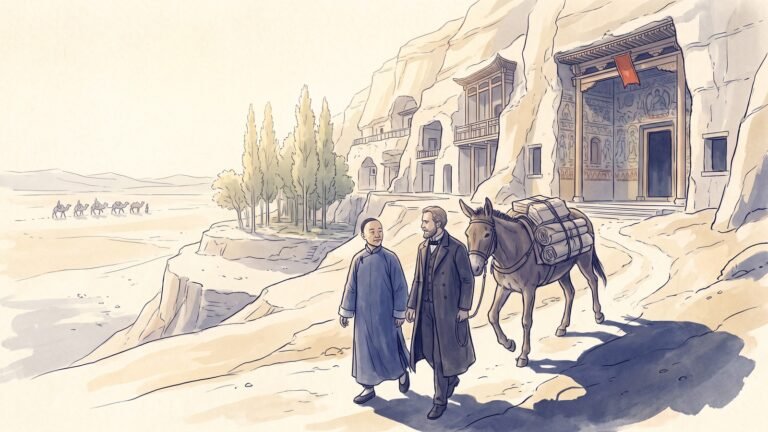
What we call the Silk Road was never a road and never run by any single power. It was a relay. Silk left Chang’an in convoy, passed the garrisons, and reached Dunhuang, where the route split around the Taklamakan’s killing sand, a desert whose name the locals rendered as “go in and you don’t come out.” From Kashgar it crossed the Pamirs to Samarkand, and from Samarkand through Persian and Syrian middlemen to Antioch and the sea. Nobody walked the whole of it. Silk changed hands a dozen times, and at each hand the price rose and the seller’s knowledge of the source grew dimmer, which suited the source perfectly. The great middlemen were the Sogdians, Iranian merchants from the oasis cities of what is now Uzbekistan, whose trading colonies dotted the route for centuries. We can hear them, briefly and heartbreakingly, because of an accident: in 1907 Aurel Stein found, in a ruined watchtower near Dunhuang, a mailbag abandoned around the year 313, its letters never delivered. The Sogdian Ancient Letters speak of silk prices, of famine, of a wife abandoned by her husband and stranded far from home. The road that carried the world’s most glamorous cargo also carried its most ordinary sorrows. The term itself is modern, by the way. A German geographer, Ferdinand von Richthofen, coined “die Seidenstrasse” only in 1877. The thing was twenty centuries old before it got its name.
At the western end of the relay, the fabric landed in a society that lost its mind over it. Julius Caesar is said to have awed Roman crowds with silken banners; a later, gossipy history insists the emperor Elagabalus was the first Roman to wear clothes made wholly of silk, presented as proof of his decadence. The price, at the market’s fever peaks, reached silk’s own weight in gold. Roman moralists saw in the fabric everything collapsing about their republic: softness, easternness, the female, the transparent. Pliny the Elder did the arithmetic and hated what he found.
India, the Seres, and the Arabian peninsula take from our empire one hundred million sesterces every year: that is the sum which our luxuries and our women cost us.
Modern historians argue about the figure, but nobody doubts the direction. Roman gold and silver flowed east in a current that ran for centuries, and the empire’s laws, bans, and sermons did nothing to slow it. The Senate could forbid a senator from wearing silk. It could not forbid a senator’s wife.
The monopoly’s first crack, by legend, came through a woman’s hair. In the fifth century, the story runs, a Chinese princess betrothed to the king of Khotan, an oasis kingdom on the southern Silk Road, was ordered by her father to leave the silkworms behind. She obeyed, more or less. Before departing she hid silkworm eggs and mulberry seeds in the lining of her headdress, knowing the border guards would never dare search a princess’s person, and carried sericulture across the mountains as her dowry. The tale was old when the monk Xuanzang recorded it in Khotan in the seventh century, and Khotan had by then been a silk-making town for generations. Whether or not any single bride did it, something like it happened: by the middle of the first millennium the oases of Central Asia were raising their own worms, and the first segment of the relay no longer needed China at all.
The second crack reached the Mediterranean in 552, and this one has a date, an author, and an emperor. Procopius, the great and venomous historian of Justinian’s reign, tells it in his history of the wars. Two monks who had lived long in Serinda, the land of silk, came to the emperor and told him the truth that three thousand years of Chinese customs law had failed to suppress forever: silk was not combed from trees but spun by worms, and the worms could be carried. Justinian, whose treasury was bleeding gold eastward for the fabric his court could not stop wearing, made the promise an emperor makes. The monks went back east and returned with eggs hidden in their hollow walking canes. Byzantine sericulture was born that year, in a staff, in a lie told at a border. The imperial workshops of Constantinople, with their state monopoly on purple-dyed silk, became the wonder and the espionage target of medieval Europe; silks woven there ended up wrapping saints’ relics and Saxon kings. After some three millennia, the secret was out in the West. And here is the twist that most accounts of the great smuggling miss: it barely mattered. China lost the monopoly on the knowledge and kept the industry for another fifteen hundred years, because by then the secret was no longer the point. The craft was.
Consider the drawloom. By the Han era, Chinese weavers were operating pattern looms of fearsome complexity, machines in which one worker wove while a second, the draw-boy, sat atop the frame lifting warp threads in sequences memorised and executed like music, each lift encoding one row of the pattern in the finished cloth. A dragon roundel, a cloud scroll, a line of prophetic characters like the one in the Niya sand: all of it was, in a strict sense, programmed. The design existed as a stored sequence of operations, executed faithfully by the machine and its operators. When silk technology crept west along the same routes the silk itself had travelled, the loom concept crept with it. In 1804, in Lyon, Joseph-Marie Jacquard perfected a loom whose patterns were governed by punched cards, and the cards became the machine’s removable memory. In 1890 Herman Hollerith adapted punched cards to count the American census, and the company his work founded became IBM. There is a straight, documented line of descent from the draw-boy chanting atop a Han loom to the card reader humming in a twentieth-century data centre. The worm’s thread does not end at the hem of a gown. It runs, quietly, into the information age.
Scale came with the dynasties this series has walked through before. The Song moved the industry’s centre of gravity to the Yangtze delta, and Jiangnan, the lake-and-canal country around Suzhou and Hangzhou, remained silk’s heartland for a thousand years; “above there is heaven, below there are Suzhou and Hangzhou” was a proverb about many things, but the looms were near the top of the list. The Ming and Qing ran imperial manufactories at Nanjing, Suzhou, and Hangzhou whose brocades dressed the court and whose schedules dressed down entire provinces. And when the maritime trade replaced the caravan, silk simply changed vehicles. Through the Canton system, silk went out by the shipload beside tea and porcelain, the triad of Chinese goods the world could not stop buying, and silver flowed in: Spanish dollars from Manila and Acapulco, and later the hard currency of every trading nation in Europe. This series has met Howqua, the Canton merchant who became one of the richest men on earth on the back of that trade, and it has walked through the century of humiliation that followed when Britain, unable to bear the silver drain any longer, found the one product China could be forced to crave. The opium that answered the silk question in the nineteenth century was, in a bleak sense, silk’s own shadow: the West’s reply to three thousand years of a trade balance it could not otherwise correct.
The twentieth century nearly killed the worm. Parachutes had been silk through two world wars, stockings had been silk, and then in 1939 DuPont arrived with nylon, and the synthetic age spent fifty years convincing the world that luxury was a chemical trick anyone could perform. Silk shrank to a niche. And yet walk the industry today and the outline of the old map is unmistakable. China still raises roughly three quarters of the world’s cocoons and supplies around nine tenths of the raw silk that crosses a border. What changed is the geography inside China. In 2006 Beijing launched a programme whose official name translates as Moving Mulberry Farming West, deliberately shifting sericulture out of the expensive, industrialising coast and into the poorer western provinces. It worked. Guangxi, subtropical and hungry for rural income, now produces more than a third of the country’s raw silk; its city of Hechi has led the nation in fresh cocoon output for nineteen consecutive years. The reeling floors are mechanised now, the cocoons sorted by machine vision, but the morning shift still begins with baskets of mulberry leaves and trays of larvae no wild place on earth could sustain. The moth still cannot fly.
And the worm, it turns out, had a second career waiting. Silk’s virtues, strength per weight beyond steel, compatibility with human tissue, a strange talent for dissolving on schedule inside the body, have made it a material of the laboratory rather than the wardrobe. Braided silk has closed surgical wounds for over a century; silk fibroin now serves as scaffolding for regrown tissue, as optical-grade film, as a biodegradable carrier for electronics designed to vanish when their work is done. Geneticists have edited silkworms to spin spider silk, a fibre nature never trusted the moth with, turning the oldest domesticated insect into a factory for materials no spider farm could ever deliver at scale. Somewhere in that work is the punchline of the whole story. The West spent three thousand years stealing the worm, and when it finally got it, it built Lyon, and Krefeld, and a legend about monks and canes. China simply kept farming, dynasty after dynasty, regime after regime, century after century, through the caravan age and the Canton age and the nylon age, until the share of world silk grown under its hand settled back to roughly where it has always been.
That is the real secret, and it was never the eggs in the headdress. It was the patience encoded in the pattern, the willingness to maintain one industry across three millennia, to standardise the bolt under the Han, to move the mulberry west under the Republic’s successors, to let the legend do the marketing and the loom do the rest. This series has seen the reflex before, in the axle gauge of the First Emperor and the examination halls that sorted a billion ambitions: China takes a practice, consolidates it, and holds it longer than anyone else considers possible. Silk is simply the purest case, the monopoly that outlived its own secrecy by fifteen hundred years. Leizu’s cocoon is still paying out its thread. It is just measured now in tonnes, in Hechi, one kilometre at a time.