
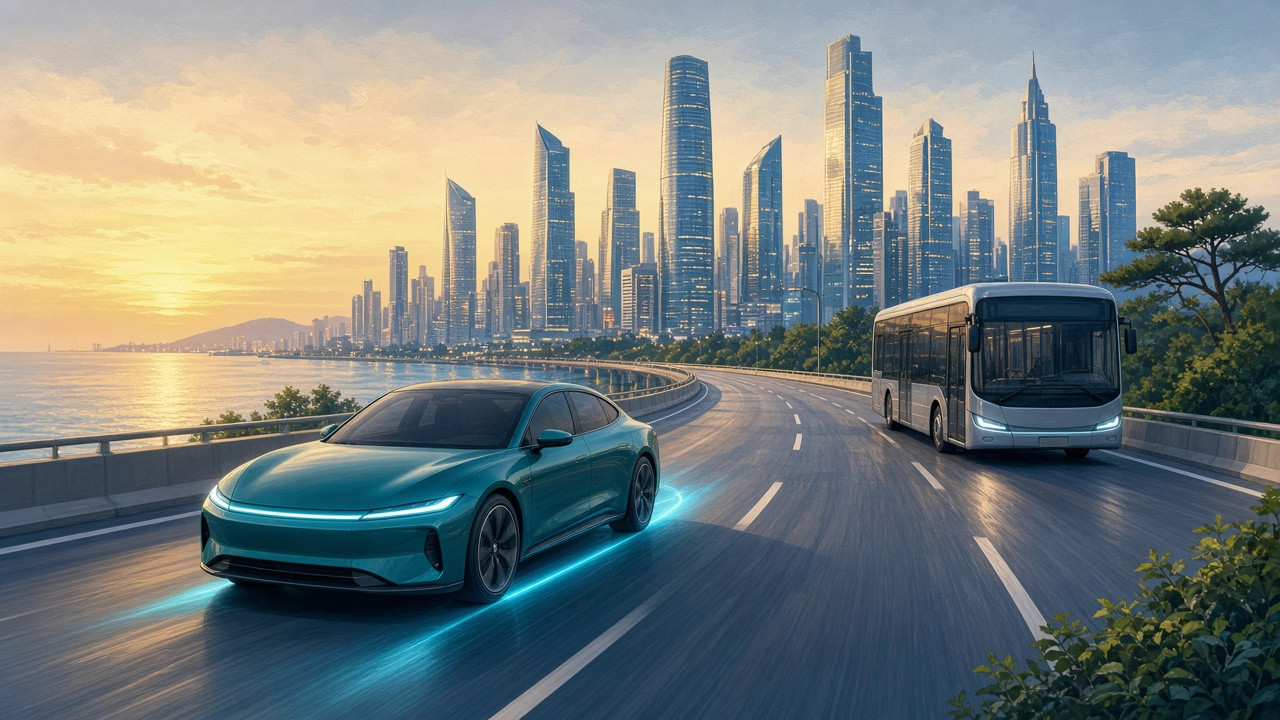
For most of the electric car era outside China, the story was told as Tesla versus everyone else. Tesla set the aspirational template: software heavy, battery hungry, vertically ambitious, and culturally loud. Then a quieter firm from Shenzhen overtook it on pure battery electric volume and began reshaping what global scale in electrified transport looks like. BYD did not win by imitating Silicon Valley rhetoric. It won by starting with chemistry, climbing into cars, buses, electronics, and rail adjacent systems, and treating the battery not as a purchased component but as the industrial core. The result is the clearest living proof that Chinese manufacturing can define a strategic industry rather than merely supply it.
Wang Chuanfu founded BYD in Shenzhen in 1995 as a rechargeable battery company. Trained in chemistry and materials, he left government research work after seeing Japanese producers shift toward higher value chemistries and leaving room in nickel cadmium and related cells that Chinese factories could attack on cost and process. With cousin Lu Xiangyang as an early partner, BYD began with a small team and modest capital. The early business was not glamorous. It was cell manufacturing discipline: yield, consistency, customer qualification for handset makers. By the early 2000s BYD had become a major supplier of rechargeable batteries to global phone brands. That mattered because it taught the firm how to live inside demanding foreign quality systems long before it put a badge on a passenger car.
The leap into automobiles came in 2003 with the acquisition of Qinchuan Automobile, a struggling state linked maker. Renamed and rebuilt as BYD Auto, the car business looked odd to battery specialists and odd to traditional car people. Battery people wondered why a cell firm wanted the regulatory and capital burden of vehicles. Car people wondered whether a battery chemist could stamp body panels and run dealer networks. Wang’s bet was that electrification would eventually make the battery the scarce and defining asset, and that owning cells, packs, motors, power electronics, and eventually more of the vehicle stack would beat a model in which carmakers begged suppliers for chemistry they did not understand.
For years the bet looked premature. BYD sold plug in hybrids and early electrics into a Chinese market still learning to trust range, charging, and residual values. Quality perceptions abroad were mixed. Design language lagged European and Japanese rivals. Yet the company kept deepening vertical integration. It built capacity not only in batteries but in semiconductors, molds, electronics assembly through BYD Electronics, commercial vehicles, and later rail transit products such as monorail systems. Electric buses became a global calling card long before BYD cars were common on European streets. Airport shuttles and city fleets in multiple countries normalised the brand as a serious electrified transport supplier rather than a curiosity.
The Blade battery, launched publicly in 2020 under the FinDreams battery organisation, crystallised the strategy. It is a lithium iron phosphate design arranged as long thin cells that can be packed efficiently, with safety demonstration as a central marketing and engineering claim. BYD emphasised resistance to dangerous failure modes that had haunted public discussion of electric vehicles, including nail penetration style abuse testing narratives popular in Chinese media and industry forums. The first passenger flagship to carry it widely was the Han EV. Whether every comparative safety claim is accepted by every foreign laboratory is less important than the industrial effect: BYD tied a distinctive pack architecture to brand trust inside China and then used that trust to push volume across price tiers.
Volume followed with a force that surprised Western commentary. Counting plug in hybrids and pure battery electrics together, BYD became the world’s largest plug in vehicle maker. On pure battery electric cars, the contest with Tesla tightened through 2024 and tipped in BYD’s favour in 2025 on full year figures reported by industry trackers: roughly 2.26 million BYD battery electrics against roughly 1.64 million Tesla deliveries. BYD’s total new energy vehicle sales for 2025 were reported around 4.6 million units, after about 4.27 million in 2024. These are wholesale and company reported sales figures that analysts parse carefully, and definitions matter. Tesla reports deliveries of its own cars. BYD’s totals include a vast hybrid volume that Tesla does not have. Still, the direction is unambiguous. In the markets that buy cars by the million, BYD is no longer an also ran.
Overseas expansion is the next act and already a large one. BYD reported overseas sales above one million vehicles in 2025, with management successively raising 2026 overseas targets as shipments and local production ramped. Plants and projects in Thailand, Brazil, Indonesia, Hungary and other locations are meant to blunt tariffs, shorten logistics, and turn BYD from an exporter into a local manufacturer. Europe has become a particular battleground: registrations grew quickly enough that BYD at times matched or exceeded Tesla’s share in parts of the European statistical area in early 2026 windows reported by industry analysts, while Brussels debates duties and industrial policy responses to Chinese electric vehicles. Latin America and parts of Southeast Asia and the Middle East offer less political friction and strong demand for value priced electrified cars and buses.
Quality and brand perception remain contested, and a Sino Despatch essay should not pretend otherwise. European and American buyers often still associate BYD with value rather than prestige. Software interfaces, dealer experience, and long term residual values are scrutinised more harshly for a Chinese challenger than for incumbents. Some early export models drew criticism for unfinished details even as crash test results and battery narratives improved. BYD’s answer has been iteration at Chinese speed: new trims, refreshed electronics, premium pushes under Dynasty and Ocean lineups, and more recently higher end models aimed at buyers who will not take a budget story. Whether brand equity can climb as fast as factory output is an open question. Scale can buy advertising and dealer footprints. It cannot instantly buy the cultural capital that decades of German or Japanese motoring mythology accumulated.
Competition is dense. Tesla still defines software narrative, Supercharger mindshare in some markets, and premium electric status for many consumers. Volkswagen Group and other Europeans are retooling under pressure, sometimes partnering with Chinese suppliers while lobbying for protection. Geely, including brands under its wider umbrella, SAIC, and a long list of Chinese peers fight brutally on price at home. CATL remains larger than BYD in global electric vehicle battery market share even as FinDreams Battery sits near the top of the supplier table. The Chinese domestic market after subsidy withdrawal has been a price war that hurts margins and forces continuous productivity gains. BYD’s vertical integration is an armour plating in that war: when cell prices and pack costs move, a firm that owns more of the chain can allocate pain differently from a pure assembler.
Industrial policy context belongs in the account without propaganda fluff. China spent more than a decade building new energy vehicle demand through purchase subsidies, license plate privileges in big cities, charging investment, and technical standards that favoured electrification. National purchase subsidies were wound down, with the policy mix shifting toward purchase tax preferential treatment, trade in schemes, and infrastructure. Local governments competed to host plants. The point is not that BYD is a puppet. Plenty of subsidised firms failed. The point is that BYD executed inside a state shaped market that created early volume, learning curves, and supplier ecosystems at a scale Western green industrial policy has struggled to match. Ignoring that context is as misleading as claiming policy alone explains the Blade pack or the export surge.
Recent operational friction shows the limits of triumph talk. In 2026 BYD’s domestic sales faced a difficult stretch linked partly to production line upgrades for second generation Blade capacity and to changes in purchase tax incentives. Wang Chuanfu publicly described battery output as a binding constraint, with capacity climbing in monthly increments while overseas demand remained a bright spot. Flash charging infrastructure ambitions inside China, including multi thousand station targets, are meant to turn charging speed into a product feature as distinctive as the original Blade safety story. Constraints of this kind are the ordinary taxes of hyper growth. They also remind investors that vertical integration concentrates both power and bottleneck risk in the same corporate body.
What does BYD’s rise mean for Chinese tech manufacturing? It means the battery era rewards firms that treat chemistry and vehicles as one industry. It means Shenzhen and related industrial clusters can host not only phones and drones but the capital goods of the energy transition. It means global car markets will not remain a Western oligopoly with China as a low cost workshop. Chinese brands will export finished vehicles, build abroad, and force incumbents to compete on cost structures forged in the world’s largest electric market. It also means political resistance. Tariffs, investment screening, and security talk about connected cars will intensify exactly because BYD and its peers are succeeding.
A fair closing judgment avoids both triumphalism and denial. BYD turned a battery workshop into a full stack electrified transport company and then used that stack to contest world leadership in electric volume. Tesla remains formidable on brand and software myth. European and Japanese makers remain formidable on legacy dealer trust and manufacturing craft in the old sense. Yet the centre of gravity for affordable mass electric mobility has moved toward Chinese industrial systems, and BYD is the emblematic firm of that move. Batteries made the company. Cars made the company famous. Vertical integration made the combination hard to copy quickly. That is the triumph, measured in factories and sales sheets rather than slogans.
Wang’s personal story helps explain the corporate temperament. Orphaned young and educated through scholarships in chemistry, he belongs to a generation of Chinese technologists who treat manufacturing competence as national and personal destiny rather than as a temporary stage before a software pivot. Interviews and shareholder meetings show a manager obsessed with capacity, cost, and incremental engineering rather than with cults of personality. When he told investors that sales depend on battery output, he was describing the company accurately. BYD’s bottleneck is often the thing it is most proud of: the cell and pack lines that make the vertical story real.
Buses and commercial vehicles remain underappreciated in Western consumer media that fixates on sedan range anxiety. Electrified buses taught BYD how to sell to cities, how to service fleets, and how to argue total cost of ownership against diesel. Those capabilities transfer when passenger cars go abroad. A firm that already maintains bus depots in foreign cities is not starting from zero when it asks regulators and dealers to trust a new Atto or Seal variant. Rail transit experiments, including monorail projects, similarly signal an ambition to treat electrified mobility as a system, not a single product category. Not every experiment will scale. The portfolio approach is itself a Chinese conglomerate strength that pure play startups cannot easily match.
Electronics roots also matter for cost. BYD Electronics made the firm intimate with the brutal margins and qualification rituals of consumer device assembly for global brands. That experience hardens managers against the romance of low volume halo cars. It encourages design for manufacture, platform sharing, and ruthless commonality of parts across models. Critics sometimes read Chinese car interiors as derivative. Derivative can be a failure of taste. It can also be a deliberate choice to spend engineering hours on the drivetrain and pack where the firm believes advantage lives. As design studios improve, that tradeoff may shift. The early export years were about proving the electric system, not about winning Milan furniture awards.
Policy after subsidy withdrawal tested the entire Chinese electric sector. Price wars compressed margins, weaker brands sought mergers or state rescue, and consumers became sophisticated bargain hunters. BYD’s scale and integration helped it endure, but endurance is not the same as comfort. Overseas markets became not only a growth story but a relief valve. That dynamic will shape geopolitics: Chinese overcapacity narratives in Europe are partly about domestic Chinese competition spilling outward. BYD’s rising export targets for 2026 and 2027, including management commentary pointing toward roughly two million overseas units as an updated 2026 ambition band in some briefings and more than 2.5 million for 2027, will keep that debate loud. Host countries must decide whether local plants count as investment success or as Trojan horses. BYD will keep offering factories and jobs as answers.
Brand premiumisation is the strategic hinge for the next decade. Volume leadership at thin margins is a Chinese specialty that Western incumbents dread. Sustainable triumph requires enough pricing power to fund software, autonomy research, and dealer quality that match Tesla’s mystique and German aftersales expectations. BYD’s assisted driving fleet size and data accumulation, cited by management in the millions of vehicles and vast daily kilometre counts, show an attempt to close the software gap with scale. Whether that data advantage converts into trusted autonomy products outside China depends on regulation, mapping rights, and consumer willingness to believe a battery first company can also be a software company. History is not obliged to grant every vertically integrated firm every adjacent crown.
Compare industrial philosophies honestly. Tesla began with cars and pulled manufacturing and cells inward over time, including large cylindrical cell strategies and factory theatre as brand. BYD began with cells and climbed into cars, then used buses and electronics as parallel ladders. Volkswagen began with cars and is still negotiating how much battery sovereignty to own versus buy. Geely mixes acquisition diplomacy with domestic electric brands. In that comparison, BYD’s originality is the battery first path executed without abandoning the messy realities of stamping, painting, and dealer finance. The world’s EV contender is not a metaphor. It is a sales table, a shipping schedule, and a factory map that now spans continents.
For huaxia.click readers the Sino perspective is evidence first. Chinese firms can own deep tech stacks. Chinese policy can create markets that produce learning by doing at unmatched scale. Chinese brands can still struggle with prestige and with political walls abroad. BYD embodies all three truths at once. Batteries made it possible. Vertical integration made it durable. Global politics will decide how far the triumph is allowed to travel, but the manufacturing fact is already on the road.