Twenty years ago a ready to fly camera drone was a curiosity for specialist hobbyists. Today it is a mass market appliance, and for most of the world that appliance was designed in Shenzhen. DJI, formally Da Jiang Innovations, did not invent flight or photography. It did something harder. It turned unstable multicopters into products that ordinary people could buy, fly, film with, and replace when they crashed. In doing so it made the civilian drone category itself look Chinese: Chinese engineering, Chinese supply chains, Chinese price performance. That is a triumph worth analysing without cheerleading and without the reverse reflex that treats every Chinese industrial success as a security plot first and a manufacturing fact second.
Frank Wang, known in Chinese as Wang Tao, founded DJI in January 2006 while still connected to the Hong Kong University of Science and Technology. Born in Hangzhou, he arrived in Hong Kong as a student with an engineer’s appetite for control systems rather than a marketer’s appetite for lifestyle branding. Early DJI sold flight control boards and components to universities, utilities, and builders who assembled their own aircraft. Those first customers paid thousands of dollars for systems that still demanded craft knowledge. The company learned the hard physics of stabilisation, sensor fusion, and reliable radio links long before it learned how to put a white quadcopter on a consumer shelf. That sequence matters. Firms that begin with a finished toy often discover they cannot fix flight. Firms that begin with flight can later wrap it in plastic and software that non specialists will trust.
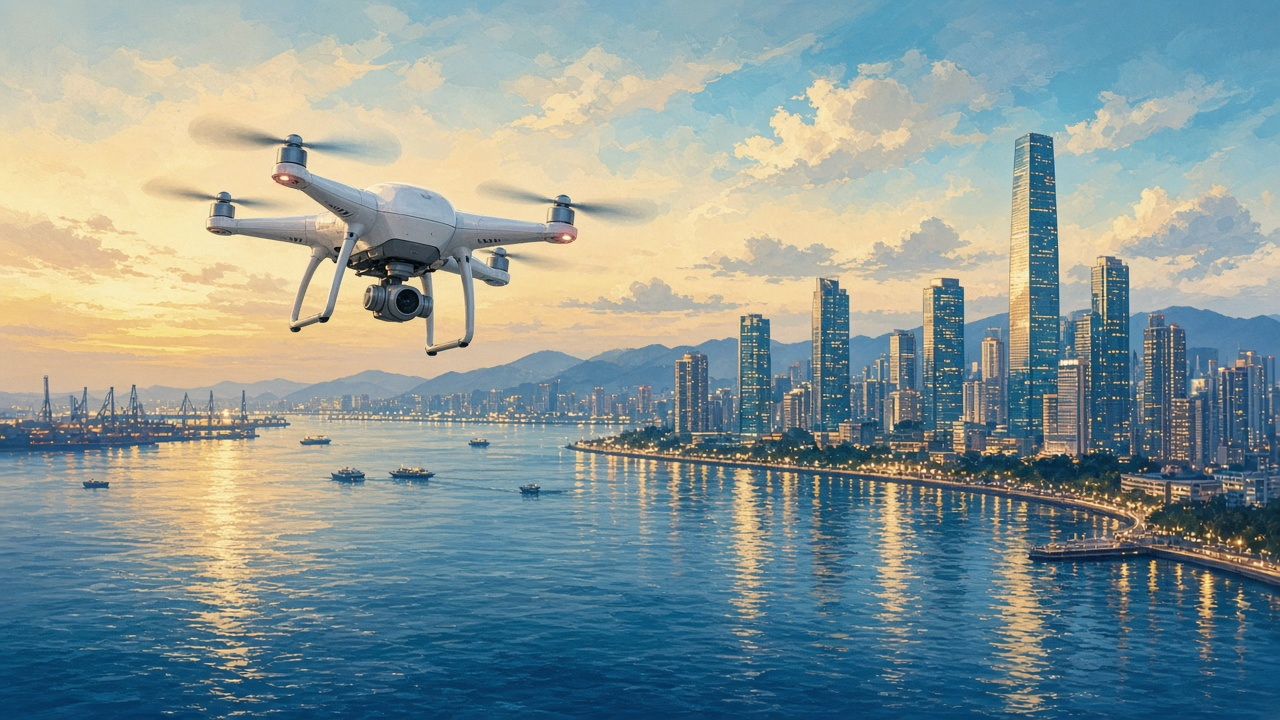
The decisive consumer break arrived in 2013 with the Phantom. Before the Phantom, aerial photography usually meant assembling parts from several vendors, tuning parameters, and accepting frequent crashes. DJI packaged flight controller, airframe, gimbal, and camera into a machine that could be flown after a short setup. Priced in the low hundreds of dollars rather than the low thousands for comparable capability, the Phantom dragged aerial filming out of a niche and into real estate marketing, wedding videos, journalism, and weekend recreation. Later Phantom generations added better cameras and live video, locking in the form factor that still defines the category in popular memory. The white X shaped craft became the cultural image of a drone for a generation of buyers who had never touched a radio controlled helicopter.
If the Phantom created the market, the Mavic series industrialised portability. The 2016 Mavic Pro folded into a packable shape without surrendering the core promise of stable footage. Subsequent Air, Mini, and Pro lines chased different weight classes and legal thresholds. Sub two hundred and fifty gram models mattered because regulators in many countries treat lighter craft more lightly. DJI did not invent those rules. It designed products that lived inside them. By the late 2010s a traveller could carry a capable camera aircraft in a backpack, and the default assumption among buyers was that the brand on the box would be DJI. Product cadence remained aggressive into the mid 2020s, with new Mini, Air, Flip, and Mavic Pro generations arriving fast enough that rivals were still answering last year’s feature list while DJI was already shipping the next one.
Consumer success funded expansion into adjacent lines that are less visible in holiday photographs but more important industrially. Enterprise platforms such as the Matrice series serve inspection, public safety, and mapping. Agricultural Agras systems spray and spread across large fields, especially in Asia and Latin America where labour costs and field sizes make aerial application attractive. DJI Agriculture has reported global agricultural fleets measured in the hundreds of thousands of units, a scale that turns drones from gadgets into farm machinery. Cinema and professional imaging grew through Inspire aircraft, Ronin stabilisers, and a controlling stake in Hasselblad. Microphones and other capture accessories followed. DJI is not only a toy company that got lucky. It is a platform firm that kept adding vertical layers of hardware and software around flight and capture, then used each layer to reinforce the others.
Why did DJI win so thoroughly? Vertical integration is the first answer. Flight control algorithms, gimbals, cameras, batteries, motors, and the application software that stitches the experience together were pulled in house or tightly controlled. Competitors that bolted cameras onto airframes from third parties repeatedly discovered that the product is the integrated stack, not any single component. A beautiful sensor on a twitchy frame is useless. A stable frame with mediocre optics is also useless for the buyers who actually drive volume. DJI treated the whole loop from stick input to recorded frame as one design problem.
Shenzhen’s dense electronics ecosystem made that integration cheaper and faster than it would have been in most Western locations. Tooling, component vendors, contract manufacturing capacity, and engineering labour sit within short physical and social distance of one another. Iteration cycles measured in months, not years, meant that a rival’s new feature could be answered before it became a durable differentiator. Cost discipline followed from the same geography. When your suppliers and your assembly lines share a city cluster, you can chase yield and scrap rates with a ferocity that remote, multi continent supply chains struggle to match. Price performance completed the lock in. DJI undercut Western makers while matching or exceeding them on the features consumers actually notice: smooth video, obstacle sensing, intelligent flight modes, and battery life that is merely inconvenient rather than disastrous.
Market research figures are estimates rather than audited monopolies, but they point the same way. Multiple industry assessments place DJI near seventy percent of the global civilian drone market in the mid 2020s, with roughly seventy four percent cited for 2024 and about seventy percent for 2025 in some summaries. Consumer camera drone measures are often higher still. In the United States around 2020, reporting put DJI near seventy seven percent of consumer share, with no single rival above a few percent. Company revenue figures circulating in open sources for 2025 are on the order of eighty billion yuan, roughly eleven and a half billion dollars, larger than the entire European drone market as estimated by some European analysts. Those numbers move with methodology and geography. What does not move is the qualitative fact that for a decade DJI has been the reference product against which others are judged.
Competition exists and should be taken seriously. Autel Robotics, also Chinese, contests enterprise and consumer segments with capable aircraft and has found buyers who want an alternative brand without leaving the Chinese supply world entirely. Skydio in the United States has emphasised autonomy and secured government and defence adjacent customers who will pay for domestic supply and for software that promises less pilot burden. European and Japanese firms hold niches. Parrot remains a European name with a revenue base that is a small fraction of DJI’s. American defence contractors and new entrants such as Anduril pursue military and government markets where DJI is politically shut out and where budgets are large enough to subsidise learning curves. None of this yet looks like a civilian consumer overturning. It looks like a segmented response: Western policy tries to create protected demand for non Chinese platforms while the open consumer market continues to prefer Shenzhen’s price and polish.
Security and dual use concerns are real and should be stated plainly. Multirotors film, map, and can carry payloads. The same airframe that inspects a bridge can survey a sensitive facility. Conflict zones have shown how cheap commercial drones and modified commercial components enter battlefields, for reconnaissance and for attack when paired with explosives or other munitions. Western governments argue that Chinese origin hardware creates risks of data exfiltration, remote access, and industrial dependence. DJI disputes many of the more absolute claims and points to local data modes, encryption options, and third party reviews. Honest analysis can hold both points at once. A dominant Chinese supplier of imaging aircraft is dual use by nature of the machine. Not every regulatory move is a carefully measured finding about a specific exploit. Some of it is industrial policy wearing a security badge, designed to starve a foreign champion of market oxygen so that domestic firms can breathe.
The United States has moved furthest. Federal procurement restrictions on DJI for many government uses accumulated over years. In December 2025 the Federal Communications Commission updated its Covered List after an executive branch national security determination covering foreign produced uncrewed aircraft systems and critical components. New foreign models blocked from FCC equipment authorisation cannot be ordinarily imported for sale in the United States. Existing authorised models and already purchased aircraft were not blanket grounded by that update. The practical effect is a tightening pipeline for new DJI hardware into the American market, which is exactly what industrial base arguments intend. Critics note that American alternatives often cost more and remain thinner in ecosystem maturity for mapping, inspection, and public safety workflows that grew up around DJI. Supporters reply that dependence itself is the vulnerability, and that price gaps are the bill for sovereignty.
Europe has been less uniform. Agency warnings, national restrictions on sensitive government and critical infrastructure use, and political pressure coexist with continued civilian and commercial flying. There is no single simple European consumer ban equivalent to the American Covered List logic, but the direction of travel for public sector procurement is clearly cooler. India has used import controls to push domestic manufacturing. Other states copy pieces of the American playbook at different speeds. The result is a bifurcated world: DJI remains dominant where markets are open and price sensitive; non Chinese vendors gain share where politics closes the door.
What does triumph mean in this setting? First, it means category creation. DJI did not merely win a share of a mature Western industry. It made the modern consumer drone industry and then defended it with continuous product renewal. Second, it means manufacturing depth. Batteries, cameras, flight computers, and mechanical design co evolved inside one firm and one city cluster. That is the Shenzhen model at its strongest: dense suppliers, rapid tooling, engineers who can touch the whole stack. Third, it means soft power that is uncomfortable for Washington and Brussels. When the world’s default aerial camera is Chinese, Chinese standards and Chinese firms set expectations for what a drone should cost and how it should feel to fly. Soft power here is not a slogan about culture. It is the quiet authority of the product people actually choose.
Triumph is not immortality. Geopolitical walls can carve out government and critical infrastructure demand for non Chinese vendors even if consumers elsewhere remain loyal. Dual use stigma can slow enterprise sales in allied markets. A serious accident, a proven large scale data breach, or a competitor that finally matches the integrated experience at a similar price could dent the brand. DJI’s private ownership and founder control have preserved focus, but they also concentrate strategic risk in a single culture and a single leadership style. Markets that DJI cannot enter become training grounds for Autel’s rivals and for Western autonomy specialists. Over time those protected gardens may grow trees sturdy enough to export. That is the bet Western industrial policy is making.
There is also a lesson for Chinese technology strategy more broadly. Export led consumer hardware that wins on merit invites political reaction precisely because it wins. Pretending otherwise is naive. The durable response is not only diplomacy. It is continued engineering advantage so deep that even restricted markets feel the absence, and open markets feel no urge to switch. DJI’s story so far is that kind of advantage: flight control that feels invisible, cameras that punch above their weight, and a price that makes second best look like a lecture on patriotism rather than a shopping decision.
Still, the historical judgment is already clear enough for an essay. Before DJI, consumer aerial photography was awkward and expensive. After DJI, it was a Chinese dominated appliance category with global reach into farming, film, inspection, and leisure. Regulatory pushback acknowledges that dominance rather than disproving it. Chinese tech manufacturing is often described abroad as assembly for foreign brands. DJI is the counterexample that matters: a Chinese brand that defined the product, owned the stack, and forced the rest of the world to respond. That is what industrial triumph looks like when it is earned in the open market and then contested in the closed one.
The supply chain story deserves a separate beat because it is easy to reduce DJI to clever software. Propellers, carbon and plastic structures, brushless motors, electronic speed controllers, imaging sensors, and lithium cells all have to arrive at quality and cost that leave margin after retail discounts and warranty. DJI’s Shenzhen base sits inside the Pearl River Delta’s unmatched density for these parts. When a Western startup tries to localise the same bill of materials, it discovers that ‘buy American’ or ‘buy European’ is a political sentence that does not conjure vendors overnight. That discovery feeds the security argument: if you cannot make the stack, you remain dependent. It also explains why DJI’s lead proved sticky for so long. Dependence is not only a buyer problem. It is a builder problem for anyone trying to catch up.
Software and product psychology matter as much as motors. DJI’s apps taught millions of first time pilots to frame shots, set return to home points, and trust automated modes that reduce crash rates. The company turned fear of flying into a manageable learning curve. That soft infrastructure, maps of no fly zones, firmware update culture, accessory ecosystems, and repair channels, creates switching costs that pure airframe competitors underestimate. A slightly better camera from a smaller brand does not automatically move a user who already owns batteries, filters, ND kits, and muscle memory for DJI’s interface. Platform businesses win twice: once on the vehicle and again on the habits around it.
Agriculture and enterprise also rewrite the moral tone of the DJI debate. It is easy for newspaper columns to treat drones as toys or as weapons. It is harder to dismiss a spraying aircraft that cuts chemical exposure for farm workers or an inspection craft that keeps technicians off dangerous towers. DJI’s commercial lines sit in that ambiguous middle where public benefit and dual use risk share a chassis. Policymakers who ban first and inventory use cases later risk harming legitimate operators, including their own public agencies that quietly relied on Chinese hardware because it worked. Policymakers who ignore security entirely risk waking up to a single point of failure in critical aerial sensing. The adult position is inventory, segment, and harden, not slogan.
Finally, triumph should be measured against Chinese industrial history, not only against Western fear. Late twentieth century China specialised in processing and assembly under foreign brands. Twenty first century China produces global category leaders in several hardware domains. DJI sits beside firms in batteries, telecom equipment, and electric vehicles as evidence that the old hierarchy of design in the West and assembly in the East is obsolete. That shift will keep generating political heat. It will also keep generating products that people vote for with cash. DJI’s drones are one of the purest cash votes of the era: bought by individuals and firms who could have chosen otherwise, again and again, until politics narrowed the ballot.