
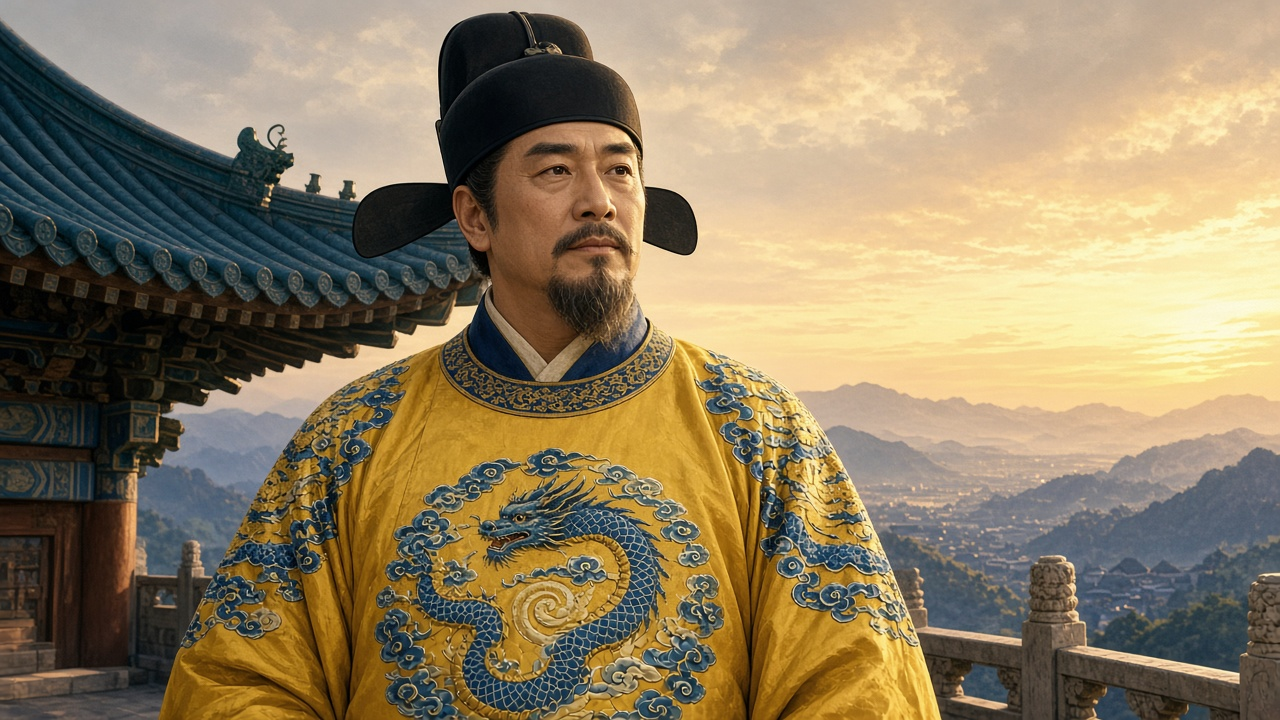
Zhu Yuanzhang, remembered as the Hongwu Emperor and Ming Taizu, ruled China from 1368 to 1398 as the founding sovereign of the Ming dynasty. His life runs from famine orphan and Buddhist novice to rebel general and autocrat who remade the state after Mongol Yuan rule. A biography that stays factual has to hold both the founding achievement and the later terror: land registers and village orders on one side, purges that emptied ministries on the other. Hongwu was not a gentle Confucian sage king. He was a peasant revolutionary who learned that paperwork and fear could keep a hard won throne.
He was born on 21 October 1328 in Zhongli, Haozhou, in what is now Fengyang, Anhui, along the Huai basin then under Yuan administration. His family were poor peasants who had already slipped toward itinerant tenancy. Infant names and early styles shifted with fortune; Zhu Yuanzhang is the name that stuck once rebellion made him a public man. The Huai region in the mid fourteenth century was a school of catastrophe: drought, locusts, flood, epidemic, and tax pressure under a dynasty losing its grip. Childhood for him was not rustic idyll but a lesson in how thin the line between survival and burial could be when harvests failed and officials still demanded grain.
In 1344 plague and dearth killed his parents and a brother. At sixteen he entered a nearby Buddhist monastery as a novice, then spent years begging and wandering before returning to monastic life. Those roads taught him how little official protection meant to common people, and they left him suspicious of scholars who knew books better than hunger. Monastery walls did not seal him from politics. In 1352, as Red Turban war spread and Yuan forces burned temples suspected of rebel ties, Zhu joined the rising under Guo Zixing at Haozhou. Marriage to Guo’s foster daughter Ma, later Empress Xiaoci, bound him into the command household. He rose because he could fight, recruit, keep men fed, and choose when to obey and when to outgrow a patron.
By 1356 he held Jiqing, the city he renamed Yingtian and later made Nanjing, the political hinge of his career. Southern grain, walls, and river access let him build a territorial regime while other rebels still lived on raids and millenarian charisma. He gathered generals and Confucian advisers such as Li Shanchang, Song Lian, and Liu Ji. Nominally he still nodded to Red Turban Song claims under Han Lin’er, the so called Lesser Prince of Radiance. In practice Nanjing policy increasingly followed Zhu alone. The Yangtze wars of the 1360s decided who would wear the next Chinese crown among rival Chinese warlords before the Mongols were fully expelled.
Defeat of Chen Youliang at Lake Poyang in 1363 was the great naval and riverine clash that broke the strongest southern rival. Zhang Shicheng’s Wu regime, rooted in the rich lower Yangtze, fell after a grinding campaign that showed Zhu’s preference for methodical siege and logistics over romantic dash. In 1364 he took the title King of Wu. In early 1368 he proclaimed the Ming dynasty and the Hongwu reign era at Nanjing. Xu Da and other captains then drove Yuan forces from Dadu, the northern capital that would become Beijing under later Ming emperors. The orphan who had begged rice as a novice had become Son of Heaven. Expelling the Yuan court north of the Wall did not erase Mongol power on the steppe, but it ended Mongol emperorship over China proper.
Hongwu’s thirty year reign aimed at recovery after war and at a social order he thought he understood better than court theorists. He pushed agriculture through reclamation, irrigation, resettlement of people onto empty land, and military colonies that tied soldiers to fields. Household and land registers tried to make people and acreage visible to the state. The lijia system organised village households into groups for tax delivery and mutual responsibility. Hereditary military households and garrisons were meant to give the dynasty a stable army without constant hireling chaos. He restored schools and civil service examinations to staff the bureaucracy with Confucian learning even as he distrusted the moral vanity of literati who had never starved.
His theory of rule differed from the soft Confucian claim that the ruler’s virtue alone transforms the world. Hongwu believed institutions, registers, and surveillance mattered as much as sermons. He wanted subordinates loyal and civilians shielded from war’s worst shocks when he could manage it. He also wanted an emperor who could see into every office. That desire reshaped Ming government permanently. In 1380, after the Hu Weiyong case destroyed the most powerful chancellor of the early reign, he abolished the chancellorship and the Central Secretariat’s old coordinating power. The six ministries answered more directly to the throne. The Embroidered Uniform Guard and related investigation organs made fear a working department of state. Later Ming emperors inherited this concentrated structure whether or not they had Hongwu’s stamina to run it.
The purges are the darkest chapter and cannot be waved away as later propaganda alone. The Hu Weiyong affair and subsequent cases, including the Guo Huan fiscal scandal and the Lan Yu military trial, implicated officials, generals, and widening circles of kin and clients. Death toll estimates vary wildly across Ming and Qing sources and should be treated cautiously, but the order of magnitude was enormous: tens of thousands caught in expanding nets of accusation across successive waves. Critics inside the regime protested that talent was being wasted and morale destroyed. Hongwu did not abandon the method. He had climbed through a world of betrayal, shifting loyalties, and millenarian armies. As emperor he treated conspiracy as the default weather of politics and preferred overkill to a second chance.
Village policy shows a more experimental, even contradictory Hongwu than the stereotype of a frozen despot. Laws on village seniors, mutual watch, and popular rights to report corrupt clerks shifted across phases of the reign. He sometimes appealed directly to ordinary subjects against local predators through texts such as the Great Warnings, then tightened mutual surveillance among neighbours. Institutions were drafted, revised, abolished, and revived. Scholars who read the founder’s own instructions year by year find an autocrat adjusting his blueprint when society pushed back. Resistance looked to him like wickedness or stupidity. His revisions show he still had to bargain with real kinship and market networks that would not sit still for an ideal agrarian diagram.
Religion in his life stayed double edged. Buddhist shelters saved him as a youth. Sectarian Red Turban energy, with its White Lotus and millenarian flavours, helped make him a warlord. As emperor he confiscated monastic estates, limited the number of monasteries, and returned huge numbers of monks and nuns to lay life when he thought the sangha had grown into a parallel landlord power. He could honour ritual and issue moral tracts while crushing organisations that resembled the world that forged him. Founders often fear their own origins. Hongwu institutionalised that fear in statutes against heterodox assemblies and in hard limits on clerical wealth.
Family and succession were his unfinished wound. Empress Ma was remembered in later tradition as a moderating influence who could speak when few others dared. Sons were enfeoffed as princes along the frontiers and in the interior, a system meant to shield the dynasty with imperial blood and instead trained future civil war. Hongwu died in Nanjing on 24 June 1398 after three decades on the throne. He left the succession to his grandson Zhu Yunwen, the Jianwen Emperor, bypassing stronger adult sons including Zhu Di, Prince of Yan. In 1402 Zhu Di overthrew Jianwen after a bitter civil conflict and became the Yongle Emperor. The founder’s settlement lasted four years. His dynasty lasted nearly three centuries. That gap is part of the biography: Hongwu could design a machine and still misread the human parts closest to him.
Foreign and frontier policy under Hongwu mixed caution with ambition. He drove Mongol power from the Chinese agrarian heartland but did not destroy the Northern Yuan on the steppe. He preferred disciplined armies and limited exposure of civilians when possible, a pragmatism shaped by his own memory of war’s cost to villages. Tributary relations with Korea and other neighbours were restored in Ming form. Maritime and grand expeditionary questions would open more dramatically under Yongle with the treasure voyages. Hongwu’s priority remained internal reconstruction, elite discipline after Yuan collapse, and the locking down of the plural warlord world from which he himself had risen.
Physical presence in the sources matters less than administrative voice. Hongwu issued moral instructions, harsh statutes, and personal warnings in a plain style that still reads like a man arguing with subordinates he does not trust. The Great Warnings and related texts tried to turn subjects into monitors of clerks. Whether they worked as intended is debated among historians. That he wrote them shows an emperor who believed words backed by death sentences could rebuild virtue after chaos. The voice is not elegant Song prose. It is the voice of a founder who thought elegance without obedience was a luxury China could not afford in his generation.
Military colonies and hereditary soldier households aimed to cheapen defence and root the army in land. Over time the system decayed into evasion, weak garrisons, and paper strengths, a long Ming problem with roots in the founder’s design. Hongwu solved the fourteenth century crisis of how to pay for reunification after Yuan collapse. He did not solve the sixteenth century crisis of how those solutions aged under commercial growth, silver flows, and new military technologies. Biography should not pretend a founder anticipates every later failure. It should note when the seed of later trouble was planted in the founding fix.
Compared with other Chinese founders, he sits nearer Han Gaozu than to Tang Taizong in social origin, and nearer to a successful Red Turban manager than to a pure Confucian restorer in method. The Mongol comparison also matters. He rejected Yuan ethnic hierarchy and the privileges of the conquest elite while keeping a hard northern security horizon. Expelling Mongol emperors from Dadu was his founding theatre. Living with steppe threat was his strategic inheritance. He did not recreate the Song’s civilian soft power dream. He built a harder, more militarised early Ming that later softened and complicated under different emperors.
How should a modern reader judge him? As state builder he restored production, recreated examinations, and gave Ming China a durable administrative skeleton after a century of Mongol rule and a generation of civil war. As politician he concentrated power to a degree that made later Ming emperors both absolute on paper and oddly dependent on eunuchs and guards when personal energy lagged. As social engineer he tried to freeze mobility and enforce agrarian virtue, then watched markets and local society erode his diagrams. As moral actor he remains hard to sentimentalise: the same man who knew famine ordered slaughter in peacetime offices and called it justice.
Chinese patriotic tradition often softens him into the peasant emperor who expelled Mongols and restored Hua Xia after alien rule. That is not false. It is incomplete. Older Western accounts sometimes exoticised Ming despotism without weighing Yuan collapse, Red Turban millenarianism, and warlord competition as the real school that trained him. A Sino Despatch biography should keep the sequence clear. Hunger made Zhu. Rebellion promoted him. Nanjing organised him. Victory enthroned him. Fear ruled with him. The Hongwu Emperor is the Ming’s necessary founder and its cautionary ghost: proof that a dynasty can be born from the bottom of society and still govern by looking endlessly over its shoulder.
For readers following the Yuan to Ming hinge on this site, Hongwu is the human face of restoration after Eurasian empire on Chinese soil. He is also the reminder that restoration is never only cultural homecoming. It is tax reform, murderous politics, village paperwork, and a palace built by a man who once begged rice outside monastery gates. The biography ends where the dynasty’s next act begins: a grandson on the throne, a prince in the north gathering strength, and a founder’s rules about to be broken by his own blood. Yongle would expand and reorder what Hongwu founded. He could not have done so without the orphan from Fengyang who decided that China would be Ming.