
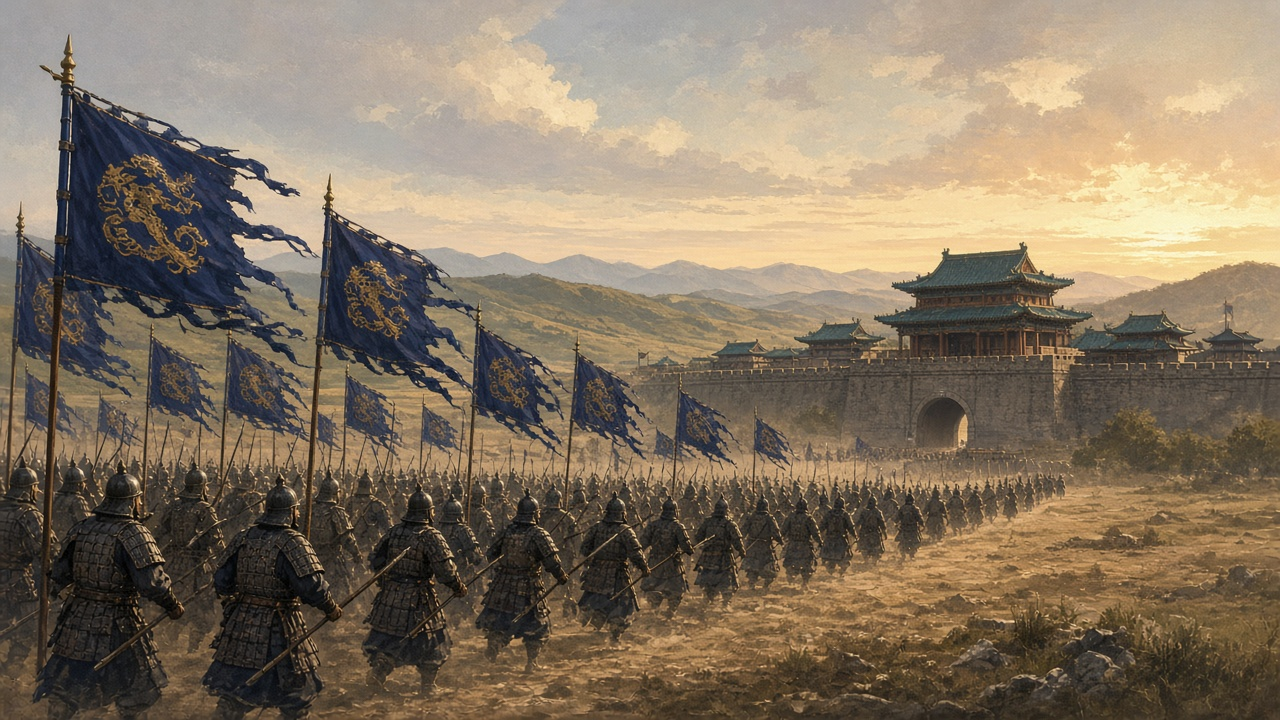
The Ming did not appear because a Chinese essence suddenly woke up and expelled Mongol strangers. It appeared because the Yuan state cracked under floods, famine, fiscal failure, court faction, and armed rebels who learned to govern as well as to fight. Zhu Yuanzhang rose from orphan, monk, and Red Turban officer to Hongwu emperor by winning a civil war among Chinese warlords as much as by chasing Mongols from Dadu. How and why the Ming took power is therefore a story of Yuan breakdown, millenarian revolt, ruthless consolidation in the south, and a final northern campaign that ended Mongol rule in China proper in 1368.
By the mid fourteenth century the Yuan court was no longer the confident Eurasian machine of Kublai’s generation. Succession fights and aristocratic faction hollowed central direction. Paper money overissue and tax extraction hit hard times harder. The Yellow River’s disasters, worsened by neglected waterworks, turned repair corvée into a recruiter for rebellion. Epidemics and local dearth emptied villages. Mongol rule had always mixed privilege with dependence on Chinese clerks and revenues. When the logistical and political circuits failed, resentment against ranked ethnic hierarchy found company with ordinary misery. The dynasty did not fall from one cause. It failed as a system.
In 1351 the Red Turban rebellions erupted across north China, tied to White Lotus and related millenarian currents that spoke of Maitreya, cosmic struggle, and the end of corrupt order. Red cloth marked the fighters. Their aim, variously stated, included expelling Mongols and restoring a Song like Chinese sovereignty, though ideology on the ground was mixed and local. Secret society religion supplied organisation and courage. It did not by itself supply a national administration. That gap is where Zhu Yuanzhang’s career becomes decisive.
Zhu was born to a poor family that had slid into itinerant tenancy in the Huai region. Famine and plague orphaned him in 1344. He entered a small Buddhist monastery, begged on the roads, and learned the thinness of official protection. In 1352 he joined a Red Turban branch near Fengyang. Marriage into a rebel commander’s household and a talent for attracting followers lifted him fast. He was not a Confucian examination graduate. He was a man who understood hunger and command.
Nanjing, taken in 1356, became his hinge. Control of a major Yangtze city gave grain, walls, shipyards, and a place to recruit scholars. Zhu built a government of generals and Confucian advisers. He kept Red Turban military energy while shifting political language toward classical legitimacy. That dual strategy mattered. Pure sectarian rule would alienate the literati who staffed tax and law. Pure literati talk would not win battles. Zhu used both, and he subordinated both to his own authority.
The Yuan were already losing the south and the Huai to regional rebel states. Song loyalist claims under Han Lin’er, Han under Chen Youliang on the middle Yangtze, and Zhang Shicheng’s Wu power on the lower Yangtze mattered more to Zhu’s immediate survival than Dadu did. Chinese warlord competition, not a simple national rising, decided who would inherit the Yuan’s Chinese territories. Zhu’s genius was to treat rival rebels as the main enemy until the south was his.
Lake Poyang in 1363 was the spectacular proof. Chen Youliang’s larger Han fleet met Zhu’s forces in a battle remembered for fire ships and slaughter on the water. Zhu’s victory opened the Yangtze basin. Zhang Shicheng fell later. By the mid 1360s Zhu held the economic core of China. Han Lin’er’s suspicious death around Zhu’s orbit in 1367 cleared a rival source of Red Turban dynastic prestige. In 1368 Zhu proclaimed the Ming and the Hongwu reign. The name promised radiance. The method had been elimination.
Only then did the northern campaign finish the Yuan in China proper. Ming armies took Shandong and Henan approaches and entered Dadu in August 1368. The Yuan emperor fled toward the steppe. Palaces were ruined or emptied. The city was renamed Beiping for a time. Mongol power continued in the north as the Northern Yuan, a fact Ming propaganda preferred to soften. Ending Yuan rule over the Chinese agrarian heartland was not the same as erasing Mongols from Inner Asian politics. It was still a regime change of the first order.
Why did this work when earlier risings had failed? First, the Yuan centre could no longer coordinate reliable suppression across the flood plain and the Yangtze. Second, Zhu built a territorial state early, with taxes, officers, and Confucian paperwork, rather than remaining a roaming millenarian host. Third, he won the richest war theatre before striking the old capital. Fourth, Mongol military prestige had been diluted by decades of garrison life and faction, while Chinese commanders had learned gunpowder, river war, and siege from the same century that the Yuan had helped globalise. Fifth, the slogan of restoring Hua and expelling Mongols gave literati and common soldiers a shared story after victory was already becoming plausible.
Ethnic grievance was real and should not be denied. Yuan legal and status rankings that privileged Mongols and certain allies left bitter memories. Ming founding rhetoric used that bitterness. Yet reducing 1368 to race war alone misreads the chronology. Zhu spent years destroying Chinese rivals who also hated Mongols. Peasants who joined Red Turbans often hated corvée and hunger more than they hated a metaphysical steppe. The Ming victory was Chinese led and Chinese staffed. Its causes included ecology, money, religion, and state failure as much as identity.
Hongwu’s later harshness makes more sense after this origin. A ruler who climbed through betrayal, famine, and lake war trusted surveillance and punishment. He rebuilt an agrarian order, bound society with law codes, and hunted threats real and imagined. The Ming presented itself as restoration of Chinese rule after Mongol interruption. Modern historians rightly note how much Ming institutions still carried Yuan precedents in military and continental thinking. Founding myths need rupture. State practice kept some inheritance.
For readers who follow huaxia.click’s longer arc from Yuan to modern China, the Ming seizure of power is the hinge where Eurasian empire yields to a restored agrarian dynasty with a chip on its shoulder. The Yuan had forced China to live as a node in a wider system. The Ming promised to put Chinese sovereignty back at the centre of the story. It did so by mastering rebellion logistics first and Mongol chase second. That order of operations is the practical answer to how the Ming came to power. The why is the Yuan’s inability to keep water, grain, money, and loyalty moving when disaster stacked on disaster.
Military sociology helps. Yuan forces in the fourteenth century included Mongol tumens in theory and many Chinese and other troops in practice. Loyalty followed pay and local command as much as blood. When rebels offered protection and grain in a collapsing county, garrison men defected or stood aside. Ming success rode those quiet collapses as much as banner victories.
Ideology shifted under Zhu with calculation. White Lotus and Manichaean coloured rhetoric could mobilise the desperate. Confucian ritual and dynastic title could reassure the gentry. Hongwu later policed heterodox sects that looked too much like the world that made him. Revolutionaries who fear their own origins are a common type. Zhu was an early master of that fear.
Geography favoured a southern winner. The Yangtze delta and middle basin could feed armies. Dadu could not feed itself without canals and northern logistics that rebellion had already smashed. Once Zhu owned the river economy, the Yuan capital became a prize at the end of a corridor rather than the cockpit of the war. That is why Nanjing first and Peking later was rational strategy, not accidental pilgrimage.
By 1382, after further campaigns including the southwest, Ming control over China was largely consolidated. The Northern Yuan remained a frontier problem for generations, culminating in crises such as the Tumu disaster in the next century. Overturning Yuan rule in 1368 was therefore both an end and a beginning: end of Mongol emperors in Dadu, beginning of a Ming security obsession with the steppe they had just expelled.
Religious mobilisation and Confucian statecraft look contradictory only if one expects purity. Zhu’s early base needed miracles and sworn brothers. His mature regime needed land registers and penal codes. The Ming founding shows a common pattern in Chinese rebellions that succeed: millenarian fire starts the engine, then bureaucratic petrol keeps it running. Failures usually stop at the first stage.
Yuan paper money and salt policies had already trained Chinese subjects to distrust official promises. When rebels issued their own orders and grain tickets in counties they held, they were competing as states. Zhu won partly because his Nanjing regime looked more like a government than a roaming cult. Peasants and clerks can tell the difference when both demand rice.
The northern flight of the Yuan court also clarifies Ming propaganda. Exiling Mongols sounded complete. In fact a Mongol imperial line continued outside the Wall and raided for decades. Ming emperors inherited a frontier problem their founding myth said they had solved. That gap between slogan and geography shaped Ming military spending and the later reconstruction of Beijing as capital under Yongle.
Comparisons with other dynastic turnovers help. The Tang did not fall in a single rebel weekend. The Song retreated south under Jurchen pressure. The Ming replacement of Yuan was closer to a successful internal warlord unification during foreign dynastic weakness. Chinese agency was decisive. Mongol overstretch and administrative decay made the opening. Both truths belong in the same paragraph.
For the Yuan essay published earlier on this site, the Ming founding is the sequel that proves the point about entanglement and rupture. The Mongol century left capitals, institutions, and continental habits. The Ming insisted on Chinese restoration theatre while quietly living with parts of that inheritance. Overturning Mongol rule was real. Pretending nothing Mongol remained in Ming statecraft is not.
Primary textures survive in tomb epitaphs, rebel proclamations, and later Ming official histories that tidy Zhu’s path. Official history makes destiny. Campaign diaries and local trauma make contingency. A Sino Despatch reading prefers contingency: flood tables, fleet counts at Poyang, grain in Nanjing granaries, and the day Dadu’s gates could no longer be held by men who had not been paid.
Social history under the late Yuan also explains recruitment. Landlord flight, bandit protection rackets, and broken irrigation made young men available for armies that promised food. Zhu’s early followers were not a nationalist parliament. They were survivors choosing the least lethal patronage network. As his network thickened into offices and ranks, choice hardened into dynasty.
The Confucian advisers who joined Nanjing did not erase Zhu’s suspicion of elites. They bargained. He gained legitimacy formulas and administrative technique. They gained a winner to serve. That bargain produced the Ming’s distinctive mix of classical posture and autocratic temper. Overturning Mongols required literati ink. Keeping power required the orphan monk’s distrust.
Finally, timing relative to Eurasia matters. The mid fourteenth century was hard in many places, with plague and political shatter zones beyond China. The Yuan’s China seat was uniquely vulnerable because it depended on canal calories and multiethnic elite cohesion at once. When both failed, a Chinese warlord who could feed the Yangtze could claim heaven’s mandate in the old language and make it stick with new armies.
Foreign observers later romanticised Ming porcelain and walls more than they studied 1351 to 1368. The founding decade was ugly: fire on rivers, purged rivals, emptied northern courts. National rebirth narratives prefer cleaner lines. Factual history keeps the dirt. Zhu Yuanzhang did not overturn Mongol rule by essay. He overturned it by building a southern war state when the Yuan could no longer govern, then walking into a capital whose masters had already lost the country beneath them.