Walk through any British high street or hospital store room and the same pattern repeats. The phone, the kettle, the solar panel on the roof and the toy in the window were very probably made in China, or made elsewhere from Chinese parts. It is tempting to describe this as two opposite philosophies: a China that insists on making everything for itself, and a Britain content to buy whatever it needs from whoever sells it cheapest. The truth is more interesting. China is not an autarky, and Britain did not simply decide one morning to stop making things. But the two countries have made very different bets about what a nation should be able to produce for itself. This post looks at why China ended up manufacturing so much for so many, why Britain went the other way, and why almost no one else has tried to do it all.
Not quite an autarky
Strictly, an autarky trades little and supplies its own needs. China is the opposite. It is the world’s largest exporter of goods, and it remains a huge importer too. According to China’s customs administration, in 2025 the country bought 577.7 million tonnes of crude oil worth $296.5 billion, 1.26 billion tonnes of iron ore worth $123.1 billion, 111.8 million tonnes of soybeans worth $50.3 billion and integrated circuits worth $424.3 billion. China spends more on imported chips than on imported oil. A country that must ship in most of its oil, its iron ore, its animal feed and its advanced semiconductors is not self-sufficient in any literal sense.
What is unusual is the shape of China’s trade. It buys raw materials, energy, food and a narrow band of high-technology components, and it sells back almost everything else. In 2025 its goods trade surplus passed $1 trillion for the first time, reaching $1.19 trillion, according to official figures reported by the BBC. Imports rose by only 0.5 per cent. China is deeply woven into world trade, but it depends on the outside world mainly for inputs it cannot dig up or grow at home, while keeping the factories that turn them into finished goods.
In 2019 Miao Wei, then minister of industry and information technology, told a press conference that China had 41 major industrial categories, 207 medium categories and 666 small ones, making it “the only country with all industrial categories in the UN industrial classification”. That is Beijing’s own description, based on China’s own classification, and it says nothing about quality or technological depth. But it captures the ambition: not to be the best at a few things, but to be present in nearly all of them.
The scale is real whichever measure is used. The World Bank’s data put China’s manufacturing value added at about $4.8 trillion in 2025, roughly 27 per cent of the world total. The UN’s industrial development agency, UNIDO, puts China’s share of world manufacturing value added at 26 per cent. Richard Baldwin, using OECD data in a 2024 column for the Centre for Economic Policy Research, estimated that China accounted for 35 per cent of global gross manufacturing output in 2020, more than the next nine countries combined, and 29 per cent in value-added terms against 16 per cent for the United States. The figures measure different things, but the conclusion is the same: between a quarter and a third of everything manufactured on Earth is made in one country.
Self-reliance as a founding instinct
The instinct behind this goes back a long way. Qing China famously told a British embassy in 1793 that it had no need of Britain’s manufactures, a story told in an earlier post on the Macartney mission and Qianlong’s refusal. The century of defeat that followed taught a different lesson: a country that cannot make its own weapons, ships and machines is at the mercy of those that can.
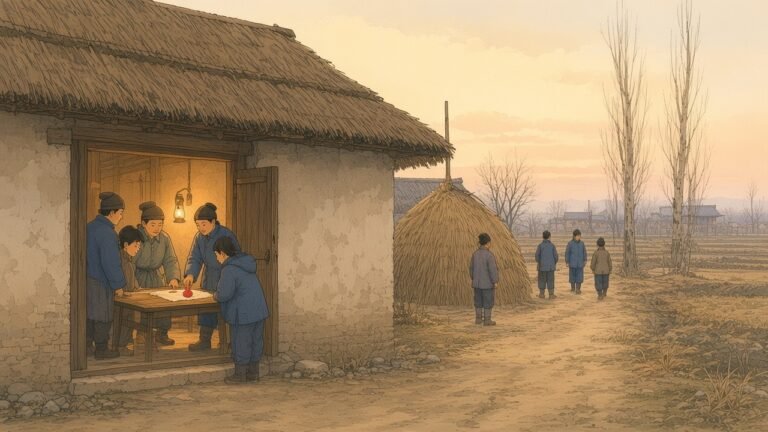
The People’s Republic absorbed that lesson twice over. In the 1950s it built its first heavy industry with Soviet loans, blueprints and engineers. Then, after the ideological split with Moscow, the Soviet Union sent a note on 16 July 1960 recalling all its specialists. By 1 September all 1,390 had gone, taking design documents with them and halting supplies of equipment and key components, according to an account in the Party journal Hongqi Wengao. Many half-built projects were left stranded. The slogan that followed, zili gengsheng, or “self-reliance”, became official doctrine. Under Mao it meant building nuclear weapons, rockets and whole industrial bases with little foreign help, often at enormous cost in efficiency and human welfare.
That episode still shapes official thinking. Dependence on a foreign supplier is seen as a vulnerability that a rival can exploit at the worst moment, and American export controls on chips since 2018 have confirmed that view in Beijing rather than weakened it.
Opening up without letting go
After 1978 Deng Xiaoping reversed the Maoist hostility to trade, but not the underlying goal. China opened special economic zones, the most famous of which grew into the city described in our post on how Shenzhen was built from border villages. Foreign firms were invited in to assemble goods for export, bringing machinery, management and access to Western markets. The idea was to learn from foreign capital, not to depend on it for ever.
The decisive step came when China joined the World Trade Organization on 11 December 2001. In that year, by the WTO’s own statistics, China exported $266 billion of goods, 4.3 per cent of the world total, and ranked sixth. By the mid-2020s the WTO put China’s share of world exports at 14.4 per cent on average over the previous three years, with merchandise exports of $3.77 trillion in 2025.
Labour made this possible. Hundreds of millions of people left farms for factory towns. China’s National Bureau of Statistics counted 301 million rural migrant workers in 2025, of whom 28.2 per cent worked in manufacturing, roughly 85 million people. Wages have risen steeply and some low-margin assembly has moved to Vietnam and elsewhere, but the depth of the workforce, from line workers to engineers, remains a structural advantage.
The machinery of a manufacturing state
Cheap labour alone does not explain why China makes nearly everything. Plenty of countries have had cheap labour. What China added was a political and financial system that consistently tilted resources towards factories.
The first part of that system is local government. Provinces, cities and counties have long competed for investment, because officials were judged on growth. They offered tax breaks, fast approvals, ready-made industrial parks and, above all, cheap land. An International Monetary Fund working paper from August 2025 used 1.6 million government land sales to estimate that land sold to manufacturers went for at least two-thirds less than land sold for other uses nearby. The same paper estimated that China’s main industrial policy tools, from cash subsidies to discounted land, cost the equivalent of 4.4 per cent of GDP in 2023. An earlier study by the Center for Strategic and International Studies put industrial policy spending at no less than 1.73 per cent of GDP in 2019, compared with 0.67 per cent in South Korea and 0.39 per cent in the United States. The estimates cover different years and methods, but both put China far above other large economies.
The second part is finance. State-owned banks dominate lending, and household savings have been channelled into investment rather than consumption. The IMF found that manufacturers paid effective interest rates about 0.4 percentage points lower than firms in other sectors. Year after year, the result is a capital stock geared to production.
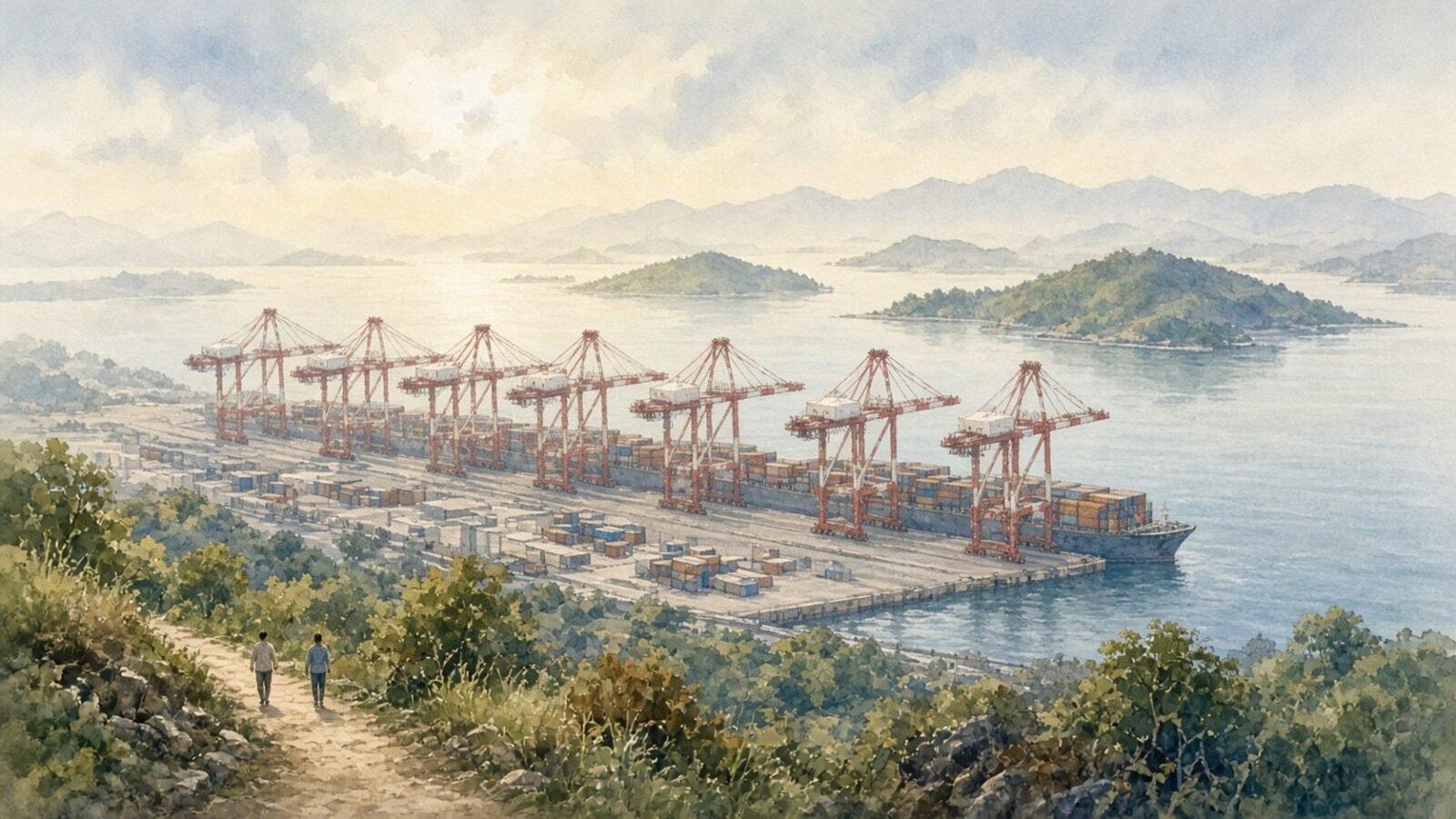
The third part is infrastructure, built ahead of demand and sometimes far ahead of it. Ningbo-Zhoushan, south of Shanghai, handled more than 1.4 billion tonnes of cargo in 2025, the most of any port in the world for the 17th year running, according to Xinhua, with more than 300 container routes reaching more than 700 ports. Our post on why China tops the container port rankings looks at that story in more detail.
The fourth part, perhaps the most underrated, is clustering. When thousands of suppliers sit within a few hours’ drive of one another, a manufacturer can source a new component in days rather than months. The small-commodity market at Yiwu alone has nearly 80,000 booths offering more than 2.1 million types of goods, and the city’s foreign trade reached a record ¥836.5 billion, about $119 billion, in 2025, according to Xinhua. Clusters like these reinforce themselves: once the suppliers are there, the next factory has every reason to locate nearby.
Xi Jinping and the fear of a “virtual” economy
Under Xi Jinping, the old instinct for self-reliance has been restated in economic terms. The key phrase is the “real economy” (shiti jingji), meaning the production of physical goods, as opposed to the “virtual economy” (xuni jingji) of finance and speculation.
Xi’s clearest statement on this came in a speech to the Central Economic Work Conference on 16 December 2016, excerpts of which appeared in a Qiushi compilation published in May 2026. “We cannot copy the approach of some countries that go in heavily for the virtual economy,” he said, “and the virtual economy itself carries great hidden dangers.” With more than 1.3 billion people, he argued, China could not meet the daily needs of its population or the material and technical needs of its development without the real economy: “Which country in the world has the capacity to supply us?” He went on to warn that the real economy, “which bears on national security, the people’s livelihood and international competitiveness”, must on no account be allowed to become hollow or shrink. Two years later, at the same conference in December 2018, he described manufacturing as “the foundation on which the country is built” and warned that although China was still industrialising, manufacturing’s share of the economy had already fallen too fast.
At the air-conditioner maker Gree in Zhuhai in October 2018 he said that “in going from a big country to a strong country, developing the real economy is crucial, and at no time can we move away from the real towards the virtual”, adding that core technologies had to be won through self-reliance. In a 2020 speech to the Party’s top economic committee, published later that year in Qiushi, he went further: “the various manufacturing industries cannot be abandoned”, and as a country of 1.4 billion people, China’s food and real economy “must be based on ourselves”, in the translation by Georgetown University’s Center for Security and Emerging Technology. The official English version renders it as China needing to be “basically self-sufficient in food production and industrial development”. In 2023 the same committee warned again that “a shift of focus from the real economy to the virtual economy must be avoided”, as People’s Daily reported.
It is often said that Xi named Britain as the virtual economy to avoid. In the published texts found for this post, he did not. The 2016 speech refers only to “some countries”. The explicit comparison with Britain has been made by Chinese state media. In July 2025 Liaowang, a weekly published by the state news agency Xinhua, ran a long article on “deindustrialisation” that held up the United States and Britain as cases where domestic industry had turned “from the real to the virtual”, borrowing Xi’s own phrase, and become hollowed out. It cited British Steel’s announcement in March 2025 that it would shut Scunthorpe’s last two blast furnaces, put British manufacturing at 8.28 per cent of GDP in 2023, and quoted a Chinese academic arguing that China’s independent path meant it “must keep all industrial categories”. Reading Xi’s “some countries” as including Britain is a reasonable inference, but it is not his wording.
Policy followed the rhetoric. Made in China 2025, issued by the State Council in May 2015, opened by calling manufacturing “the main body of the national economy”. It described China’s complete industrial system as “big but not strong”, heavily dependent on foreign core technologies. It set a target for 70 per cent of core basic components and key materials to be supplied domestically by 2025 and named ten priority sectors, from chips and robotics to aircraft, ships and electric vehicles. In May 2020 the Politburo Standing Committee called for a “dual circulation” development pattern, in which domestic and international markets reinforce each other, with the home market as the anchor. In the same 2020 speech Xi set the goal that important products and supply channels should each have “at least one alternative source”, forming an industrial backup system.
The pandemic showed what this depth could do. Xi said in that speech that China’s daily output of face masks rose from about 10 million at the end of January 2020 to 500 million. Few other countries still had the machines, materials and suppliers to do the same.
How Britain took a different road
Britain, the first industrial nation, started from the opposite position. As late as 1960 manufacturing made up 32.1 per cent of its GDP, according to official figures given to Parliament in 1984. By 1979 the share was 24.6 per cent, and by 1983 it was 20.7 per cent. The World Bank’s series, compiled on a different basis, put it at 16.6 per cent in 1990, 13.3 per cent in 2000 and 7.7 per cent in 2025, among the lowest of any major economy. The Office for National Statistics counts 6.7 million manufacturing workforce jobs in mid-1979, 4.0 million in 2000 and about 2.46 million in 2026.
Part of this decline happened everywhere. As countries grow richer, manufacturing productivity rises faster than in services, manufactured goods get cheaper, and people spend more on health, education and leisure. Manufacturing’s share falls even when factories produce more. Every rich country has seen some version of this.
But Britain’s fall was sharper and earlier than most, and policy played a large part. In the early 1980s, high interest rates and a strong pound, boosted by North Sea oil, made British exports expensive just as Margaret Thatcher’s government withdrew support from loss-making state industries. The ONS figures show about 1.6 million manufacturing jobs disappearing between mid-1979 and the mid-1980s. Supporters argue that much of what closed was uncompetitive and could only have survived on continuing subsidy; critics argue that capacity was destroyed that a more patient approach could have saved. Both views have evidence behind them.
At the same time, Britain doubled down on something it was already very good at. The “Big Bang” of 27 October 1986 ended fixed commissions on the London Stock Exchange, allowed firms to act as both brokers and dealers, and opened the market to foreign firms, strengthening London’s position as a global financial centre. Today the government says financial services account for about 9 per cent of UK economic output and 1.2 million jobs, and the wider services economy made up about 72.5 per cent of GDP in 2024, according to World Bank data.
The intellectual case for this goes back to a British economist. David Ricardo’s Principles of Political Economy and Taxation, published in 1817, set out the idea of comparative advantage: countries gain by specialising in what they do relatively best and trading for the rest, even if they could make everything themselves. In Ricardo’s famous example, England made cloth and Portugal made wine. Modern Britain’s equivalent is to sell banking, insurance, law, universities and software, and to buy televisions and trainers. For four decades that looked like a sensible bargain: consumers got cheaper goods, and many workers moved into better-paid services.
Why making things in Britain got harder
Comparative advantage, though, is not fixed by nature. It is shaped by costs and choices, and several British costs have moved the wrong way for industry.
Energy is the most obvious. The government’s own figures show that in 2024 Britain had the highest industrial electricity prices, including taxes, of the 25 countries reporting to the International Energy Agency. For energy-intensive industries such as steel, chemicals, glass, ceramics and paper, that alone can decide whether a plant survives.
Investment is the second. The ONS reports that whole-economy investment was 18.9 per cent of GDP in 2025, the lowest in the G7. Economists argue about the reasons, from planning delays and policy uncertainty to a shareholder culture said to reward quick returns over long-term projects. Prime Minister Keir Starmer, launching the government’s Industrial Strategy in June 2025, promised “a clear break from the short-termism and sticking plasters of the past”, an unusually frank admission.
Steel shows how these pressures combine. At Port Talbot in south Wales, Tata Steel shut the last blast furnace on 30 September 2024, ending the production of steel from iron ore in Wales. Tata said its blast furnaces had been losing £1 million a day, and about 2,800 jobs were cut. The site is being converted to an electric arc furnace, which recycles scrap, with £500 million of government support towards a £1.25 billion project, and in the meantime relies on imported steel slab. As one academic told the BBC, “You are removing the capacity of the UK to be able to produce its own primary steel.”
That left Scunthorpe, owned by China’s Jingye, as the last British site able to make steel from iron ore. When Jingye moved to close its furnaces, Parliament was recalled on a Saturday in April 2025 to pass emergency legislation allowing the government to take control of the plant. In July 2026 British Steel was brought into public ownership under the Steel Industry (Nationalisation) Act. Meanwhile China made 960.8 million tonnes of crude steel in 2025, about 52 per cent of the world total, according to the World Steel Association. Britain did not make the top 40. China’s side is told in our post on Baowu and the making of China’s steel industry.
Cars tell a similar story. British vehicle production fell to 764,715 in 2025, the lowest since 1952, according to industry figures reported by the BBC. Car output was 717,371, against about 1.7 million in 2016, after a cyberattack on Jaguar Land Rover, the closure of Vauxhall’s Luton plant and new US tariffs. The industry’s trade body said meeting government targets would probably need a new manufacturer, most likely Chinese.
When the supply chains snapped
The pandemic made the risks concrete. The National Audit Office found that in early 2020 the global supply of personal protective equipment fell because of a drop in exports from China, “the country that manufactures the most PPE”, while some other countries restricted exports. The result was a sellers’ market with “desperate customers competing against each other”. Between February and July 2020 the Department of Health and Social Care spent £12.5 billion on 32 billion items, with unit prices up by between 166 per cent for respirator masks and 1,310 per cent for body bags.
Medicines are another pressure point. Many of the active ingredients behind generic drugs sold in Britain and Europe now come from China or from Indian firms that depend on Chinese chemical inputs, a story explored in our post on the pharmacy behind the pharmacy. The same is true, to varying degrees, for solar panels, batteries and rare-earth magnets.
Long supply chains are efficient in normal times and fragile in abnormal ones. The question is how much a country will pay to keep spare capacity at home.
Britain’s second thoughts
Britain has since edged back towards industrial policy. The Industrial Strategy published in June 2025 picked eight priority sectors, including advanced manufacturing, clean energy industries, defence and life sciences alongside financial and professional services. It admitted that “British manufacturers currently pay some of the highest electricity prices in the developed world” and promised to cut electricity costs by up to 25 per cent from 2027 for more than 7,000 firms. It set an ambition to make 1.35 million vehicles a year by 2035. A Steel Strategy in March 2026 committed up to £2.5 billion and set an aim for up to half the steel used in Britain to be made in Britain, alongside sharp cuts to tariff-free import quotas.
These are significant shifts by British standards but modest by Chinese ones. Britain’s aim is selective resilience, not completeness.
Why almost no one else does it all
Other rich countries still manufacture heavily but stop short of trying to make everything.
Germany’s manufacturing sector was still 17.6 per cent of GDP in 2025, and Japan’s 18.8 per cent in 2024, according to the World Bank. South Korea’s was 27.4 per cent in 2025, higher than China’s 24.7 per cent. These countries specialise in machinery, cars, chemicals, chips and precision components, but they import huge amounts of basic goods and rely on China for many intermediate inputs.
The United States, where manufacturing fell to about 10.5 per cent of GDP in 2021 on the World Bank’s latest figures, is attempting the most aggressive reversal. The CHIPS and Science Act of 2022 provided $39 billion in incentives for semiconductor factories and $11 billion for research, and tariffs have been used repeatedly since 2018, and on a much larger scale since 2025, to push production back onshore. Whether tariffs rebuild industrial depth or simply raise prices is fiercely disputed.
The main reason no one else does it all is that it is extremely expensive. Making everything requires a home market big enough to support efficient plants in hundreds of industries at once, a workforce large enough to staff them, a state willing to direct savings into factories for decades, and a political system that tolerates losses and overcapacity in the name of security. India has the population but not yet the infrastructure or industrial base. The European Union has the market but not a single state to direct it. The United States has both but higher costs and frequent changes of political direction.
Scale also creates momentum. Because China already has suppliers for almost everything, making one more product there is cheaper than anywhere else, and every foreign buyer strengthens the clusters that make the next buyer’s choice easier. The advantage compounds.
The costs of each choice
None of this means China has found a free lunch or that Britain made a simple mistake. Each model carries costs.
China’s approach has produced extraordinary industrial capability, but it has also produced waste. The IMF paper estimated that misallocation caused by industrial policy lowers China’s total factor productivity, a measure of how efficiently labour and capital are used, by about 1.2 per cent, and could reduce GDP by up to 2 per cent. Subsidised industries tend to build more capacity than the market can absorb, pushing prices down and exports out, as described in our post on how China came to export its excess capacity. That has brought trade disputes with the United States, the European Union and, increasingly, developing countries. Household consumption remains low by international standards.
Britain’s approach, meanwhile, has delivered real benefits. Cheaper imported goods have raised living standards, and services exports have become a major national strength. Many economists argue that recreating lost industries would cost more than it is worth, and that resilience is better achieved through diverse suppliers, stockpiles and alliances. But the costs are visible too: regions that never fully recovered, dependence on imports for essentials in a crisis, and a shrinking ability to build what security might require.
The two countries are, in a sense, converging from opposite ends. China is trying to make better rather than simply more, and to rely less on foreign chips. Britain is trying to rebuild a few strategic industries and lower its energy costs. Neither will match its caricature: China will keep importing oil, ore and grain, and Britain will keep buying most of its manufactured goods abroad.
The deeper difference is in outlook. Britain’s model assumes that markets will stay open and that whatever it needs can always be bought. China’s model assumes that one day they may not. Xi’s question from 2016, “Which country in the world has the capacity to supply us?”, was asked about China. More British policymakers now ask it about Britain.
References
- Manufacturing, value added (% of GDP), World Bank World Development Indicators, data updated 13 July 2026
- Manufacturing, value added (current US$), World Bank World Development Indicators, data updated 13 July 2026
- Services, value added (% of GDP), World Bank World Development Indicators, data updated 13 July 2026
- World Manufacturing Production: Statistics for Quarter III 2025, UNIDO, 2025
- China is the world’s sole manufacturing superpower: A line sketch of the rise, Richard Baldwin, CEPR VoxEU, 17 January 2024
- 我国是全世界唯一拥有全部工业门类的国家, Xinhua, 20 September 2019
- China’s Major Imports by Quantity and Value, Dec 2025 (in USD), General Administration of Customs of China, 8 January 2026
- China announces record trade surplus despite Trump tariffs, BBC News, 14 January 2026
- 历史回顾:那些年,苏联确实“逼了债”, Shi Yun, Hongqi Wengao via People’s Daily, 28 June 2013
- China and the WTO, World Trade Organization, accessed 4 October 2026
- International Trade Statistics 2002: World trade in 2001, overview, World Trade Organization, 2002
- Global Trade Outlook and Statistics, World Trade Organization, March 2026
- 2025年农民工监测调查报告, National Bureau of Statistics of China, 30 April 2026
- Industrial Policy in China: Quantification and Impact on Misallocation, Daniel Garcia-Macia, Siddharth Kothari and Yifan Tao, IMF Working Paper WP/25/155, August 2025
- Red Ink: Estimating Chinese Industrial Policy Spending in Comparative Perspective, Gerard DiPippo, Ilaria Mazzocco and Scott Kennedy, CSIS, 23 May 2022
- Ningbo-Zhoushan Port sees cargo throughput surpassing 1.4 billion tonnes in 2025, Xinhua, 8 January 2026
- China’s Yiwu witnesses record-high foreign trade in 2025, Xinhua, 17 January 2026
- 习近平:做强做优做大实体经济, Qiushi via the Central People’s Government of China, 15 May 2026
- 习近平强调自主创新:要有骨气和志气,加快增强自主创新能力和实力, Xinhua via the Central People’s Government of China, 23 October 2018
- 国家中长期经济社会发展战略若干重大问题, Xi Jinping, Qiushi, 31 October 2020
- Xi Jinping: Certain Major Issues for Our National Medium- to Long-Term Economic and Social Development Strategy, translation, Center for Security and Emerging Technology, Georgetown University, 2020
- Major Issues Concerning China’s Strategies for Mid-to-Long-Term Economic and Social Development, Xi Jinping, Qiushi English edition, 14 January 2021
- Xi: Accelerate upgrading of industries, Mo Jingxi, China Daily via People’s Daily Online, 6 May 2023
- 各国应对“去工业化”兴衰启示, Liaowang, Xinhua, 14 July 2025
- 国务院关于印发《中国制造2025》的通知, State Council of China, 8 May 2015
- 中共中央政治局常务委员会召开会议 习近平主持, Xinhua, 14 May 2020
- Manufacturing Industry, written answers, Hansard, House of Commons, 29 November 1984
- Workforce jobs by industry (SIC 2007): C Manufacturing (JWR7), Office for National Statistics, accessed 4 October 2026
- “Big Bang” Deregulation Bolsters London’s Position as Global Finance Center, Goldman Sachs, accessed 4 October 2026
- Financial Services Growth and Competitiveness Strategy, HM Treasury, July 2025
- On the Principles of Political Economy and Taxation, David Ricardo, 1817, Library of Economics and Liberty
- Quarterly Energy Prices: September 2025, Department for Energy Security and Net Zero, September 2025
- Business investment in the UK: October to December 2025, revised results, Office for National Statistics, 2026
- Powering Britain’s future: electricity bills to be slashed for over 7,000 businesses in major industry shake-up, GOV.UK, 23 June 2025
- Traditional steelmaking ends as Tata’s Port Talbot blast furnace closes, BBC News, 30 September 2024
- Government acts to save British Steel production, GOV.UK, 12 April 2025
- Government brings British Steel into public ownership to protect UK steelmaking, British Steel, 16 July 2026
- December 2025 crude steel production and 2025 global crude steel production totals, World Steel Association, 23 January 2026
- Vehicle production in the UK falls to 73-year low, BBC News, 29 January 2026
- The supply of personal protective equipment (PPE) during the COVID-19 pandemic, National Audit Office, 25 November 2020
- CHIPS for America, National Institute of Standards and Technology, accessed 4 October 2026