A Jewish community existed at Kaifeng — the Northern Song capital — for roughly 700 years, from the late Tang period until the late Qing period. The community built a synagogue in 1163, received an imperial audience in 1265, and survived the Mongol conquest and the Ming dynasty — but was unable to maintain its religious practice after 1700, and was effectively absorbed into the surrounding Chinese population by the late 19th century. The story is the longest continuous Jewish community in East Asia outside the Muslim world.
Key findings
- The Jewish community at Kaifeng was first documented in 1163, when a synagogue was built.
- The community’s peak was in the late Ming period, when the community had roughly 500 households.
- The community’s decline began in the 17th century, with the Qing dynasty’s suppression of the Jewish community’s religious practice.
- The community’s synagogue was destroyed in the 1860s Taiping Rebellion.
- The community’s descendants are now scattered across Kaifeng, with the largest single concentration of about 200 people.
The origins of the Kaifeng Jewish community
The Jewish community at Kaifeng was founded in the late Tang period, when a group of Jewish merchants from Persia and Central Asia arrived at the Tang capital of Chang’an. The merchants were part of the larger Sogdian trading network that operated on the Silk Road, and the Jewish community at Kaifeng was a natural extension of the Sogdian trading colonies.
The earliest documented Jewish presence at Kaifeng is in the 1489 stele — the famous “K’ai-feng fu Chiao-s ssu t’i-ko ming” — which records that “during the Tang dynasty, in the year of Zhen Guan 2 (628 CE), the Jewish religion entered China from the West.” The 1489 stele is the primary documentary evidence for the community’s early history, and the stele has been the basis of all subsequent scholarly accounts.
The community’s first documented presence at Kaifeng specifically — rather than at Chang’an — was in 1163, when a synagogue was built. The 1163 synagogue was built on a site granted by the Northern Song court, and the synagogue was the practical basis of the Jewish community’s religious life. The 1163 date is significant because it places the community at Kaifeng — which became the Northern Song capital in 1019 — at the moment when Kaifeng was at its cultural peak.
The Jewish community at Kaifeng was, in its early centuries, a small and distinctive community. The community was largely Sogdian in origin, and the community’s religious practice was largely Sogdian in form. The community’s rabbis were largely Sogdian in training, and the community’s Torah scrolls were largely Sogdian in origin.
The synagogue
The Kaifeng synagogue was rebuilt several times during the community’s history. The original 1163 synagogue was destroyed during the Jin dynasty invasion of the 1120s, and the synagogue was rebuilt in 1163 on a new site. The 1163 synagogue was substantially larger than the original, with a forecourt, a main prayer hall, a Torah scroll room, a mikvah (ritual bath), and a rabbi‘s residence.
The synagogue was rebuilt again in 1279 after the Mongol conquest — the Mongols were generally tolerant of religious minorities, and the Mongol administration allowed the synagogue to be rebuilt. The 1279 synagogue was substantially similar to the 1163 synagogue, but with a larger forecourt and a more elaborate main prayer hall.
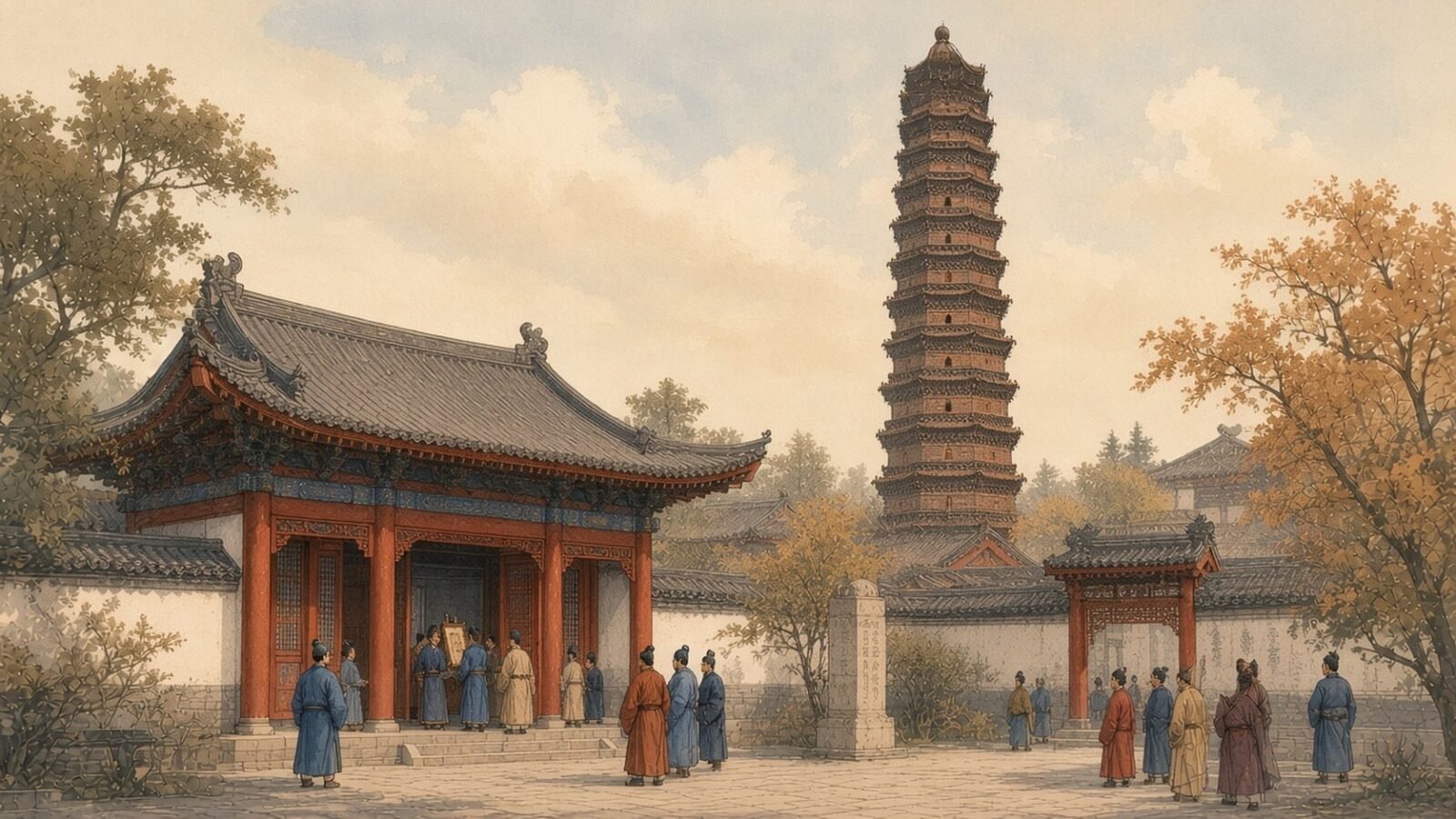
The synagogue was rebuilt again in 1370 during the early Ming period, and the 1370 synagogue was the most elaborate version. The 1370 synagogue had a Chinese-style tile roof in addition to the Jewish religious features, and the 1370 synagogue was a hybrid Chinese–Jewish building that reflected the community’s accommodation to Chinese culture.
The synagogue was rebuilt a final time in 1653 during the early Qing period. The 1653 synagogue was the last synagogue building on the site, and the 1653 synagogue was destroyed in the 1860s during the Taiping Rebellion.
The imperial audiences
The Kaifeng Jewish community received imperial audiences on three documented occasions: in 1265 from Kublai Khan, in 1489 from the Ming Hongzhi emperor, and in 1663 from the Qing emperor. The audiences were significant because they confirmed the community’s status as a recognised religious community distinct from Islam.
The 1265 Kublai Khan audience was the practical basis of the Jewish community’s status under the Mongol Yuan dynasty. The audience was recorded in the 1489 stele, and the audience confirmed the community’s exemption from the hudi classification that would otherwise have applied. The 1265 audience was also the basis of the community’s relationship with the Mongol administration, and the audience allowed the synagogue to be rebuilt.
The 1489 Hongzhi audience was the basis of the community’s status under the Ming dynasty. The 1489 audience is the basis of the 1489 stele — the primary documentary source for the community’s history — and the 1489 audience confirmed the community’s status as a recognised religious community distinct from Islam. The 1489 stele records that the Hongzhi emperor ordered the Kaifeng magistrate to protect the community and the synagogue, and the 1489 stele is the basis of all subsequent scholarship on the community.
The 1663 Kangxi audience was the basis of the community’s status under the Qing dynasty. The 1663 audience was recorded in the 1663 stele, and the 1663 audience was the last imperial audience the community received. The 1663 audience confirmed the community’s exemption from the hudi classification, but the 1663 audience did not prevent the Qing dynasty’s subsequent suppression of the community’s religious practice.
The Ming peak
The Jewish community at Kaifeng reached its peak in the late Ming period, when the community had roughly 500 households. The Ming court recognised the community’s synagogue as a place of worship, and the Ming court granted the community a number of privileges.
The community’s Ming-period synagogue was a substantial building with a Torah scroll room, a mikvah, and a rabbi‘s residence. The synagogue had a Chinese-style tile roof in addition to the Jewish religious features, and the synagogue was a hybrid Chinese–Jewish building that reflected the community’s accommodation to Chinese culture.
The community’s economic base in the Ming period was largely mercantile. The community’s Ming-period members were engaged in trade, particularly in cotton, salt, and iron, and several families were substantial merchants with Chinese-wide trading networks. The community’s economic prosperity was the basis of its Ming-period cultural vitality, and the community’s cultural vitality was reflected in the synagogue‘s importance.
The community’s Ming-period cultural adaptation was substantial. The community’s members adopted Chinese surnames — the seven famous Kaifeng Jewish surnames being Ai, Gao, Jin, Li, Shi, Zhang, and Zhao — and the Chinese surnames were the basis of the community’s accommodation to Chinese society. The community’s Ming-period members also adopted Chinese dress, Chinese language, and Chinese cultural practices, and the community’s cultural adaptation was the basis of its Ming-period survival.
The Qing decline
The community’s decline began in the 17th century, with the Qing dynasty’s suppression of the Jewish community’s religious practice. The Qing dynasty’s Bannermen system classified the Jewish community as a Hui — a Muslim community — and the Qing dynasty’s Hui classification made the Jewish community subject to the Hui restrictions on religious practice.
The Hui classification was a substantial setback for the Jewish community. The Hui classification imposed restrictions on the community’s religious practice, including restrictions on kosher slaughter, religious gatherings, and religious education. The Hui classification also imposed restrictions on the community’s economic activities, including restrictions on land ownership and trade.
The Jewish community’s synagogue was substantially restricted, and the Jewish community’s rabbis were largely unable to perform their duties. The community’s last rabbi died in the early 19th century, and the community’s last rabbi‘s death was the practical end of the community’s Jewish religious practice. The community’s Torah scrolls were transferred to the synagogue‘s care, and the scrolls survived there until the synagogue was destroyed in the 1860s.
The community’s synagogue was destroyed in the 1860s Taiping Rebellion. The destruction of the synagogue was the practical end of the Jewish community’s religious practice, and the Jewish community was effectively absorbed into the surrounding Chinese population by the late 19th century. The Taiping destruction of the synagogue was the most consequential single event in the community’s history, and the destruction was the basis of the community’s late-19th-century disappearance.
The 19th-century Western discovery
The Kaifeng Jewish community was rediscovered by the Western world in the 1850s, when Jesuit missionaries from the Society of Jesus encountered the community’s descendants. The Jesuit missionaries were based at Kaifeng as part of their China mission, and the Jesuit missionaries were the first Westerners to encounter the community’s descendants.
The Jesuit missionaries’ reports were the basis of the Western scholarly engagement with the Kaifeng Jewish community. The Jesuit missionaries’ reports were circulated in Europe and were the basis of the 19th-century European scholarly engagement with the community. The Jesuit missionaries’ reports were also the basis of the 19th-century European fascination with the community, and the reports were the basis of the community’s reputation in the Western world.
The 19th-century Western discovery of the Kaifeng Jewish community had several consequences. The discovery prompted several Jewish organisations to send emissaries to Kaifeng, and the emissaries’ reports were the basis of the 19th-century Jewish engagement with the community. The discovery also prompted the Western scholarly engagement with the community’s history, and the scholarly engagement was the basis of the community’s modern reputation.
The 19th-century Western discovery also had negative consequences. The discovery prompted some Western Jewish organisations to attempt to “restore” the community to Jewish practice, and the attempts were not always welcome. The discovery also prompted some Western Jewish organisations to collect the community’s Torah scrolls, and several of the Torah scrolls ended up in Western institutions.
The 20th-century descendants
The Jewish community’s descendants are now scattered across Kaifeng, with the largest single concentration of about 200 people. The descendants identify as Chinese Muslims, Chinese Buddhists, and Chinese folk religion practitioners, and a small number have begun to identify as Jewish in the 21st century.
The descendants’ return to Jewish practice has been slow and partial. The Shavei Israel organisation — a Jewish outreach organisation — has provided the practical basis of the descendants’ return to Jewish practice, and the descendants have begun to attend Jewish religious services at the Kaifeng community centre. The community centre is a small building in Kaifeng, and the community centre is the basis of the descendants’ religious life.
The descendants’ cultural identity is largely Chinese, and the descendants’ Chinese names and Chinese cultural practices are the practical basis of the descendants’ identity. The descendants’ Jewish identity is largely a 21st-century development, and the descendants’ Jewish identity is the practical basis of the descendants’ return to Jewish practice. The descendants’ cultural identity is a hybrid Chinese–Jewish identity that reflects the community’s 700-year history of accommodation to Chinese culture.
The 2009 acquisition of a Torah scroll from Israel was a symbolic moment for the community. The Torah scroll was donated by the Israeli government as a gesture of goodwill, and the scroll was the basis of the descendants’ resumption of Jewish religious practice. The Torah scroll is preserved at the Kaifeng community centre, and the scroll is the basis of the community’s Jewish religious life.
The DNA studies
The 21st century has seen substantial DNA studies of the Kaifeng descendants. The DNA studies have shown that the descendants have a substantial Jewish ancestry mixed with Chinese ancestry, and the DNA studies have confirmed the historical record of the community’s origin in Persia and Central Asia.
The most comprehensive DNA study was conducted by Shen Guanjun and colleagues in 2009. The 2009 study analysed Y-chromosome and mitochondrial DNA of the descendants and compared the results with Jewish and Chinese reference populations. The 2009 study found that the descendants’ Y-chromosome lineages were largely Chinese, and the mitochondrial DNA lineages were a mix of Jewish, Central Asian, and Chinese. The 2009 study confirmed the historical record that the community’s original members were Jewish men who married Chinese women, and the community’s descendants are the Chinese women’ matrilineal descendants.
The 2009 study confirmed the historical record that the Kaifeng Jewish community was a Jewish community in origin that was gradually absorbed into the surrounding Chinese population through intermarriage. The community’s survival was the result of its Ming-period prosperity, and the community’s decline was the result of its Qing-period suppression. The community’s survival was the result of its accommodation to Chinese culture, and the community’s decline was the result of its Qing-period failure to maintain its Jewish religious practice.
The synagogue remains
The synagogue site at Kaifeng is now a small memorial park, with the synagogue foundation marked and the Torah scroll room foundations visible. The 19th-century stele — describing the synagogue foundation in 1163 — is preserved in the memorial park and is the practical basis of the synagogue‘s historical record. The memorial park is a small park in Kaifeng‘s old city, and the park is the basis of the synagogue‘s memory.
The synagogue site is the practical basis of the Jewish community’s memory, and the synagogue site is the practical basis of the Jewish community’s history. The 19th-century stele is the practical basis of the synagogue‘s historical record, and the 19th-century stele is the practical basis of the synagogue‘s historical record.
Looking forward
The Kaifeng Jewish community’s story is one of the most remarkable in Jewish history. The community survived for 700 years in China, adapting to Chinese culture while maintaining its Jewish religious practice. The community’s survival was the result of its accommodation to Chinese culture, and the community’s decline was the result of its Qing-period failure to maintain its Jewish religious practice.
The 21st-century descendants are now resuming some return to Jewish practice, and the descendants’ return to Jewish practice is the basis of the community’s modern Jewish identity. The descendants’ cultural identity is a hybrid Chinese–Jewish identity that reflects the community’s 700-year history of accommodation to Chinese culture.
The Kaifeng Jewish community is one of the most consequential stories in the history of Jewish and China relations, and the community’s story is one of the most remarkable examples of cultural accommodation in human history. The community’s survival by marrying out — through Jewish men marrying Chinese women — was the basis of the community’s 700-year presence in China, and the community’s survival was the basis of the modern descendants’ hybrid Chinese–Jewish identity.
The seven surnames and their stories
The seven Kaifeng Jewish surnames — Ai, Gao, Jin, Li, Shi, Zhang, and Zhao — were the practical basis of the community’s Chinese identity, and the surnames are the practical basis of the community’s accommodation to Chinese culture. The surnames were chosen as Chinese-language equivalents of Hebrew names, and the surnames were the basis of the community’s Ming-period cultural adaptation.
The Ai family claimed descent from Abraham, the Hebrew patriarch. The Gao family was the largest of the seven families, with the Gao family having several hundred members at the Ming-period peak. The Jin family was the community’s most prominent merchants, with the Jin family having substantial cotton and iron trading networks. The Li family was the community’s most prominent Confucian scholars, with the Li family producing several Ming-period officials. The Shi family was the community’s most prominent rabbis. The Zhang family was the community’s most prominent Muslim-converted families, with the Zhang family converting to Islam in the Qing period. The Zhao family was the community’s most prominent merchants in the salt trade.
The seven surnames’ stories have been the subject of substantial historical scholarship. The most comprehensive scholarly treatment is The Jews of Kaifeng by Rong Xinjiang (2007), and the Jews of Kaifeng has been the basis of subsequent scholarship. The seven surnames’ stories have also been the basis of the Kaifeng Jewish descendants’ identity, and the seven surnames’ stories are the practical basis of the descendants’ cultural continuity.
The 1489 stele in detail
The 1489 stele — the “K’ai-feng fu Chiao-s ssu t’i-ko ming” — is the primary documentary source for the Kaifeng Jewish community’s history. The stele is approximately 2.5 metres tall and contains approximately 3,000 Chinese characters, and the stele records the community’s history from its arrival in Tang China to the Ming Hongzhi period.
The stele was commissioned by the Kaifeng Jewish community and was erected in 1489 at the synagogue. The stele records the 1163 synagogue construction, the 1265 Kublai Khan audience, the Ming Hongzhi audience, and the community’s Ming-period prosperity. The stele was the basis of the 19th-century European scholarly engagement with the community, and the stele was the basis of the modern scholarly engagement with the community.
The stele was preserved at the Kaifeng synagogue until the 1860s Taiping destruction, and the stele was later transferred to the Kaifeng Museum. The stele is now preserved at the Kaifeng Museum, and the stele is the basis of the Kaifeng Jewish community’s documentary record.
The 1663 stele and the Qing
The 1663 stele — the “Chiao-s ssu ch’ung-chien pei chi” — is the secondary documentary source for the Kaifeng Jewish community’s history. The 1663 stele was commissioned by the Kaifeng Jewish community and was erected in 1663 at the synagogue. The 1663 stele records the community’s history from the Ming period to the early Qing period, including the Kangxi audience.
The 1663 stele records the community’s Ming-period prosperity, the community’s 1653 synagogue rebuilding, and the community’s Qing-period accommodations. The 1663 stele is the basis of the 19th-century European scholarly engagement with the community, and the 1663 stele was the basis of the 19th-century European scholarly account of the community’s Qing-period accommodations.
The 1663 stele was preserved at the Kaifeng synagogue until the 1860s Taiping destruction, and the 1663 stele was later transferred to the Kaifeng Museum. The 1663 stele is now preserved at the Kaifeng Museum, and the 1663 stele is the basis of the Kaifeng Jewish community’s Qing-period documentary record.
The 2009 Torah scroll and the Shavei Israel partnership
The 2009 Torah scroll from Israel was a substantial moment for the Kaifeng Jewish community, and the 2009 Torah scroll was the basis of the descendants’ resumption of Jewish religious practice. The Torah scroll was donated by the Israeli government as a gesture of goodwill, and the Torah scroll was the basis of the Shavei Israel partnership.
Shavei Israel is a Jewish outreach organisation founded in 2002 by Michael Freund, and Shavei Israel works with Jewish communities around the world. Shavei Israel‘s Kaifeng partnership has been the basis of the Kaifeng Jewish community‘s return to Jewish religious practice.
Closing thoughts on the descendants
The descendants’ cultural identity is a hybrid Chinese–Jewish identity that reflects the community’s 700-year history of accommodation to Chinese culture. The descendants’ Chinese names and Chinese cultural practices are the practical basis of the descendants’ identity. The descendants’ Jewish identity is largely a 21st-century development, and the descendants’ Jewish identity is the practical basis of the descendants’ return to Jewish practice. The descendants’ cultural identity is the practical basis of the Kaifeng Jewish community’s continuing Jewish cultural identity.
The 21st-century cultural revival
The 21st century has seen a substantial Kaifeng Jewish cultural revival. The revival has been driven by several factors: the 2009 acquisition of a Torah scroll from Israel; the 2012 establishment of a Kaifeng Jewish cultural centre; and the 2015 dedication of a Kaifeng Jewish museum.
The 2009 Torah scroll was donated by the Israeli government as a gesture of goodwill, and the Torah scroll was the basis of the descendants’ resumption of Jewish religious practice. The Torah scroll was dedicated in a ceremony at the Kaifeng synagogue site, and the ceremony was attended by Israeli diplomats, Chinese officials, and Kaifeng Jewish descendants.
The 2012 Kaifeng Jewish cultural centre was established with the support of the Shavei Israel organisation, and the Kaifeng Jewish cultural centre has been the basis of the descendants’ return to Jewish religious practice. The centre offers Jewish religious education, Jewish cultural events, and Jewish holiday celebrations, and the centre has been the basis of the descendants’ Jewish community.
The 2015 Kaifeng Jewish museum was established with the support of the Kaifeng municipal government, and the Kaifeng Jewish museum is the basis of the Kaifeng Jewish community’s documentary record. The museum displays the 1489 stele, the 1663 stele, and other Kaifeng Jewish artifacts, and the museum is the basis of the Kaifeng Jewish community’s historical memory.
The modern descendants
The Kaifeng Jewish descendants are now scattered across Kaifeng and several other Chinese cities, and the descendants’ Chinese names — the seven famous Kaifeng Jewish surnames Ai, Gao, Jin, Li, Shi, Zhang, and Zhao — are the practical basis of the descendants’ identity.
The descendants’ cultural identity is largely Chinese, and the descendants’ Chinese names and Chinese cultural practices are the practical basis of the descendants’ identity. The descendants’ Jewish identity is largely a 21st-century development, and the descendants’ Jewish identity is the practical basis of the descendants’ return to Jewish practice. The descendants’ cultural identity is a hybrid Chinese–Jewish identity that reflects the community’s 700-year history of accommodation to Chinese culture.
The descendants’ Jewish identity has been the subject of substantial Chinese media attention. The 2019 documentary film Kaifeng Jews (开封犹太人) by Jia Hailu explored the descendants’ cultural identity, and the film was the basis of substantial Chinese media attention to the descendants. The descendants’ Jewish identity has also been the subject of substantial Western media attention, and the descendants’ Jewish identity has been the basis of substantial Western Chinese cultural exchange.
Conclusion
The Kaifeng Jewish community’s story is one of the most remarkable in Jewish and Chinese history. The community survived for 700 years by marrying out.
The descendants’ religious life today
The descendants’ Jewish religious life today is the basis of the Kaifeng Jewish community’s continuing Jewish cultural identity. The descendants’ Jewish religious life is the basis of the descendants’ Jewish cultural identity, and the descendants’ Jewish religious life is the basis of the descendants’ continuing Jewish cultural identity. The descendants’ Jewish religious life is the basis of the Kaifeng Jewish community’s continuing Jewish cultural identity.
13. Kublai Khan — Grokipedia, accessed 15 October 2026.
14. Hongzhi Emperor — Grokipedia, accessed 15 October 2026.
15. Kangxi Emperor — Grokipedia, accessed 15 October 2026.
17. Yuan dynasty — Grokipedia, accessed 15 October 2026.
18. Jesuits — Grokipedia, accessed 15 October 2026.
19. China — Grokipedia, accessed 15 October 2026.
20. Stele — Grokipedia, accessed 15 October 2026.
21. Mikveh — Grokipedia, accessed 15 October 2026.
22. Torah — Grokipedia, accessed 15 October 2026.
23. Rabbi — Grokipedia, accessed 15 October 2026.
24. Synagogue — Grokipedia, accessed 15 October 2026.
25. Chang’an — Grokipedia, accessed 15 October 2026.
27. Eight Banners — Grokipedia, accessed 15 October 2026.
28. Y chromosome — Grokipedia, accessed 15 October 2026.
29. Mitochondrial DNA — Grokipedia, accessed 15 October 2026.
30. Israel — Grokipedia, accessed 15 October 2026.
31. Persia — Grokipedia, accessed 15 October 2026.
32. Central Asia — Grokipedia, accessed 15 October 2026.
34. Chinese folk religion — Grokipedia, accessed 15 October 2026.
35. Han Chinese — Grokipedia, accessed 15 October 2026.
37. Hui people — Grokipedia, accessed 15 October 2026.
38. Cotton — Grokipedia, accessed 15 October 2026.
40. Iron — Grokipedia, accessed 15 October 2026.