Khubilai Khan, who would reign as emperor of a Chinese-style state from 1271 to 1294 and who would be remembered in European memory as the superlative monarch of the Mongol world, was born in 1215 at a Mongol camp on the edge of the Asian steppe, the grandson of Genghis Khan and the son of Tolui’s son. He was four years old when his grandfather died and the Mongol Empire was divided among Genghis’s sons and grandsons. He grew up among the Mongol cousins who were being trained in the running of the largest land empire the world had then seen: an empire that stretched, by the time he was twenty, from the borders of Korea and the Sea of Japan to the Hungarian plains and the Persian Gulf. He held a frontier command in the Mongol-controlled part of North China in his teens and twenties, managed his first provincial government of Hebei and Shandong in his late twenties, and became Great Khan, the supreme ruler of the unified Mongol Empire, only after his elder brother Mongke had been killed on campaign in Sichuan in 1259 and a brief succession war had played itself out in the Mongol strongholds of Central Asia. By the time he assumed the title, the Mongol world was already fragmenting into four regional khanates, and Khubilai’s branch of the family would rule only the eastern one, which by 1271 he was calling Dai On, the Great Yuan.
This split of the Mongol world, which would deepen rather than close over the rest of Khubilai’s reign, was the most consequential political fact of the late thirteenth century. The four regional khanates – the Yuan under Khubilai in East Asia, the Chagatai under the line of Chagatai in Central Asia, the Ilkhanate under the line of Hulagu in Persia, and the Golden Horde under the line of Jochi in Russia and the western steppe – came to differ more and more from each other in administration, religion, language, and political style. The Yuan would adopt a Chinese-style imperial administration, build a new capital at what is now Beijing, and gradually adopt the institutions, religion, and language of its Chinese subjects. The Ilkhanate would Islamify. The Chagatai khanate would remain essentially Mongol in language and custom. The Golden Horde would continue to rule its Russian subjects through local intermediaries for two and a half centuries after Khubilai’s death. Khubilai’s Yuan would also be the only Mongol state that controlled substantial Chinese territory, ruled a largely sedentary Chinese population, and attempted to combine the Mongol inheritance with the Chinese imperial inheritance into a single state.
The size of the achievement is difficult to convey in any short summary. By 1290 the Yuan state ruled something like eighty-five to ninety million people across the territories of the modern Chinese provinces and the Mongolian heartland, and the administrative and fiscal apparatus that the Mongols had constructed across these territories was the largest the world had ever seen under a single imperial dynasty. The Mongol state under Khubilai ran a postal road system that connected Beijing to the Hungarian plains by relay stations every twenty-five to thirty miles, with a permanent staff of mounted couriers, official accommodation for travelling officials, and a paper currency that could be honoured anywhere on the system. The state operated a paper-money economy that was more sophisticated than any earlier Chinese currency had been. The state ran a census that was, by the standards of the fourteenth century, exceptional. The state built a new imperial capital at Dadu (now Beijing), the planning of which is still legible in the surviving street grid of the modern city. The state attempted, in two campaigns that failed spectacularly, to add Japan and the principalities of Southeast Asia to the empire. The state ended in the middle of the fourteenth century with a series of droughts, floods, famines, and pestilences that the Mongol administration could not manage; the dynasty was replaced in 1368 by a Chinese rebel who took the dynastic name of Ming, meaning bright.
Khubilai’s own role in this story was distinct. He was not a conqueror on the Mongol scale. He did not win new territories on the battlefield the way his grandfather had. He inherited the largest part of the Mongol Empire and ruled it for a longer period than any of the other Great Khans, except his second successor Temur. He made the conversion to a Chinese-style imperial ideology in middle age, with the establishment of the Yuan dynasty in 1271 a self-conscious echo of the Chinese dynastic founding. He commissioned Marco Polo’s employer to come to China, opened the Mongol state to foreign merchants and missionaries on a scale that the Chinese dynasties had not done in modern times, and presided over the cosmopolitan court at Dadu that became the most famous Mongol capital in the world. He also failed at sea, where his grandfather had succeeded on land. The Yuan dynasty’s history is therefore not a single story but several stories at once: the Mongol inheritance, the Chinese imperial inheritance, the world system of the late thirteenth century, and the slow failure of the imperial administration in the face of environmental and fiscal stress.
The grandfather Genghis and the unification of the Mongols
Khubilai’s grandfather Genghis Khan, born Temujin to a minor branch of the Mongol Borjigin clan in the late twelfth century, had spent his first forty years unifying the Mongol tribes of the central Asian steppe through a combination of military conquest, political marriage, and tactical betrayal. The unification was completed in 1206, when Temujin was proclaimed Khagan, the universal ruler, at a kurultai on the Onon River. Genghis then turned the unified Mongols outward, into the regions that bordered the steppe. The first campaigns, against the Jin dynasty of North China and the Western Xia state of northwest China, were successful and produced substantial reparations and territorial concessions. The second campaigns, against the Khwarezmian Empire of Central Asia (1219-1223), were even more successful. The third campaign, against the Russian principalities and the Kievan Rus, opened the western steppe to the Mongols.
Genghis’s political thought was based on a centralised administration of the steppe that, for the first time, gave the Mongols a written administrative system, a phonetic alphabet adapted from the Uyghur script, a codified system of customary law (the yassa), and a permanent standing army. The administrative system was inherited, with modifications, by Genghis’s successors. The alphabet was used for the administration of the Mongol Empire from the Black Sea to the Sea of Japan. The yassa remained in force in various partial translations and partial survival for several centuries. The standing army became the basis of the Mongol conquests of the next forty years.
Genghis died in 1227 during the campaign against the Western Xia. The empire was divided at a kurultai among his four sons, Jochi (who died before Genghis), Chagatai, Ogedei, and Tolui. Tolui was Khubilai’s father. Tolui had the shortest reign and died in 1232 during the Mongol campaign against the Jin. The substantive command of the empire fell to Ogedei, who ruled as Great Khan from 1229 to 1241. Ogedei completed the conquest of North China in 1234, organised the postal road system across the Mongol territories, and began the more permanent administration of the Mongol holdings in Persia and the west. The empire under Ogedei was the largest contiguous empire the world had yet seen, and the administration that the Mongols had created was the most ambitious state-building project of the medieval period.
From Tolui’s line to the Great Khan
Ogedei died in 1241 and was succeeded by his son Guyuk, who reigned briefly and whose own reputation was mixed. Guyouk was deposed and died in 1248 in the controversies that followed. The Mongol leadership then chose Mongke, son of Tolui and brother of Khubilai, as Great Khan. Mongke was enthroned at a kurultai in 1251 and held the title for eight years. Mongke’s great contribution was to organise the systematic completion of the Mongol conquest of the remaining Chinese dynasties, in particular the Southern Song dynasty based at Hangzhou. The campaign against the Southern Song, conducted by Mongke and his brothers, was one of the largest and longest of the Mongol wars, requiring the capture of Sichuan and the flanking of the Song heartland through the Huai river valley. Mongke died of dysentery or was killed in a skirmish on the Sichuan frontier in 1259.
Mongke’s death produced a succession dispute. Khubilai, his brother, was campaigning in the Mongol army in North China and had his base at Shangdu (the summer capital of the Mongols in Inner Mongolia). Ariq, another of Mongke’s brothers, was campaigning in the west and had his base at Karakorum, the original Mongol capital. Both brothers claimed the title of Great Khan in 1260. The brief succession crisis was resolved in Khubilai’s favour by 1264, but the resolution was accompanied by a deeper shift in the meaning of the title: Khubilai’s Great-Khanship came to refer, in practice, to the Mongol territories of East Asia, while the Ilkhanate, the Chagatai khanate, and the Golden Horde came to be independent regional states. The Mongol world system that had been unified under Genghis was now a system of four related but independent Mongol states.
Khubilai’s assumption of the Great Khanship did not, in the short run, change his practical position. He had been the administrator of the Mongol territories of North China since the early 1250s, working through a network of Mongol and Central Asian officials that he had built up over the previous two decades. The transition from a Mongol commander in the field to the ruler of a Chinese-style state was already in motion by the time he assumed the formal Great Khanship. The transition would be completed by the dynastic declaration of 1271 and by the capture of the Southern Song capital Hangzhou in 1276.
Building the Yuan
The Yuan dynasty was declared in 1271 in imitation of the Tang. The dynastic name Yuan, meaning origin or principal, was a Chinese-style imperial title. The Mongol administration that Khubilai had been running was reorganised along the lines of a Chinese imperial bureaucracy, with a central secretariat at the top, six ministries below it, a censorate, an academy, and a hierarchy of regional governments. The system had been in development for twenty years, with Khubilai’s Central Asian-trained administrators including Bolad, the Uyghur secretary, and Yelü Chucai, the Khitan strategist who had first suggested the value of taxation over slaughter, playing significant roles in shaping the apparatus. The 1271 declaration formalised the administrative development that was already happening.
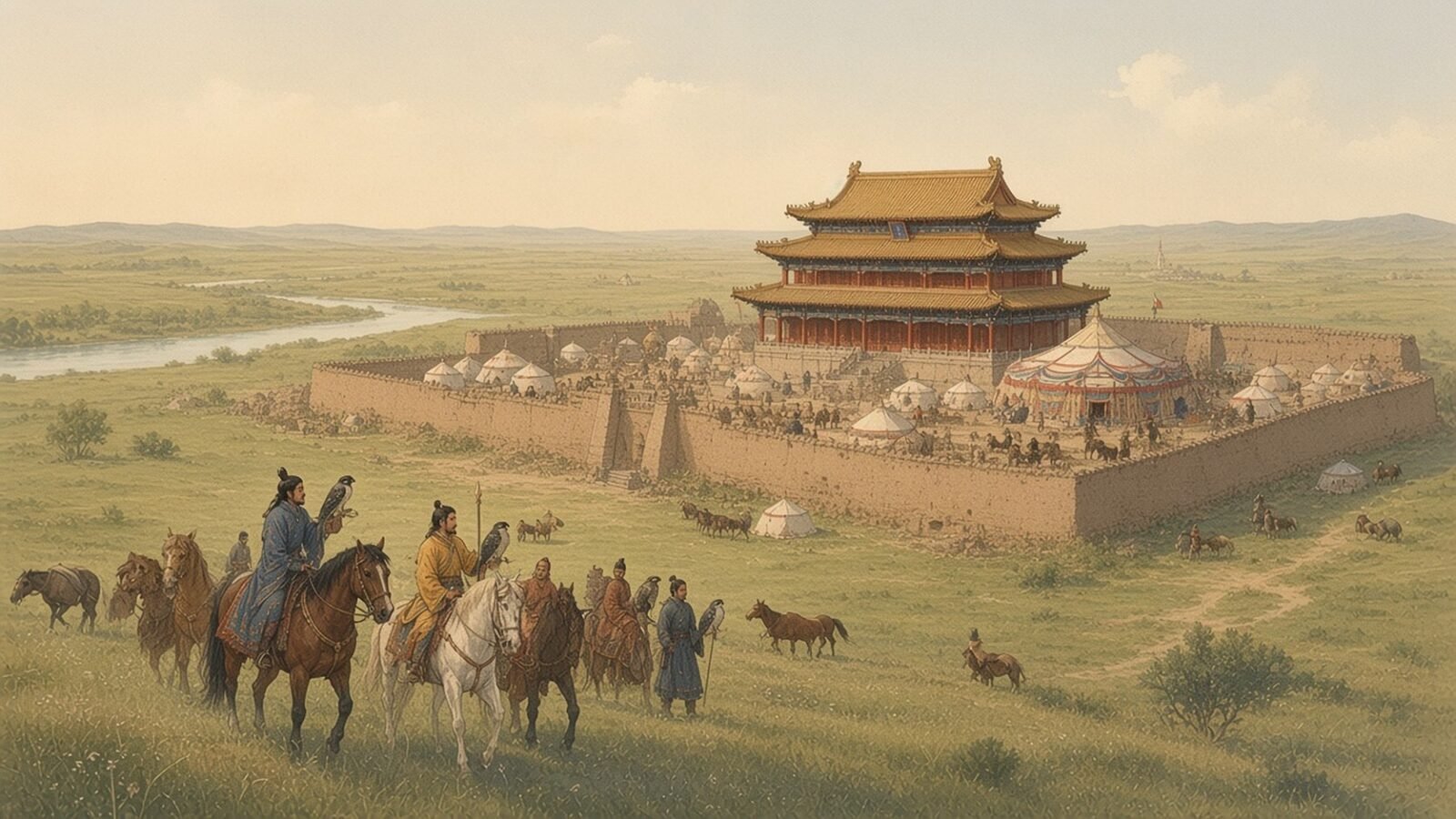
The capital was moved from Karakorum, the Mongol capital in Mongolia, to a new city at what is now Beijing. The new capital was called Dadu, the Great Capital, in Chinese, and Khanbaliq, the City of the Khan, in Mongol and Persian. The site had been a frontier town in Jin territory before the Mongol conquests; Khubilai’s plan was for a grand rectangular city, with the imperial palace at the south side of the city, surrounded by a wall on a grid of broad avenues. The plan was commissioned from the architect Liu Bingzhong and the Central Asian engineer Araniko. The wall was erected in 1271 or 1272; the inner palace was completed in 1274. The site had been carefully chosen for its proximity to the steppe, for its central position in the Mongol holdings of North China, and for its access to the Grand Canal linking it to the rich agricultural lands of the Yangtze. The city would remain the capital of the Yuan, the Ming, the Qing, and the early Republic of China until 1928, when the Nationalist government moved to Nanjing.
The administrative system was a substantial innovation in Chinese history. The Mongols handled the central government through their trusted Central Asian, Uyghur, and Persian administrators, with the Chinese bureaucracy subordinated to them but not abolished. The Chinese officials were particularly present in the lower ranks of the imperial civil service, in the local administration, and in the educational and ceremonial institutions. The Mongol and Central Asian officials were particularly present in the upper ranks, in the military, and in the various revenue agencies. The four-class system – Mongols at the top, then Central Asians (called särä-sä-män or semu, meaning the various categories), then Han Chinese of North China, then Southern Chinese – was institutionalised in the legal codex of the Yuan, the Da Yuan Hui Hui Dian. The system is sometimes presented as a simple racial caste, but in practice the highest offices were open to a broader range of people than the codex alone suggests, and the system accommodated Chinese intellectual traditions through institutions like the Yuan Imperial Academy and the Imperial Library.
The Mongol world system in the late thirteenth century
The most distinctive feature of the Mongol world was its openness. The Mongol Empire, despite its military character, was a place where merchants, missionaries, and craftsmen from across Eurasia could travel and work, using the imperial postal roads and the imperial language of administration. Khubilai, in particular, opened his realm to foreign visitors on a scale that no Chinese dynasty had done since the Tang. The most famous visitors in his time were the Polo brothers, who arrived at the Yuan court in 1275 and who would spend seventeen years in Khubilai’s service before returning to Venice in 1292. Marco Polo’s account of the Mongol court and the Yuan capital at Dadu, written in the early years of the fourteenth century, was, for Europeans, the principal evidence that the Mongol world was a real place and not just a rumour.
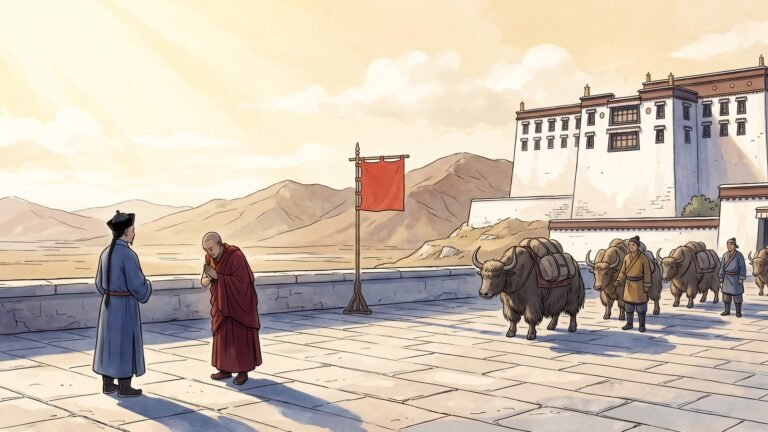
The openness extended to religions. The Mongols were traditionally animist, with elements of ancestor worship, and the ruling family was eclectic in its religious interests. Khubilai was a patron of Tibetan Buddhism and of the Sakya school, with the Tibetan lama Phagpa serving as his court priest and personal religious advisor. The Yuan court also patronised Muslim astronomers, who were responsible for the calendar reforms of 1280 and the construction of the astronomical observatory at Dadu, with engineers from Samarkand and Damascus playing important roles. The court patronised Nestorian Christian communities, which had been present in Mongolia since the eleventh century, with several of Khubilai’s relatives being Christian. The court patronised Daoist and Confucian temples in the Chinese tradition. The combination of religious patronage, commercial openness, and linguistic diversity made Dadu the most cosmopolitan capital the world had ever seen, and the Mongols’ success at running such a capital contributed to the broader Eurasian exchange that brought Asian technologies to Europe and European artefacts to Asia.
The commercial openness was the most visible economic effect of the Mongol world system. The Silk Road trade, which had declined under the previous Tang and Song dynasties, was revived under the Yuan. The overland routes from Central Asia to the Mediterranean, the maritime routes from the South China Sea to the Indian Ocean, and the river routes along the Yangtze and the Yellow River all saw substantial traffic. The leading Chinese export goods were silk, porcelain, tea, and lacquerware. The leading imports were glassware, spices, gems, and precious metals. The Yuan government regulated the trade through the Office of Foreign Trade (Huiguan Si) and through a system of merchant registration. The state also ran a substantial monopoly on the most valuable trade commodities – tea, salt, iron, and bullion. The combination of the state monopoly and the paper-money economy that ran the rest of the financial system is one of the more important fiscal innovations of the Yuan period.
The economy and the paper currency
The paper currency was the most distinctive economic innovation of the Yuan. The Jin dynasty of North China had experimented with paper money under the occupation of the Jurchen state, but the Yuan paper currency was on a scale and with a stability that the Jin had not achieved. The Yuan paper money, the Chao, was first issued in 1287 and rapidly displaced the bulk coinage in circulation. The notes were issued in several denominations, from one wén to two kwan, and circulated in a regulated market under the supervision of the Yuan treasury. The treasury held reserves in bullion and in commodities, but the issuance policy was not strictly tied to the reserves. The result was a working paper currency that, in the late thirteenth and early fourteenth centuries, was widely accepted across the Mongol territories and that, in some places, also circulated in the cities of the Indian Ocean and the Mediterranean.
The paper currency was a major factor in the commercial expansion of the Yuan period. The merchant houses of Quanzhou and Guangzhou could accept the paper notes and use them to finance their purchasing in the South China ports. The travelling merchants of Central Asia could convert the notes at the imperial exchange offices in Karakorum and Samarkand. The Chinese port cities of Quanzhou, Guangzhou, and Hangzhou saw their trade volumes expand to unprecedented levels. The Yuan administration claimed, plausibly, that the volume of trade through the Yuan fiscal system was several times the trade volume through the Song system.
The paper currency was, however, the source of the most important fiscal crisis of the late Yuan. The notes were over-issued from the early 1300s, with the treasury running deficits to cover the costs of the failed campaigns, the corruption of the later emperors, and the costs of the postal road system. The currency depreciated steadily, then precipitously. By the 1340s the notes were at a small fraction of their face value. The fiscal breakdown was one of the major causes of the political crisis of the 1340s and 1350s. The Mongols’ fiscal innovation, which had supported the cosmopolitan economy, became the source of the dynasty’s collapse.
Foreign campaigns and the failure at sea
The Mongol campaigns at sea were the most spectacular failure of the Yuan. The campaigns were attempts to extend the land conquests to the sea, and they were undertaken by a dynasty that had no naval tradition and that was fighting against experienced seafaring enemies on their home waters.
The campaign against Japan was attempted twice, in 1274 and 1281, with the second attempt much larger than the first. The 1274 attempt was a joint Mongol-Korean force of about 23,000 men, sailing from Korea in late spring, and reaching Hakata Bay in northern Kyushu on 19 November 1274. The Mongol force was unable to land in force; the Japanese defenders held the beach; and a storm off the Kyushu coast destroyed much of the Mongol fleet on the night of 19 November. The defenders called the storm kamikaze, the divine wind, and incorporated the experience into the Japanese founding myth. The 1281 attempt was a much larger force, of about 140,000 men in two fleets (one from Korea and one from southern China), and again met with naval disaster: a typhoon destroyed a substantial portion of the joint fleet on 1 August 1281. The Japanese defenders again held the line and again incorporated the victory into their national mythology. The Mongol expeditions to Japan were the largest amphibious operations the world had seen up to that point and were also the largest failures.
The campaigns against Southeast Asia had similar results. The campaign against the Đại Việt kingdom (modern Vietnam) was attempted twice, in 1258 and 1287-8, with both attempts failing. The Mongol forces were resisted by the Vietnamese general Trần Hưng Đạo, whose strategy was to avoid pitched battles and to inflict attritional losses on the Mongol forces through small-unit engagements in the jungle and river terrain. The campaign against Java was attempted in 1293, with the Mongol forces commanded by Shi Bi and the campaign aimed at the Singhasari kingdom of Java; the Mongols were forced to withdraw by the diplomatic and military manoeuvrings of the Majapahit kingdom, which had supplanted Singhasari by the time the Mongol expedition reached the Javanese coast.
The failures at sea did not affect the basic stability of the Yuan land empire. The Mongol administration of North China, the Yangtze region, and the southern provinces remained substantially intact. The treasury continued to operate. The Mongol armies in the interior continued to function. The failure at sea was, however, a turning point in the political fortunes of the dynasty. The fiscal costs of the failed expeditions, particularly the second Japanese expedition, were substantial, and they contributed to the over-issuance of paper money that produced the late-Yuan fiscal crisis. The failure also reinforced the East Asian insularity of Japan and Vietnam, which would last until the modern period.
The collapse of the Yuan
The Mongol dynasty that Khubilai had founded in 1271 survived him. Khubilai died in 1294 and was succeeded by his grandson Temur, who ruled from 1294 to 1307. Temur’s reign consolidated the Chinese-style administration of the Yuan but did not arrest the slow decline of Mongol political vitality. The next six Great Khans, from Yesun Temur (1323-8) through Toghon Temur (the last Yuan emperor, 1333-68), were largely ineffective. The Mongol political class, distributed across the Mongol world and most of them by now culturally adapted to their respective regional settings, was no longer producing the unified political leadership that had made the conquests possible. The Yuan administration in China remained in place, but the imperial centre could no longer enforce its will on the regional elites.
The fiscal crisis, the over-issuance of paper money, the corruption of the administration, and the environmental disasters of the 1330s and 1340s combined to produce the political collapse. The 1340s saw a series of harvest failures and floods, the 1350s saw the spread of the Black Death from Yunnan to the Yangtze basin and north to the Mongol capital at Dadu. The Mongol administration could not meet the basic fiscal and political challenges of the crises. The Chinese population, particularly in the south, rebelled against the Mongol administration in a series of armed revolts that began in the mid-1350s. The most consequential rebellion, led by a former Buddhist monk named Zhu Yuanzhang, conquered the Yuan provincial capital at Nanjing in 1359 and the Yuan capital at Dadu in 1368. The Mongol emperor fled northward to the Mongol heartland; the Mongol ruling family continued to hold parts of the Mongolian steppe for several centuries but did not return to China.
The replacement of the Yuan by the Ming in 1368 was not the simple substitution of one dynasty for another. The Ming was the product of the Chinese population’s revolt against the Mongol administration; it was a state that defined itself in opposition to Mongol rule and that incorporated a sustained critique of Mongol governance into its founding ideology. The Ming founder’s edicts denounced the Mongols as illegitimate rulers, as foreign, and as having corrupted Chinese institutions during their century of rule. The new Ming capital at Nanjing was, in its founding ideology, the antithesis of Dadu. The Mongol administrative legacy, however, persisted in many ways that the official Ming ideology did not acknowledge. The Yongle emperor’s reconstruction of the imperial state in the early fifteenth century, the relocation of the capital from Nanjing to Beijing in 1421, and the use of the Mongol postal road system and the Mongol paper money economy were all continuities with the Yuan that the Ming tried to disguise.
What the Yuan left behind
The Yuan dynasty, despite its relative brevity, was one of the formative regimes in the history of China. It established the standard imperial capital at Beijing that all subsequent Chinese dynasties, including the Qing, would maintain. It institutionalised the use of paper money on a scale that the Ming revived and that lasted in one form or another until the early nineteenth century. It adopted a tolerant religious policy that the Ming matched and that the Qing also matched. It extended the Mongol postal road system across the whole of North China and the Yangtze basin. It developed a system of imperial governance that combined Chinese, Mongol, and Central Asian administrative practices and that the later Chinese dynasties would draw on extensively. It opened China to the largest sustained contact with the world beyond East Asia that the Chinese state had enjoyed since the Tang, with consequences for Chinese culture, Chinese cuisine, Chinese music, and Chinese medicine that can still be observed.
The Mongol contribution to Chinese culture was substantial and lasting. The Mongolian impact on Chinese music, in particular the development of the southern Chinese opera tradition, was substantial. The Mongolian impact on Chinese cuisine, in particular the introduction of lamb and mutton dishes into the Chinese diet, was substantial. The Mongolian impact on Chinese language, in particular the introduction of loanwords from Mongolian and from Central Asian languages into the Chinese vocabulary, was substantial. The Mongolian impact on Chinese military technology, in particular the use of the composite reflex bow and the mounted archer, was substantial. The Mongolian impact on Chinese painting and visual art, in particular the introduction of Central Asian motifs into Chinese painting, was substantial. The Mongols also brought substantial new population to North China, in the form of the semu and the Central Asian administrative class, with substantial demographic and genetic consequences for North China.
The Yuan also left lasting legacies for the wider world. The Mongol world system connected East Asia and Europe on a scale that had not been attempted since the late Roman empire. The Mongol postal road system, the Mongol paper money, and the Mongol openness to foreign visitors made possible a level of Eurasian exchange that would have been impossible in the previous period. The most famous single artefact of the Eurasian exchange was Marco Polo’s account of Khubilai’s court and his travels through the Mongol world, an account that had substantial influence on European mapping and on European imperial ambition. The Mongol legacy in China is more straightforward. The Mongol capital at Dadu became the Chinese capital at Beijing; the Mongol postal road system became the Chinese postal road system; the Mongol paper money survived in the Ming and Qing experiments with paper currency; and the Chinese Empire that survived the Mongol conquest was, in substantial ways, a Chinese Empire that had been transformed by the Mongol experience.
Khubilai Khan, the man who oversaw all this, is remembered in Chinese history as the founder of the Yuan, the grandfather of the Mongol imperial state in China, the patron of foreign visitors, and the builder of the new capital at Dadu. He is remembered in European memory as the superlative monarch of the Mongol world, the most luxurious and cosmopolitan of the khans, the opponent of the European crusades in the Holy Land through his kinsmen the Ilkhans. He is remembered in Mongol tradition as one of the last effective khans of the unified empire, the ancestor whose descendants continued to rule the steppe in various forms for centuries. He died in 1294 and was buried in Mongolia. The state he founded fell in 1368. The capital he built remains the capital of China. The marriage of Mongolian steppe empire and Chinese imperial state that he sought to combine in a single dynasty is one of the most consequential experiments in the political history of pre-modern Eurasia.
The court at Dadu and the architecture of imperial life
The imperial court that Khubilai assembled at Dadu was, by the standards of the late thirteenth century, the most extravagant capital the world had seen. The imperial city, designed by the Chinese architect Liu Bingzhong and the Central Asian engineer Araniko, covered an area of about four square kilometres within the larger city wall of Dadu, with the imperial palace at the south side of the imperial enclosure, the offices of the central administration in the centre, and the imperial gardens and lakes to the west. The lakes, which the Mongols filled with imported water plants and kept stocked with swans and other water birds, were an elaborate artificial landscape. The imperial palace contained a great throne hall, the Dacheng Hall, with a curved roof of glazed yellow tiles and carved woodwork. The court rituals observed by Khubilai were a mix of Mongol ceremonial practice and Chinese imperial ritual: court audiences were held in the Mongol style, with the Great Khan seated alone at the raised end of the throne hall and the officials arranged according to a strict court hierarchy below him. Court rituals of the Mongol tradition, including the cup-bearing ceremonies, the roasting of whole sheep, and the slaughter of horses for the sacred banner, were combined with the Confucian-style rituals of imperial China: state ancestral rites, sacrifices to Heaven and Earth, and the cycles of imperial ceremonies observed by the Tang and the Song.
The cosmopolitan character of the court at Dadu was its most distinctive feature. Italian merchants, Persian astronomers, Tibetan lamas, Armenian and Greek Christians, Russian bodyguards, Mongol nobles from the steppe, Korean scribes, and Chinese civil officials all served in or around the court at the same time, often in close proximity. The court used four writing systems routinely: Chinese characters for the Chinese administration and the imperial decrees, the Uyghur-derived Mongol script for the Mongol correspondence, the Phagpa script invented for the Mongol diplomatic usage by the Tibetan lama Phagpa, and Arabic or Persian for the diplomatic correspondence with the Ilkhanate and the Central Asian trading houses. The multi-lingual operation of the imperial bureaucracy was, for its time, unparalleled in scale. The imperial cities of the Tang had also used multiple scripts, but the Yuan administration used them at a higher volume and for a wider range of functions than any of its predecessors.
The court’s openness to foreign religion and foreign visitors was not, however, unbounded. The Buddhist establishment was the principal religious tradition under imperial patronage; the Daoist temples received imperial support in some periods but were subject to varying degrees of imperial disfavour; the Muslim communities were recognised as a distinct religious community and were authorised to run their own law courts under their own religious officials; the Christian communities were small but recognised; the Jewish communities in Kaifeng and Hangzhou were recognised. The court tried, in short, to permit each religious tradition to operate under its own rules while preserving the imperial supremacy. The arrangement worked, more or less, for the duration of Khubilai’s reign and the reigns of his immediate successors. The arrangement was substantially modified under the late Yuan, when the Mongol political class became more sceptical of religious diversity and more committed to the imperial cult of heaven and earth, in the Chinese tradition.
What the Mongol experience changed in China
The Mongol experience transformed China in ways that subsequent Chinese states had to absorb even where they did not consciously acknowledge the Mongol contribution. The most visible physical transformation was the new capital at Dadu. Beijing’s location as the imperial capital of the Ming and the Qing was set by Khubilai’s choice of site for Dadu. The Ming emperor Yongle, in building the Forbidden City in 1406-21, drew extensively on the Mongol imperial architecture. The Qing emperors, in turn, used the same site. The street grid of modern central Beijing, including the road called Chang’an Avenue and the surrounding districts, follows the Yuan-era plan. The Mongol city did not survive into the Ming unchanged, but the bones of the city are recognisably Mongol.
The administrative transformations of the Yuan were absorbed by the subsequent Chinese dynasties in less obvious but no less lasting ways. The Yuan system of provincial governments, with the central secretariat and the six ministries, was the prototype for the Ming and Qing administrative structure. The Yuan code of law, the Da Yuan Hui Hui Dian, was a substantial compilation of Mongol, Central Asian, and Chinese legal traditions that the Ming drew on for its own codification. The Yuan postal road system, with its extensive network of stations and couriers, was the prototype for the Ming and Qing imperial messenger system. The Yuan cangue, a wooden frame for public punishment, was adopted by the Ming and was used in China until the early twentieth century. The Yuan use of paper money, even though the Ming eventually abandoned it, established the principle that the state could issue paper money if it chose to, and the Qing issued paper money in the early nineteenth century.
The Mongol period also transformed Chinese culture in ways that Chinese historical consciousness has been slow to acknowledge. The Chinese diet was substantially altered by the Mongol adoption of lamb and mutton dishes, and lamb remains more common in northern Chinese cuisine than it would have been without the Mongol rule. Chinese music was altered by the introduction of Central Asian and Persian musical instruments, including the suona, the pipa, and various percussion instruments, into the standard ensemble. Chinese painting was altered by the introduction of Central Asian motifs and the practice of court-sponsored painting of imperial hunts and ceremonies. Chinese language was altered by the adoption of Mongol loanwords into the Chinese lexicon, with many of these loanwords surviving into modern Chinese. Chinese medical practice was altered by the introduction of Central Asian and Middle Eastern medical traditions, particularly in the treatment of certain conditions. The cumulative effect of these cultural changes was substantial, even where the Chinese historiographical tradition has been slow to acknowledge the Mongol contribution.
The Yuan and the question of foreign rule
The Mongol rule over China is one of the rare historical cases in which a foreign dynasty was able to rule a substantially larger Chinese population for an extended period. The Mongols achieved this through a combination of military force, administrative accommodation, fiscal innovation, and a degree of cultural restraint that the earlier non-Chinese dynasties (the Western Qin, the Sixteen Kingdoms) had not always achieved. The most visible instruments of accommodation were the formal Chinese-style imperial rituals and the patronage of the Confucian establishment. The Mongols adopted the imperial examinations in modified form in 1251 and 1253, although they never relied on the examination system as the principal recruitment channel for the imperial bureaucracy in the way that the Song and Ming did. The Mongols recognised the Confucian temples and the imperial ancestral rites. The Mongols patronised the standard Chinese historical texts. The result was a Chinese-style imperial state that was, at the same time, a Mongol administrative system.
The question of how the Chinese responded to the Mongol rule is more complex than the standard historiography allows. The standard historiography, written in large part by the compilers of the Ming dynasty official history, presents the Mongol rule as a foreign occupation that the Chinese barely tolerated, and the conquest as a period in which Chinese civilisation nearly disappeared. The actual historical record is more varied. The Chinese gentry class, especially in the south, retained their local influence through the period of Mongol rule. The Chinese commercial class flourished under the Mongol peace, particularly in the commercial cities of the south. The Chinese Buddhist establishment gained under the Mongol rule, as the Mongol khans patronised Tibetan Buddhism and the Chinese Buddhist establishments in turn. The Chinese literary class continued to write in the Chinese language and to produce the kind of literature that the Chinese reading public expected. The Mongol rule did not eliminate Chinese culture; it changed its content and patronage in ways that the subsequent Ming, in their anxiety to distinguish themselves from their Mongol predecessors, sometimes painted in a more dramatic light than the historical record would warrant.
The Mongol rule did, however, end. The Ming conquest of 1368 was one of the major political transitions in East Asian history, and the Mongols were expelled from China proper. The Mongol population, including those who had intermarried with the Chinese population, remained in substantial numbers in the northern provinces and the steppe, and the descendants of this population are still identifiable in the genetic record of northern China. The Ming founder’s anti-Mongol policy was implemented successfully. The Mongol postal road system was preserved. The Mongol capital at Dadu was preserved, renamed Beiping (Northern Peace), and then reoccupied by the Yongle emperor in 1421 as the new Ming capital. The Mongol legacy, in short, was not erased by the Ming conquest, but it was systematically de-emphasised in the official Ming ideo
References
- Weatherford, Jack. Genghis Khan and the Making of the Modern World — Crown, 2004.
- Rossabi, Morris. Khubilai Khan: His Life and Times — University of California Press, 1988.
- Allsen, Thomas T. The Yuan Dynasty and the Founding of the Mongol Empire — Cambridge University Press, 2001.
- Allsen, Thomas T. The Mongols and the Making of Modern China, 1200-1800 — University of Washington Press, 1994.
- Chaffee, John W. The Yuan Dynasty: Political and Economic History — Cambridge University Press, 2008.
- Buell, Paul D. Historical Dictionary of the Mongol Empire — Rowman & Littlefield, 2018.
- Mote, Frederick W. The Yuan and the Cambridge History of China — Cambridge University Press, 1994.
- Steinhardt, Nancy Shatzman. The Mongol Imperial Capital Dadu — University of Pennsylvania Press, 2007.
- Sansom, George. A History of Japan to 1334 — Stanford University Press, 1958.
- Twitchett, Denis, and John K. Fairbank, eds. The Cambridge History of China — Cambridge University Press, 1994-2008.
- Onon, Urgunge. The Secret History of the Mongols — Cambridge University Press, 2001.
- Pelliot, Paul, and Louis Hambis. Histoire des campagnes de Genghis Khan — Brill, 1951.