The Largest Encyclopedia Ever Made
There is an old, slightly tired joke in Chinese history books that the only encyclopedia bigger than the Yongle dadian is a modern online encyclopedia, and that it took six hundred and four years to overtake it. The figure is rough but real. When the Yongle Encyclopedia, compiled between 1403 and 1408 by order of the third Ming emperor Zhu Di, was completed, it held 22,937 manuscript rolls, or chapters, gathered into 11,095 bound volumes (the *ce*), comprising roughly 370 million Chinese characters. By comparison, the English-language Encyclopaedia Britannica’s fifteenth edition runs to about 65 million words. The Yongle dadian was nearly six times that size.
The reason we know this with any confidence is not because the original set survives — it does not — but because a single hand-copied duplicate was made in the 1560s on the order of the Jiajing emperor, and roughly four hundred volumes of that duplicate still exist, scattered in libraries and private collections from Beijing to Berlin. The fact that we have even this much is, in part, an accident of nineteenth-century history. Most of the original duplicate was destroyed in the burning of the Hanlin Academy during the Boxer Rebellion in 1900, and a great deal more was pilfered in the years around it.
Even at four per cent of its original size, the surviving Yongle dadian remains the largest anthology of pre-modern Chinese writing ever attempted. The Library of Congress in Washington holds forty-one volumes. The National Library of China in Beijing holds about 220. The National Palace Museum in Taipei holds 62 more. The British Library, the Bodleian at Oxford, the Huntington Library in California, the SOAS library in London, Cambridge University Library, and a handful of German institutions hold the rest. If you take even a single Yongle volume off a shelf and open it, what you find is not in any modern sense a “book” — it is a panoramic cut through the literary inheritance of a four-thousand-year-old language, organised by the sound of words rather than by subject.
That last point is the most important and the most often missed. The Yongle dadian was not arranged topically. It was organised by rhyme. If you wanted to look up, say, a passage about astronomy and a passage about a famous horse and a court ritual about flood control, all three might appear within a few pages of one another if their index characters rhymed. This was a deliberate editorial decision, and it is one of the reasons no one has yet produced a critical index of the encyclopedia’s surviving volumes: the material is, by its very design, scattered across rhyme groups.
For the past seven centuries, then, the Yongle dadian has functioned as both the high-water mark of the Chinese encyclopedic tradition and the most spectacular casualty of it. The sheer size of the work, and the way it was built and then lost, tells us as much about how the Ming state imagined itself as the texts inside it tell us about the Confucian tradition.
Why Zhu Di Ordered It Built
Zhu Di came to the throne in 1402 after a protracted civil war with his nephew, the Jianwen emperor, whom he ultimately defeated and whose family he largely destroyed. The official verdict the dynasty eventually imposed on his reign was that he had usurped the throne; the unofficial verdict, expressed in private correspondence and later folklore, was that he had done so by brutally murdering his way to it. Zhu Di had spent the years of the civil war as Prince of Yan, garrisoned in Beiping (modern Beijing), running the northern frontier against the residual Mongols.
Two things followed from this. The first was a strong instinct, common to successful usurpers, to bind the literate bureaucratic elite to his rule by a useful piece of work. The second was a desire to fix the reputation of the empire he had just taken over, in part by demonstrating that the Ming state could outdo the Song dynasty’s classical encyclopedias in every particular.
The Song dynasty is famous for its encyclopedias. Between the tenth and thirteenth centuries Chinese officialdom produced successive *leishu* compendia — encyclopaedias, although the genre was broader than that, more like hyper-organised annotated anthologies of the literary inheritance — of unprecedented scale. The *Taiping yulan* of 978, the *Taiping guangji* of the same period, the *Cefu yuangui* completed in 1013, the *Wenxian tongkao* of 1311: these were vast anthologies whose existence any subsequent dynasty had to reckon with.
In the first year of Zhu Di’s reign, 1403, he charged his chief minister, the Buddhist scholar-official Xie Jin, with the task of assembling a single bibliographic digest of the inherited writings of the empire that would outclass them all. Xie’s first attempt, called the *Wenxian dacheng* (“Great Compendium of Literature and Learning”), ran to about 22,877 chapters in 11,095 volumes, and may be considered something close to the first Yongle dadian. It was Zhu Di who then ordered the much more ambitious second version, the one we now call by the reign name.
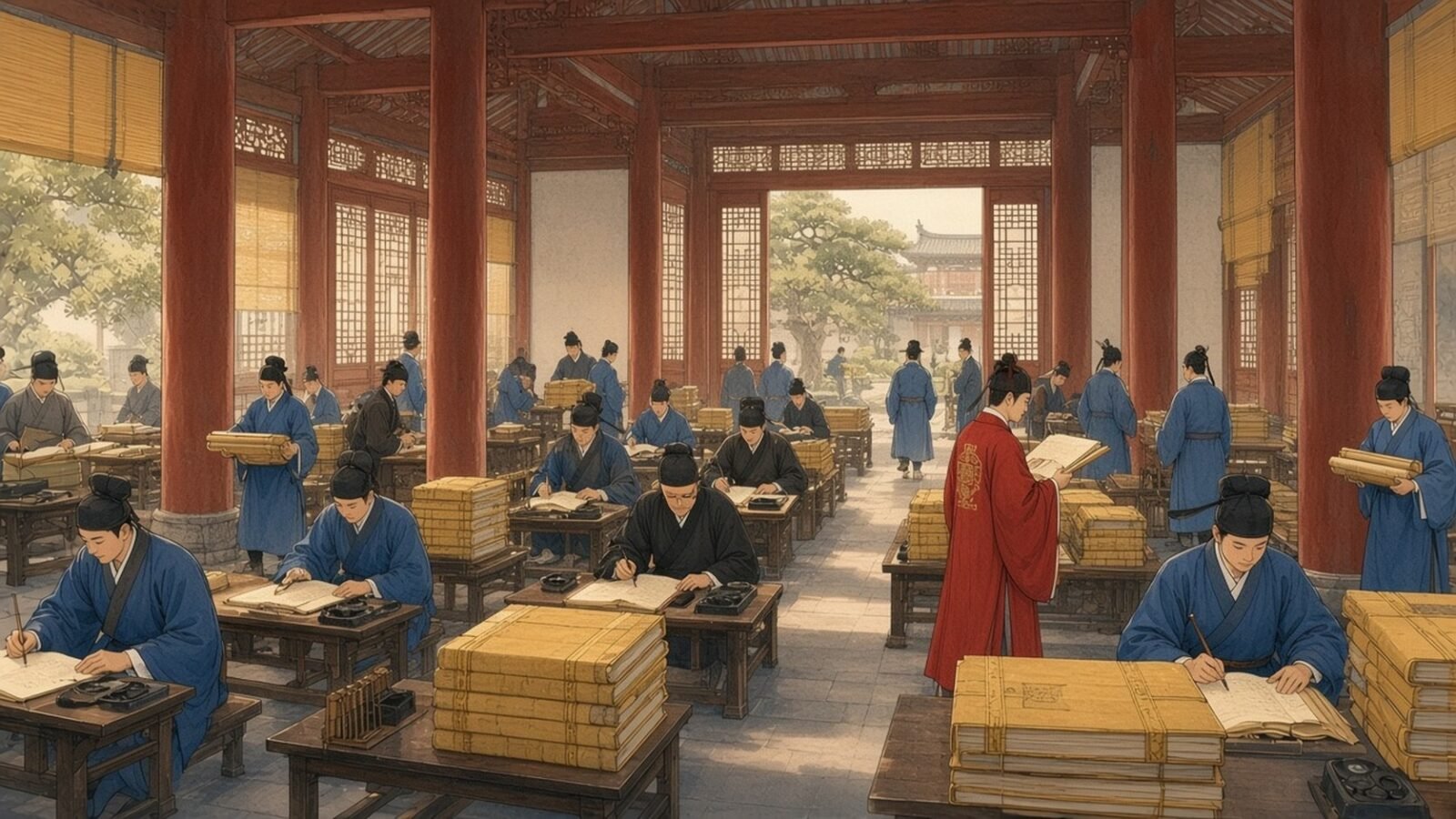
By 1405 Yao Guangxiao had joined Xie Jin as chief director. Yao was in many ways the more famous of the two: a former Buddhist monk turned soldier, supposedly once a rebellious monk who had his sword, then a strategic advisor to Zhu Di through the entire civil war, and later the famous prime mover behind several large publishing projects in the early Ming. Together they and their editorial staff — at one point more than 2,000 scholars in total — produced the final encyclopedia in the lower Yangtze capital of Nanjing. The physical making of the object was done by professional copyists, each of whom was assigned a quota of fascicles to be transcribed during the day.
The compilation timeline is often reported as 1403 to 1408, with the front end being Xie’s first attempt, the back end being Yao’s expanded project, and the final manuscript being handed over to Zhu Di’s government in the last year of his reign. The 22,937-chapter figure is the standard one; some sources give 22,877, which probably reflects the difference between the textual chapters and the bound volumes in the title page count. (The discrepancy of about sixty chapters is small relative to the total.) For all the prestige of the work, the production period is unusually short — about five or six years of actual compilation by a large editorial team of professional scholars.
This is not a trivial detail. The Yongle dadian was compiled at a tempo that only a centralised imperial bureaucracy could sustain. The state supplied the copyists, the editors, the paper, the binding labour, and the lamp oil; the production involved a coordination problem that no private or semi-private enterprise in early fifteenth-century China could have solved. The fact that it took only six years, not twenty, is itself part of the imperial answer the encyclopedia was meant to give.
What Was Inside
The Yongle dadian was structured as a *leishu* — an encyclopaedic anthology drawn from earlier books — but with the unusual feature that its material was arranged by rhyme rather than by subject. Inside each rhyme group, the compilers assembled everything they could find in the inherited literary corpus that contained, or was relevant to, the index character. Most of these excerpts were short. Some were paragraphs long. A few — entries about the Book of Songs, the *Yijing* (the *I Ching*), the dynastic histories, the Confucian classics — ran for hundreds of pages.
The text of the encyclopedia is a kind of pastiche: it does not present an original argument or even an original synthesis; it cites the relevant passages from previous books and marks each citation with the title of the source and, sometimes, a brief editorial gloss in red ink. The result is something like an annotated reading list of all the literature that mattered to the early Ming bureaucracy. In volume order, you would walk past excerpts from the Confucian classics, the histories, the philosophical schools, the poems of the Tang and Song, medical textbooks, the major almanacs, treatises on divination, plays and stories, and even the Buddhist and Daoist canons.
For practical purposes the Yongle dadian was a private reference work for the imperial household. The single surviving account of an actual reader is Zhu Di himself, who was reportedly frustrated by the indexing system: he had wanted a topical encyclopedia he could use to look things up on the spot, but the rhyme-based organisation meant that even a literate scholar had to know the rhyme group of the index character first. (Later leishu, like the *Gujin tushu jicheng* of the early eighteenth century, reverted to topical organisation for exactly this reason.) The Yongle dadian was therefore far more useful as an anthology — a body of literary quotations — than as a quick-reference desk encyclopedia.
What most people know about the Yongle dadian today is what could be reconstructed from the surviving volumes, which are about 800 of the original 22,937 chapters. The fact that anything has survived is significant. For most of the Ming and Qing, the encyclopedia was inaccessible: it lived in the imperial archives at the Hanlin Academy in Beijing, in a special vault, and copies did not exist. The Jiajing emperor’s decision to commission a duplicate in 1562-1567 — apparently motivated by his concern that the original was being worn down by use and his desire to have a portable backup — is the single reason we have any of the work today.
That duplicate was finished during the Jiajing reign and was almost immediately stored alongside the original in the Hanlin Academy. By the late Ming, the original edition had been lost. Some historians think it was destroyed in the chaos of the Manchu takeover of Beijing in 1644; others have suggested — perhaps apocryphally — that it was buried with one of the late Ming emperors. (This last story is repeated in older popular histories but has no firm documentation.) What we have today is the Jiajing duplicate, and even that has been reduced to about four per cent of its original size by the events of the nineteenth century.
How It Was Lost
The single most important reason for the loss of the Yongle dadian is that the Hanlin Academy was burned. The Academy sat inside the imperial city compound, on the eastern side of the palace complex in Beijing. It was one of the principal libraries of late imperial China and held the imperial rolls, the genealogies of the Aisin Gioro, the great encyclopedias of the Ming and Qing courts, the standard editions of the classics, and an enormous private collection of manuscript and printed texts. In June 1900, during the Boxer Rebellion, the Eight-Nation Alliance entered Beijing; in the disorder that followed, the area around the Academy was set on fire, on some accounts deliberately by Allied soldiers and Chinese collaborators, on others by the Boxers themselves trying to destroy records they feared would be used against them. Whatever the cause, the fire consumed most of the Hanlin collection. By the time the library was rebuilt in the early 1900s, the inventory of the remaining Yongle volumes had collapsed.
The actual surviving rate is hard to estimate and depends on whether one counts individual *ce* (bound fascicles), *juan* (chapters within them), or volumes as units. The Library of Congress says “less than four per cent”; some sources give “around 400 volumes” or “420,” and the Library of Congress press release of 2023 says “430 volumes.” The National Library of China in Beijing holds about 220 of these, with smaller collections in the National Palace Museum in Taipei (62), the British Library (43), the Library of Congress (41), the Bodleian (4), the SOAS Library (4), and a few isolated volumes in Cornell, Cambridge, and three German libraries.
The way those volumes were saved is itself a story of nineteenth-century Chinese cultural politics. During the late Qing, low-level officials at the Hanlin Academy evidently realised the original duplicate was being looted; small batches of volumes were smuggled out or simply taken by officials as commemorative objects. Some were purchased by foreign collectors and booksellers in Beijing in the 1870s and 1880s, and from there they percolated through the European and American rare-book market into the libraries we now associate them with. A few of the volumes that ended up in Western libraries in the late nineteenth century were purchased from Chinese antiques dealers; others were won in games of chance, taken as souvenirs by Western soldiers during the Boxer Rebellion, or quietly acquired by imperial officials themselves as heirlooms. The first Yongle volume to be extensively photographed by Western scholars was one acquired by a French diplomat in 1872 and passed eventually to the Bibliothèque nationale de France.
In other words, the cultural catastrophe of 1900 created a diaspora of volumes rather than the destruction of a single library. The tragedy is real, but it is also the reason that the work is now distributed internationally rather than kept behind a high wall in Beijing.
The Encyclopedia Today
For most of the period since 1900, the surviving Yongle dadian volumes have been physically scattered and largely inaccessible to ordinary readers. The original volumes are kept in climate-controlled vaults under tight borrowing restrictions. Researchers have been able to consult them, but only one or two at a time, only with permission, and only with a reading-room appointment at the institution that holds the particular fascicle needed.
The Library of Congress has taken a slightly more open approach. Between 2017 and 2023 the Library’s Asian Division worked systematically to digitise all forty-one volumes in its holdings and to publish the digital facsimiles in the public domain, with translations and scholarly commentary. By 2023 the entire LOC collection was online, free to view. The release in 2023 was announced as “the first time a major collection of Yongle dadian volumes has been made freely available online.” Other libraries have since begun their own digitisation efforts, but the LOC project remains the benchmark.
The reason the digital versions matter is that the Yongle dadian, more than perhaps any other large pre-modern Chinese encyclopedia, has had its modern value precisely because the rest of the works it cites are gone. Hundreds of titles quoted in the encyclopedia are no longer extant anywhere else in the world; the Yongle dadian is, for those passages, the only surviving source. That makes the surviving volume not a literary curiosity but a critical witness to otherwise lost texts. Scholars working on the Daoist or Buddhist traditions of the Tang, on Song dynasty mathematics, on Ming everyday life, on the history of medicine, on minor classical poets — all of them have produced scholarship that pivoted on a single Yongle dadian passage. The Bodleian’s four volumes, for example, contain a section on Tang musical instruments that is not preserved anywhere else. The Huntington volume has a previously unknown biography of a Southern Song official.
The picture we now have of the encyclopedia is necessarily partial. If you actually want to read the Yongle dadian in anything like its original order, you have to read about four hundred and twenty volumes scattered across at least thirty institutions, plus a partial synthesis of the publishing history that has to be reconstructed from the catalogues of those institutions and from the surviving Chinese-language bibliographic studies. Even by the standards of working out of a digital critical edition, it is a hard object to study.
That has not stopped people from trying. A 2003 project at Peking University produced a partial photographic reprint edition, careful to focus on the surviving volumes and to leave gaps rather than guessing what might have been in the missing ones. The National Library of China’s cataloging programme for the surviving volumes has been underway since at least the 1960s and is the de facto international standard. Scholars in China, Japan, Germany, France, and the United States have been working for a century to reconstruct the work’s publishing history, and there is now a small but real international scholarly community whose work revolves around individual Yongle volumes.
What is striking in all of this is that the encyclopedia was a failure as a working tool almost from the day it was finished, and a success as a cultural object for centuries after. The reason is structural. As a reference work its rhyme-based design was unwieldy; as an anthology of the Chinese literary inheritance it has been unrivaled. The Ming state built the Yongle dadian to assert its own greatness. Six centuries later, what makes the surviving volumes important is the incidental property that they preserve texts that the rest of Chinese history has lost.
The edition you would most like to have is also the one that never will exist: the complete set. The Jiajing manuscript was a single copy, written on paper that was meant to last five or six centuries at most. The Tongzhi emperor in 1875 ordered a wooden cabinet system to store the surviving volumes, the Cabinet was destroyed with the Hanlin Academy, and the rebound volumes we now have in libraries around the world were reconstructed from whatever fragmentary material survived.
For all of these reasons the Yongle Encyclopedia has become a Chinese cultural object of almost mythical scale. It is larger than the Encyclopédie of Diderot and d’Alembert, larger than the Bibliotheca of Photius in the Byzantine Empire, larger than any medieval European compilation. It is the work that a later online encyclopedia, when it overtook Yongle in late 2007, took six hundred years to surpass.
There is a particular irony in this. The Yongle dadian could not be used easily, and was largely hidden from view, when it was intact. It is widely studied, photographed, and searched electronically now that most of it is gone. It is the most cited Chinese encyclopedia in modern scholarship by a factor of ten, and at the same time the most partial. It was an editorial monument to a dynasty that wanted the world to know it had been there, and it has turned into a monument to its own loss.
That is what is interesting about it. A complete encyclopedia that no one ever read, that was barely indexed, that was filed in a single vault in a single library: that is the kind of object only an empire could bring into being. A scattered half-broken set of 420 volumes whose quotations are the only surviving evidence for hundreds of lost texts: that is the kind of object only an empire could lose.
The Yongle dadian is both at once, and that is why it remains a fixture in any honest account of late imperial Chinese cultural history.
The Editors and the Editorial Work
Behind the project there was a small group of senior scholars rather than a single figure. The first chief editor, Xie Jin, came up through the Hongwu emperor’s examination service and had been a Hanlin academic in Nanjing for years before the civil war. He was working on a preliminary digest of the imperial library’s holdings when Zhu Di’s editorial decree expanded it into the full encyclopedia. The second chief editor, Yao Guangxiao, came to the work from a different background entirely: he had been a Buddhist monk at the Xihu monastery in the second quarter of the fourteenth century, came out of the religious life after the Yuan collapse, joined Zhu Di’s household staff, and became a military commander of some note during the civil war against the Jianwen emperor. By 1405 Yao was old and tired of court life, but he agreed to lead the Yongle editorial effort as a consolation and a chance to be useful.
The contrast between the two chief editors became a small legend in Ming historiography. Xie Jin was meticulous; Yao Guangxiao was strategic. The unrolling of the project across the years 1403-1408 was carried out by a succession of editorial committees, with several hundred to two thousand scholars (depending on the source) working at any given moment. The work force was divided into subject groupings: classics, history, philosophy and belles-lettres, medicine and astronomy, religion and divination, arts and music, and so on. Each subgroup had a head editor who reported to one of the two chiefs.
The actual copyists were very different professionals from the editors. They were professional scribes, often from the Jiangnan region, who could write fast cursive script in a day without errors. The encyclopedia was compiled on heavily sized paper of the kind used for important documents, and the binding was the standard leishu “butterfly” form, with printed-style folding inside a stiff yellow-silk wrapper. The yellow silk cover is part of why the volumes were sometimes identified by Ming and later imperial authorities as a piece of working imperial business: yellow was the imperial colour, and the volume covers shared this with the highest-grade court publications.
The editorial model worked as follows. Each subgroup selected excerpts of length anywhere from a single sentence to several pages from the works in its remit. The excerpts were transcribed onto loose sheets, with the source title marked in red ink at the head of each. The head editor verified that the excerpt was correctly transcribed and that the source title was correctly given. The loose sheets were then sent to the binding workers, who cut and folded the sheets into the standard leishu format, with the chapters running on a single folio column when laid out.
What this approach produced was not a continuous narrative but a citation matrix. The encyclopedia reads more like an annotated bibliography than a volume of essays. The result is that the Yongle dadian is highly searchable if you know the rhyme group of your topic: you go to that rhyme group and scan the index character, and you find a concatenated list of excerpts from earlier books whose subject matter relates to the index. If the index character is rare or unusual, the excerpts are likely to be long; if the index character is common, the excerpts are likely to be short and packed closely.
The bibliographic discipline of the editorial team is what makes the surviving volumes useful as historical sources today. The red-ink titles at the head of each excerpt were copied with great care, and it is these that allow modern scholars to identify which books the encyclopedia cited. Some of those books survive independently; many do not. The Yongle dadian, in its surviving form, is effectively the only record of hundreds of titles that were once part of the Chinese learned inheritance and are now otherwise lost.
A Sense of Scale
The size of the Yongle dadian is hard to grasp in modern terms. The British Library’s medieval manuscript collection, which is the largest in the world outside the Vatican, contains about 6,000 medieval manuscripts. The Yongle dadian was more than twice as large as that. For half a millennium the Yongle dadian alone contained more characters of Chinese text than any other single manuscript or set of books produced in the world.
For comparison, the entire output of European printing presses between 1455 and 1500 is estimated at about twenty million characters of type (a generous per-page count); the Yongle dadian’s surviving 4 per cent is several times that. The Catholic Church’s monumental book, the Liber Pontificalis, runs to about a thousand pages and was copied over centuries by scribes. The Yongle dadian, on the face of it, copied in five years by roughly two thousand scribes working together, was a comparable exercise at a single stroke and at a much larger scale.
The comparison is not just numerical. The Yongle dadian was deliberately designed to be larger than the Song-dynasty encyclopedias it had displaced. The classic *Taiping yulan* ran to a thousand chapters; the *Cefu yuangui* ran to a thousand chapters; the *Wenxian tongkao* had three hundred and forty-eight chapters. The Yongle dadian had 22,937 — more than twenty times as many. The implicit editorial claim, and probably the implicit political claim, is that the Yongle imperial state was twenty times the size of any of its predecessors, and that the literary inheritance it had taken over was correspondingly larger.
Whether the project was worth the cost is a separate question. The actual financial outlay was small compared with the Yongle emperor’s other projects — the construction of the new capital at Beijing, the lower Yangtze transport system, the personal expeditions to Mongolia. But the moment the first set was finished in 1408, an order was already being placed for the duplicate (although it took more than a century and a half before Jiajing’s copyists got around to making it). The Chinese imperial government evidently felt that one copy was not enough; the original was effectively a treasure to be backed up.
Modern historians sometimes wonder whether the Jiajing emperor really ordered a duplicate because of concern about wear, or whether there was some other motive. The standard explanation is that the Jiajing emperor wanted to make the encyclopedia read-locked for himself — he didn’t trust his officials with it — and had his staff produce the duplicate set in a closed compound. This is consistent with what we know of the Jiajing emperor’s paranoia and his preference for direct imperial control of textual projects. It is also consistent with Jiajing’s obsession with Daoist self-cultivation and longevity formulae; the emperor was a notoriously enthusiastic alchemical practitioner in his late years, and may have wanted the encyclopedia for the long passages on Daoist immortals and meditation that he is known to have had a strong interest in.
Whatever the motive, the duplicate is the reason we can still consult the encyclopedia today. Without the Jiajing copy, every page would have been lost in the Boxer Rebellion disaster. With it, four hundred volumes survive to be re-read.
The Decline of the Encyclopedia After the Twentieth Century
Throughout the late Qing and the early twentieth century, surviving Yongle dadian volumes became curiosities and valuable goods. They were purchased by foreign collectors, catalogued by Western and Japanese librarians, and consulted occasionally by Chinese scholars. The National Library of China in Beijing began formal cataloguing in the 1930s, a project interrupted by the Sino-Japanese war, and only fully resumed after 1949. The major publication to document the surviving material was the multi-volume *Yongle dadian cankao* (Reference Material from the Yongle Encyclopedia), a Chinese-Japanese project of the late 1950s and 1960s that published enough material to show the breadth of the surviving volumes.
By 2010 there was broad international scholarly consensus that the only way to make the surviving material usable was systematic digital imaging. The Library of Congress, the National Library of China, and the National Palace Museum in Taipei each began work on the surviving volumes in their custody. The Library of Congress completed its work in 2023; the National Palace Museum has gradually released many of its volumes in digital form; the National Library of China has its collection in open digital form on a Chinese-language platform.
The shift to digital availability has changed Yongle dadian scholarship in two important ways. First, it has made individual volumes accessible to scholars who could never have travelled to Beijing, Taipei, Washington, or London to see them. Second, it has made the question of re-printing the encyclopedia tractable for the first time. The Hong Kong-based commercial publisher Zhonghua Shuju has begun a project to publish the surviving volumes in photo-reproduction form, with critical apparatus, starting in the early 2020s. Critics note that even this effort produces a critically incomplete object: you cannot print what you do not have.
A more radical re-proposal has come from a Chinese computer science team that has begun a project to use deep learning to reconstruct portions of the lost volumes from parallel passages in surviving related text. The project has so far produced reliable reconstructions of some pages of the Yijing-related material; for other parts of the encyclopedia, the method is harder to apply, because the lost material was itself unique. What is striking is that the proposal assumes that an encyclopedia reconstructed from internal probabilities is better than no encyclopedia, a position that traditional bibliographers would not have accepted. The project is still in early stages.
For better or worse, the Yongle dadian has entered a phase in which its substance is more accessible than it has ever been, while its completeness is more lost than it has ever been. The digital versions are free to consult; the original Jiajing manuscript, when consulted, is in tiny fragments scattered around the world. That is the latest twist in an already long story.
References
- About this Collection | Yongle Da Dian | Digital Collections — Library of Congress (overview of the work, the compilation, and the survival of the Jiajing duplicate).
- Library of Congress Completes Digitization of Yongle Encyclopedia, Largest Reference Work of Pre-Modern Era — Library of Congress press release, May 8, 2023.
- Yongle Encyclopedia — Grokipedia, accessed 15 October 2026.
- Yongle Encyclopedia Volumes Fully Digitized — Library of Congress / Asian Division blog, May 2023.
- Organizing an Encyclopedia, Chinese Style — The Huntington Library blog, on the rhyme-based classification system of the encyclopedia.
- Compiling Ancient and Modern Texts — Compendium of Knowledge — Library of Congress online exhibition on the Yongle dadian.
- Organizing an Encyclopedia, Chinese Style (long-form) — The Huntington Library, Verso.
- Yongle Encyclopedia — Traditional Culture — China State Council Information Office (Chinese government source on the work and its compilation).
- Biggest and Earliest Encyclopedia — Chinese Embassy in Nigeria, traditional cultural overview (background on the destruction during the Boxer Rebellion).
- Yao Guangxiao — Grokipedia, accessed 15 October 2026.