On 11 October 2012 Peter Englund, the permanent secretary of the Swedish Academy, opened the doors of the Academy’s hall in the Old Town of Stockholm and announced that the Nobel Prize in Literature for that year had been awarded to the Chinese writer Mo Yan, “who with hallucinatory realism merges folk tales, history and the contemporary”. It was the first time the prize had been given to a writer who was a citizen of the People’s Republic of China and lived there. The announcement was greeted with celebration by the Chinese state media and by many readers in China, with surprise in parts of the international literary world, and with criticism from some writers and commentators who questioned the award to an author who held positions within the official Chinese literary establishment. The debate that followed was as much about the relationship between literature and politics as it was about Mo Yan’s books, but the books themselves, a body of novels and stories set largely in a single rural district of Shandong province, had by then been read in translation for a quarter of a century. This post describes the writer’s life and work, the award of the prize, and the discussion it provoked.
A childhood in Gaomi
Mo Yan is the pen name of Guan Moye, who was born in the mid-1950s in a farming family in the village of Pingan, in Dalan township, Gaomi county, in the north-east of Shandong province. The Nobel Foundation’s record gives his date of birth as 25 March 1956, which the Foundation notes is the laureate’s preferred date; many Chinese sources give 17 February 1955. Gaomi lies on the plain south-west of the port city of Qingdao, a region of fields of wheat, maize and sorghum crossed by rivers and dikes, and it was the setting of almost all his later fiction, transformed into the literary territory he called Northeast Gaomi Township.
His childhood coincided with some of the most difficult years in modern Chinese history. He was a small child during the famine that followed the Great Leap Forward, and he later wrote and spoke repeatedly about the hunger of those years, recalling that he and other children ate tree bark, weeds and, on one occasion, coal. His family were classified as upper-middle peasants, a category that carried political suspicion in the years of class struggle, and when the Cultural Revolution began in 1966 he was removed from primary school, apparently because of his family background and an incident in which he criticised a teacher. He spent the following years herding cattle and sheep and working in the fields, and later in a cotton-processing factory. In his autobiographical writings and in his Nobel lecture he described how, as a boy alone with the animals in the fields, he talked to birds and cattle, and how he listened to the stories told by the elderly people of the village and by itinerant storytellers at the local market.
His pen name, which means “don’t speak”, is usually explained as a reminder of his parents’ warnings to him as a child, in a period when careless talk could bring danger to a family, to be careful of what he said outside the home. Mo Yan himself has given this explanation, while also noting the irony that a writer known for the exuberance and volubility of his prose should have chosen such a name.
The army and the beginning of a literary career
In 1976 he enlisted in the People’s Liberation Army, which offered young men from poor rural families one of the few routes out of the village. He served first as a guard and later in political and teaching roles, and he began to write in the late 1970s, publishing his first story, “Falling Rain on a Spring Night”, in a literary magazine in 1981. His early stories were conventional in manner, but he soon developed a distinctive voice. In 1984 he was admitted to the newly established literature department of the People’s Liberation Army Academy of Art in Beijing, where he studied until 1986, and where he read widely in foreign literature in translation. He later described his discovery of William Faulkner and Gabriel García Márquez as a revelation: in Faulkner’s Yoknapatawpha County he found the example of a writer who made a single small region into a world, and in García Márquez’s One Hundred Years of Solitude, which appeared in Chinese translation in the early 1980s, he found a way of combining the marvellous and the everyday that seemed to him to correspond to the stories he had heard as a child. He also later stressed that he had tried to free himself from these influences, describing them as “two blazing furnaces” from which a writer must keep his distance to avoid being consumed.
The story that brought him to national attention was “The Transparent Carrot”, published in 1985. It describes a mute, mistreated boy working on a construction site during the commune era who sees, in a radish held up to the light of a forge, a transparent, glowing beauty that no one else can perceive. The story’s combination of harsh rural reality with intense sensory imagery and a child’s perspective was widely praised, and it established Mo Yan as one of the leading figures of a generation of young writers who, in the mid-1980s, were transforming Chinese fiction.
Root-seeking and the literature of the 1980s
Mo Yan’s emergence belonged to a period of great creativity in Chinese literature. After the end of the Cultural Revolution, writers first produced what was called “scar literature”, depicting the suffering of the previous decade, and then “reflection literature”, which examined its causes. By the mid-1980s a younger generation had begun to experiment with forms and subjects that broke with the conventions of socialist realism. One movement, known as “root-seeking” literature, sought sources of cultural identity in regional traditions, folk customs and the lives of rural people, often in remote or marginal areas, while another, sometimes called the avant-garde, experimented with narrative technique influenced by modernist and postmodernist writing from abroad. Mo Yan’s work drew on both tendencies. Writers such as Han Shaogong, Ah Cheng, Wang Anyi, Yu Hua, Su Tong and Can Xue, together with Mo Yan, made the second half of the 1980s one of the most productive periods in modern Chinese fiction, and many of their works were later translated into Western languages.
Red Sorghum
In 1986 Mo Yan published a novella, “Red Sorghum”, in the literary journal People’s Literature, followed by four related novellas that were collected as the novel Red Sorghum: A Family Saga in 1987. The novel is narrated by a grandson who reconstructs the history of his family in Northeast Gaomi Township in the 1920s and 1930s. Its central figures are his grandmother, who is married against her will to the leprous son of a wealthy distiller of sorghum wine, and his grandfather, a bandit who kills her husband and becomes her lover, and who later leads a band of local fighters in an ambush against Japanese troops in 1939. The narrative moves back and forth in time between the courtship of the grandparents, the ambush and its bloody aftermath, and the later fortunes of the family, and it is told in a prose of extraordinary sensuous intensity, in which the red fields of sorghum, the colour of blood and wine, become the dominant image of the vitality and violence of the land.
The novel’s treatment of the war against Japan departed markedly from the conventions of earlier Chinese fiction on the subject. Its heroes are bandits and lovers rather than disciplined Communist soldiers, its violence is depicted in unflinching detail, including a notorious scene of a man being flayed alive by Japanese soldiers, and its moral world is one of passion and loyalty to kin rather than ideology. The narrator contrasts the vigour of his ancestors with what he sees as the timidity of his own generation, and the theme of a degenerating lineage runs through Mo Yan’s later work.
The novel’s fame was greatly increased by its adaptation as a film. Zhang Yimou, then a cinematographer making his debut as a director, worked with Mo Yan on the screenplay, and the film Red Sorghum, starring Gong Li and Jiang Wen, was released in 1987. In February 1988 it won the Golden Bear at the Berlin International Film Festival, the first major international film prize for a film from the People’s Republic, and it was a great commercial success in China. The film brought both its director and the novelist to international attention, and it became one of the defining works of the “Fifth Generation” of Chinese film-makers, whose bold use of colour and landscape transformed Chinese cinema in the 1980s.
Northeast Gaomi Township as a literary territory
The district Mo Yan called Northeast Gaomi Township occupies in his work a place comparable to that of Faulkner’s Mississippi county or García Márquez’s Macondo. It is based on the real landscape of his childhood, with its villages, river, dikes, bridges, marshes and fields, but it is freely transformed, expanded and populated with figures drawn from family memory, local legend and invention. Over the course of his career it acquired a history stretching from the late Qing dynasty to the present, a set of recurring places, such as the stone bridge over the Black Water River, the sorghum fields and the distillery, and a population of families whose members appear in several books. Readers who follow the novels in sequence encounter the same district under the Germans in 1900, under bandits and Japanese soldiers in the 1930s, in the land reform and the communes, and in the reform era of markets, factories and new roads.
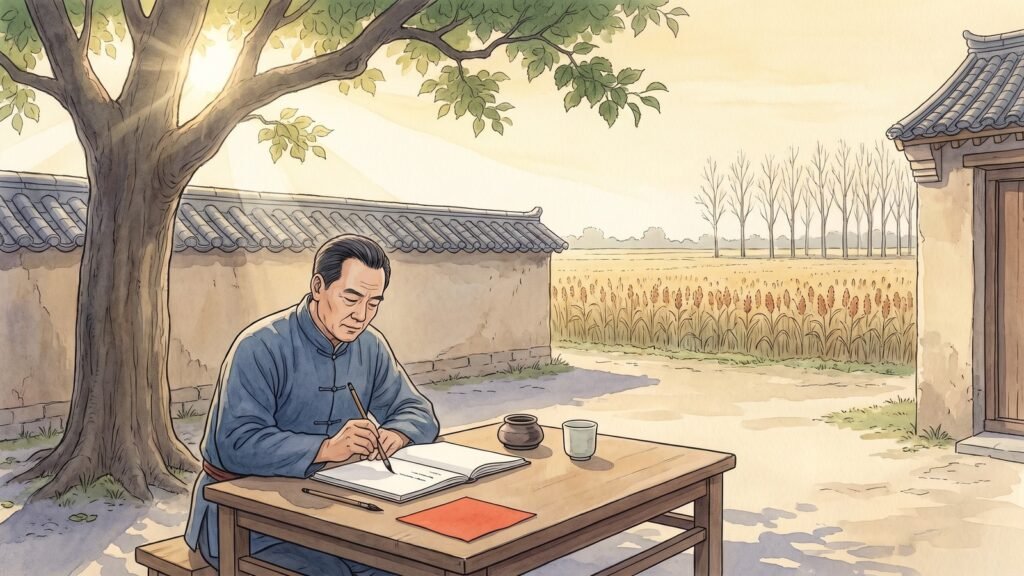
Mo Yan has explained that he came to understand the value of this territory only gradually. In his early stories he wrote about the army and about places he had not known well, and his writing changed when he recognised that the memories, sensations and stories of his village were inexhaustible. In essays he has described how a single image, such as a field of red sorghum, a black horse by a river or the voice of a storyteller, could become the seed of a story, and how he returned to Gaomi in his imagination even while living in Beijing. The real Gaomi changed greatly during his lifetime, as roads, railways and factories replaced much of the landscape he described, and he has written with some melancholy of the disappearance of the sorghum fields, which by the 1990s had largely given way to maize and other more profitable crops.
The local culture of the district also gave him material and forms. Gaomi is known in Shandong for its paper-cutting, its clay figures, its woodblock New Year prints and its maoqiang opera, a form of folk drama with a distinctive plaintive melody, and these crafts and performances appear throughout his work. Sandalwood Death is built on the rhythms of maoqiang; paper-cuts and clay figures appear in Frog, in which a craftsman makes clay dolls representing the children who were never born. Mo Yan has spoken of his wish to preserve in literature the sounds, songs and stories of a rural world that modernisation was rapidly changing, and critics have read his work as, among other things, a record of the oral and material culture of the north China countryside in the twentieth century.
The novels of the 1990s
Over the following two decades Mo Yan wrote a series of long novels set mostly in Northeast Gaomi, each different in form and tone. The Garlic Ballads, published in 1988, was based on a real incident in Shandong in 1987, when farmers who had been encouraged by local officials to grow garlic found that the market had collapsed and the officials would not buy their crops, and rioted, attacking government offices. The novel, structured around the songs of a blind folk singer, depicts the corruption and indifference of local officials and the desperation of the farmers, and it is among the most directly critical of his works. The Thirteen Steps, published in the same year, was an experimental novel of shifting narrators and perspectives.
The Republic of Wine, published in 1993, is a satirical novel in which a special investigator is sent to a provincial city, Liquorland, to investigate reports that officials there are eating children cooked as a delicacy. The narrative, interspersed with letters between an aspiring writer and a character named Mo Yan, and with the aspiring writer’s own lurid stories, becomes a phantasmagoria of feasting, drunkenness and confusion in which the investigator loses his way and his sense of reality. The novel has been read as an allegory of consumption and corruption, extending the theme of cannibalism that Lu Xun had used in “A Madman’s Diary” of 1918 as a metaphor for traditional Chinese society.
Big Breasts and Wide Hips, published in 1995, is perhaps his most ambitious novel. It follows a mother, Shangguan Lu, and her eight daughters and one son through the history of twentieth-century China, from the Japanese invasion through the civil war, land reform, the Great Leap Forward, the Cultural Revolution and the period of reform. The son, Shangguan Jintong, the only boy and the product of his mother’s union with a Swedish missionary, is a weak and dependent figure obsessed with women’s breasts throughout his life, while the women of the family bear the burdens of history. The novel presents the political campaigns of the century through the experience of a single family and a single village, and its depiction of the land reform and of the excesses of all sides in the civil war drew criticism from conservative critics, some of whom also objected to its sexual frankness. It won a large literary prize offered by a private company, but after criticism in official circles Mo Yan, still an army officer, withdrew it from circulation for a time and made a self-criticism. He left the army in 1997 and took a position at a newspaper of the procuratorate, and later at a cultural institution.
Sandalwood Death, Life and Death and Frog
In the 2000s Mo Yan published three of his most admired novels, each of which drew deliberately on Chinese traditional forms. Sandalwood Death, published in 2001, is set in Gaomi in 1900, during the Boxer Uprising and the German construction of the railway from Qingdao into the Shandong interior. Its central figure, Sun Bing, a performer of maoqiang, the local form of folk opera, leads a rebellion against the Germans and is condemned to an excruciating public execution, carried out by an imperial executioner who is the father-in-law of the local magistrate and the father of Sun Bing’s daughter. The novel is narrated in turns by its principal characters in a style modelled on the rhythms of the local opera, and its detailed depiction of the executioner’s craft made it one of the most disturbing of Mo Yan’s works. He described it as an attempt to write a novel that could be read aloud, in the manner of the market storytellers of his childhood, and as a “retreat” from Western influences toward the forms of Chinese popular tradition.
Life and Death Are Wearing Me Out, published in 2006, begins in 1950 with the execution of a landlord, Ximen Nao, during the land reform. In the underworld Ximen Nao protests his innocence to Lord Yama, the king of the dead, and is sent back to earth, reincarnated successively as a donkey, an ox, a pig, a dog and a monkey on the land that was once his, and finally as a child born in the year 2000. Through the eyes of these animals the novel follows half a century of rural history in Gaomi, from collectivisation through the Great Leap Forward, the Cultural Revolution and the reform era, and in particular the story of Lan Lian, the one peasant in the district who refused to join the collective and continued to farm his small plot alone. The novel uses the structure of the traditional Chinese chapter novel, with couplets as chapter headings, and its comedy and inventiveness were widely praised. Mo Yan said he wrote it in about forty-three days, by hand, working continuously.
Frog, published in 2009, is told through letters and a play written by a playwright, nicknamed Tadpole, to a Japanese writer, and it concerns his aunt, Gugu, a gifted village doctor who in the 1950s brings modern obstetrics to Gaomi, delivering thousands of babies, and who from the 1960s and 1980s becomes a zealous enforcer of the family planning policy, carrying out abortions and sterilisations. The novel examines the consequences of the one-child policy for the women and families of the village and for Gugu herself, who in old age is haunted by guilt. Its title plays on the similarity in Chinese between the words for “frog” and “baby”. Frog won the Mao Dun Literature Prize, the most prestigious official literary award in China, in 2011. The novel’s subject was a sensitive one, and critics in and outside China debated whether its treatment of the policy, which presents both the suffering it caused and the arguments made for it, constituted a critique or an accommodation. The history of the policy itself is described in the post on the one-child policy, 1980 to 2015.
Style, storytelling and “hallucinatory realism”
The phrase chosen by the Swedish Academy, “hallucinatory realism”, was intended to describe the distinctive combination in Mo Yan’s work of exact physical detail and fantastic or grotesque invention. His fiction is full of the sights, smells and sounds of rural life: the colour of sorghum, the taste of wine and food, the bodies of animals and people, often depicted in states of extremity, hunger, illness, sexual passion, violence and death. Into this world he introduces events that exceed realism: a man reincarnated as animals, children who eat iron, a boy who can see through a carrot. The Academy’s press release and the presentation speech compared him to writers such as Rabelais and Swift and to the tradition of magical realism, while noting his roots in Chinese oral storytelling.
Mo Yan has described himself above all as a storyteller. His Nobel lecture, delivered at the Swedish Academy on 7 December 2012, was titled “Storytellers”, and it consisted largely of stories: of his mother, of his childhood, of his early efforts as a writer and of the people of Gaomi who had inspired his characters. He spoke of the market storytellers whom he had followed as a boy, neglecting his chores, and of his realisation that the people of his village, their legends and their way of speaking were his true literary resources. He described the evolution of his work from the influences of foreign literature toward an increasingly independent use of Chinese traditions, and he ended with a parable about a boy who refuses to cry when the rest of his class cries on cue during a school visit to an exhibition of the suffering of the old society, a story that some listeners interpreted as a reflection on the writer’s duty to resist conformity.
Critics have also noted the importance of the body and of food in his work, the frequency of carnivalesque episodes in which social hierarchies are overturned, and the prominence of strong women. His prose is notably dense, digressive and exuberant, sometimes deliberately crude, and his novels frequently employ multiple narrators, shifts in time and self-referential devices, including the appearance of a character named Mo Yan who is sometimes treated with irony by the other narrators. Some critics, both Chinese and foreign, have found his work excessive, repetitive or careless in construction; others have argued that its excess is the source of its power.
Translation and international reception
Mo Yan’s international reputation depended to a great extent on his translators. His principal English translator was the American scholar Howard Goldblatt, who translated Red Sorghum in 1993 and most of the major novels thereafter, including The Garlic Ballads, The Republic of Wine, Big Breasts and Wide Hips, Life and Death Are Wearing Me Out, Sandalwood Death and Frog. Goldblatt’s translations were praised for their readability, and the scholar and translator also attracted discussion about the degree of freedom he took, including cuts and rearrangements made with the author’s agreement in order to adapt the novels for English-speaking readers. In Sweden his work was translated by the sinologist Anna Gustafsson Chen, and he was also translated widely into French, German, Italian, Japanese, Spanish and many other languages, so that by the time of the prize most of his major works were available in several European languages. French and Japanese readers had in fact taken a particular interest in his work from an early date, and Japanese writers, including Kenzaburō Ōe, the Nobel laureate of 1994, had long spoken highly of him.
In China itself Mo Yan was a well-established figure. He had won many of the country’s main literary prizes, he was vice-chairman of the Chinese Writers’ Association, the official body to which most professional writers belong, and his novels were widely read. His work had at times been criticised by conservative critics and officials, as with Big Breasts and Wide Hips, but he had never been banned, and he had generally avoided public political statements. This position, as an author who wrote critically about many aspects of Chinese history and society while remaining within the institutional framework of official literature, was the background to the controversy that followed the award.
The award of the prize
The Nobel Prize in Literature had been awarded to two writers of Chinese origin before Mo Yan, although neither was a citizen of the People’s Republic. In 2000 the prize was given to Gao Xingjian, a novelist and playwright who had left China in 1987, settled in France, and become a French citizen. His work, including the novel Soul Mountain, had been banned in China after he resigned from the Communist Party following the events of 1989. The Chinese government responded to his award by criticising the decision as politically motivated and by refusing to recognise it. In 2010 the Nobel Peace Prize was awarded by the Norwegian Nobel Committee to Liu Xiaobo, a literary critic and activist who was serving a prison sentence in China, and the Chinese government strongly protested the award and took a number of diplomatic measures against Norway. Against this background, the award of the literature prize in 2012 to a writer living in China and holding official positions was welcomed by the Chinese government and the official media, which reported it extensively as a recognition of Chinese literature. The official summary of the 2012 prize records the motivation.
The Swedish Academy stated that its decision was based solely on literary merit. Peter Englund, speaking to journalists after the announcement, described Mo Yan as a writer of great originality and recommended Garlic Ballads as a place for new readers to start. The prize, worth eight million Swedish kronor in that year, was presented at the ceremony in Stockholm on 10 December 2012. Mo Yan attended the ceremonies, gave his lecture and his banquet speech, and was received in Sweden with considerable public interest. The award prompted an immediate surge in sales of his books in China, where bookshops sold out of his works within days, and in translation abroad. His hometown in Gaomi became a destination for visitors, and his former family home was opened to the public.
The debate after the prize
The award provoked an international debate that continued for many months. Its critics advanced several arguments. Some pointed to Mo Yan’s membership of the Communist Party and his position as vice-chairman of the Writers’ Association. Others cited an episode in 2012, before the award, in which he had taken part, with about a hundred other writers, in a project to copy out by hand passages from Mao Zedong’s “Talks at the Yan’an Forum on Literature and Art” of 1942, the text that had subordinated literature to politics in Communist China, to mark its seventieth anniversary. Some writers criticised his decision to attend the Frankfurt Book Fair of 2009 as part of the official Chinese delegation, which had walked out of a symposium when dissident writers were invited to speak. The German-Romanian novelist Herta Müller, who had received the literature prize in 2009, described the 2012 award as a catastrophe, and the artist Ai Weiwei and some Chinese dissident writers made similar criticisms. At a press conference in Stockholm in December, Mo Yan was asked about censorship and compared it to security checks at airports, a remark that was widely reported and criticised.
Mo Yan’s statements immediately after the award also attracted attention. At a press conference in his hometown the day after the announcement, he said that he hoped Liu Xiaobo would be released as soon as possible and that he would be able to pursue his research in freedom, a remark that was not reported by the Chinese official media. In later interviews he defended his decision to write within China and argued that his novels should be judged as literature and not by his political statements, observing that his books themselves contained extensive criticism of injustice and corruption.
Many writers and critics defended the award. Supporters argued that his novels, read on their own terms, contained some of the most searching depictions of the violence and suffering of twentieth-century Chinese history, of the famine, the land reform and the family planning policy, and of the abuse of power by officials, to be found in Chinese literature. The scholar and critic Perry Link, while criticising Mo Yan’s public stance, acknowledged the literary quality of much of his work; other critics argued that the novels’ satirical and subversive energy had been underestimated by those who focused on the author’s public life. The novelist Salman Rushdie and others discussed the question of the writer’s responsibilities in a state with censorship. The debate became one of the most extensive public discussions of the relationship between literature and politics in China since the 1980s.
Scholars of Chinese literature have often pointed out that the debate reflected different expectations of what a writer from China should be. Outside China, the writers best known to Western readers had frequently been dissidents or exiles, and their reputations were bound up with their opposition to the government. Mo Yan represented a different position, that of a writer who had spent his career inside the official system, negotiating the limits of what could be published, and whose criticism was expressed through the indirections of fiction rather than through public statements. Whether that position was a compromise or a legitimate form of literary independence was, and remains, a matter of disagreement.
After the Nobel
In the years after the prize Mo Yan published relatively little new fiction for a time. He spoke in interviews of the difficulty of writing after the award, of the demands on his time and of the attention given to every word he said. In 2017 he published a group of new stories and a play, and in 2020 a collection of stories, poems and plays titled Late Bloomers, set like his earlier work in Gaomi. He has continued to give public lectures, to take part in literary events in China and abroad, and to work in calligraphy, an art he practised seriously after the prize. He holds a position at Beijing Normal University, where he directs an international writing centre, and he has served in various official cultural capacities.
His novels continue to be read and taught in China and abroad, and the prize led to new translations and editions in many languages. Several of his works have been adapted for the stage and the screen, including a television series based on Red Sorghum broadcast in China in 2014. The museum in his hometown, his former house, and the sorghum fields of Gaomi, which had become less common as farmers turned to other crops, have become part of the cultural identity of the district.
The significance of the 2012 prize
The award of the Nobel Prize to Mo Yan marked the recognition of a generation of Chinese writers who, in the decades after the Cultural Revolution, created a literature of great richness and variety. Its significance can be seen in several ways. For the Chinese government it represented an acknowledgement of the achievements of contemporary Chinese culture, after the years in which Nobel prizes connected with China had been sources of diplomatic friction. For Chinese readers and writers it was the fulfilment of a long-standing wish, sometimes described in the Chinese press as a “Nobel complex”, that a writer of the mainland be recognised by the world’s most famous literary prize. For international readers it drew attention to a body of fiction that, though available in translation for decades, had been read mainly by specialists and a relatively small number of enthusiasts.
The work for which the prize was given, the novels and stories of Northeast Gaomi Township, is likely to remain the centre of discussion of Mo Yan’s place in literature. In them a single rural district of Shandong becomes the stage for the whole history of modern China, told through the voices of peasants, bandits, executioners, mothers, animals and storytellers, in a style that combines the oral traditions of the countryside with the techniques of world literature. The debate about the writer’s public positions will no doubt continue, but the books, as the Swedish Academy and many of its critics alike acknowledged, are the basis on which the award was made and on which his reputation will ultimately rest.
References
- Mo Yan: Facts – The Nobel Prize
- Mo Yan: Biographical – The Nobel Prize
- Mo Yan: Nobel Lecture, Storytellers – The Nobel Prize, 7 December 2012
- The Nobel Prize in Literature 2012: Press release – The Swedish Academy
- The Nobel Prize in Literature 2012: Summary – The Nobel Prize
- Mo Yan, Grokipedia
- Red Sorghum (novel), Grokipedia
- Zhang Yimou, Grokipedia
- Big Breasts and Wide Hips, Grokipedia
- Life and Death Are Wearing Me Out, Grokipedia
- Nobel Prize in Literature, Grokipedia