At nine o’clock in the morning, Beijing time, on 15 October 2003, a Long March 2F rocket lifted off from the Jiuquan Satellite Launch Center in the desert of western Inner Mongolia, carrying a spacecraft named Shenzhou 5 and a single passenger, an air force pilot of thirty-eight named Yang Liwei. He orbited the earth fourteen times in a little over twenty-one hours, and on the morning of 16 October his capsule descended under its parachute onto the grasslands of central Inner Mongolia. With his flight China became the third country, after the Soviet Union and the United States, to launch a human being into orbit with its own rocket and spacecraft, forty-two years after the flight of Yuri Gagarin. The mission was the culmination of a programme approved eleven years earlier, and it drew on the work of tens of thousands of scientists, engineers and workers, as well as on ambitions for human spaceflight in China that went back to the 1960s. It also made Yang Liwei, previously unknown outside the air force, one of the most famous people in the country.
Early ambitions
China’s space programme grew out of its missile programme, which was organised in the second half of the 1950s under the direction of Qian Xuesen, an aerodynamicist who had worked at the California Institute of Technology and had helped to found the Jet Propulsion Laboratory before returning to China in 1955. The first Chinese satellite, Dongfanghong 1, was launched in April 1970 on a Long March 1 rocket from Jiuquan, and broadcast the song “The East Is Red” from orbit. In the same period planners began to study the possibility of human flight. A project for a two-person spacecraft, named Shuguang, or “Dawn”, was approved in the early 1970s, and a group of nineteen candidates was selected from among air force pilots in 1971. The project was cancelled in 1972 and 1973 because of its cost, the technical difficulties and the political conditions of the Cultural Revolution, and the candidates returned to their units. Biological experiments continued, and in 1975 China launched the first of a series of recoverable satellites, the Fanhui Shi Weixing, whose return capsules gave Chinese engineers experience in bringing spacecraft back from orbit.
Interest revived in the 1980s. In 1986 the government launched a national programme for high technology, known as the 863 Programme from the year and month of its approval, which included spaceflight among its fields, and engineers and scientists debated whether China should develop a small reusable spaceplane or a capsule. The capsule was chosen as the cheaper and more reliable option.
Project 921
On 21 September 1992 the Standing Committee of the Politburo approved a programme for human spaceflight, known by its date as Project 921. It was planned in three steps. The first was to launch astronauts into orbit and return them safely, and to conduct experiments in space. The second was to master the techniques of extravehicular activity and of rendezvous and docking between spacecraft, and to launch a small space laboratory. The third was to build a permanently inhabited space station. The programme was managed by the China Manned Space Engineering Office, under the General Armaments Department of the People’s Liberation Army, and its industrial work was carried out by the China Aerospace Science and Technology Corporation and its predecessors, together with institutes of the Chinese Academy of Sciences and the universities. The chief designer of the programme in its early years was Wang Yongzhi, a rocket engineer, and the chief designer of the spacecraft was Qi Faren.
The spacecraft developed under the programme, named Shenzhou, often translated as “divine vessel”, owed much to the Soviet and Russian Soyuz. In 1995 China agreed with Russia for the transfer of technologies and training, including a Soyuz descent capsule, docking systems and space suits, and two Chinese air force pilots, Wu Jie and Li Qinglong, trained at the Gagarin Cosmonaut Training Center near Moscow in 1996 and 1997 and then became instructors for the Chinese astronaut corps. Shenzhou is, however, a distinct and larger design. Like Soyuz it consists of three modules: an orbital module at the front, in which the crew can live and work in orbit; a descent module in the middle, in which they ride during launch and return; and a service module at the rear, carrying propulsion, power and life-support systems. Unlike Soyuz, the Shenzhou orbital module has its own solar panels and control systems, so that it can remain in orbit after the crew has returned and function as an independent satellite for several months. The spacecraft is larger and heavier than Soyuz, with a mass of about eight tonnes.
The rocket for the programme, the Long March 2F, was developed from the Long March 2E, a launcher used for commercial satellites. Its designers increased its reliability and added a launch escape system, a tower above the spacecraft carrying solid rockets that could pull the descent and orbital modules clear of the rocket in an emergency on the pad or during the first minutes of flight. A new launch complex was built at the Jiuquan Satellite Launch Center, where the rocket is assembled vertically in a tall building and moved to the pad on a mobile platform along a rail track. A recovery zone was established on the grasslands of Siziwang Banner in central Inner Mongolia, and a fleet of tracking ships, the Yuanwang, was prepared to follow the spacecraft over the oceans, where no Chinese ground stations could see it.
The unmanned flights
Four unmanned test flights preceded Yang Liwei’s mission. Shenzhou 1 was launched on 20 November 1999 and returned after fourteen orbits, a duration that would be repeated on the first crewed flight. Shenzhou 2, launched in January 2001, was the first fully equipped version of the spacecraft and carried small animals and biological samples; its descent module returned after a week, while the orbital module continued its work in orbit for several months. Shenzhou 3, in March and April 2002, carried a mannequin equipped with sensors to measure the conditions that an astronaut would experience, and Shenzhou 4, launched on 29 December 2002 in the cold of the desert winter, carried a full set of life-support equipment and was considered the dress rehearsal for crewed flight. Chinese accounts later described problems detected during these flights and corrected before the crewed mission, including faults in the parachute system and the environmental controls.
A pilot from Liaoning
Yang Liwei was born on 21 June 1965 in Suizhong County, in the city of Huludao in the province of Liaoning, on the narrow coastal corridor that leads from north China into the north-east. His mother was a schoolteacher, and his father worked in the local administration. Accounts of his childhood, published widely after his flight and in his own memoir, describe a boy who was fascinated by aircraft and who swam in the rivers near his home and played at flying with friends. He was a good student, particularly in mathematics, and in 1983, after finishing secondary school, he passed the selection examinations for the air force and entered the People’s Liberation Army Air Force’s Eighth Aviation School, a flight college in Xinjiang.
He graduated in 1987 and became a fighter pilot, flying Chinese-built jet fighters with air force units in the west and north of the country. By the time of his selection as an astronaut he had accumulated about 1,350 hours of flying time. Chinese accounts often recount an incident in which, during a training flight over the Turpan basin, the engine of his aircraft failed at low altitude, and he brought the aircraft back to land safely. Such episodes were used later to illustrate the qualities sought in astronaut candidates: calm under pressure, technical skill and physical fitness.
Selection and training
The selection of China’s first astronaut corps began in 1995 and 1996. More than fifteen hundred pilots of the air force were screened on the basis of their records, and the number was progressively reduced through medical, psychological and physical examinations. In January 1998, fourteen men were named as the first group of Chinese astronauts, or hangtianyuan; in Western usage they were sometimes called taikonauts, from the Chinese word for space, taikong. The group consisted of twelve new candidates, including Yang Liwei, together with the two instructors, Wu Jie and Li Qinglong, who had trained in Russia. All were air force pilots aged around thirty, of good education and with long records of accident-free flying, and all were married, since the selectors preferred candidates whose family situations were stable.
The astronauts lived and trained at a centre in the north-west of Beijing, later known as the Astronaut Center of China. Their training lasted five years and covered more than fifty subjects, including the theory of spaceflight, the systems of the spacecraft, astronomy, geography and meteorology, as well as physical conditioning and medical training. They practised in simulators of the Shenzhou spacecraft, rode in centrifuges that exposed them to the high accelerations of launch and re-entry, experienced weightlessness for short periods in aircraft flying parabolic arcs, underwent tests in low-pressure chambers and rotating chairs, and trained for survival after landing in desert, at sea and in cold mountains. The physical demands of the centrifuge training, in which candidates experienced loads of up to eight times the force of gravity for extended periods, were often described in Chinese accounts.
By 2003 the selectors had chosen three candidates for the first flight, Yang Liwei, Zhai Zhigang and Nie Haisheng, ranked in that order. The choice of the astronaut who would fly was made public only on the eve of the launch. Yang was told the day before, and his name was released to the public only shortly before the flight. The secrecy was characteristic of the programme, whose budget, organisation and timetable were not published in detail; Chinese officials stated only that the first crewed flight would take place in the second half of 2003.
The flight of Shenzhou 5
On the morning of 15 October Yang Liwei was seen off at the launch site by senior officials, including members of the Politburo, and was driven to the pad, where he boarded the spacecraft and strapped into the single seat in the descent module. The Long March 2F lifted off at nine o’clock. The ascent was later revealed to have been more difficult than it appeared from outside. In his memoir and in interviews published in later years, Yang described how, about two minutes into the flight, the rocket began to vibrate violently at a low frequency that resonated with the human body, causing him intense pain and the sensation that his internal organs were being shaken apart. The vibration lasted for about twenty-six seconds, and for some time afterwards he lay still, unable to speak, so that the engineers on the ground feared that something had gone wrong. The problem was traced to the interaction between the rocket’s structure and the flow of fuel to its engines, known in rocket engineering as the pogo effect, and was corrected for subsequent flights.
About ten minutes after launch the spacecraft separated from the rocket and entered an elliptical orbit, which was later raised to a nearly circular orbit at an altitude of about 340 kilometres. Yang reported that he felt well. He remained in the descent module for most of the flight, eating, resting and carrying out observations, and for a time moved into the orbital module. During the flight he displayed the national flag of China and the flag of the United Nations in front of the cabin camera, and spoke to his wife and young son in a broadcast conversation. He made entries in a logbook, writing that the Chinese people had come to space for the peace and progress of humankind; the words were later quoted widely. He photographed the earth and observed it through the cabin’s window, remarking later that he had not been able to see the Great Wall from orbit, a comment that was widely reported in the Chinese press and that prompted discussion of an old claim in Chinese school textbooks.
The flight was directed from the Beijing Aerospace Control Center, a large building in the north-western suburbs of the capital, whose main hall, with its tiers of consoles facing a wall of screens showing the spacecraft’s track across a map of the world, became a familiar image in the Chinese media. The centre received data from the tracking stations and ships, calculated the orbit, sent commands to the spacecraft and maintained voice contact with the astronaut. Senior leaders gathered there during the flight, and the premier, Wen Jiabao, spoke with Yang Liwei by radio while he was in orbit. The control of the mission was divided between Jiuquan, which was responsible for the launch and the first minutes of ascent, Beijing, which controlled the spacecraft in orbit, and the recovery command in Inner Mongolia. The coordination of these organisations, together with the industrial teams that had built the rocket and the spacecraft and the medical teams responsible for the astronaut, was the work of a management system developed over the previous decade, in which separate chief designers and chief commanders were responsible for each of the programme’s seven systems: the astronauts, the scientific payloads, the spacecraft, the rocket, the launch site, tracking and control, and landing and recovery. This structure was retained for later missions and is often cited in China as a model for the organisation of large engineering projects.
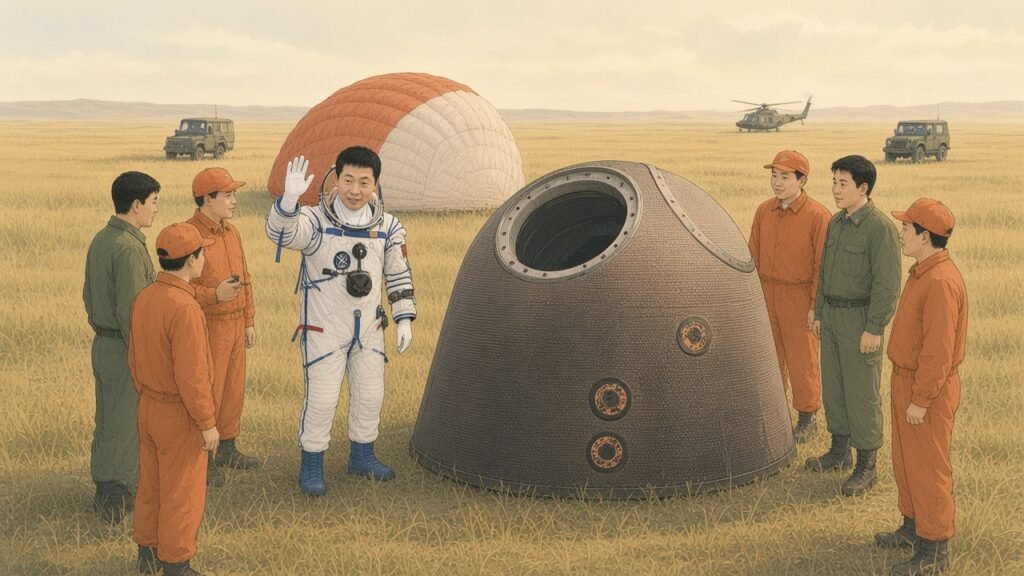
On its fourteenth orbit the spacecraft prepared for return. The orbital module separated and remained in orbit, where it continued to function for several months as a reconnaissance and experimental platform. The service module fired its engines to slow the spacecraft and then separated, and the descent module entered the atmosphere, protected by its heat shield, and descended under a large parachute. The capsule landed at about 6.23 in the morning of 16 October in the recovery zone in Siziwang Banner, about five kilometres from its intended point, after a flight of about twenty-one hours and twenty-three minutes. Recovery crews reached it within minutes, and Yang climbed out of the hatch unaided and was helped to stand, waving to the cameras. Asked how he felt, he replied that he felt very good and that he was proud of his country.
Inside the descent module
The cabin in which Yang Liwei flew was a bell-shaped capsule about two and a half metres in diameter, its interior crowded with control panels, storage lockers and life-support equipment. For the first flight only one of the three seats was fitted, and the space beside it was used for equipment and supplies. The seat was a moulded couch shaped to the astronaut’s body, set to absorb the shocks of launch and landing, and its shock absorbers were designed to cushion the final impact of the capsule on the ground, which was softened by small solid rockets that fired a moment before touchdown. In front of the seat were display screens showing the spacecraft’s position and the state of its systems, and a set of switches and handles allowing the astronaut to take over some functions manually if the automatic systems failed. A small window let him see the earth.
He wore a pressure suit of Chinese manufacture, white with a blue and red trim and the national flag on the shoulder, designed to protect him if the cabin lost pressure during launch or return. Its design drew on the Russian Sokol suits worn on Soyuz, examples of which China had acquired in the 1990s. The suit was connected to the spacecraft’s air supply and communications by hoses and cables, and the astronaut could remove its gloves and open its visor while the cabin was pressurised. Food for the flight was prepared by a specialised laboratory and included rice, shredded pork, chicken and other dishes adapted to weightlessness, together with Chinese herbal tea. The cabin’s environmental system controlled temperature, humidity and the composition of the air, removing carbon dioxide with chemical absorbers.
The engineers had given great attention to safety. The launch escape system on the Long March 2F could separate the spacecraft from the rocket at any point from the pad to the moment, about two minutes after launch, when the escape tower was jettisoned; after that, the spacecraft itself could separate and make an emergency return. Emergency landing zones were designated along the ground track of the first orbit, in China and abroad and in the oceans, and recovery forces were positioned to reach them. The descent module carried a reserve parachute in case the main one failed, and the astronaut was trained to survive for several days after landing in the wrong place, with emergency rations, a radio beacon and a small survival kit that was reported to include a pistol, a knife and fishing equipment.
The other members of the 1998 group continued their training after the first flight, and almost all of them later flew in space. Nie Haisheng, who had been the third-ranked candidate in 2003, flew on Shenzhou 6, Shenzhou 10 and Shenzhou 12, the first long-duration mission to the Tiangong station; Zhai Zhigang flew on Shenzhou 7 and Shenzhou 13; Jing Haipeng flew three times, including the month-long Shenzhou 11 mission. Fei Junlong, Liu Wang and Deng Qingming also flew. A second group, selected in 2010, included the first women astronauts, Liu Yang and Wang Yaping, and later groups included engineers and scientists as well as pilots.
Reception and fame
The descent module in which Yang Liwei returned was later placed on public display. It is exhibited at the National Museum of China on Tiananmen Square in Beijing, in the permanent exhibition known as the Road of Rejuvenation, which presents the history of China from the nineteenth century to the present. The capsule is shown with its scorched outer surface as it came back from orbit, the circular hatch at its top open to show the interior, and beside it stands the pressure suit that Yang wore during the flight. Its place in an exhibition otherwise devoted largely to political and military history reflects the way in which the first crewed flight was presented as a national milestone rather than only as a technical achievement.
News of the launch was released in China shortly after the rocket left the pad, and the landing the next morning was broadcast live. The flight was greeted with official celebrations and widespread public enthusiasm. The president, Hu Jintao, who had attended the launch, described it as a glorious achievement of the Chinese people, and messages of congratulation came from the governments of many countries, including the United States and Russia, and from the United Nations. Newspapers carried the story on their front pages for days, and Yang’s face appeared on posters, stamps and commemorative coins. On 7 November 2003 the Central Military Commission and the State Council conferred on him the honorary title of “Space Hero”. He was promoted, and a long tour of public appearances followed, in China and abroad, including visits to Hong Kong and Macau, where he was received by large crowds, and to the headquarters of the United Nations in New York.
The flight was presented in China as a demonstration of national technological capacity and as a symbol of the country’s rise. It came at a time of rapid economic growth, two years after the accession to the World Trade Organization and the award of the 2008 Olympic Games to Beijing, and it was widely interpreted in the Chinese press as evidence that the country had joined the leading powers in science and technology. Foreign commentary also discussed the flight’s significance for the military and political balance in Asia and for the future of international cooperation in space. Chinese officials stated that the programme was for peaceful purposes and that China would be willing to cooperate with other countries.
For Yang Liwei himself the flight brought a new career. He did not fly in space again, but he became one of the leading officials of the programme. He served as deputy director of the China Astronaut Research and Training Center and then as deputy director of the China Manned Space Engineering Office, the body that manages the programme, and he was promoted to the rank of major general in 2008. He took part in the selection and training of later astronauts and represented the programme at international meetings and in public education. His memoir, published in 2010 under a title that may be translated as Nine Levels of Heaven, gave the first detailed public account of the vibration during the ascent and of many other aspects of the programme. An asteroid, 21064 Yangliwei, was named in his honour. In later years he was regularly interviewed on the anniversaries of his flight and on the occasion of new missions.
Yang Liwei’s home county also marked his achievement. Suizhong built a memorial exhibition devoted to his life and flight, and his old school displayed his photographs and letters to pupils. In interviews in later years he described the difficulty of adjusting to fame after a career spent in the anonymity of the air force and the closed world of the astronaut centre, and he spoke of the responsibility he felt to the engineers and workers whose efforts had been concentrated in his single day in orbit. He returned to the theme often when speaking to students, emphasising that the flight had been the achievement of a very large team.
The second and third steps
The flight of Shenzhou 5 completed the first of the three steps of Project 921. The programme moved on steadily. Shenzhou 6, launched in October 2005, carried two astronauts, Fei Junlong and Nie Haisheng, for five days, during which they moved between the descent and orbital modules and carried out experiments. Shenzhou 7, in September 2008, carried three astronauts, and on 27 September Zhai Zhigang, who had been one of the candidates for the first flight, made China’s first spacewalk, wearing a Chinese-built suit named Feitian and waving a small national flag outside the orbital module.
The second step continued with the launch of a small space laboratory, Tiangong 1, in September 2011. The unmanned Shenzhou 8 docked with it in November 2011, and Shenzhou 9 in June 2012 carried the first Chinese woman in space, Liu Yang, together with Jing Haipeng and Liu Wang, who performed the first manual docking. Shenzhou 10, in June 2013, carried another woman astronaut, Wang Yaping, who gave a lesson in physics from orbit to schoolchildren across China, an event watched by tens of millions of pupils. A second laboratory, Tiangong 2, launched in 2016, received the crew of Shenzhou 11 for a stay of thirty days, and was resupplied by an automated cargo spacecraft, Tianzhou 1, in 2017.
The third step was the construction of the Tiangong space station. Its core module, Tianhe, was launched in April 2021 on a Long March 5B, the most powerful Chinese rocket of its day, and the crew of Shenzhou 12 arrived in June to begin the long series of occupations. Two laboratory modules, Wentian and Mengtian, were added in 2022, completing the station in its basic T-shaped configuration. Since then crews of three have lived aboard for six months at a time, with rotations overlapping so that the station is continuously occupied. Astronauts from the Hong Kong and Macau regions and from the civilian scientific community have joined the corps, and in 2023 a payload specialist, Gui Haichao, a professor of Beihang University, became the first Chinese civilian to fly in space. The programme has also announced plans to land astronauts on the Moon before 2030, using a new rocket, the Long March 10, and a new crewed spacecraft and lunar lander.
The launch site and the tracking network
The Jiuquan Satellite Launch Center, from which Yang Liwei flew, lies not near the city of Jiuquan in Gansu, whose name it bears, but some two hundred kilometres to the north-east, in the Ejin Banner of western Inner Mongolia, on the edge of the Badain Jaran desert near the lower course of the Ruo Shui river, known in Mongolian as the Ejin Gol. The site was chosen in the late 1950s for its remoteness, its dry climate and its clear skies, and it was built with Soviet assistance before the break between the two countries in 1960. The town that grew up around it, known as Dongfeng, houses the launch centre’s staff and their families. A cemetery at the site contains the graves of many of the engineers, soldiers and scientists who worked there, including the marshal Nie Rongzhen, who directed China’s defence science programmes in the 1950s and 1960s and whose ashes were partly interred there at his request.
Following a spacecraft in orbit requires a network of tracking and communications stations spread around the globe. China built ground stations across its own territory and arranged for stations abroad, including in Namibia, Pakistan and Kenya, and later in South America. Over the oceans the spacecraft was tracked by the Yuanwang ships, a fleet of instrumented vessels that had been developed in the 1970s for missile tests and satellite launches. For the Shenzhou 5 flight several Yuanwang ships were positioned in the Pacific, Indian and Atlantic Oceans to keep contact with the spacecraft during the parts of each orbit that passed beyond the reach of land stations. In later years the programme launched a series of data relay satellites, the Tianlian, which allowed continuous communication with crewed spacecraft and the space station from geostationary orbit, reducing the reliance on ships.
The recovery of returning capsules was a further task. For the first crewed missions a recovery force of helicopters and vehicles was stationed on the grasslands of Siziwang Banner, a region of rolling, sparsely populated steppe north of Hohhot whose flat terrain and open sky made it suitable for landing. The herding families of the area grew accustomed to the arrival of the capsules and the recovery teams, and some were honoured for their help in early missions. From 2016 the main landing zone was moved to the Dongfeng area near the launch centre, in the desert of western Inner Mongolia.
Experiments in orbit
Although the main purpose of Shenzhou 5 was to show that a person could be launched and returned safely, the mission also carried scientific and technical experiments, chiefly in the orbital module. After Yang Liwei’s return the orbital module remained in orbit for about six months, using its solar panels and control systems to carry out observations of the earth and tests of equipment. Chinese sources described it as having carried cameras for earth observation; some foreign analysts suggested that these may have had military reconnaissance applications. The descent module also carried seeds and biological samples, a practice continued on later flights, in which seeds exposed to the conditions of space were returned for experiments in plant breeding. Yang Liwei’s own body was the most closely studied experiment: his heart rate, blood pressure, breathing and other physiological signs were monitored throughout the flight and compared with data recorded in training, and he underwent extensive medical examination after landing.
Space in the national imagination
The flight had a strong effect on public interest in science and space in China. Applications to study aerospace engineering rose, and the astronauts became familiar figures in schools and the media. The programme’s successive missions were broadcast live, and the lessons given by astronauts from orbit to schoolchildren became an established tradition. The Shenzhou spacecraft, the Tiangong laboratories and the names of the astronauts entered the language of popular culture, appearing on postage stamps, in children’s books and in advertising.
Interest in human spaceflight also coincided with a revival of Chinese science fiction, whose leading writer is the subject of the post on Liu Cixin and the rise of Chinese science fiction. Liu’s novels, written in the years before and after Shenzhou 5, imagined Chinese astronauts and engineers taking part in the exploration of the solar system, and readers and critics often linked the growing confidence of the genre to the achievements of the real space programme. The names chosen for Chinese spacecraft and lunar probes, such as Chang’e for the Moon probes, after the goddess who flew to the Moon in Chinese legend, and Tianwen, or “Questions to Heaven”, for the Mars programme, after a poem attributed to Qu Yuan, drew on classical literature and mythology.
International context
China’s human spaceflight programme developed largely outside the international partnerships that shaped those of other countries. The International Space Station, assembled from 1998 by the United States, Russia, Europe, Japan and Canada, did not include China, and in 2011 the United States Congress passed a measure, often called the Wolf Amendment after its sponsor, restricting cooperation between the American space agency and Chinese organisations. China instead pursued its own station and invited cooperation through the United Nations Office for Outer Space Affairs, which in 2019 selected a number of international experiments to be flown on Tiangong. Chinese and European astronauts trained together in sea survival exercises in 2017, and in the 2020s China agreed with Pakistan to train a Pakistani astronaut for a visit to the Chinese station. The flight of Yang Liwei in 2003 was thus the beginning of an independent programme that, two decades later, had produced one of only two continuously inhabited stations in orbit.
A single orbit of history
Yang Liwei’s flight was brief, and in the technical sense it repeated what Soviet and American astronauts had done four decades earlier. Its significance lay in what it represented within the history of China: a capacity to design, build and operate the complex systems required to send a person into space and bring him back, achieved by a country that had launched its first satellite only thirty-three years before and that had been, at the start of the reform era in 1978, still largely a poor and agricultural society. The scale of the industrial and scientific base that made it possible is described in the post on the Chinese Academy of Sciences. For Yang Liwei, the day of 15 October 2003 made him a public figure for the rest of his life, and his account of the shaking of the rocket in its second minute became one of the best-known stories of the Chinese space programme, retold each time a new crew lifts off from the desert at Jiuquan.