
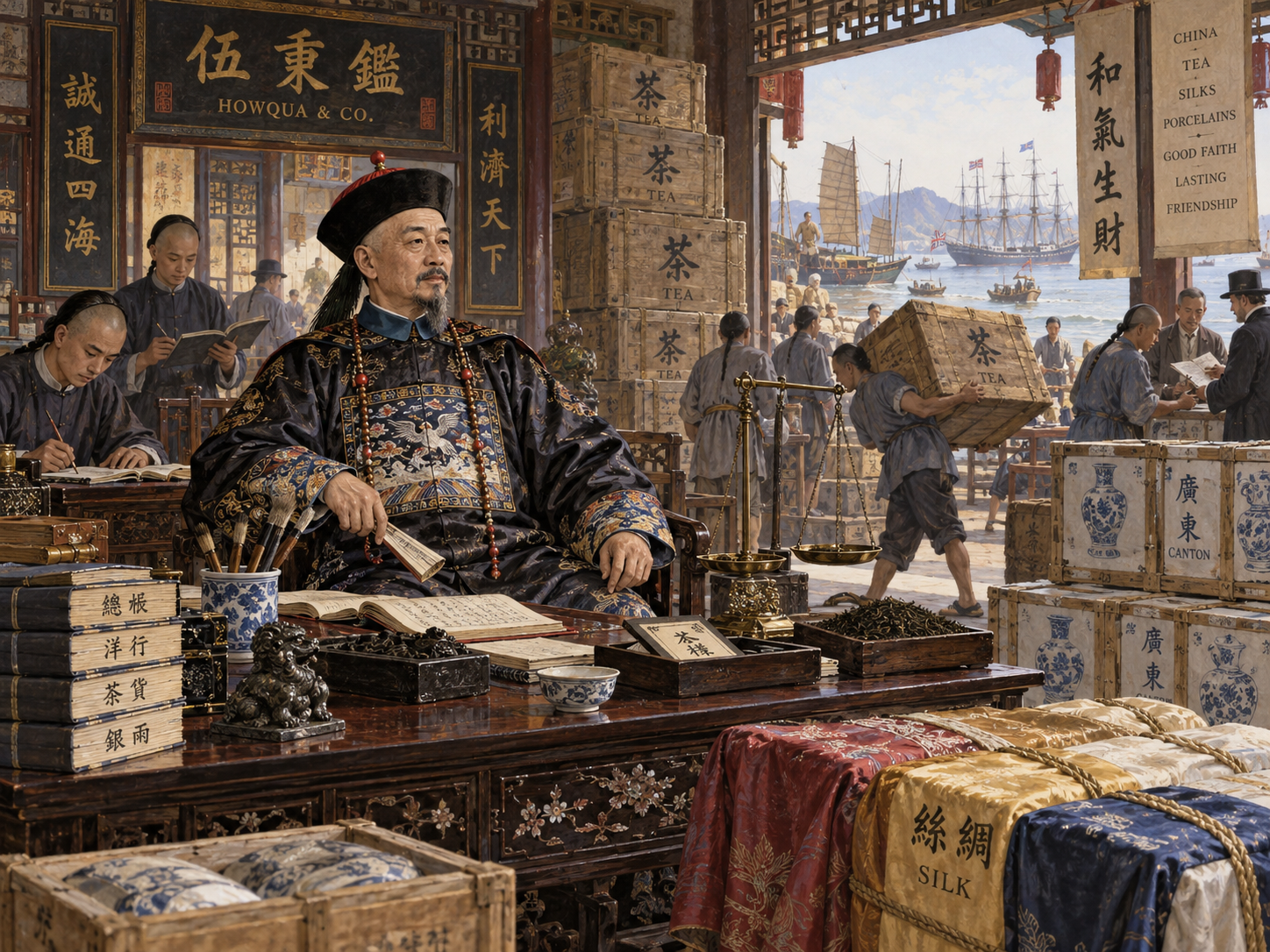
There is a habit in the West of treating China’s manufacturing dominance as a historical accident. We tell the story as if China appeared suddenly in the late twentieth century, offered the world cheap labour, absorbed Western factories and then somehow became the workshop of the planet. It is a neat story. It is also incomplete. Long before Shenzhen, long before container ports, long before electronics, electric vehicles and solar panels, there was Howqua. His Chinese name was Wu Bingjian. He lived from 1769 to 1843 in Canton, modern Guangzhou, and for a time he was quite possibly the richest merchant in the world. Contemporary estimates placed his fortune at roughly $26 million in 1834, an almost absurd amount of money for the period. But the size of his fortune is not really the interesting thing. What matters is how he made it. Howqua occupied the critical junction between Chinese production and foreign demand. He understood suppliers, credit, foreigners, shipping, officials, pricing and trust. He did not need to manufacture everything himself because he understood the more valuable skill: how to organise the people who did. Look at modern China and that sounds surprisingly familiar.
Under the Canton System, foreign merchants were largely confined to Canton and had to conduct trade through a small group of licensed Chinese merchants known collectively as the Cohong. Howqua became the greatest of them. It would be easy to dismiss him as the fortunate beneficiary of a protected system, and certainly his position gave him privileges, but that explanation only goes so far. Other Hong merchants failed. Some went bankrupt. Howqua became indispensable because foreign merchants trusted him, and in the China trade trust was worth almost as much as silver. His relationships with American merchants were particularly deep. Traders associated with firms such as Perkins & Company and Russell & Company became far more than customers. They became agents, partners and financial intermediaries. Howqua placed portions of his fortune abroad and became connected to investments in American railroads and mines. This was not some provincial merchant timidly selling tea to foreigners at the edge of an inward looking empire. This was an international capitalist managing money and relationships across oceans during the age of sail. He understood something that many merchants never understand: the network itself was the asset.
That matters because the great economic fact behind Howqua’s fortune was that the world badly wanted Chinese goods. Tea was the obvious product, but there was also silk, porcelain and an enormous range of sophisticated manufactured luxuries. Europeans came to China carrying silver because they often had remarkably little that Chinese merchants actually wanted. British demand for Chinese goods became so large that the trade imbalance itself turned into a strategic problem. The notorious solution was Indian opium, which helped reverse the flow of silver and contributed to the sequence of events that ended in the Opium Wars. None of this needs romanticising. The old China trade was full of monopoly privilege, corruption, narcotics, imperial ambition and eventually violence. But underneath all of it sat a stubborn economic reality: China could make things the rest of the world wanted, and foreigners were willing to cross oceans to buy them. That should sound familiar too.
Now move forward two centuries. Tea has become electronics. Silk has become industrial machinery. Porcelain has become batteries, telecommunications equipment, machine tools and solar panels. The tea clipper has become the container ship. Canton is no longer the single gateway but one node in an industrial belt that runs through Guangzhou, Shenzhen, Dongguan, Suzhou, Ningbo, Shanghai, Tianjin, Chongqing and dozens of other manufacturing cities. The products are radically different, yet the underlying picture has a strange continuity. China once again sits at the point where enormous productive capacity meets enormous global demand. According to the United Nations Industrial Development Organization, China accounted for only 2.8 percent of global manufacturing production in 1990. By 2024 its share had reached 32 percent. That is larger than the combined manufacturing shares of the United States, Japan, Germany and South Korea. This is not merely a large manufacturing sector. It is industrial concentration on a scale the modern world has rarely seen.
The lazy explanation is cheap labour. It is also increasingly wrong. China is no longer one of the cheapest places in the world to manufacture. There are many countries with lower wages, yet factory production has not simply drained out of China and moved to whichever country offers the lowest hourly rate. The reason is that wages are only one part of manufacturing. The real advantage is the ecosystem. A Chinese manufacturer can often find component makers, tooling specialists, mould makers, chemical suppliers, packaging companies, electronics firms, engineers, logistics providers and ports within one industrial region. A missing screw, sensor, circuit board, casing or machine component may be available from a supplier an hour away. Prototypes can become products at extraordinary speed because the infrastructure for making things already exists all around the factory. This is the part outsiders repeatedly underestimate. You can build a factory relatively quickly. You cannot build an industrial civilisation quickly.
And this is where Howqua becomes more than an interesting historical character. He begins to look like a clue. Howqua did not grow every tea leaf, weave every yard of silk or fire every porcelain bowl that passed through Canton. His genius was coordination. He understood that commerce at great scale depends less on owning every stage of production than on controlling relationships between them. He understood financing, reliability, logistics and reputation. Modern Chinese manufacturing operates at a scale he could never have imagined, but the principle is remarkably similar. The real product is not always the object coming off the production line. The deeper product is the network capable of making that object rapidly, cheaply, repeatedly and in enormous quantities. That is why copying a Chinese factory is much easier than copying Chinese manufacturing. A factory can be photographed, measured and rebuilt. A dense web of suppliers, skills, habits, relationships and accumulated know how cannot.
There is another reason Howqua matters. He complicates the familiar picture of old China as commercially naive, inward looking and unable to understand the outside world. The Qing state could certainly be suspicious of foreign influence, and the Canton System itself was designed partly to control foreign contact. But Howqua was anything but inward looking. He dealt constantly with Americans and Europeans. He understood international credit. He placed capital abroad. He cultivated relationships across profound cultural differences. He was operating globally before most people had any conception of a truly global economy. This matters because observers have been underestimating Chinese commercial sophistication for a very long time. Every few generations the outside world seems to rediscover that China contains exceptionally capable merchants, engineers, manufacturers and organisers, and every time it behaves as though this capability has appeared from nowhere.
None of this means modern Chinese manufacturing dominance was inevitable. Far from it. Between Howqua’s death in 1843 and China’s modern industrial rise came invasion, civil war, revolution, famine and enormous economic disruption. The factories of contemporary China are products of modern investment, modern reforms, modern infrastructure and decades of deliberate industrial development. There is no mystical cultural straight line from the Qing dynasty to Shenzhen. But history does reveal recurring strengths, and one of China’s recurring strengths is the ability to operate at scale. A huge domestic market creates huge commercial networks. Those networks encourage specialisation. Specialisation produces expertise. Expertise attracts more production. More production attracts more suppliers. More suppliers make production faster and cheaper. At some point the process becomes self reinforcing. China has taken that cycle further than any other manufacturing economy in the modern world.
That is why Howqua feels so contemporary. His world vanished shortly after his death. The Canton System collapsed. The Opium War broke the old trading order. Treaty ports opened. Steamships, industrialisation and imperial power changed the balance between China and the West. Yet the central commercial lesson of his life survived. Vast fortunes could be made by standing at the place where Chinese productive capacity met world demand and by making oneself indispensable to both sides. Two hundred years later, China itself occupies something close to that position. It has become difficult to make almost anything complicated without encountering some part of the Chinese industrial system, whether directly or several layers down the supply chain. Governments and companies can diversify. Other countries can and will build powerful industries. Supply chains will shift. But industrial gravity is real. Once thousands of suppliers, millions of skilled workers, enormous ports, specialised machinery, engineering expertise and deep pools of capital cluster together, the system starts pulling more activity toward itself.
That is the part of Howqua’s story worth remembering. We tend to remember tycoons because of the size of their fortunes. The more interesting ones understood something larger than money. They understood systems. Howqua understood the commercial system linking Chinese production to global demand better than almost anyone alive in his time. Modern China has done something remarkably similar with manufacturing. Seen in that light, Howqua is not merely a curiosity from a vanished Canton trading world. He is an early glimpse of a pattern that has returned on a scale he could scarcely have imagined. China did not suddenly discover how to organise trade, production and commercial networks in the twentieth century. It had been producing people who understood those things for a very long time. Howqua was one of the greatest of them.