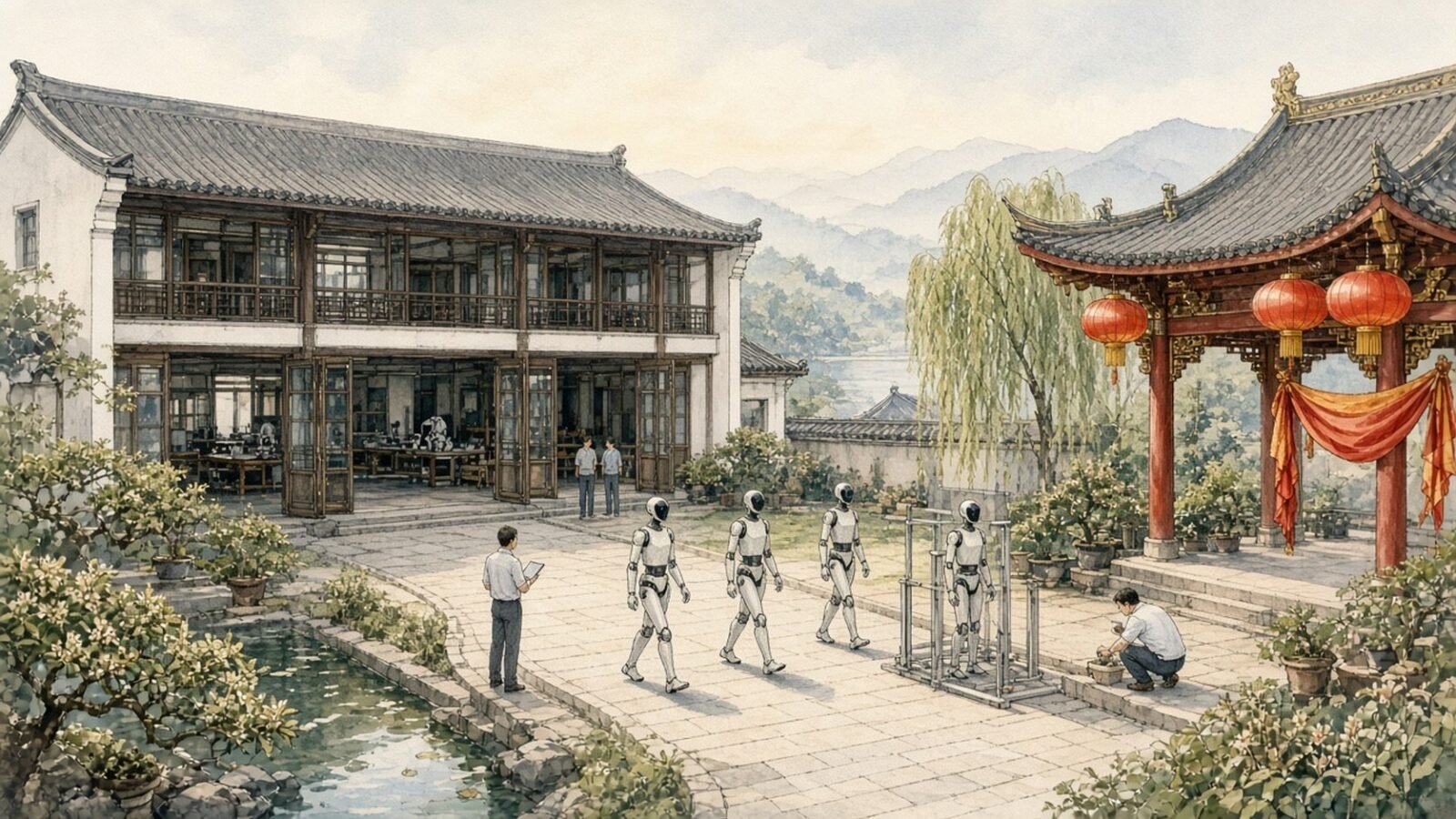
On 19 August 2026 Unitree Robotics began trading on the STAR Market of the Shanghai Stock Exchange, the first company built around humanoid robots to list on China’s mainland exchanges. That same day the World Robot Conference opened in Beijing. Ten years earlier Unitree had been one engineer, one four-legged prototype and a 50-square-metre office in Hangzhou. By 2026 Chinese firms were making nearly all of the world’s humanoid robots, the state had written “embodied intelligence” into its five-year plan, and the planning agency that wrote it was already warning about a bubble. This piece explains how China got there, who is building the machines, what sits inside them, and what they actually do once they leave the showroom.
Earlier posts on huaxia.click covered how DJI made consumer drones a Chinese industry, how China came to dominate batteries and the rare-earth magnet chokepoint. Humanoid robots draw on all three. They are small electric machines full of motors, magnets, batteries and sensors, and they are made in the same industrial districts that learned to make those parts cheaply.
From a Thesis Dog to a Listed Company
Unitree’s story begins at Shanghai University, where Wang Xingxing worked on legged robots as a postgraduate from 2013. His master’s project, a small quadruped called XDog, was unusual for its time. Most capable legged robots of the early 2010s used hydraulics, which are powerful but heavy, noisy and expensive. XDog used compact brushless electric motors driving the joints directly. That made it cheaper, quieter and easier to build in numbers. Videos of the little machine spread online and brought in both buyers and investors.
Wang joined DJI, the Shenzhen drone maker, after graduating but left within a few months. On 26 August 2016 he registered Hangzhou Yushu Technology, trading as Unitree, in a small office in Binjiang District. The first commercial quadruped, Laikago, followed in 2017. The Go and B series of robot dogs came after it and made Unitree the volume leader in four-legged robots, sold mainly to universities, laboratories, hobbyists and inspection users. In 2021 a pack of its quadrupeds danced together on CCTV’s Spring Festival Gala.
The turn to humanoids came in 2023. Unitree introduced its first two-legged model, the H1, that year. In 2024 it put the smaller G1 into mass production at a starting price of 99,000 yuan, roughly 16,000 US dollars, which was far below what most Western humanoids cost and made it the default research platform in many laboratories. In 2025 it added the full-size H2 and the lightweight R1, which Unitree’s own website lists from 4,900 dollars for the basic version and 5,900 dollars for the standard one, before tax and shipping.
The prospectus filed for the listing shows how far the pivot went. In 2025 Unitree reported revenue of about 1.7 billion yuan and a net profit attributable to shareholders of about 278 million yuan. Humanoid robots brought in 868 million yuan, more than half of the total, up from a negligible share in 2023. The filing also gives three different counts for its 2025 humanoids: 5,716 produced, 5,511 shipped and 5,215 sold, the gap being robots that had left the factory but had not yet been formally accepted by customers. At the offer price of 150.80 yuan per share Unitree raised about 6.1 billion yuan, roughly 910 million dollars, for a 10 per cent stake, which implied a valuation of around 61 billion yuan. Unusually for the sector, it was profitable when it listed.
Why a Television Dance Mattered
The single event that made humanoid robots familiar to ordinary Chinese households was a dance. On the eve of the Lunar New Year in January 2025, sixteen Unitree H1 robots appeared on the CCTV Spring Festival Gala, the most watched television programme in the country, in a segment directed by Zhang Yimou. Dressed in the bright flowered padded jackets of north-eastern China, they performed a yangge folk dance, changing formation and twirling red handkerchiefs alongside human dancers. Chinese media counted billions of online discussions of the routine in the following days.
Unitree itself credits the gala for part of its growth. Its prospectus says the share of revenue from customers inside China rose to 56.35 per cent in 2025 and names the national recognition from the performance as one reason. The company went back to the gala in February 2026 with 25 robots performing martial arts beside young students from the Tagou martial arts school in Henan. Chinese reports say models marketed as the “gala version” sold out within minutes when they went on sale on JD.com later that evening.
This kind of public display has a long history in Chinese industrial promotion, from model factories to televised launches of rockets and high-speed trains. It works by turning an abstract national goal into something people can watch. For a company selling robots that still have few proven commercial uses, it also works as marketing. Both things were true at once, and neither cancels the other.
Who Is Building Them
Unitree is the best known name abroad, but by 2026 it was no longer the largest. The research firm Smart Analytics Global estimated that about 19,100 humanoid robots were shipped worldwide in the first half of 2026, up 272 per cent from about 5,100 a year earlier. Counterpoint Research put the figure above 22,000. Both firms ranked the same five companies at the top, in the same order.
- AgiBot (Zhiyuan Robotics), Shanghai. Founded in February 2023, with Peng Zhihui, a former member of Huawei’s “Genius Youth” recruitment programme, as co-founder and chief technology officer. It shipped about 8,400 robots in the half-year according to SAG and about 9,700 according to Counterpoint, overtaking Unitree with more than 40 per cent of the global total.
- Unitree, Hangzhou. About 5,900 units according to SAG, or more than 7,000 according to Counterpoint, around 31 per cent of the world total. Its half-size G1 had reached roughly 11,000 cumulative units by mid-2026.
- Galbot, Beijing. Just over 1,100 units, about 5 per cent.
- UBTech, Shenzhen. Listed in Hong Kong since December 2023. Its full-size Walker series is aimed at factories and commercial sites, and it reported 1,079 humanoids sold in 2025 for revenue of about 821 million yuan, up from 36 million yuan the year before.
- Leju Robotics, Shenzhen. About 650 units.
Behind these five sits a long tail. In November 2025 the National Development and Reform Commission counted more than 150 humanoid robot companies in China, more than half of them start-ups or firms from other industries. Some of those entrants are large. The phone maker Honor built the robot that won the 2026 Beijing half-marathon. Carmakers have joined too, because a humanoid robot shares much of its hardware with an electric car: motors, batteries, power electronics, cameras and the software that interprets what the cameras see. Readers who followed Xiaomi’s move from phones into cars or BYD’s rise will recognise the pattern of a company using one manufacturing base to enter the next product.
There is also a state-backed research arm. The Beijing Humanoid Robot Innovation Center, which trades as X-Humanoid, was set up with city and industry backing to develop open platforms that smaller firms can build on. Its Tiangong robots have become a fixture of Beijing’s public events.
SAG estimated that Chinese companies made more than 97 per cent of the humanoids shipped in the first half of 2026, and that China accounted for more than 85 per cent of demand. Most of the market, in other words, is Chinese firms selling to Chinese customers.
The Supply Chain Under the Skin
A humanoid robot is mostly joints. Each joint needs an actuator, which is a motor, a gearbox or screw to turn fast weak rotation into slow strong movement, a sensor to measure position and force, and a controller. Industry studies estimate that actuators make up between 40 and 60 per cent of a humanoid’s bill of materials. Morgan Stanley’s widely cited 2025 report The Humanoid 100 put the parts cost of a Tesla Optimus Gen 2 at roughly 50,000 to 55,000 dollars, with the legs as the single most expensive block and the hands next.
Three components matter most.
- Harmonic reducers, compact gearboxes that use a flexing steel ring to give high reduction in a small space. They were long dominated by Japan’s Harmonic Drive Systems and Nabtesco. Leaderdrive, a company in Suzhou, has become the main Chinese supplier for humanoids.
- Planetary roller screws, which turn rotation into precise linear push and pull for the large joints. They are hard to make and have few suppliers, and analysts regard them as one of the likeliest bottlenecks as volumes grow.
- Motors and magnets. Almost every electric actuator relies on rare-earth permanent magnets, a material China dominates from mine to finished magnet.
The Chinese advantage here is less about any single breakthrough than about the surrounding industry. Car-parts makers such as Sanhua and Tuopu, which already supply actuator-like assemblies to electric-vehicle makers including Tesla, have moved into humanoid joint modules. A McKinsey analysis cited estimates that building an Optimus Gen 2 without Chinese suppliers would raise its bill of materials from about 46,000 dollars to about 131,000, close to three times as much. That is the same logic that made China the cheapest place to build consumer electronics and electric cars: dense clusters of suppliers, short distances between them, and many competitors pushing prices down.
Official planning now aims to push this further down the chain. A National Development and Reform Commission feature on the 15th Five-Year Plan, published in April 2026, noted that a dexterous robot hand has close to twenty joints and more than thirty patents in its fingertip “skin” alone, and that about a hundred companies work together on a single hand design. It set a goal of raising the domestic share of the specialist steels used in robot “skeletons” from about 30 per cent to more than 70 per cent within five years. It also described a new laboratory working on tendon-like cords for robot joints whose core team came from a textile company, an example of older industries being pulled into the new one.
Teaching Robots With Data
Building a robot that can walk is now largely a solved engineering problem. Building one that can do useful work in an untidy room is not. The large language models behind chatbots learned from text gathered off the internet. There is no equivalent internet of physical movement, so robot makers have to create the data themselves.
Chinese firms have approached this as an industrial problem. AgiBot built a data-collection centre in Shanghai of more than 4,000 square metres, laid out as mock homes, shops, restaurants, offices and factory stations, where about a hundred robots are run through tasks. Human operators guide them using virtual-reality headsets and motion-capture suits, and each successful attempt is recorded and checked. The company’s published research describes more than a million recorded trajectories across 217 tasks, released in part as an open dataset called AgiBot World. Beijing and other cities have set up similar public “training grounds” where several companies can share the cost of collecting data.
This connects humanoid robots to China’s wider AI effort. Hangzhou, where Unitree is based, is also home to DeepSeek, and the two were grouped in Chinese media in 2025 among the city’s “six little dragons” of technology start-ups, as described in our piece on Hangzhou’s rise. The large pool of AI researchers now working in China, covered in an earlier post, is part of the same story. Unitree has said that after its listing it will spend more on embodied AI foundation models, the software layer that is meant to let one robot learn many tasks.
Data collection also creates jobs of its own. The same NDRC planning feature predicted that new roles such as data collector and robot fleet coordinator could employ more than a million people during the 15th Five-Year Plan period.
Races, Games and Public Tests
Chinese cities have turned robot testing into public events. On 19 April 2025 the Beijing E-Town district of Yizhuang held what it called the world’s first humanoid robot half-marathon, run on the same day and over the same 21.0975-kilometre course as a race for about 12,000 human runners. Twenty robot teams took part. The winner was X-Humanoid’s Tiangong Ultra, a robot about 1.8 metres tall and weighing about 55 kilograms, in 2 hours, 40 minutes and 42 seconds. Many others fell, overheated or needed battery changes along the way, and those stumbles were part of the point. Long-distance running tests heat dissipation, joint wear, balance and navigation in a way that a short demonstration does not.
A year later the improvement was striking. At the 2026 race on 19 April more than a hundred robot teams entered. A 169-centimetre robot named Lightning (Shandian), developed by Honor and run by a team called Monkey King, won the robot category with a net time of 50 minutes and 26 seconds while navigating on its own. A remote-controlled version finished in 48 minutes and 19 seconds. The organisers said the winning autonomous time was more than six minutes faster than the men’s world record for a human half-marathon. A robot built for one flat urban course is not a human athlete, but going from almost three hours to under an hour in twelve months shows how quickly the hardware is improving.
In August 2025 Beijing also hosted the first World Humanoid Robot Games at the National Speed Skating Oval, built for the 2022 Winter Olympics. About 280 teams from 16 countries competed in 26 events, including running, football, kickboxing and practical tasks such as sorting medicines and cleaning. Unitree robots won the 1,500 metres, the 400 metres and the relay, and Tiangong Ultra won the 100 metres in 21.50 seconds. The football matches, played by small robots that fell over constantly, became the most shared clips of the event.
The State’s Push and Its Warning
Government support has been explicit. In March 2025 the annual government work report named embodied intelligence as a future industry for the first time. Ministries and city governments followed with guidance funds, subsidies, open-access training centres and procurement by state-owned firms. The 15th Five-Year Plan, covering 2026 to 2030, lists embodied intelligence among a small group of future industries alongside quantum technology, biomanufacturing, hydrogen and fusion energy, brain-computer interfaces and 6G communications. The NDRC said that investment in embodied-intelligence robotics in the first two months of 2026 was already equal to half of the total for 2025.
The same agency has also been the most prominent voice of caution. On 27 November 2025 NDRC spokeswoman Li Chao told a press conference that the industry was growing explosively but had “yet to fully mature in terms of technological pathways, business models and application scenarios”. She warned against “highly repetitive” products crowding the market and squeezing out research and development. “Speed and bubble have always been issues that need grasping and balance in the development of frontier industries,” she said, and the same applied to humanoid robots. The commission promised industry standards, evaluation systems and better rules for companies entering and leaving the sector.
This is a familiar sequence in Chinese industrial policy. The state names a priority, local governments and investors pour in money, dozens of firms make similar products, and the centre then tries to manage the resulting overcapacity. Solar panels, electric vehicles and batteries all went through versions of this cycle, with many failures along the way and a handful of very strong survivors. Officials appear to expect humanoid robots to follow the same path. A report from the State Council’s Development Research Center put the embodied-intelligence market at 400 billion yuan by 2030 and over a trillion yuan by 2035.
Counting the Robots
Production numbers for the industry vary widely depending on who is counting. SAG and Counterpoint both put global first-half 2026 shipments at around 20,000. Chinese industry bodies give much larger figures. The Humanoid Robot Scene Application Alliance estimated more than 30,000 units shipped in China alone in the first half, including about 12,000 wheeled machines with humanoid upper bodies. Another industry committee put the figure above 40,000. Reports of official forecasts suggest that total Chinese production could pass 100,000 units in 2026.
Part of the gap comes from definitions. Some counts include wheeled robots with arms and a head, while others count only machines that walk on two legs. Part of it comes from the difference between producing, shipping and selling, which Unitree’s own filing shows can differ by hundreds of units. And part of it is simply that most of the companies involved are private and publish little. Listed firms such as Unitree and UBTech are the exception, which is why their filings are quoted so often.
What the Robots Actually Do
The most important question is who buys these robots and for what. The honest answer in 2026 is that most still go to research, education, exhibitions and entertainment. Analysts note that research and education customers make up a large part of Unitree’s sales. Universities buy robots as platforms for their own AI work, schools buy them for teaching, and shopping centres, museums and tourist sites rent them as attractions. That is a real market, and a profitable one for Unitree, but it is not yet the factory workforce that investors are betting on.
Industrial use is growing, slowly. AgiBot and UBTech have sold robots to carmakers, electronics plants and logistics firms for tasks such as moving parts boxes, inspecting assembly lines and sorting goods. These are trials rather than replacements for workers, and reports describe customers facing high integration costs and robots that are still slower than people at most jobs. UBTech has been reported to have fallen short of some of its own delivery targets, which shows how hard the move from orders to working deployments can be.
There is a reason for patience, at least in China. The country’s working-age population is shrinking, and manufacturers in the coastal provinces have long struggled to find young workers willing to stand on assembly lines. Factory automation with conventional industrial arms has already gone further in China than almost anywhere else. Humanoids are pitched as the next step: machines that can work in spaces designed for people without rebuilding the whole factory. Whether that pitch holds up depends on cost, reliability and software, and all three are still being worked out.
What to Watch
Several things will show whether the boom turns into a lasting industry.
- Prices. Unitree’s R1 at under 6,000 dollars shows how low entry prices can go. The next test is whether full-size working robots fall to the price of a small car.
- Consolidation. With more than 150 firms making similar machines, mergers and failures are likely. Watch which companies win repeat orders from factories rather than one-off showcase sales.
- Components. Domestic harmonic reducers, roller screws, sensors and dexterous hands will decide costs. A Chinese lead in parts could matter more than any one robot brand, much as it did for batteries.
- Software. The hardest problem is getting robots to cope with new tasks without weeks of retraining. Progress in embodied AI models, and in the data collected at training centres, will matter more than marathon times.
- Exports. At present most robots are sold inside China. If cheap Chinese humanoids start selling widely abroad, they may face the same tariff and security arguments that met Chinese electric cars and drones.
China’s humanoid robot industry grew out of an earlier set of industries, including drones, batteries, electric cars and consumer electronics, and it follows the same pattern of state backing, intense local competition and fast falling costs. The robots can now dance on national television, run a half-marathon in under an hour and walk off an assembly line in their thousands. Proving that they can do steady, paid work is the stage that began in 2026.
Sources
- TechNode, “Why Unitree became the first humanoid robot company to go public in China,” 20 August 2026 — listing date, ticker 688836, offer price, proceeds, 2025 revenue and profit.
- Humanoid Analytics, “How many humanoid robots have actually been sold in 2026?”, 27 August 2026 — Unitree produced/shipped/sold figures, valuation, comparison of SAG, Counterpoint and Chinese industry estimates.
- Smart Analytics Global, “Global humanoid robot shipments surged 272% YoY to 19.1K units in 1H 2026; AGIBOT overtook Unitree,” 10 August 2026.
- Axis Intelligence, “China humanoid robot companies 2026: shipments, revenue per robot, and the disclosure gap,” citing Counterpoint Research and UBTech’s 2025 annual results filed with HKEX on 31 March 2026.
- RoboticsIntl, “AgiBot and Unitree split 26,000 units in China’s 100,000-robot projection” — reported MIIT forecasts and customer mix.
- Grokipedia, “Unitree Robotics” — founding, XDog, H1 and G1 chronology; Unitree, official R1 product page (prices).
- 36Kr, “Unitree’s high-time IPO amid intense humanoid robot market competition” — Laikago, 2021 gala quadrupeds, G1 launch price, 2025 gala.
- Odaily, “Wang Xingxing’s nine-year, 10,000x Unitree” — 2025 and 2026 Spring Festival Gala performances, prospectus figure on domestic revenue share.
- Xinhua via english.www.gov.cn, “China to promote sound, orderly development of embodied intelligence industry,” 27 November 2025; AFP via France 24 and South China Morning Post coverage of the same NDRC briefing.
- National Development and Reform Commission, “‘十五五’新图景:聚力‘未来产业’ 引领产业未来,” 1 April 2026 — 15th Five-Year Plan future industries, investment pace, component and employment targets.
- Beijing Municipal Government (english.beijing.gov.cn), reports on the 2025 and 2026 Beijing E-Town humanoid robot half-marathons; X-Humanoid press release on Tiangong Ultra, 19 April 2025; Xinhua, “Humanoid robot ‘Lightning’ breaks human record in Beijing half-marathon,” 19 April 2026; Beijing E-Town official event page.
- Global Times and Xinhua coverage of the World Humanoid Robot Games, Beijing, 14–17 August 2025.
- AgiBot World Colosseo research paper (arXiv 2503.06669) and agibot-world.com — data-collection centre and dataset.
- Morgan Stanley, The Humanoid 100: Mapping the Humanoid Robot Value Chain, February 2025; CNBC, “China car suppliers can be early winners in humanoid race: Morgan Stanley,” 22 June 2025.
- McKinsey & Company, “Scaling the humanoid robotics supply chain into billion-dollar wins” — actuator cost share, harmonic drive and roller screw bottlenecks, cost without Chinese suppliers.