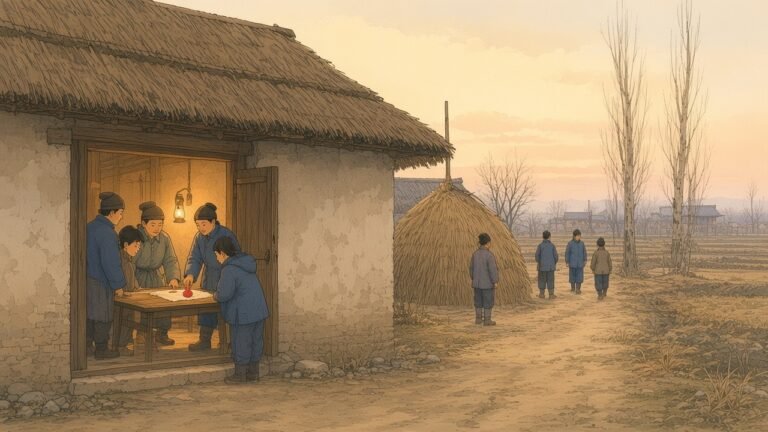
Samsung began in 1938 as a small trading shop in Daegu selling dried fish, fruit and noodles. It is now one of the world’s largest makers of memory chips, smartphones, televisions and display panels, and in May 2026 the market value of Samsung Electronics passed $1 trillion. In between, the business became the model of the Korean chaebol: a family-controlled group of affiliated companies, built with state credit under export targets and joined by cross-shareholdings, that moved from one industry into the next while keeping as much of the supply chain as it could in-house. Its history explains much about how South Korea industrialised, and it offers a useful if imperfect comparison with the vertically integrated firms that now lead Chinese manufacturing.
A trading house in Daegu
Lee Byung-chul was born in 1910 into a landowning family and spent a few semesters at Waseda University in Tokyo. According to the Hoam Foundation, which preserves his legacy, he founded Samsung Sanghoe (Samsung Company) on 1 March 1938 in Su-dong, Daegu, near Seomun Market, with capital of 30,000 won. The firm traded produce from around Daegu and dried seafood from Pohang to China and Manchuria, and it ran flour mills that made a noodle brand called Star. In 1939 it bought the Chosun Brewery. Sources do not quite agree on the founding date: the Daegu city encyclopedia gives 1 November 1938, while the foundation and the company use 1 March.
The foundation explains that “sam”, meaning three, stood for something large, plentiful and strong, and “sung” meant star. One of Lee’s best-known maxims, “Do not employ those you doubt, and do not doubt those you employ”, shaped a culture in which trusted managers had wide authority while the founder kept control of the whole.
Sugar, wool and the post-war state
After liberation Lee moved the headquarters to Seoul in 1947, and the historian Andrei Lankov notes that the first big export was dried squid to Hong Kong. In 1951, during the Korean War, he founded Samsung Moolsan, the trading company that is now Samsung C&T. Real growth came from import substitution. Cheil Sugar was Korea’s first sugar refinery after liberation and began trial production on 5 November 1953. The foundation records that Korea’s dependence on imported refined sugar fell from 100 per cent in 1953 to 7 per cent in 1956. Cheil Wool Textile followed in 1954.
These were protected businesses in a poor country short of dollars. Lankov writes that subsidies for sugar and wheat processing helped make Samsung the largest Korean business group by 1960, with 16 affiliates. Lee also moved into finance, buying Ankuk Fire & Marine Insurance in 1958 (later Samsung Fire & Marine) and Dongbang Life in 1963 (later Samsung Life). Insurers would later become central to family control.
How the Park-era chaebol worked
The military coup of May 1961 nearly ended Samsung’s rise. Park Chung-hee’s junta drew up a list of corrupt businessmen, and Lee, who was in Tokyo at the time, was on it. Lankov describes how he met Park in late June 1961, after which the allegations were scaled down. Edward Graham of the Peterson Institute records one estimate that put Lee’s personal fortune in 1962 at up to 19 per cent of all wealth in Korea, and notes that he paid large fines in 1963. The bargain that emerged set the pattern for a generation: businessmen kept their firms, but invested where the state directed, and exported.
The state held the purse. In 1962 most commercial banks were nationalised, and the government could also guarantee foreign loans. Graham explains that policy loans carried negative real interest rates and went only to firms the government had selected. Credit was conditional on exporting, and firms that met targets got more of it. Exports passed $100 million in 1964, and the government made the day an annual “Export Day”. After Park’s Heavy and Chemical Industry declaration of 1973, preferential loans made up between 16.4 and 19 per cent of all lending. According to the Council on Foreign Relations, exports rose from about 4 per cent of GDP in 1961 to more than 40 per cent by 2016.
The CFR explains that “chaebol” combines the Korean words for wealth and clan. Each group was run by a founding family that held a modest share of total equity but controlled dozens of affiliates through cross-shareholdings, one affiliate owning part of another, which owned part of a third. Affiliates guaranteed one another’s debts and shared managers and brands, and the chairman’s office moved resources between them. High debt made sense when the state supplied credit and seemed unlikely to let a big group fail, and diversification made sense when every favoured industry came with protection and cheap loans.
Relations with Park were not always easy. In 1966 officials in Busan found that Korea Fertilizer, a Samsung affiliate, was smuggling 55 tonnes of saccharin. The Korea Herald recounts that the scandal sent Lee’s second son, Lee Chang-hee, to jail and led Lee to step down temporarily as chairman. The eldest son also fell out of favour, and the group eventually passed to the third son, Lee Kun-hee. Other branches of the family later split off as separate groups, including CJ and Shinsegae.
Into electronics
Electronics followed the same logic of state priorities and foreign partners. The promoters met on 30 December 1968, and Samsung Electronics was established on 13 January 1969. The Electronics Industry Promotion Act of 1969 protected the domestic market and banned foreign direct investment, while allowing joint ventures. Samsung formed one with Japan’s Sanyo the same year. The company’s own history records that 137 trainees were recruited in 1969 and sent to Sanyo and NEC in Japan the following year to learn production.
Early products were simple, and volume grew quickly: by the company’s account, in 1978 Samsung produced its four millionth black-and-white television, the largest output of any manufacturer. In 1974 the group incorporated Samsung Heavy Industries during Park’s heavy-industry drive, and that December it bought Korea Semiconductor, a struggling start-up that for years did little more than assembly.
The bet on memory chips
The decisive move came on 8 February 1983. Staying at the Okura Hotel in Tokyo, and encouraged by advisers including Dr Inaba Hideo, Lee decided that Samsung would make advanced memory chips, starting with dynamic random-access memory (DRAM). The Asia Business Daily records that critics gave the venture three years. Korea met none of the conditions then thought necessary for a chip industry, such as a population above 100 million and income per head above $10,000.
What followed was a textbook catch-up. Development of a 64K DRAM began in May 1983 and produced a working chip on 1 December, cutting a technology gap with the United States and Japan of more than ten years to about four. Giheung Plant 1 was completed on 17 May 1984. In 1992 Samsung was the first to develop a 64Mb DRAM and became the world’s largest DRAM maker, and by 1993 it was the largest memory maker overall. Lee Byung-chul did not live to see it: he died in 1987, and Lee Kun-hee took over as group chairman that December.
Samsung did not invent the DRAM. It acquired technology, trained people abroad, built plants quickly and kept spending through downturns, which a group with cross-subsidies and patient creditors could afford. It went on to lead NAND flash in the early 2000s, opened a contract chipmaking (foundry) business in 2005, and in 2013 introduced the first vertical, or 3D, NAND.
Frankfurt and the quality revolution
By the early 1990s Samsung’s consumer products were known as cheap rather than good. In June 1993 a Japanese design adviser, Fukuda Tamio, gave Lee Kun-hee a report arguing that Samsung was copying rather than creating. On 7 June 1993, at a hotel in Frankfurt, Lee spoke to about 200 executives he had summoned from around the world. As the Korea Herald reports it, he told them: “If you are to change, change completely. I’m not kidding. Change everything except your wife and children.” The speech launched what Samsung calls the New Management initiative. A new corporate identity and English-language logo followed, along with a shift from volume to quality.
The most famous episode came two years later. On 9 March 1995, at the Gumi factory, around 2,000 employees took hammers to defective handsets, fax machines and cordless phones and then burned them. The handset defect rate had reached 11.8 per cent. The Elec puts the number of phones destroyed at 150,000, worth more than 50 billion won. One Korean newspaper later gave a figure of 1.5 million, so the exact number is uncertain. The Korea Herald calculates that group revenue grew from 41 trillion won in 1993 to 466.8 trillion won by 2023, and market capitalisation from 3.1 trillion won to 626.6 trillion won.
Crisis in 1997
The chaebol model ran on debt, and in 1997 the debt came due as the Asian financial crisis spread. The BBC put the IMF-led rescue package at $58 billion, and other accounts describe it more loosely as more than $50 billion. The CFR notes that 15 of the 30 largest chaebol went bankrupt in the crisis or shortly afterwards. Daewoo collapsed under debts that the BBC estimated at $47.7 billion.
Samsung survived, but its car venture did not. In 2000 Renault paid $560 million for a 70 per cent stake in Samsung Motors, which had been in receivership for more than a year with about $4 billion of debt and was running its Busan plant at a quarter of its capacity. As the government pressed the big groups to restructure, the BBC reported in 1999 that average debt-to-equity across four of the big five groups had fallen from 386 per cent to 302 per cent, that the ceiling on cross-shareholdings for the top 30 groups would be restored from April 2001, that inheritance tax would rise from 40 to 50 per cent, and that a “firewall” would be built between chaebol and their financial affiliates. Samsung, meanwhile, kept investing in chips.
The crisis changed the chaebol less than reformers hoped. Groups became more focused, but family control survived; the CFR notes that the top five groups still made up roughly half of Korean stock market value in the late 2010s.
An integrated empire
Samsung’s supply chain is unusually deep for a single group. Samsung Electronics designs and makes memory chips, mobile processors, image sensors and other logic chips. Samsung Display, its subsidiary, makes the OLED panels that go into its own phones and those of its rivals, including Apple. Affiliates such as Samsung Electro-Mechanics and Samsung SDI make components such as capacitors and batteries. On top sit Galaxy phones, televisions and appliances, so Samsung is often both supplier and competitor to the same customer.
Beyond electronics the group spans unrelated industries. Samsung Heavy Industries builds liquefied natural gas carriers at its yard on Geoje island; by mid-May 2026 it had won orders for 22 ships worth $4.7 billion that year, 12 of them LNG ships. Its contest with Chinese yards is covered in our post on China’s shipyards and the race to catch them. Samsung C&T combines construction, trading, fashion and resorts. Samsung Life and Samsung Fire & Marine are large insurers, and Samsung Biologics makes drugs under contract.
The finance affiliates matter. Samsung’s control structure has long run from the Lee family to Samsung C&T, from C&T to Samsung Life, and from Samsung Life to Samsung Electronics. Yonhap Infomax describes this chain and notes that C&T also holds about 5 per cent of Samsung Electronics directly. The family’s direct stake is small, so control rests on affiliates, which is why a proposed change to insurers’ accounting, nicknamed the “Samsung Life law”, attracts such attention.
Galaxy and the fight with Apple
Samsung launched its first handset in 1988 and became a smartphone power with the Android-based Galaxy line after the iPhone appeared. Integration helped: it could supply its own memory, displays and processors and release phones at many price points. Apple sued in 2011, alleging that Samsung had copied the iPhone’s design. A US jury’s initial award of about $1 billion was later reduced, and after seven years of litigation the two companies settled in June 2018 on undisclosed terms.
In October 2016 Samsung discontinued the Galaxy Note7 after battery fires, estimating a hit to operating profit in the mid-3 trillion won range over two quarters. It also lost China almost entirely. The Hankyoreh reported Strategy Analytics figures showing that Samsung’s share of the Chinese smartphone market fell from about 20 per cent, first place, in 2013 to 0.8 per cent at the end of 2017. Globally, though, Samsung has stayed at or near the top. IDC counted 241.2 million Samsung smartphones shipped in 2025, against 247.8 million for Apple and 165.3 million for Xiaomi. As we argue in Xiaomi is more than China’s Samsung, the Chinese challenger has its own model. Rising component costs pushed Samsung’s mobile and networks business to a small loss on 33.2 trillion won of revenue in the second quarter of 2026.
Succession and the courts
Lee Kun-hee led Samsung for 27 years. He was convicted of bribing former presidents in the 1990s and given a suspended sentence. In 2008 he stepped down after a slush-fund investigation and promised governance reforms, returning to management two years later. He was incapacitated by a heart attack in 2014, and his son Lee Jae-yong, who had joined the company in 1991, became de facto leader. Lee Kun-hee died on 25 October 2020.
The handover was entangled with politics. The 2015 merger of Cheil Industries and Samsung C&T strengthened Lee Jae-yong’s position in the control chain. After President Park Geun-hye fell in a corruption scandal, prosecutors charged him with bribing Park and her confidante Choi Soon-sil to win government support for the succession. In 2017 he was sentenced to five years. An appeals court suspended the sentence in 2018, and the Supreme Court sent the case back for retrial in 2019. In January 2021 the Seoul High Court sentenced him to two and a half years, ruling that he had given bribes worth 8.6 billion won. He was paroled in August 2021 and received a special presidential pardon from President Yoon Suk Yeol in August 2022. On 27 October 2022 the Samsung Electronics board appointed him executive chairman.
A second case concerned the merger itself. Prosecutors accused Lee of stock manipulation and accounting fraud designed to secure the merger on favourable terms. He was acquitted on all charges at first instance and on appeal, and on 17 July 2025 the Supreme Court upheld the acquittal, nearly five years after the indictment. Pardons and suspended sentences for chaebol leaders are common in Korea, as the CFR notes.
Losing and regaining ground in AI memory
Samsung’s biggest recent test came from high-bandwidth memory (HBM), stacked DRAM packaged beside AI processors such as Nvidia’s. SK Hynix moved first and became Nvidia’s main supplier, while Samsung struggled to get its HBM3E qualified. TrendForce reported that in the first quarter of 2025 SK Hynix overtook Samsung in total DRAM revenue for the first time, with 36 per cent of the market against Samsung’s 33.7 per cent. Samsung had held 48 per cent at its peak in 2016.
The recovery came with the next generation. According to the Seoul Economic Daily, Samsung was the first to begin mass-production shipments of HBM4. Counterpoint Research figures reported by the Korea Herald show Samsung’s share of HBM revenue rising to 33 per cent in the second quarter of 2026, from 21 per cent in the first quarter, while SK Hynix’s share fell to 50 per cent from 64 per cent a year earlier. In the broader DRAM market Samsung regained first place in the second quarter of 2026. Korea JoongAng Daily, citing Counterpoint, puts it at 39 per cent against 26 per cent for SK Hynix and 25 per cent for Micron, although another report of the same data gave 38, 25 and 24 per cent.
Contract chipmaking remains the weak spot. TrendForce estimates that in the second quarter of 2026 TSMC took 72.5 per cent of global foundry revenue, against 5.9 per cent for Samsung, with China’s SMIC close behind on 5.4 per cent. Samsung has won some large orders, notably a $16.5 billion contract signed in July 2025 to make Tesla’s next-generation AI chips at its new plant in Taylor, Texas. TSMC’s lead shows one limit of integration: some chip designers hesitate to hand designs to a firm that competes with them.
Where Samsung stands in 2026
AI-driven memory shortages have made 2026 Samsung’s most profitable year. In the second quarter it reported revenue of 171.5 trillion won and record operating profit of 89.5 trillion won, almost all of it, 89.2 trillion won, from the chip division. In May its market value passed 1,500 trillion won, about $1.03 trillion, making it the second Asian company after TSMC to pass that mark. Preliminary results released on 8 October put third-quarter operating profit at about 107.4 trillion won on revenue of about 195 trillion won, the first time a South Korean company had made more than 100 trillion won of operating profit in a single quarter; final figures are due later in October. Samsung has also committed 300 trillion won to a chip cluster at Yongin through 2042.
The weaknesses are clear too. Phones and televisions are barely profitable, the foundry trails TSMC, and Chinese rivals are growing in memory, displays and phones. The group depends more than ever on one famously cyclical product.
The chaebol and China
Did China copy this model? Partly, but with important differences. Curtis Milhaupt and Li-Wen Lin, in a 2013 study of China’s national champions, write that Japan and Korea “served as models for Chinese economic strategists in the 1990s”. They describe Chinese strategists as “intrigued by Japanese and Korean business groups”. In 1991 the State Council designated 57 experimental enterprise groups, adding 63 more in 1997 for a total of 120, and gave them preferential treatment on taxes, contracts and stock market listings. Dylan Sutherland has described these as China’s “national team”.
The 1997 crisis arrived as this policy was expanding, and Lin and Milhaupt note that Korea then became a cautionary example as well as a model. The Chinese groups were organised differently. Most were owned by the state through the State-owned Assets Supervision and Administration Commission (SASAC) rather than by a family, and their ownership typically ran in one direction, from the state to a parent group to listed subsidiaries, with little of the cross-ownership that knit the chaebol together. Lin and Milhaupt suggest that, “although the parallel is far from perfect”, the central state-owned groups taken together resemble a giant chaebol with a single controlling shareholder.
Private champions are closer to Samsung in behaviour, if not ownership. Huawei, which makes telecoms equipment, phones, chips and operating systems, is integrated in a way Samsung would recognise, but it is not family-controlled. The company says it is wholly owned by its employees through a union-administered share scheme with 169,054 participants, and that its founder Ren Zhengfei holds about 0.59 per cent. It reported revenue of 880.9 billion yuan in 2025 and spent 192.3 billion yuan, nearly 22 per cent of revenue, on research and development.
BYD is perhaps the clearest Chinese case of Samsung-style integration. It began as a battery maker and sold 4.6 million new-energy vehicles in 2025. A 2023 UBS teardown of the BYD Seal found about 75 per cent of its parts, including batteries and power semiconductors, were made in-house. Our post on how BYD turned batteries into an EV contender traces that story. CATL, by contrast, is a specialist rather than a conglomerate. It held 39.2 per cent of the global electric vehicle battery market in 2025, according to SNE Research, against 2.4 per cent for Samsung SDI. Focused scale can beat a diversified group, as discussed in our post on China’s battery dominance.
Financing differs most. Park’s Korea lent through nationalised banks to family-owned groups that had to prove themselves in exports. China often puts state money directly into equity. CXMT, China’s leading DRAM maker, was founded in 2016 by an investment vehicle of the Hefei city government. Reuters calculated before its July 2026 listing that Hefei-linked investors held 36.8 per cent, and that state ownership rose to roughly half once provincial entities were counted, with the national semiconductor fund also among its backers. YMTC, the NAND maker, has similar state investors. Reuters describes local governments acting as venture capitalists, accepting years of losses and recycling gains into the next strategic industry, which is quite different from Korea’s state lender and family owner.
Samsung in China
Samsung’s own record in China is mixed. Its Xi’an memory plant began full-scale V-NAND production in May 2014, 20 months after construction started. Korea JoongAng Daily reports that Xi’an now makes about 40 per cent of Samsung’s NAND flash. Samsung increased its equity investment there to 465.4 billion won in 2025. Since Washington ended blanket export-control waivers for these plants in 2025, they need annual licences for American equipment, and Samsung plans no meaningful capacity increase before 2028. SK Hynix makes about 40 per cent of its DRAM in Wuxi.
Elsewhere Samsung has pulled back. Suzhou hosts its only overseas chip testing and packaging base, but in 2020 Samsung Display sold its Suzhou LCD factory to TCL’s CSOT for $1.08 billion as Chinese competition made LCDs unprofitable. In September 2019 Samsung ended production at Huizhou, its last phone factory in China.
Competing with Chinese champions
The most direct challenge comes from Chinese firms built with patient capital. CXMT’s share of the DRAM market reached between 7 and 10 per cent in the second quarter of 2026, depending on the report, up from about 4 per cent a year earlier. The Seoul Economic Daily reports capacity of about 300,000 wafers a month, with a target of 600,000 by 2028, and CXMT is now moving into HBM. Our post on CXMT reaching the flagship tier covers its rise. In NAND, CNBC reports that YMTC ranked third by shipments in the second quarter of 2026 with 14 per cent, ahead of Micron and Kioxia, though it ranks lower by revenue.
In displays the shift has already happened. Market researcher CINNO estimates that in 2025 Chinese makers supplied 50.6 per cent of smartphone AMOLED panels, the first time they had passed half. Samsung Display remained the largest single supplier with 41.5 per cent, but BOE was second on 16.3 per cent. The mechanism echoes Samsung’s rise against Japan: acquired technology, state support, investment through downturns and a protected home market.
Where the analogy breaks down
There are reasons for caution. First, ownership: the chaebol remain family enterprises, while China’s largest groups are mostly state-owned and its private champions are held by founders, employees or public shareholders. Second, discipline: Korean groups depended on state credit but were judged on exports, and the 1997 crisis showed that the state would let large groups fail. Chinese state-backed firms often face softer budget constraints, a theme of our post on China’s excess capacity. Third, scale: China’s home market can support many competing champions in one industry.
Fourth, diversification. Samsung spans chips, ships and life insurance under family control, whereas most Chinese champions integrate within one industry, such as BYD in cars or CATL in batteries. Finally, timing. Samsung caught up with Japan when American and Japanese markets were open to Korean exports and Korea was a Cold War ally of the United States. Chinese firms are catching up amid export controls and tariffs that now constrain Samsung in China too.
Samsung did not set a template that China copied wholesale. It showed what a late developer could achieve by concentrating credit, protecting a home market, borrowing technology and investing through downturns, and Chinese planners studied that closely before adapting it with a far larger state role. The two systems now compete in the industries Samsung chose decades ago.
References
- Journey: Samsung’s Founding, Samsung Company, Hoam Foundation
- Journey: Expansion and Diversification, Hoam Foundation
- Samsung Sanghoe entry, Encyclopedia of Daegu Culture (Grand Culture)
- Samsung History, Samsung Global Strategy Group
- (542) Chaebol in Korea, Andrei Lankov, Korea Times, 7 October 2010
- The Miracle with a Dark Side, Edward M. Graham, Reforming Korea’s Industrial Conglomerates, Peterson Institute for International Economics, 2003
- South Korea’s Chaebol Challenge, Eleanor Albert, Council on Foreign Relations, 2018
- DECODED: SAMSUNG, The titan that began with Lee Byung-chull, Korea Herald, 20 July 2016
- The History of Samsung Electronics (1): Paving a New Path, 1968–1970, Samsung Newsroom, 2012
- 40 Years of the Tokyo Declaration: “Why Must We Pursue Semiconductors?”, Asia Business Daily, 7 February 2023
- About Us: History, Samsung Semiconductor Newsroom
- The complicated legacy of late Samsung Chairman Lee Kun-hee, Hankyoreh, 26 October 2020
- Samsung’s iconic Frankfurt declaration marks 30th anniversary, Korea Herald, 6 June 2023
- Samsung chairman famously burned 150,000 units of phones, The Elec, October 2020
- New action plan for Korea’s big five, BBC News, 25 August 1999
- Renault takes over Samsung, BBC News, 25 April 2000
- Samsung Heavy Industries Wins Orders for Three LNG Carriers, Cumulative Orders Reach USD 4.7 Billion, Asia Business Daily, 18 May 2026
- Samsung Governance (4): Samsung Expands Options to Address Corporate Structure Overhaul, Yonhap Infomax, 5 June 2025
- Apple and Samsung settle patent battle over copying the iPhone, The Verge, 27 June 2018
- Samsung Electronics estimates mid-3 trillion won negative impact due to Galaxy Note7 discontinuation, Samsung Newsroom, 14 October 2016
- Samsung Electronics’ share of Chinese smartphone market drops below 1%, Hankyoreh, 6 April 2018
- IDC: Smartphone shipments up 2.3% in Q4 2025, Apple is the clear winner, GSMArena, 14 January 2026
- Lee Jae-yong: Samsung heir released from prison on parole, BBC News, 13 August 2021
- Samsung heir Lee jailed again after getting 2 1/2 year prison sentence for bribery, Yonhap, 18 January 2021
- Samsung heir Lee granted special presidential pardon, Yonhap, 12 August 2022
- Jay Y. Lee Appointed Samsung Electronics Executive Chairman, Samsung Newsroom, 27 October 2022
- Supreme Court finalizes acquittal of Samsung Chairman Lee in 2015 merger case, Yonhap, 17 July 2025
- Samsung’s DRAM Market Share Reportedly Plunges to 33% in H1, Bets on HBM and DDR5 Recovery, TrendForce, 15 August 2025
- Samsung narrows HBM gap with SK hynix, Korea Herald, 4 September 2026
- Samsung heads for 100 trillion won profit milestone in Q3, Korea JoongAng Daily, 2 October 2026
- CXMT Hits 10% DRAM Share, Pushing Korea Toward HBM4, Seoul Economic Daily, 4 September 2026
- Global Foundry Revenue Approaches US$53.49 Billion in 2Q26 as SMIC Narrows Market Share Gap with Samsung, TrendForce, 9 September 2026
- Elon Musk confirms Tesla has signed a $16.5 billion chip contract with Samsung Electronics, CNBC via NBC News, 28 July 2025
- Samsung Electronics Announces Second Quarter 2026 Results, Samsung Semiconductor Newsroom, 30 July 2026
- Samsung Electronics’ market cap surpasses $1 trillion, RTÉ News, 6 May 2026
- We Are the (National) Champions: Understanding the Mechanisms of State Capitalism in China, Li-Wen Lin and Curtis J. Milhaupt, Stanford Law Review 65, 2013
- Policies to Build National Champions: China’s “National Team” of Enterprise Groups, Dylan Sutherland, in Peter Nolan, China and the Global Business Revolution, Palgrave, 2001
- Company Facts, Huawei
- BYD closes 2025 strong globally as domestic demand softens, Electric Cars Report, January 2026
- BYD’s manufacturing costs in EU could be 25% lower than rivals: UBS, TechNode, 6 September 2023
- Global EV battery market share in 2025, CnEVPost (SNE Research data), 4 February 2026
- Chipmaker CXMT debut spotlights China’s state-funded path to tech power, Reuters via The Economic Times, 23 July 2026
- Samsung Announces Operation of its Memory Facility in Xi’an, China, Samsung Newsroom, 9 May 2014
- Samsung, SK hynix pour fresh investment into aging China factories despite US curbs, Korea JoongAng Daily, 24 August 2026
- Samsung Electronics Expands Packaging Facilities in Suzhou, Businesskorea, 19 November 2024
- Samsung Display sells its LCD factory to CSOT, The Elec, 31 August 2020
- South Korea’s Samsung closes its last smartphone factory in China, South China Morning Post (AP), 4 October 2019
- Chinese firm tops Micron and Kioxia in shipments of NAND memory chips, CNBC, 13 August 2026
- Global AMOLED Smartphone Panel Shipments Rise 4.7% in 2025; Chinese Suppliers’ Annual Share Exceeds 50% for First Time, Tiger Brokers (CINNO Research data), 29 January 2026
- Samsung Electronics Announces Earnings Guidance for Third Quarter 2026, Samsung Newsroom, 8 October 2026
- Samsung’s Q3 operating profit reaches new high of 107.4 tln won, Yonhap, 8 October 2026