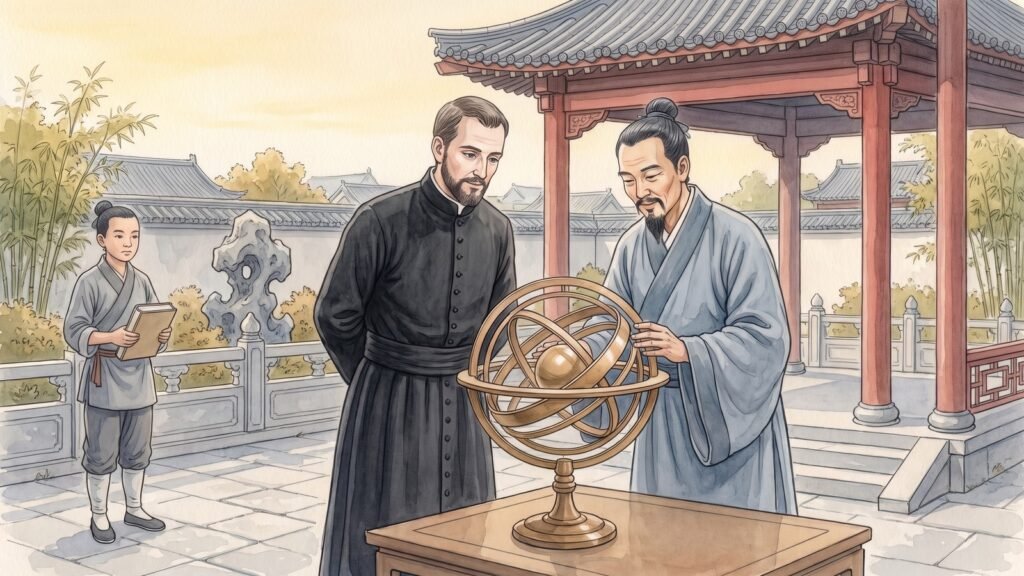
In the spring of 1607 a book called the Jihe Yuanben was printed in Beijing. It was a Chinese translation of the first six books of the Elements of Euclid, the Greek treatise on geometry composed in Alexandria around 300 BCE, and it was the work of two men, the Italian Jesuit Matteo Ricci and the Chinese scholar-official Xu Guangqi. Ricci explained the Latin text aloud, and Xu rendered it into literary Chinese, devising in the process much of the vocabulary that Chinese geometry still uses. The translation introduced into China a style of mathematical reasoning based on definitions, axioms and step-by-step proof, and it became one of the most discussed products of the encounter between European and Chinese learning in the late Ming. This article describes the lives of the two translators, the circumstances of their collaboration, the method and language of the translation, its reception in China, and the completion of the work two and a half centuries later. The wider history of the Jesuit mission is described in The Jesuits at the Chinese Court, and Xu Guangqi’s later work on the calendar in The Mandarin Who Rebuilt the Chinese Sky; the present article concentrates on the Euclid translation and the partnership that produced it.
Euclid and His Book
Little is known of the life of Euclid. He is believed to have taught in Alexandria in the time of the first Ptolemaic kings, and his Elements gathered and organised the geometrical knowledge of earlier Greek mathematicians into thirteen books. The work begins with definitions of basic terms such as point, line and surface, followed by postulates and common notions that are accepted without proof. From these foundations it proceeds through a long sequence of propositions, each demonstrated by reasoning from the definitions, postulates and propositions already established. The first six books deal with plane geometry, including triangles, parallel lines, the properties of circles and the theory of proportion and similar figures; later books treat the theory of numbers, irrational magnitudes and solid geometry.
The Elements was copied, translated and commented upon throughout the ancient and medieval worlds, passing through Greek, Arabic and Latin traditions, and after the invention of printing in Europe it became one of the most frequently printed books. Its general history is set out in the Grokipedia article on Euclid’s Elements. For European scholars of the sixteenth century it was not only a textbook of geometry but a model of certain knowledge, an example of how true conclusions could be reached through rigorous demonstration from evident principles.
Christopher Clavius and the Roman College
The version of Euclid that Ricci brought to China came from his teacher, the German Jesuit mathematician Christopher Clavius. Clavius taught mathematics at the Collegio Romano, the principal Jesuit college in Rome, for several decades from the 1560s, and he played a leading part in the reform of the calendar promulgated by Pope Gregory XIII in 1582. He argued strongly that mathematics should hold an important place in the education of Jesuits, both for its own value and because it would earn respect for the order among the learned. In 1574 he published a Latin edition of the Elements in fifteen books, with extensive commentary, additional propositions and explanations. This edition, which went through several revisions, was not a strict translation of the Greek text but a teaching edition that incorporated material from many commentators along with Clavius’s own additions.
Ricci studied at the Collegio Romano in the 1570s and received his mathematical training from Clavius. His knowledge of geometry, astronomy and the construction of instruments such as sundials and globes was to prove one of his most valuable assets in China.
Matteo Ricci
Matteo Ricci was born in 1552 in Macerata, in the Papal States of central Italy. He went to Rome to study law, but in 1571 he joined the Society of Jesus. After his studies he was sent to the Jesuit missions in Asia, sailing from Lisbon in 1578 and reaching Goa in India, where he taught and was ordained. In 1582 he was summoned to Macau, the Portuguese settlement on the south China coast, to prepare for entry into China. The Jesuit superior Alessandro Valignano had decided that missionaries to China should learn the Chinese language thoroughly and adapt themselves to Chinese customs, and Ricci and his colleague Michele Ruggieri were among the first to put this policy into practice.
In 1583 Ricci and Ruggieri were permitted to settle at Zhaoqing in Guangdong province. In the early years they dressed in the robes of Buddhist monks, but Ricci came to believe that the educated class held Buddhism in low esteem, and in the mid-1590s he adopted the dress and manners of a Confucian scholar. He studied the Chinese classics intensively and sought to present Christianity as compatible with, and a fulfilment of, the ancient teachings of Confucius, while criticising later Neo-Confucian and Buddhist doctrines. Over the following years he moved northward, living in Shaozhou, Nanchang and Nanjing, gaining a reputation among scholars for his learning, his remarkable memory and the curiosities he possessed, including clocks, prisms, maps and books.
Ricci’s world map, which showed China within the context of the whole globe, attracted wide attention. Versions were printed in several Chinese cities, and the large edition of 1602, produced in Beijing with the scholar Li Zhizao, is described in the Grokipedia article on the Kunyu Wanguo Quantu. In 1601 Ricci obtained permission to reside in Beijing, where the Wanli emperor accepted his gifts, including chiming clocks, and granted him a stipend. He remained in the capital for the rest of his life. A fuller account of his life is given in the Grokipedia article on Matteo Ricci.
Xu Guangqi
Xu Guangqi was born in 1562 in Shanghai, then a county town in the prosperous Songjiang prefecture of the lower Yangtze region. His family was of modest means, engaged in farming and small trade, and Xu had to support himself for many years as a teacher while he pursued the examinations. He gained the lowest degree in 1581, but success at the higher levels came slowly. In 1597 he passed the provincial examination at the capital, taking first place, and in 1604 he gained the jinshi degree and was selected for the Hanlin Academy, the elite institution that trained scholars for the highest posts.
Xu’s interest in European learning began in the 1590s. While working as a tutor in Shaozhou in Guangdong he met the Jesuit Lazzaro Cattaneo and saw a version of Ricci’s world map. In 1600 he met Ricci himself in Nanjing. In 1603, again in Nanjing, he was baptised by the Jesuit João da Rocha, taking the Christian name Paul. He became one of the most prominent Chinese Christians of his time and, with Li Zhizao and Yang Tingyun, is often counted among the three leading converts of the late Ming scholar class. His life and career are summarised in the Grokipedia article on Xu Guangqi.
Xu’s interests were broad and strongly practical. He was concerned throughout his life with agriculture, water management, famine relief, military defence and the reform of the state’s finances. He regarded European mathematics and science as tools that could strengthen the empire and improve the welfare of the people, and he saw in Christianity a moral teaching that could complement Confucian ethics. These concerns shaped his approach to the translation of Euclid.
The Beginning of the Translation
After Xu entered the Hanlin Academy in 1604 he lived in Beijing, where Ricci had his residence. The two men met frequently, and Xu studied mathematics and other subjects with Ricci. Ricci had earlier attempted a translation of Euclid with another Chinese student, Qu Rukui, who had studied mathematics with him in the 1590s, but this effort had not been completed. Other attempts with different collaborators also came to nothing. According to Ricci’s own account, Xu proposed that they undertake the translation together, and they began work in 1606.
The method was oral and collaborative. Ricci read and explained the Latin text of Clavius, and Xu wrote down the Chinese version, questioning Ricci until he understood each point and then polishing the prose. This method was common for translations made with the Jesuits in China, since few missionaries could write elegant literary Chinese and no Chinese scholars of the time read Latin. It required both participants to work closely together, and the quality of the result depended heavily on Xu’s skill as a writer and on his grasp of the mathematical content. Ricci recorded that Xu worked with great diligence, revising the text several times.
By the spring of 1607 they had completed the first six books. Xu wished to continue with the remaining books, but Ricci considered that it was better to publish the first part and to see how it was received before going further. The six books were printed in Beijing in 1607 with prefaces by both men. Shortly afterwards Xu’s father died, and Xu returned to Shanghai for the mourning period required of officials, which interrupted any further collaboration on Euclid. Ricci died in Beijing in May 1610, and the remaining books were not translated in his lifetime or Xu’s.
The Title and the Language
The title Jihe Yuanben can be translated as the Origins of Quantity or the Fundamentals of Magnitude. The word jihe originally meant how much or how many, and it was used in Chinese mathematical texts in the posing of problems. Ricci and Xu adopted it to render the Latin concept of magnitude or quantity that geometry studies. In later usage jihe came to be understood as the Chinese term for geometry itself, and it remains the standard word for the subject in modern Chinese.
One of the principal achievements of the translation was the creation of a technical vocabulary. Xu and Ricci needed Chinese terms for the basic concepts of Euclidean geometry, many of which had no exact equivalent in earlier Chinese mathematics. They chose existing words and gave them precise meanings, or combined characters to form new terms. Among the terms established or popularised by the translation are words for point, line, surface, right angle, acute angle, obtuse angle, parallel lines, triangle, quadrilateral, polygon, circle, centre, diameter and similar figures. Many of these terms passed into general use in Chinese mathematics and are still used in Chinese classrooms, and some were later adopted in Japanese.
Xu also had to find a way to express the structure of Euclid’s argument. Each proposition in the Elements consists of a statement, a construction, a demonstration and a conclusion. The translators preserved this structure, using conventional Chinese formulas to mark the different parts and labelling the points in the diagrams with characters, often drawn from the cyclical signs of the Chinese calendar, in place of the Greek and Latin letters of the original.
Chinese Mathematics Before Euclid
To understand the significance of the translation it is necessary to consider the state of Chinese mathematics at the time. China had a long and sophisticated mathematical tradition. The Nine Chapters on the Mathematical Art, compiled in its received form during the Han dynasty, contained methods for calculating areas and volumes, solving systems of linear equations, extracting roots and working with proportions, and the commentator Liu Hui in the third century provided justifications for many of its procedures. In the Song and Yuan periods mathematicians such as Qin Jiushao, Li Ye, Yang Hui and Zhu Shijie developed advanced methods for solving polynomial equations and other problems. Chinese mathematicians had worked with a form of the theorem relating the sides of a right triangle, which they treated in their own terms, and had calculated the ratio of the circumference of a circle to its diameter with great accuracy.
Chinese mathematics was, however, organised differently from Euclid’s geometry. It was generally presented as a collection of problems and procedures for solving them, with an emphasis on calculation and practical application. Justification was offered, but there was no tradition of presenting a whole field of mathematics as a deductive system derived from a small set of definitions and axioms. By the late Ming, moreover, knowledge of some of the most advanced Song and Yuan methods had declined, and important texts were little read. Commercial arithmetic using the abacus was widespread, but the higher mathematics of earlier centuries had become obscure.
The Contents of the Six Books
The six books translated in 1607 covered the whole of Euclid’s plane geometry. The first book begins with definitions of the point, the line, the surface, angles of various kinds, circles and the principal types of triangles and quadrilaterals, followed by the postulates and common notions. Its propositions show how to construct an equilateral triangle on a given line, establish the conditions under which triangles are equal, develop the theory of parallel lines and the sum of the angles of a triangle, and end with the theorem on the squares of the sides of a right triangle and its converse. The second book deals with relations between areas of rectangles and squares that are equivalent to certain algebraic identities. The third book treats the properties of circles, chords and tangents, and the fourth the inscription and circumscription of regular figures in and about circles.
The fifth book, which presents the general theory of proportion attributed to the Greek mathematician Eudoxus, is the most abstract part of the plane geometry, defining what it means for ratios of magnitudes to be equal in a way that applies even to magnitudes that cannot be measured by a common unit. The sixth book applies this theory to similar figures. These two books posed particular difficulties for the translators, since Chinese mathematics had no close equivalent to the abstract theory of ratio, and their rendering required careful explanation. Clavius’s edition added further propositions and comments throughout, some of which were included in the Chinese version, so that the Jihe Yuanben contained material that went beyond the Greek text of Euclid.
The diagrams were an essential part of the work. Each proposition was accompanied by a figure, and the reader was expected to follow the argument by referring to the labelled points and lines. Chinese printers reproduced these figures in woodblock, and the clarity of the diagrams in different editions varied considerably. For readers unfamiliar with the conventions of Euclidean geometry, learning to read the diagrams was itself part of learning the subject.
The Prefaces
Both translators wrote prefaces for the edition of 1607. Ricci’s preface described the place of mathematics in European learning, explaining that it formed the basis for many other fields of study, and gave an account of the history of the translation, including his earlier unsuccessful attempts with other collaborators and his work with Xu. He presented Euclid’s book as the foundation of European mathematics and emphasised the importance of proceeding from what is clear and certain to what is less evident.
Xu’s preface placed the work within a Chinese frame of reference. He referred to the ancient tradition of the six arts, in which mathematics had been one of the subjects of a gentleman’s education in early China, and suggested that the decline of mathematical learning in later times had harmed the practical arts of government. The translation, in his view, offered a means of restoring this lost learning. This argument presented European geometry not as something foreign that would displace Chinese tradition, but as a resource that would help to revive the best of the Chinese past, a theme that recurred in the writings of many Chinese scholars who engaged with European learning in the following centuries.
Xu Guangqi’s View of Geometry
In his writings about the translation Xu Guangqi set out his view of the value of Euclidean geometry. He emphasised its certainty, arguing that each proposition followed from those before it in such a way that the whole could not be doubted, and that the reader who studied it carefully would find each step clear and necessary. He also stressed its usefulness, describing it as a foundation for many practical arts, including astronomy and calendar making, surveying, hydraulic engineering, architecture, the construction of instruments and the design of machines. In this sense he presented geometry as a tool that could serve the practical needs of the state.
Xu also suggested that the study of geometry had value for the training of the mind, encouraging careful and precise thinking. He predicted that in time everyone would study the book, though he acknowledged that its reception in his own day might be limited. His enthusiasm was connected to his broader programme of practical reform, in which he hoped that European methods would help to restore Chinese learning and improve government. Ricci, for his part, presented Euclid as an example of the rigour of European learning, and hoped that the respect it earned would help to gain a hearing for the Christian teaching that the Jesuits brought.
Ricci’s Scholarly Network
The collaboration between Ricci and Xu took place within a wider network of scholars and officials who were interested in Ricci’s learning. Ricci’s residence in Beijing became a meeting place for literati curious about European books, instruments and ideas, and he corresponded and conversed with many men who did not become Christians. His Chinese writings, which included works on friendship, on memory and on Christian doctrine, circulated widely, and his reputation as a scholar who had mastered the Chinese classics gave him access to circles that would otherwise have been closed to a foreigner.
The Jesuits regarded mathematics and astronomy as a means of gaining the respect of this educated elite. Ricci repeatedly wrote to his superiors in Rome requesting that skilled astronomers be sent to China, believing that expertise in calendar making would be particularly valuable, since the imperial calendar was a matter of great importance to the Chinese state. This strategy was later pursued with success by the Jesuits who served in the Astronomical Bureau under the Qing, as described in the article on the Jesuits at the Chinese court. The translation of Euclid was an early and foundational part of this programme.
Related Works
The Jihe Yuanben was one of several works on mathematics and science that Xu produced with the Jesuits. During his mourning in Shanghai and afterwards he worked on a treatise on surveying methods, applying geometrical principles to the measurement of heights, distances and depths, which he had prepared with Ricci. He also wrote works comparing Chinese and European methods for problems involving right triangles, and examining the similarities and differences between the two traditions. With the Jesuit Sabatino de Ursis he produced a work on European hydraulic machinery, published in 1612, reflecting his long-standing interest in water management. His friend Li Zhizao, working with Ricci’s teaching, compiled a work on arithmetic based on another text of Clavius, introducing European methods of written calculation.
In 1611 a revised edition of the Jihe Yuanben was prepared with the help of other Jesuits, correcting some errors in the first printing. The work was later included in collections of Jesuit-inspired scientific writings and was widely reprinted.
Reception in the Ming and Qing
The reception of the translation in the late Ming was mixed. Some scholars were impressed by the rigour of its reasoning and the novelty of its approach, while others found it difficult or of little use. The book’s demonstrations were long and abstract, and readers accustomed to Chinese mathematical texts organised around problems and solutions often struggled to see the purpose of proving propositions that seemed obvious. Its value was most clearly recognised by those engaged in astronomy and the reform of the calendar, a field in which Xu himself played a leading part in the years before his death in 1633.
In the Qing period the work became an established part of the mathematical learning of the court and of scholars interested in astronomy. The Kangxi emperor studied geometry with Jesuit tutors, including Jean-François Gerbillon and Joachim Bouvet, using teaching materials prepared in Manchu and Chinese, and the court-sponsored mathematical compendium completed in 1723 included geometrical material derived from European sources. The mathematician Mei Wending, the leading Chinese mathematical scholar of the early Qing, studied Euclidean geometry closely and wrote works that sought to relate it to the Chinese tradition. A theory developed among some Qing scholars that European mathematics had in fact originated in China and had been transmitted westward, a view that allowed them to accept European methods while asserting the priority of Chinese learning. The Rites Controversy, which led to restrictions on Christian missionary activity in the early eighteenth century, reduced the direct influence of the Jesuits, but the mathematical works they had helped to translate continued to be studied.
Opposition and Defence
The introduction of European learning did not go unchallenged. In 1616 Shen Que, a vice minister in the Ministry of Rites at Nanjing, submitted memorials to the Wanli emperor accusing the missionaries of spreading a heterodox teaching and of posing a danger to the state. His campaign led to the arrest of several Jesuits and Chinese Christians in Nanjing and to the expulsion of some missionaries to Macau, an episode known as the Nanjing persecution. Xu Guangqi responded with a memorial defending the missionaries, in which he argued that their teaching supported Confucian morality and loyalty to the throne and that their learning in astronomy, mathematics and other practical arts could benefit the empire. The restrictions were gradually relaxed in the following years, and missionaries returned to Beijing in the 1620s.
Opposition revived in the early Qing. The scholar Yang Guangxian attacked the Jesuit astronomers at the court in a series of writings, collected under the title Budeyi, which he completed in the 1660s, criticising the European calendar and the Christian religion together and naming Xu Guangqi among the Chinese who had introduced them. His accusations led to the trial and imprisonment of Jesuit astronomers in 1664 and 1665, and he was briefly placed in charge of the Astronomical Bureau. After errors in his own calculations were demonstrated, the Kangxi emperor restored the Jesuits to the bureau at the end of the 1660s. These controversies show that the geometry and astronomy associated with Xu and Ricci remained bound up with wider debates about foreign religion and the authority of the state.
Xu Guangqi’s Household and Practical Interests
Xu’s commitment to Christianity extended to his family. His household became Christian, and his descendants included Candida Xu, his granddaughter, who became known in the later seventeenth century as a patron of the mission, supporting the building of churches and the printing of books. A biography of her by the Jesuit Philippe Couplet was published in Europe in 1688.
His practical interests also continued alongside his scientific work. While at home in Shanghai during his periods of mourning and retirement, he conducted agricultural experiments on his land, among them trials of the sweet potato, a crop introduced to southern China from the Americas in the late sixteenth century. He wrote in favour of its cultivation as a protection against famine, and his promotion of the crop is often cited as an example of the empirical approach that he also applied to mathematics. After his death he received the posthumous name Wending, conferred by the court in recognition of his service.
The Completion of the Translation
The remaining nine books of Clavius’s Euclid were not translated until the nineteenth century. In the 1850s the Chinese mathematician Li Shanlan and the British Protestant missionary Alexander Wylie, working in Shanghai, completed the translation of books seven to fifteen, using an English version of the Elements. Their translation was published in 1857. In 1865, with the support of the official Zeng Guofan, a complete edition of all fifteen books, combining the work of Ricci and Xu with that of Li and Wylie, was printed in Nanjing. Zeng Guofan was at that time engaged in the self-strengthening programme of the Qing government, which sought to adopt Western technology and learning to strengthen the state, as described in The Self-Strengthening Movement.
It was a notable coincidence that the work begun by a Shanghai scholar in the late Ming should have been completed in Shanghai some two and a half centuries later, at a time when the city had become a centre of contact with the West. Li Shanlan, like Xu before him, was a gifted mathematician who saw in Western learning both intellectual value and practical benefit, and his collaboration with Wylie followed a method similar to that of Xu and Ricci, with the foreign scholar explaining the text and the Chinese scholar composing the translation.
Li Shanlan and Alexander Wylie
The two men who completed the translation in the nineteenth century had backgrounds very different from those of Ricci and Xu. Li Shanlan was born in 1811 in Haining in Zhejiang province. He showed an early talent for mathematics, studying the Jihe Yuanben and the classical Chinese mathematical texts on his own, and he developed original work on series and on methods related to the calculus. He did not succeed in the higher examinations, and in 1852 he went to Shanghai, where he began working with Protestant missionaries at the London Missionary Society press.
Alexander Wylie, born in London in 1815, had come to China in 1847 to manage the printing press of the London Missionary Society in Shanghai. He learned Chinese and developed a deep interest in Chinese literature and science, later publishing a widely used bibliographical guide to Chinese literature. With Li Shanlan he translated not only the remaining books of Euclid but also works on algebra, on the differential and integral calculus and on astronomy, introducing these subjects to Chinese readers. Li later taught mathematics at the Tongwen Guan, the government school for foreign languages and sciences in Beijing, from 1868 until his death in 1882, and trained a generation of Chinese mathematicians.
The Later Life of Xu Guangqi
Xu Guangqi’s later career took him to the highest levels of government. He held posts in the Ministry of Rites and was involved in military matters, advocating the training of troops and the acquisition of European-style cannon from the Portuguese in Macau to defend against the Manchus. In 1616, when an official in Nanjing launched a campaign against the missionaries, Xu wrote a memorial in their defence. In his later years he directed the reform of the calendar and rose to the rank of Grand Secretary, a story told more fully in the article on the observatory platform referred to above. He also compiled a comprehensive treatise on agriculture, the Nongzheng Quanshu, published after his death, which drew on Chinese agricultural literature and European knowledge of water management.
Xu died in Beijing in 1633. His body was taken back to Shanghai and buried at the family estate west of the city, an area that came to be known after his family as Xujiahui, meaning the meeting place of the Xu family. In the nineteenth century the Jesuits established a major centre at Xujiahui, including a cathedral, a library and an observatory. Xu’s tomb stands today in a park named after him in the Xuhui district of Shanghai, and a statue and memorial hall commemorate his life.
The Translation in Historical Perspective
Historians have debated the significance of the Jihe Yuanben. Some have seen it as an important moment in the introduction of modern science to China, marking the first appearance of deductive mathematics in Chinese. Others have emphasised the limited immediate impact of the work and the ways in which Chinese scholars adapted it to their own concerns rather than adopting it wholesale. Studies such as those by the historian Peter Engelfriet have shown in detail how Xu and Ricci rendered Clavius’s text, how their choices of language and presentation shaped its reception, and how later scholars read and reinterpreted it. These studies suggest that the translation should be understood as a complex act of cultural exchange, in which both European and Chinese participants brought their own assumptions and purposes.
The partnership of Xu and Ricci has also come to be seen as a symbol of intellectual exchange between China and Europe. Their portraits, standing side by side, were reproduced in European works of the seventeenth century, including the illustrated account of China published by the Jesuit scholar Athanasius Kircher in 1667. In modern times the two men have been commemorated together in China and in Italy, and their collaboration has been cited as an example of mutual respect between scholars of different civilisations.
Conclusion
The translation of the first six books of Euclid’s Elements by Matteo Ricci and Xu Guangqi in 1607 brought to China a form of mathematical reasoning that differed fundamentally from the native tradition. Its creation of a geometrical vocabulary, much of which remains in use, and its presentation of mathematics as a system of proofs derived from definitions and axioms had a lasting influence, though one that developed slowly over the following centuries. The work reflected the interests and hopes of both translators: Ricci’s belief that the rigour of European learning would win respect for his mission, and Xu’s conviction that geometry could serve the practical needs of the empire and the cultivation of the mind. Completed in the nineteenth century by Li Shanlan and Alexander Wylie, the Chinese Euclid stands as one of the enduring results of the first sustained encounter between the learned traditions of Europe and China.
Sources and Further Reading
- Grokipedia, Xu Guangqi
- Grokipedia, Matteo Ricci
- Grokipedia, Euclid’s Elements
- Grokipedia, Kunyu Wanguo Quantu
- Peter M. Engelfriet, Euclid in China. The Genesis of the First Chinese Translation of Euclid’s Elements, Books I-VI (Jihe yuanben, Beijing, 1607) and Its Reception up to 1723, Brill, 1998
- Catherine Jami, Peter Engelfriet and Gregory Blue (eds.), Statecraft and Intellectual Renewal in Late Ming China. The Cross-Cultural Synthesis of Xu Guangqi (1562-1633), Brill, 2001
- Jonathan D. Spence, The Memory Palace of Matteo Ricci, Viking, 1984